Healthcare Services 10-Year Targets

Below are the valuation targets for Healthcare Services Group (HCSG) over the next 10 years. Continue reading

Bull Market Ranking

Slowly and deliberately, the bull market moves ever closer to the 1923 rank of 3rd place in the top 10 stock market recoveries.

image

Let us consider the significance of the current market matching the rise of 1923.  In James Grant’s book titled The Forgotten Depression, Amazon has the following review:

“James Grant’s story of America’s last governmentally untreated depression: A bible for conservative economists, this ‘carefully researched history…makes difficult economic concepts easy to understand, and it deftly mixes major events with interesting vignettes’ (The Wall Street Journal).

“In 1920-1921, Woodrow Wilson and Warren G. Harding met a deep economic slump by seeming to ignore it, implementing policies that most twenty-first century economists would call backward. Confronted with plunging prices, wages, and employment, the government balanced the budget and, through the Federal Reserve, raised interest rates. No ‘stimulus’ was administered, and a powerful, job-filled recovery was under way by late 1921. Yet by 1929, the economy spiraled downward as the Hoover administration adopted the policies that Wilson and Harding had declined to put in place.

“In The Forgotten Depression, James Grant ‘makes a strong case against federal intervention during economic downturns’ (Pittsburgh Tribune Review), arguing that the well-intended White House-led campaign to prop up industrial wages helped turn a bad recession into America’s worst depression. He offers examples like this, and many others, as important strategies we can learn from the earlier depression and apply today and to the future. This is a powerful response to the prevailing notion of how to fight recession, and ‘Mr. Grant’s history lesson is one that all lawmakers could take to heart’ (Washington Times).”

The claim in Grant’s book is that the absence of market intervention will allow markets to correct and recover on their own.  Considering that the 1923 market rise was an outgrowth of the decline from 1920-1921 it is not surprising that the current market could increase as much as it has from the 2009 low. 

In fact, as we’ve continuously argued since February 2009, markets work in spite of government intervention. As highlighted in the chart above, with or without a Federal Reserve, the current stock market recovery is not unusual and has the potential to increase to the 1929 (29,207.53) or 1987 (44,474.68) recovery levels.

Share Buybacks: Revised Data

On July 3, 2019, we attempted to draw conclusions based on data from New York Times references to the words “buyback” and “stock”.  After reviewing the data, it has become clear, when viewed from all the numerous sources available, that our data did not match anything that was out there.

This time, we have sought out data from Barron’s to see of a different outcome would result.  When breaking down the same period of time, it was clear that Barron’s was 1) different from the New York Times and 2) more consisted will all other sources on the topic.  Below is a comparison of the two sources over the same period of time originally posted on July 3, 2019.

image

It seems clear that there is a disparity between the two sources.  However, in the case of Barron’s numbers, the data is more consistent with many other sources on the topic.  This is best represented in the annual representation of the data when contrasted against a chart found on the The Market Oracle’s website in an article titled “Why Stock Buybacks Are Such A Mistake.”

image

The number of references to stock buybacks in Barron’s resembles the above dollar value of buyback data (that also includes 2018 & 2019) from Market Oracle:

image

The upshot to using Barron’s is that it is a dedicated source for financial reporting and therefore a more concentrated resource for tracking share repurchases and writing on the topic.

The point of the data gathering is to determine whether or not stock buybacks are the cause of the increase in the stock market since 2009 or a function of a rising market or completely unrelated altogether.

One way to look at the data is in periods when the Dow Jones Industrial Average traded in a range and compare that data to Barron’s references to stock buybacks.  There are two periods that are most compelling in this regards, 1965 to 1982 when the average annual level of the Dow Jones Industrial Average went from 910.70 to 884.53, a change of -2.87%.

image

The other period of interest is 1999 to 2010 when the Dow Jones Industrial Average traded at an average annual level of 10,482.61 to 10,668.60, a change of  +1.77%.

image

In both cases, the average level of share buyback references increased while the Dow Jones Industrial Average treaded water.  The period from 1965 to 1982 saw the number of references to buybacks increase 12.5x.  This is in contract to the period from 2009 to the 2018 peak where the increase has only been 1.75x

What is the point of comparing the DJIA levels in known secular bear markets to the period when the index increases roughly 3x from the 2009 low?  First, in the 1965-1982 scenario, the staggering level of the buyback references suggest that buybacks had little impact on the change in the index.

So what impact does buybacks have on the market if from 1965-1982 or 1999-2010, there were substantial references but the market didn’t go anywhere?  Well, within all of those Barron’s references to buybacks was a great article by Anna Merjos titled “Good on the Rebound: Company Stock Buy-Backs Work Only in Rising Markets” dated March 15, 1982.  In that article, the author states the following:

“So, how are companies' stockholders likely to fare when management moves to repurchase some of its shares in the open market? According to a Barron's study of 48 companies that bought back their own stock in 1979, the answer is fine-over the long pull. The conclusion supports the findings of similar surveys published by Barron's in 1973, 1975 and 1979, which showed that large purchasers of company stock in bear - or at least lackluster markets usually outperform the averages in subsequent broad recoveries, but that corporate buying can't stop a stock's decline when the trend is decisively down.”

The accuracy of the observation cannot be overstated and is worth repeating:

  • Companies that buy back shares in sufficient quantity will be the biggest beneficiaries in the subsequent recovery after a major decline, as indicated in Anna Merjos’ published work on the topic of buybacks spanning the period from 1960 to 1982.
  • Buybacks are not a cure for avoiding declines in a cyclical or secular bear market.

As we said in our February 13, 2009 article on the market’s odds of recovery (link is active and accurate):

“In every instance that the Dow has fallen 40% or more in one fell swoop, as it has recently, the market rebounded 50% to 100% every time.”

Our point then, as has grown in confidence since 2009, is that the market is destined to recover and is likely to increase, on average, +167% from the established low (as seen here) and potentially can go substantially higher (as seen here) especially after a decline of -40% or more.  Additionally, the stock market’s rise since 2009 is probably a function of stock buybacks in the previous cycle and the perceived benefits of the current buyback cycle, 2009 to 2019, may have yet to be seen.

U.S Dividend Watch List: July 19, 2019

Previous Year Performance Review

In our ongoing review of the NLO Dividend Watch List, we have taken the top five stocks on our list from July 20, 2018 and have checked the performance one year later. The top five companies on that list can be seen in the table below.

Symbol Name 2018 Price 2019 Price % change
T AT&T Inc 31.10 32.79 5.4%
IVZ Invesco Ltd. 25.46 19.77 -22.3%
LM Legg Mason 33.36 38.09 14.2%
SLGN Silgan Holdings Inc. 26.62 30.15 13.3%
CAH Cardinal Health 48.80 44.99 -7.8%
      Average 0.5%
         
DJI Dow Jones Industrial 25,064.50 27,154.20 8.3%
SPX S&P 500 2,804.49 2,976.61 6.1%

The average gain for the top five company was subpar compared to the market. It was driven by large losses in Invesco (IVZ) and Cardinal Health (CAH). We thought that AT&T (T) offered an exceptional opportunity for income investors last year when it yielded 6%. The good and bad news is that the yield is still at 6% because the price hasn't changed much while the dividend payout has increased by 2%.

Our team shined a spotlight on Hershey Company (HSY) which was the second best performing stock on our watch list with a +58% gain in one year. At $91, the stock was below our 10-year target undervalued level.

U.S. Dividend Watch List: July 19, 2019

After crossing the 3,000 mark, the S&P 500 took a little breather this week and closed -1.3% lower. With the market virtually at an all-time high and the Transport 8% off its high, one has to be a little cautious establishing any position at this point. If you are to do so, we suggest our readers to start with the watch list below. Continue reading

Year Over Year: Cimarex Energy Co.

We have some experience with XEC in the past.  On July 17, 2012, we bought the stock and said the following:

“At the quarterly dividend rate of $0.12, we believe that XEC should be sold at a price of $123 or above. This will increase or decrease with the dividend policy.  Based on the previous Altimeter buy indications, investors should expect to hold XEC for 2 to 3 years before the next sell signal.”

The chart below outlines the actual change in Cimarex Energy Co. from when we bought to the present.  Notice how the purchase came after the substantial decline and near the low.  Additionally, our anticipation of when to sell at $123 and above came exactly 2 years later with additional years to unload at $123 if the first opportunity was missed.

image

Below is a chart of Cimarex Energy Co. (XEC) from 2003 to 2019 reflecting the year-over-year (YoY) percentage change.  We’re hopeful that this added perspective will shed some light on the prospects for XEC going forward. Continue reading

Transaction Alert

The NLO team executed the following transaction(s): Continue reading

Year Over Year: Methanex Corp.

Below is a chart of Methanex (MEOH) from 1993 to 2019 reflecting the year-over-year (YoY) percentage change. Continue reading

Methanex Corp. 10-Year Targets

Below are the valuation targets for Methanex Corp. (MEOH) over the next 10 years. Continue reading

Costco: Cyclical Trends

Below is a chart of Costco Wholesale Corp. (COST) from 1986 to 2019.

image

In the charts that follow, we break down the percentage change in each cyclical rise and decline of  Costco.  These cyclical changes put into perspective the current rise and help to gauge what to expect when the next cyclical decline arrives while suggesting there might be more room to the upside. Continue reading

W.W. Grainger 10-Year Targets

Below are the valuation targets for W.W. Grainger (GWW) over the next 10 years. Continue reading

Onex Corporation 10-Year Targets

Below are the valuation targets for Onex Corporation (ONEX.TO) over the next 10 years. Continue reading

Gluskin Sheff Acquisition Complete

On January 22, 2019, we said the following of Gluskin Sheff:

“Gluskin Sheff  has an expected price range of $13.46-$48.08 by 2021-2023.  However, the absence of a dividend increase since 2016 and a decline below the undervalued level suggest that, at best, GS.TO can only increase to the “fair value” target price under favorable conditions.”

On March 22, 2019, Onex Corporation (ONEX.TO) announced that they would acquire Gluskin Sheff (GS.TO) for $14.25. Below are the final Altimeter and target ranges for GS.TO.

image

Overvalued and Undervalued levels since 2006 are as follows:

image

Our take on the acquisition is that Onex got a bargain with their well timed purchase.  We will now track Onex Corp. (ONEX.TO) with updated target prices going forward.

Dow Theory: July 2019

There are only two levels to beat for a confirmed bull market to ensue. Continue reading

Dogs of the Dow: July 2019

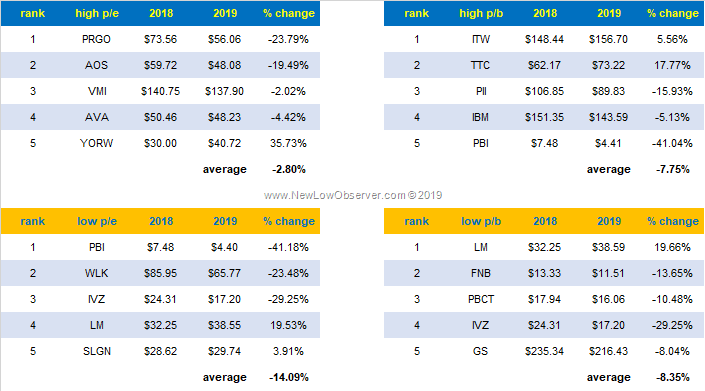
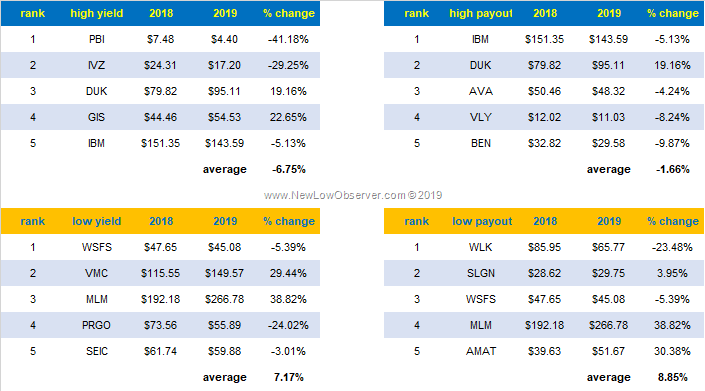
On January 1, 2019, we posted our list of the “Dogs of the Dow”.  In that list we broke down all the categories that we track.  Our closing remark was as followings:

“Our preference is for stocks in the highest p/e or lowest yield stocks.”

Our preference is based on evidence going back to 1996, which shows that low yielding stocks don’t outperform the index which is contrary to Michael O’Higgins book Dogs of the Dow,which claims that the way to beat the index is to invest in the ten highest yielding stocks at the beginning of each year. 

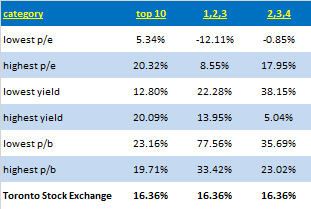
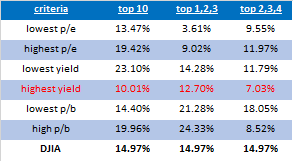
Additionally, the data has demonstrated that stocks with the highest p/e or lowest yield generally beat the index and crush the highest yielding stocks.  Below, we list the performance of the various categories of Dow Jones Industrial Average stocks as compared to the index.

image

So far,  the best performing category of stocks among the top ten, which is the best relative comparison to the top ten highest yielding stocks, is the lowest yielding stocks with a gain of +23.95%.  This gain exceeds the top ten highest yielding stocks by nearly 100%.

Not to be outdone, the ten highest p/e stocks gained +21.70% as compared to the ten highest yielding stocks with a gain of +12.42%. 

The changes related to DowDuPont (DWDP) has had a material impact on the data and has been excluded from the categories of the “ten highest p/e”, “ten lowest p/b”, and the “lowest 2,3,4: lowest p/b”. 

If the next best stock were added to the “ten highest p/e” category it would have increased the return to +22.92%, the “ten lowest p/b” group would have seen a reduction from +14.35% to +13.16% while adding CVX to the “lowest 2,3,4: lowest p/b” reduced the category performance.  

Below is the individual breakdown of the stocks and their performance. The data is as of July 5, 2019. Continue reading

U.S Dividend Watch List: July 5, 2019

Previous Year Performance Review

In our ongoing review of the NLO Dividend Watch List, we have taken the top five stocks on our list from July 6, 2018 and have checked the performance one year later. The top five companies on that list can be seen in the table below.

Symbol Name 2018 Price 2019 Price % change
LM Legg Mason 34.32 37.96 10.6%
SWK Stanley Black & Decker 133.14 146.52 10.0%
IVZ Invesco Ltd. 26.44 20.97 -20.7%
CMI Cummins Inc. 131.40 169.15 28.7%
FULT Fulton Financial Corp. 16.65 16.57 -0.5%
      Average 5.6%
         
DJI Dow Jones Industrial 24,456.48 26,922.12 10.1%
SPX S&P 500 2,759.82 2,990.41 8.4%

The top five companies slightly underperformed the market. The best performer was Cummins (CMI) which is a major industrial company operating in the natural gas market. Cummins raised their dividend payment by 5%, from $1.08 to $1.14. The share price increase of +29% could be attributed to a strong gain in the net income. At the time of our writing last year, EPS were at $5.56 with projected EPS for 2018 to be at $14.07, current EPS (TTM) is at $15.41.

Our team said Legg Mason (LM) was setting up to be a good long-term accumulation and shares rose +10.60% in one year. However, share fell -32% hitting $23.51 before rebounding to $37.96. That's a 62% swing in share price to the upside. This type of action helps reaffirm our strategy of multi-stage purchases which could involve buying 1/3 or 1/2 of the position with the anticipation for further declines.

LM 07.05.2019

Another company we highlighted was 3M (MMM) which lost -13% of its value in one year. Shares were trading at a 2.50% dividend yield one year ago and the yield is currently at 3.30%. 3M raised their dividend 5.80%, from $1.36 to $1.44. Our 10-year target suggests that 3M is undervalued and should be considered for long-term accumulation.

U.S Dividend Watch List: July 5, 2019

The S&P 500 and the Dow Jones Industrial Average pushed through their all-time highs this week. This upward movement isn't confirmed by the Transportion index which is about 10% off the peak. Naturally a rise in the market leads to lower number of companies trading near their yearly low. Below is our watch list. Continue reading