According to Propublica’s Bailout Tracker, General Motors received $50.7 billion as part of the Hank Paulson’s bailout of the auto industry.

Since the bailout, General Motors has failed to pay back $11.3 billion of the $50.7 billion.

According to Propublica’s Bailout Tracker, General Motors received $50.7 billion as part of the Hank Paulson’s bailout of the auto industry.
Since the bailout, General Motors has failed to pay back $11.3 billion of the $50.7 billion.
Posted in Deadbeat File, GM
On November 21, 2015, we said the following:
“While a Fed rate increase is what everyone is waiting for, history suggests that Fed policy (government regulated) follows short-term Treasuries (market driven).”
We made the commentary because we saw that the 3-month Treasury rate was advancing higher.
Since that time, we’ve watched as the Federal Reserve Bank continues to followed the short-term market rates both up and down. After the November 21, 2015 posting, we saw, in December 15, 2015, the Federal Reserve increase the Fed Funds Rate for the first time since June 29, 2006. Again, the Fed Funds Rate increase followed the action of 3-month Treasury.
As with the rate increases in the 3-month Treasury followed by the Fed Funds Rate shortly thereafter, so too did we see the Fed Funds Rate decline after the 3-month Treasury reversed to the downside. As we said in our April 23, 2019 posting:
“If the current run of stability in rates is anything like the period of 2015 to 2016, we should see a sharp drop in rates…”

The chart above highlights the point of our April 23, 2019 claim relative to the actual rate activity that has followed. Most important is the fact that Fed Funds Rate policy did not take place until four months after the peak in the 3-month Treasury. Even after the rate decreased in July 2019, it was clear that the Fed would have to catch up for lost ground which is reflected in the September 18, 2019 rate cut.
Below are the targets that we have set for the 3-month Treasury which will be reflected, in direction only, with the Fed Funds Rate. Continue reading
Posted in 3-month, Federal Reserve Bank, Interest Rate Monitor, interest rates
Tagged members
Below is a chart of the Bloomberg Commodity Index from 2011 to the present. Since 2011, there has been only one other period that has come close to the current level in the market. Continue reading
Below is a chart of Helmerich & Payne (HP) from 1981 to 2019 reflecting the year-over-year (YoY) percentage change.
Below are the remaining downside targets for the Hang Seng Index when applying Dow Theory: Continue reading
Posted in Dow Theory, downside, Hang Seng Index, HSI
Below are the upside resistance targets for the Shanghai Composite Index for both the short and long-term moves.
Short-Term Targets
Based on the price action since January 2019, the Shanghai Composite Index has conformed to the upside resistance targets ranging from 3,012.38 to 3,378.93.

The short-term upside resistance target determines market sentiment for achieving the 3,559.47. So far, the market appears on course to achieve a re-test of the prior low at 2,464.36. The theory of the re-test is known as a double top, or in this case a double bottom, as described by Charles H. Dow in 1901.
"Another method is what is called the theory of double tops. Records of trading show that in many cases when a stock reaches top it will have a moderate decline and then go back again to near the highest figures. If after such a move, the price again recedes, it is liable to decline some distance (Dow, Charles H. Wall Street Journal. July 20, 1901.)."
The expectation should be that after obtaining a new low or a new peak, the price will trend in the opposite direction and then re-test the prior extreme level. In this case, it is the 2,464.36. This makes the 3,012.38 upside resistance level a reasonable level for expectation on the way to the down from the current level as diagramed in the chart above.
Long-Term Targets
The most important factor to watch for is the long-term trend in the Shanghai Composite. The chart below outlines the long-term prospects for the index. Continue reading
In the chart below, we see two different stocks showing strongly bullish reversal patterns in the period from July 2017 to October 2019.
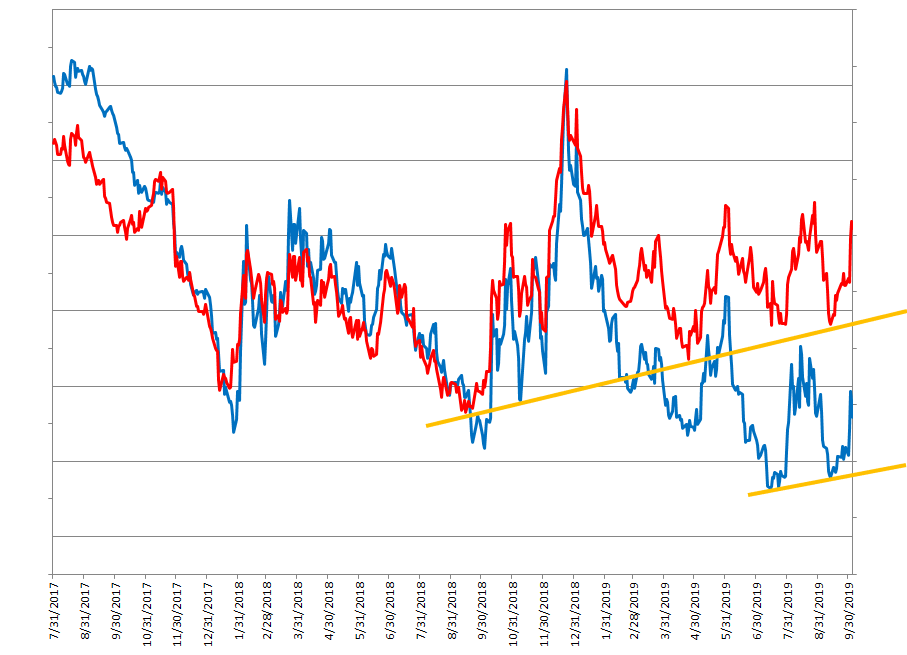
The line in red saw a bottom in September 2018 while the line in blue saw a bottom in July 2019. Adding strength to the direction of these two stocks is the persistent inability of the stocks to decline below the yellow support lines. Especially encouraging is the blue line having the ability to bounce in September 2019 and move sharply higher since that time.
Except, the chart above isn’t a couple of stocks and the yellow lines aren’t bullish trends. Instead, the red line is the Dow Jones Transportation Average and the blue line is the Dow Jones Industrial Average. The chart is the inverse of the actual pattern and shows what the two indexes have done in the last couple of years.
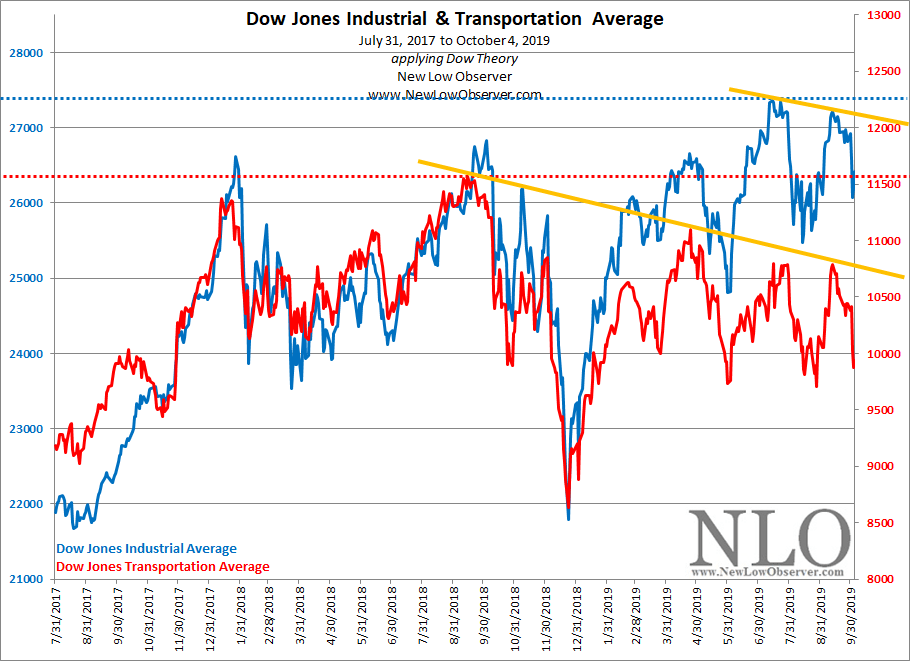
If a stock market analyst is in agreement that the charts at the beginning of this post is showing a bullish reversal pattern then the same analyst should view the actual charts of the same two indexes as exhibiting bearish reversal patterns from the prior trend.
The bear market continues until the dashed red and blue lines are exceeded to the upside. How do we know we are in a bear market? The inability of the two market indexes to exceed the prior peaks is one indication. The other indication is best stated by Charles H. Dow regarding the formation of a line:
“Such a narrow fluctuation, to the experienced student of the averages, may be as significant as a sharp movement in either direction. (Rhea, Robert. The Dow Theory. Barron’s. 1932. page 82.).”
At present, a market that meanders sideways or down must earn the patient investor income. For now, there is some time (approximately 3-4 months; if successful) that will have to pass before the upside targets are defied.
Below are the valuation targets for Lancaster Colony (LANC) over the next 10 years. Continue reading
Below are the valuation targets for Charles Schwab (SCHW) over the next 10 years. Continue reading
Below is a chart of Charles Schwab (SCHW) from 2004 to 2019 reflecting the year-over-year (YoY) percentage change.
Below is a chart of Pentair plc (PNR) from 1974 to 2019 reflecting the year-over-year (YoY) percentage change.
Below is the breakdown of top 5 stocks from our September 27, 2019 list based on the fundamental ratios that we track. Continue reading
The market is trying to find its footing and closed the week slightly lower than it began. From the chart, the index is approaching the 50-day moving average which may provide a short-term support. Anyone seeking to go long at this moment should utilize the list below as a starting point for your research. Continue reading
Posted in Dividend Achiever Watch List, Dividend Achievers, Dividend Watch List
Tagged members
Below is the Watch List for September 2019. Continue reading
The table below outlines the performance of the top five of the Canadian Dividend Watch list for September 2018.
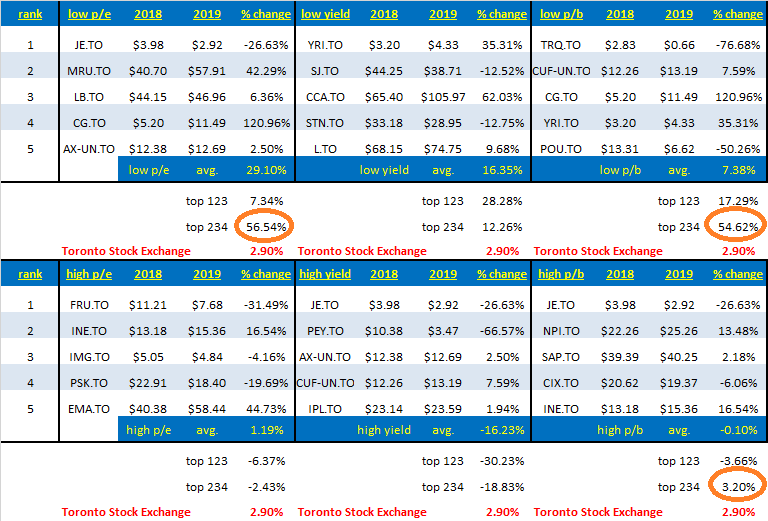
The orange circles indicate where, among the top five, the performance was improved if the top 2nd, 3rd and 4th stocks were selected instead of buying the top five.
A very important observation is taking the performance of the top five low yield stocks and the top five high yield stocks. According to the Dogs of the Dow investment strategy, selecting the top ten stocks with the highest yield will result in higher performance than the representative index. In this case, the Toronto Stock Exchange is the index we compare the performance to.
In the case of the high yield stocks, they generated returns of –16.23% while the low yield stocks generated returns of +16.35%. The chasm in performance between the two is wide, deep, and consistent on a historical basis.
We are confident that if you are an investor seeking average returns then you will not find it in the group of the highest yielding stocks. In addition, low yielding stocks are able, on a consistent basis, to provided competitive returns year in and year out, as confirmed in our work of the same stocks in the Dow Jones Industrial Average since 1996.