Category Archives: Uncategorized

NLO Dividend Watch List: November 25, 2011

The S&P 500 index closed down -4.7% for the week while the blue-chip Dow Jones Industrial index was down -4.6%. Our dividend list contains 29 companies this week. Those companies within 5% of the 52-week low are listed below.

November 25, 2011

Symbol Name Price % Yr Low P/E EPS (ttm) Dividend Yield Payout Ratio
AVP Avon Products, Inc. 16.09 0.00% 9.46 1.70 0.92 5.72% 54%
CCBG Capital City Bank Group  9.65 0.00% 21.93 0.44 0.40 4.15% 91%
FNFG First Niagara Financial Group 8.24 0.24% 12.48 0.66 0.64 7.77% 97%
TR Tootsie Roll Industries Inc  22.88 0.26% 31.78 0.72 0.32 1.40% 44%
WST West Pharmaceutical 35.6 0.28% 19.67 1.81 0.72 2.02% 40%
AROW Arrow Financial Corp.  21.58 0.37% 11.66 1.85 1.00 4.63% 54%
T AT&T Inc 27.41 0.77% 13.91 1.97 1.72 6.28% 87%
BMS Bemis Co Inc 27.62 1.51% 13.88 1.99 0.96 3.48% 48%
MTB M & T Bank Corp. 67.7 1.96% 9.80 6.91 2.80 4.14% 41%
CHRW C.H. Robinson Worldwide, Inc.  63.63 2.13% 24.76 2.57 1.16 1.82% 45%
BDX Becton, Dickinson and Co. 71.11 2.18% 12.65 5.62 1.64 2.31% 29%
BMO Bank of Montreal 53.22 2.68% 10.82 4.92 2.82 5.30% 57%
WFSL Washington Federal, Inc.  12.52 3.05% 12.52 1.00 0.24 1.92% 24%
LM Legg Mason, Inc.  23.31 3.10% 14.21 1.64 0.32 1.37% 20%
AVY Avery Dennison Corp. 24.25 3.10% 9.19 2.64 1.00 4.12% 38%
BCR CR Bard, Inc. 83.37 3.18% 21.43 3.89 0.76 0.91% 20%
BMI Badger Meter, Inc. 27.83 3.42% 17.29 1.61 0.64 2.30% 40%
VNO Vornado Realty Trust 70.73 3.42% 16.96 4.17 2.76 3.90% 66%
HCC HCC Insurance Holdings, Inc. 25.6 3.81% 10.58 2.42 0.62 2.42% 26%
SYK Stryker Corp. 45.52 4.09% 14.45 3.15 0.72 1.58% 23%
WFC Wells Fargo & Co. 23.51 4.12% 8.71 2.70 0.48 2.04% 18%
BXS BanCorp.South Inc. 8.57 4.13% 17.85 0.48 0.04 0.47% 8%
WEYS Weyco Group, Inc.  21.72 4.32% 16.58 1.31 0.64 2.95% 49%
BEN Franklin Resources, Inc. 91.63 4.47% 10.63 8.62 1.00 1.09% 12%
EXPD Expeditors Intl of Washington 40 4.58% 22.10 1.81 0.50 1.25% 28%
CTAS Cintas Corp.  27.63 4.70% 15.44 1.79 0.54 1.95% 30%
SIAL Sigma-Aldrich Corp.  58.89 4.82% 16.36 3.60 0.72 1.22% 20%
GE General Electric Co 14.7 4.85% 11.22 1.31 0.60 4.08% 46%
CWT California Water Service 17.47 4.92% 17.83 0.98 0.62 3.55% 63%

Watch List Summary

Topping our list this week is Avon Products (AVP). According to IQTrends (http://www.iqtrends.com/), AVP is considered undervalued once it reaches a 3.7% dividend yield. The yield rose to 5.7% this week from 5.05% two weeks prior. Any long-term investor would need to do some extensive due diligence prior to committing their hard earned capital to this company. The current payout ratio (dividend/earnings) is at 54% imply that earnings can fall by half before a dividend cut is considered. Please note that the company is being investigated by SEC.

Another company for yield seekers is AT&T (T).  The current yield of 6.28% is hard to ignore when the 10 year T-Bill pays 1.97%.  IQTrends estimates that AT&T is undervalued when the yield reaches 5.5%. A return to historical undervalued yield would equate to 14% upside move. The payout ratio of 87% is quite high but not unusual for AT&T. The recent M&A deal with T-Mobile was broken up.  This should provide an interesting backdrop for how AT&T would fight off competition from its main rival Verizon.

Disclaimer:
On our current list, we excluded companies that have no earnings. Stocks that appear on our watch lists are not recommendations to buy. Instead, they are the starting point for doing your research and determining the best company to buy. Ideally, a stock that is purchased from this list is done after a considerable decline in the price and extensive due diligence. We suggest that readers use the March 2009 low (or the companies' most distressed level in the last 2 years) as the downside projection for investing. Our view is to embrace the worse case scenario prior to investing. A minimum of 50% decline or the November 2008 to March 2009 low, whichever is lower, would fit that description. It is important to place these companies on your own watch list so that when the opportunity arises, you can purchase them with a greater margin of safety. It is our expectation that, at the most, only 1/3 of the companies that are part of our list will outperform the market over a one-year period. 

Please consider donating to the New Low Observer. Thank you.

NLO Dividend Watch List: September 16, 2011

The market rallied everyday this week taking the Dow Jones Industrial Average above the 11,500 mark.  The S&P 500 is back above 1,200 level. In regards to Dow Theory, we believe that the bear market is still intact (see Dow Theory Bear Market stands).  Until both the Industrials and Dow Jones Transports can break above their intermediate high, we believe the market remains very vulnerable.

September 16, 2011 

Symbol Name Price % Yr Low P/E EPS (ttm) Dividend Yield Payout Ratio
ANAT American National Insurance 70.88 1.10% 11.74 6.04 3.08 4.35% 51%
TMP Tompkins Financial Corp. 36.51 2.41% 11.59 3.15 1.44 3.94% 46%
HGIC Harleysville Group Inc.  26.76 3.60% 15.12 1.77 1.52 5.68% 86%
SYY Sysco Corp. 27.4 3.71% 13.98 1.96 1.04 3.80% 53%
BRO Brown & Brown, Inc. 19.01 4.51% 17.28 1.10 0.32 1.68% 29%
PEP PepsiCo Inc. 62.05 4.73% 15.79 3.93 2.06 3.32% 52%
SFNC Simmons First National Corp.  21.8 5.47% 10.48 2.08 0.76 3.49% 37%
GBCI Glacier BanCorp., Inc.  10.64 5.56% 18.67 0.57 0.52 4.89% 91%
ALL Allstate Corp.   24.94 5.59% 23.75 1.05 0.84 3.37% 80%
GD General Dynamics Corp. 60.6 5.59% 8.64 7.01 1.88 3.10% 27%
SYBT S.Y. BanCorp., Inc.  19.4 5.66% 11.21 1.73 0.72 3.71% 42%
VLY Valley National BanCorp.  11.11 5.71% 13.23 0.84 0.69 6.21% 82%
CBSH Commerce Bancshares, Inc.  37.36 5.78% 13.25 2.82 0.92 2.46% 32%
CATO Cato Corp. 24.03 5.86% 10.97 2.19 0.92 3.83% 42%
MMM 3M Co 80.53 5.96% 13.67 5.89 2.20 2.73% 37%
CTBI Community Trust BanCorp., Inc.  24.65 6.02% 10.53 2.34 1.24 5.03% 53%
FRS Frisch's Restaurants, Inc 19.66 6.10% 10.51 1.87 0.64 3.26% 34%
BDX Becton, Dickinson and Co. 77.25 6.19% 12.98 5.95 1.64 2.12% 28%
BXS BanCorp.South Inc. 10.31 6.29% 21.94 0.47 0.04 0.39% 9%
T AT&T Inc 28.94 6.40% 8.41 3.44 1.72 5.94% 50%
CFR Cullen/Frost Bankers, Inc. 48.98 6.43% 13.88 3.53 1.84 3.76% 52%
NTRS Northern Trust Corp.  37 6.69% 14.68 2.52 1.12 3.03% 44%
DOV Dover Corp. 52.34 6.71% 11.45 4.57 1.26 2.41% 28%
SJW SJW Corp. 22.31 6.80% 16.77 1.33 0.69 3.09% 52%
BRK-A Berkshire Hathaway Inc. CL 'A' 107100 6.82% 14.36 7457.95 N/A N/A N/A
TR Tootsie Roll Industries Inc  24.89 7.01% 28.94 0.86 0.32 1.29% 37%
MDP Meredith Corp. 24.28 7.05% 8.73 2.78 1.02 4.20% 36%
MTB M & T Bank Corp. 74.15 7.11% 10.44 7.10 2.80 3.78% 39%
FNFG First Niagara Financial Group Inc.  10.46 7.28% 15.61 0.67 0.64 6.12% 96%
MATW Matthews International Corp.  31.25 7.35% 12.86 2.43 0.32 1.02% 13%
EOG EOG Resources, Inc. 90.16 7.44% 56.70 1.59 0.64 0.71% 40%
SWK Stanley Black & Decker, Inc. 56.73 7.59% 15.80 3.59 1.64 2.89% 46%
BOH Bank of Hawaii Corp. 40.13 7.62% 11.91 3.37 1.80 4.49% 53%
GS Goldman Sachs Group, Inc.   107.49 7.73% 10.54 10.20 1.40 1.30% 14%
ALB Albemarle Corp. 46.3 7.77% 10.72 4.32 0.66 1.43% 15%
PAYX Paychex, Inc.  27.08 7.80% 19.07 1.42 1.24 4.58% 87%
CYN City National Corp. 42.13 7.89% 13.95 3.02 0.80 1.90% 26%
PRK Park National Corp. 53.56 7.92% 12.06 4.44 3.76 7.02% 85%
ATNI Atlantic Tele-Network, Inc. 32.6 7.95% 31.65 1.03 0.88 2.70% 85%
FFIN First Financial Bankshares, Inc.  28.23 8.00% 13.70 2.06 0.96 3.40% 47%
CWT California Water Service 18.05 8.41% 18.61 0.97 0.62 3.43% 64%
WEYS Weyco Group, Inc.  22.81 8.41% 18.85 1.21 0.64 2.81% 53%
JCI Johnson Controls Inc   30.19 8.48% 13.48 2.24 0.64 2.12% 29%
THFF First Financial Corp. 28.75 8.49% 11.88 2.42 0.94 3.27% 39%
SHW Sherwin-Williams Co. 75.37 8.49% 16.53 4.56 1.46 1.94% 32%
TRV The Travelers Companies, Inc. 50.61 8.56% 9.57 5.29 1.64 3.24% 31%
BANF BancFirst Corp.  34.61 8.60% 12.49 2.77 1.08 3.12% 39%
EGN Energen Corp. 47.11 8.75% 12.30 3.83 0.54 1.15% 14%
TRMK Trustmark Corp.  20.24 8.88% 12.19 1.66 0.92 4.55% 55%
WMT Wal-Mart Stores, Inc. 52.65 8.98% 11.20 4.70 1.46 2.77% 31%
CB Chubb Corp.   60.39 9.03% 8.69 6.95 1.56 2.58% 22%
BMO Bank of Montreal 60.07 9.08% 11.55 5.20 2.82 4.69% 54%
AVP Avon Products, Inc. 22.1 9.14% 12.92 1.71 0.92 4.16% 54%
UMBF UMB Financial Corp.  36.79 9.17% 14.96 2.46 0.78 2.12% 32%
DNB Dun & Bradstreet Corp. 66.59 9.25% 12.96 5.14 1.44 2.16% 28%
FFIC Flushing Financial Corp.  11.20 9.27% 8.55 1.31 0.52 4.64% 40%
ASBC Associated Banc-Corp.  10.32 9.32% 32.25 0.32 0.04 0.39% 13%
ARE Alexandria Real Estate Equities, Inc. 68.56 9.57% 23.97 2.86 1.80 2.63% 63%
HNZ HJ Heinz Co. 51.52 9.66% 17.12 3.01 1.92 3.73% 64%
FUL HB Fuller Company 20.89 9.95% 12.90 1.62 0.30 1.44% 19%
SEIC SEI Investments Company  16.88 9.97% 13.84 1.22 0.24 1.42% 20%
BMS Bemis Co Inc 31.25 10.00% 15.55 2.01 0.96 3.07% 48%
GCI Gannett Co Inc 10 10.05% 4.73 2.13 0.32 3.18% 15%
ADM Archer Daniels Midland Co. 28.62 10.08% 9.14 3.13 0.64 2.24% 20%
AFL AFLAC Inc. 36.33 10.09% 9.56 3.80 1.20 3.30% 32%
CBU Community Bank System, Inc. 23.99 10.30% 12.30 1.95 1.04 4.34% 53%
AOS AO Smith Corp. 37.51 10.32% 11.20 3.35 0.64 1.71% 19%
CHFC Chemical Financial Corp.  16.74 10.42% 12.49 1.34 0.80 4.78% 60%
APD Air Products & Chemicals, Inc. 82.36 10.43% 15.34 5.37 2.32 2.82% 43%
EXPD Expeditors International of Washington, Inc.  44.33 10.44% 25.33 1.75 0.50 1.13% 29%
WFC Wells Fargo & Co. 24.95 10.50% 9.67 2.58 0.48 1.92% 19%
MUR Murphy Oil Corporation 52.21 10.52% 10.59 4.93 1.10 2.11% 22%
EMR Emerson Electric Co. 45.74 10.56% 14.12 3.24 1.38 3.02% 43%
UBSI United Bankshares, Inc.  21.52 10.70% 13.04 1.65 1.20 5.58% 73%
FII Federated Investors Inc 17.75 10.87% 11.02 1.61 0.96 5.41% 60%
GE General Electric Co 16.33 10.94% 12.86 1.27 0.60 3.67% 47%
STT State Street Corp. 34.43 10.96% 10.90 3.16 0.72 2.09% 23%
77 Companies

Watch List Summary
Topping our list this week is a life insurance company, American National (ANAT), which is selling at half of its book value.  With a 4.35% dividend yield and a conservative dividend payout ratio, ANAT should entice most patience investors to look into this company.  We've initiated a 5% position of this company in our portfolio.
Another company we like and have mentioned many times is Sysco (SYY).  We again bring back the concept of using dividend yield to gauge valuation.  Sysco historically is undervalued at 2% thus making it very attractive at current levels.  If the yield returns to the historical undervalued range, the potential upside would be 90%.  With a payout ratio sitting at 53%, the earnings could take a hit and the dividend is would still be safe. We've initiated a 5% position of this company in our portfolio.
Pepsi Co. (PEP) is another name we'd like to highlight.  The earnings predictability of Pepsi Co. is high and investors could possibly extract additional information on key metrics such as cash flow or dividend outlook.  According to its historical trend, anytime Pepsi trades above 2.2% dividend yield, the stock is considered undervalued.  The current yield of 3.32% could reward long-term investor with 50% upside in a fairly short period of time.

Top Five Performance Review

In our ongoing review of the NLO Dividend Watch List, we have taken the top five stocks in our database from September 17, 2010 (not published) and have checked their performance one year later. The top five companies on that list can be seen in the table below.


Symbol Name 2010 Price 2011 Price % change
WST West Pharmaceutical 33.43 40.07 19.86%
OMI Owens & Minor, Inc. 26.63 29.89 12.24%
WFSL Washington Federal, Inc.  14.59 14.99 2.74%
FUL HB Fuller Company 19.32 20.89 8.13%
CSL Carlisle Companies Inc. 29.31 37.15 26.75%
Average 13.94%
DJI Dow Jones Industrial 10,607.85 11,509.09 8.50%
SPX S&P 500 1,125.59 1,216.01 8.03%

Last year's top five outperformed the market by more than 5%.  The best performer was Carlisle (CSL) whose share have risen as high as 73% and that occurred within 7 months.  West Pharma (WST) rose as high as 40% in just 6 months.

Disclaimer:

On our current list, we excluded companies that have no earnings. Stocks that appear on our watch lists are not recommendations to buy. Instead, they are the starting point for doing your research and determining the best company to buy. Ideally, a stock that is purchased from this list is done after a considerable decline in the price and extensive due diligence. We suggest that readers use the March 2009 low (or the companies' most distressed level in the last 2 years) as the downside projection for investing. Our view is to embrace the worse case scenario prior to investing. A minimum of 50% decline or the November 2008 to March 2009 low, whichever is lower, would fit that description. It is important to place these companies on your own watch list so that when the opportunity arises, you can purchase them with a greater margin of safety. It is our expectation that, at the most, only 1/3 of the companies that are part of our list will outperform the market over a one-year period.


Please consider donating to the New Low Observer. Thank you.

In the News: September 10, 2011

Please consider donating to the New Low Observer. Thank you.

Nasdaq 100 Watch List: September 9, 2011

Below are the Nasdaq 100 companies that are within 6% of their respective 52-week lows.  Keep in mind that we received a Dow Theory Bear Market indication on August 2, 2011 (article here).  This means that we have reallocated our positions to much lower levels than when we had a bull market indication on July 24, 2009 (article here).

Symbol Name Trade P/E EPS Yield P/B Div/Shr payout ratio % from Low
QGEN Qiagen N.V. 13.87 25.22 0.55 0 1.30 0 0.65%
ESRX Express Scripts, Inc. 43.67 17.89 2.44 0 12.25 0 0.81%
FISV Fiserv, Inc. 51.47 16.88 3.05 0 2.44 0 1.00%
INFY Infosys Limited 47.17 17.34 2.72 1.70% 4.57 0.85 31.25% 1.46%
AMAT Applied Materials 10.73 7.39 1.45 2.90% 1.67 0.32 22.07% 2.14%
PAYX Paychex, Inc. 25.93 18.26 1.42 4.60% 6.44 1.24 87.32% 3.22%
BMC BMC Software 38.46 15.19 2.53 0 4.23 0 3.41%
FSLR First Solar, Inc. 84.96 14.48 5.87 0 2.03 0 3.47%
WCRX Warner Chilcott plc 14.95 31.81 0.47 0 141.57 0 4.18%
URBN Urban Outfitters 24.56 16.63 1.48 0 3.01 0 4.51%
EXPD Expeditors Intl of Wash. 42.06 24.03 1.75 1.10% 4.88 0.5 28.57% 4.78%
VOD Vodafone Group Plc 25.77 10.6 2.43 7.30% 0.95 1.92 79.01% 4.80%
NIHD NII Holdings, Inc. 36.18 14.7 2.46 0 1.67 0 4.84%
VRSN VeriSign, Inc. 29.03 6.47 4.49 0 N/A 0 4.99%
PCAR PACCAR Inc. 35.38 17.96 1.97 2.00% 2.26 0.72 36.55% 5.20%
SIAL Sigma-Aldrich 59.18 17.45 3.39 1.10% 3.27 0.72 21.24% 5.34%
DTV DIRECTV 41.42 13.66 3.03 0 N/A 0 5.89%
CA CA Inc. 19.71 11.87 1.66 1.00% 1.76 0.2 12.05% 5.91%

From this list, we have initiated new positions in Applied Materials (AMAT) and Expeditors International of Washington (EXPD) on Friday September 9, 2011 equal to 5% of our portfolio, respectively.  As these stocks decline we expect to add to our positions.

Disclaimer:

On our current list, we excluded companies that have no earnings. Stocks that appear on our watch lists are not recommendations to buy. Instead, they are the starting point for doing your research and determining the best company to buy. Ideally, a stock that is purchased from this list is done after a considerable decline in the price and extensive due diligence. We suggest that readers use the March 2009 low (or the companies' most distressed level in the last 3 years) as the downside projection for investing. Our view is to embrace the worse case scenario prior to investing. A minimum of 50% decline or the November 2008 to March 2009 low, whichever is lower, would fit that description. It is important to place these companies on your own watch list so that when the opportunity arises, you can purchase them with a greater margin of safety. It is our expectation that, at the most, only 1/3 of the companies that are part of our list will outperform the market over a one-year period.
Please consider donating to the New Low Observer. Thank you.

The General Nature of Bear Market Declines According to Charles H. Dow

"The stock market seldom has uninterrupted advances or declines. Its gains and its losses are the net outcome of an irregular movement. Even in a bear market, days of advance are very frequent.
"This is because there are always strong people long of stocks and hopeful enough to be willing to add something to their lines. It is because the seller of short stocks must become a buyer, while the holder of long stocks is not necessarily a seller. It is because whenever stocks become oversold, and there is difficulty in borrowing, somebody endeavors to start covering in order to make a turn out of frightened shorts. These, and other causes, combine to make more rallies in a bear market than there are relapses in a bull market, even where the total movement is about the same.
"Furthermore there is always a feeling on the part of traders when the market has gone one way for several days in succession, that it ought to turn, and stocks are bought in anticipation of recovery. The buyers are sometimes numerous enough, and powerful enough, to make by their own purchases the rally which they anticipate."
Quick Summary
  • Declines are seldom uninterrupted
  • Short sellers must eventually buy, investors that are long the market can remain inactive
  • There are more rallies in a bear market than there are secondary reaction in a bull market even when the total movement is the same
  • Buyers produce self-fulfilling rebounds in the market
Dow, Charles H. Wall Street Journal. October, 9, 1901
Sether, Laura. Dow Theory Unplugged. W&A Publishing. 2009. page 339.
Bishop, George W. Charles H. Dow and the Dow Theory. Appleton-Century-Crofts. 1960. page 167.

Please consider donating to the New Low Observer. Thank you.

A Review of Projection Strategies

There are two articles that we published in 2010 on Seeking Alpha (also found on our site) that explore different methodologies but come to the same conclusion.  The first article is titled "Three Upside Scenarios for the Dow Industrials."  In that article, we covered the timing aspect of the Dow Industrials reaching the old high of 14,164 using price projection lines.The second article on Seeking Alpha is titled "A Market Cycle Worth Observing" which covers the 4-4 1/2 year market cycle.  Although the first article incorrectly anticipates the Dow Industrials going back to the old high of 2007, in both cases they arrive at a market top occurring between the months of January and June of 2011. 
If we look at the Dow Industrials in the chart above, we can see that May 3, 2011 was the actual top.  Coincidentally, the May 3, 2011 top was 93 days from our January 31, 2011 estimate and 91 days from the Dow Theory bear market indication on August 2, 2011. The two different approaches to analyzing the market may prove useful for market projections going forward.

Please consider donating to the New Low Observer. Thank you.

In the News: August 7, 2011

Buy this market at MarketWatch
Transatlantic Holdings (TRH) gets lowball offer from Buffett
 It was announced on Sunday August 7, 2011 that Warren Buffett has put up a bid for Transatlantic Holdings (TRH).  The all cash offer is coming in at $52, a premium of nearly 15% above the closing price of Friday August 5, 2011.  In a market that appear on the brink of collapse, the all cash offer from Berkshire Hathaway appears to be tantalizing.  However, we know for a fact that Buffett is making a lowball offer.
According to Yahoo!Finance, Transatlantic Holdings has a book value of $67.  According to Valueline Investment Survey, TRH has a book value of $66 and is expected to have a book value of $70 in 2012.
This is among the many stocks that we’ve tracked and then Buffett has subsequently made an offer for.  In fact, only two days after our investment recommendation of Wesco Financial, Buffett made an offer to buy the company out. In our August 29, 2010 Dividend Watch List, we said the following:
Our Investment Observation of Wesco Financial (WSC) on August 24, 2010 was quickly verified as being undervalued by Warren Buffett's offer to buy the remaining portion that he didn't already own on Thursday August 26th. We were able to provide a new Investment Observation of Transatlantic Holdings (TRH). With Transatlantic Holdings selling below book value, median price-to-earnings and dividend increases every year since going public, we believe TRH is a great alternative to Wesco Financial.
After we made the switch from Wesco to Transatlantic Holdings (TRH), we later sold Transatlantic Holdings within two days of the 52-week high.  Subsequent to our sell recommendation of Transatlantic Holdings the stock declined from $53.52 to $44.  On our June 12, 2011 Dividend Watch List we reiterated Transatlantic Holdings as a stock that should be considered.  Three suitors later, we’re getting the lowball offer from Buffett.  We’re hopeful that the Davis Advisors and other large shareholders fight this offer.
Please consider donating to the New Low Observer. Thank you.

NLO Dividend Watch List: August 6, 2011

Quick Take: U.S. rating downgrade
Late Friday evening, Standard & Poor's downgraded the debt of the U.S. from AAA to AA+.  The full implications of such action are yet to be known.  However, we believe that there are some interesting points to be made.  A lower debt rating will require the U.S. government to increase the yield offered on new issuance's. A more competitive yield might draw money out of the stock market and into fixed income securities. As rates rise, utilities and real estate investment trusts (REITs) might come under extreme pressure as the markets try to weight the benefit of holding assets that offer no guarantee and relatively less competitive yields.
Also, it has not gone unnoticed by us that the U.S. first got tagged with the AAA rating in 1941 and had held that rating through a completed interest rate cycle.  It seems almost ironic that the AAA rating ascribed to the U.S. when interest rates were at their lowest would be taken away at the same level 70 years later.  We also note that rating agencies tend to show up late to the party.  The chart below tells us that it only gets interesting from here.
  
NLO Dividend Watch List
At the end of the week, our list contained over 120 companies. We had to pare down the number of companies on the list so we decided to post only those stocks trading within 5% of the 52-week low.
symbol name price p/e earnings yield p/b % from low
GBCI Glacier Bancorp, Inc. 12.41 21.66 0.59 3.9 1.05 0.08%
SYBT S.Y. Bancorp, Inc. 21.47 12.41 1.71 3 1.72 0.28%
BOH Bank of Hawaii 43.04 12.77 3.37 4 2.03 0.49%
O Realty Income 30.01 28.5 1.04 5 2.21 0.81%
SFNC Simmons First National 23.47 11.29 2.15 3 1.03 0.95%
FNFG First Niagara Financial 11.06 16.58 0.76 5 0.79 1.10%
CHFC Chemical Financial 18.05 13.52 1.34 4.2 0.88 1.12%
MLM Martin Marietta 67.63 36.76 2.24 2 2.16 1.17%
SUSQ Susquehanna Bancshares 6.8 39.53 0.17 1 0.45 1.19%
CFR Cullen/Frost Bankers 51.28 14.53 3.5 3.4 1.46 1.24%
PRK Park National 60 13.52 4.51 5.8 1.42 1.52%
TCB TCF Financial 11.83 13.77 0.99 1.5 1.07 1.55%
SON Sonoco Products 29.9 15.03 2.04 3.5 1.91 1.63%
CMA Comerica 29.13 14.98 1.68 1.2 0.88 1.75%
IBKC IBERIABANK 49.18 28.84 1.84 2.3 1 1.80%
ALL Allstate 26.29 25.06 2.45 3 0.72 1.94%
EMR Emerson Electric 45.39 13.99 3.11 2.5 3.15 1.95%
BRK-A Berkshire Hathaway 107k 16.3 6.6k - 1.1 1.98%
MCY Mercury General 36.54 13.43 2.72 6.2 1.11 2.07%
MDP Meredith 26.56 9.56 2.85 3.4 1.58 2.08%
NTRS Northern Trust 41.3 16.39 2.71 2.4 1.41 2.13%
FII Federated Investors 19.53 12.14 1.67 4.3 3.75 2.20%
GS Goldman Sachs 125.18 12.28 9.13 1 0.94 2.31%
HGIC Harleysville 29.5 10.56 2.79 4.7 1.03 2.36%
SEIC SEI Investments 17.76 14.56 1.22 1.2 3.11 2.36%
AFL AFLAC 41.72 10.97 4.44 2.7 1.65 2.38%
PG Procter & Gamble 60.59 15.97 3.8 3.3 2.53 2.40%
BKH Black Hills 28.8 17.61 1.64 4.8 1 2.42%
LEG Leggett & Platt 19.3 16.31 1.16 4.6 1.88 2.50%
CINF Cincinnati Financial 25.97 14.36 2.27 5.8 0.84 2.53%
WMT Wal-Mart Stores 50.85 11.11 4.58 2.7 2.68 2.54%
AVY Avery Dennison 29.12 10.47 2.88 3.2 1.72 2.57%
UBSI United Bankshares, Inc. 22.66 13.73 1.66 4.8 1.24 2.58%
ANAT American Nat'l Insurance 76.02 12.85 5.91 4.1 0.55 2.59%
WEYS Weyco Group, Inc. 22.83 19.85 1.15 2.5 1.48 2.61%
NWN Northwest Natural Gas 42.8 16.31 2.62 3.7 1.58 2.64%
AVP Avon Products 23.21 13.56 1.62 3.3 4.87 2.72%
TDS TDS 25.47 19.59 1.3 1.6 0.7 2.83%
RBCAA Republic Bancorp 17.29 3.95 4.36 2.9 0.83 2.86%
CYN City National 48.58 16.09 3.02 1.5 1.27 2.95%
BXS BancorpSouth 11.92 25.36 0.16 0.3 0.83 3.03%
LLTC Linear Technology 27.08 10.83 2.36 3.1 12.52 3.08%
MRK Merck & Company 31.71 59.94 0.53 4.2 1.79 3.12%
EV Eaton Vance 23.29 15.12 1.54 2.5 5.71 3.14%
TRH Transatlantic Holdings 45.24 17.2 3.06 1.7 0.69 3.17%
TEG Integrys Energy Group 47.58 12.67 3.75 5.2 1.23 3.19%
NUE Nucor 34.95 23.6 0.82 3.6 1.48 3.22%
SCG SCANA Corp 37.32 12.56 2.97 4.7 1.24 3.38%
VLY Valley National Bancorp 12.15 14.45 0.77 5 1.6 3.47%
VNO Vornado Realty Trust 80.78 18.75 4.31 2.8 2.61 3.48%
ADM Archer-Daniels-Midland 28.64 9.15 3.25 2.1 0.97 3.58%
FCBC First Community Banc 12.04 9.48 1.25 2.7 0.76 3.70%
ECL Ecolab Inc. 47.78 21.51 2.23 1.4 4.77 3.71%
UVV Universal 36.33 6.7 5.42 5.1 0.84 3.74%
VAL Valspar 30.17 13.94 2.16 2.1 1.82 3.78%
BMI Badger Meter 35.27 20.04 1.76 1.5 3.01 3.80%
GCI Gannett Co. 10.8 5.07 2.13 2.3 1.19 3.85%
LOW Lowe's 20.15 14.18 1.42 2.4 1.53 4.13%
PEP Pepsico 64.67 16.45 3.74 3.1 4.17 4.22%
SJW SJW 22.86 17.2 1.28 2.8 1.67 4.48%
MUR Murphy Oil 55.2 11.64 4.74 1.6 1.29 4.55%
FFIN First Financial 30.44 14.79 1.99 2.8 2 4.85%
KMB Kimberly-Clark 64.07 15.12 4.4 4.1 4.22 4.93%
Top 5 Performance review
In our ongoing review of the NLO Dividend Watch List, we have taken the top five stocks on our list from August 6, 2010 and have check their performance one year later. The top five companies on that list can be seen in the table below.
Symbol Company 2010 2011 % change
PBI Pitney Bowes Inc   20.71 20.02 -3.33%
WST West Pharmaceutical Services 35.26 41.91 18.86%
PAYX Paychex, Inc.  25.56 27.09 5.99%
HGIC Harleysville Group 30.9 29.5 -4.53%
CWT California Water Service Group 17.49 18.09 3.43%
Average 4.08%
^DJI Dow Industrials 10653.56 11444.61 7.43%
^GSPC S&P 500 1121.64 1199.39 6.93%
The top 5 companies on our list last year underperformed the major indexes by a wide margin.  However, in the chart below, you'll notice that all 5 stocks achieved 10% gains (our ideal target for selling) within 4 months of the August 6th posting; such a gain approximates nearly 30% annualized returns.  We cannot emphasis enough the value of selling these stocks if a 10% gain is accomplished within a year while inside of a tax-deferred account.  As you can see, the year end results vastly differ from the gains that could have been made.
Please consider donating to the New Low Observer. Thank you.

Nasdaq 100 Watch List: July 29, 2011

Below are the Nasdaq 100 companies that are within 20% of the 52-week low. This list is strictly for the purpose of researching whether or not the companies have viable business models. Although these companies are very risky, based on the current price they are at reasonable values and offer significant opportunity to outperform the market in the coming year.
Symbol Name Price P/E EPS Yield P/B % from Low
RIMM Research In Motion 25 3.97 6.3 0.00% 1.38 0.77%
YHOO Yahoo! Inc. 13.1 14.79 0.89 0.00% 1.38 1.24%
QGEN Qiagen N.V. 16.94 29.21 0.58 0.00% 1.57 2.17%
AKAM Akamai Technologies 24.22 25.63 0.95 0.00% 2.02 2.45%
LLTC Linear Technology 29.3 12.42 2.36 3.20% 17.06 2.99%
TEVA Teva Pharmaceutical 46.64 12.54 3.72 1.70% 1.8 3.97%
FSLR First Solar, Inc. 118.23 16.87 7.01 0.00% 2.84 6.13%
LIFE Life Technologies 45.03 22.45 2.01 0.00% 1.87 6.20%
PCAR PACCAR Inc. 42.81 21.73 1.97 1.70% 2.67 7.64%
CSCO Cisco Systems, Inc. 15.97 12.47 1.28 1.50% 1.87 8.05%
AMGN Amgen Inc. 54.7 11.37 4.81 0.00% 2 8.83%
ADBE Adobe Systems 27.71 14.84 1.87 0.00% 2.57 8.88%
SPLS Staples, Inc. 16.06 13.05 1.23 2.50% 1.57 8.88%
INFY Infosys Limited 62.22 22.88 2.72 1.40% 5.69 9.68%
WCRX Warner Chilcott plc 21.02 32.9 0.64 0.00% N/A 10.57%
VRSN VeriSign, Inc. 31.21 6.66 4.69 0.00% 9.89 12.27%
MRVL Marvell Technology Group, Ltd. 14.82 11.73 1.26 0.00% 1.87 12.53%
CHRW C.H. Robinson Worldwide, Inc. 72.31 28.92 2.5 1.60% 9.29 13.34%
ATVI Activision Blizzard, Inc 11.84 27.41 0.43 1.40% 1.34 13.85%
FLIR FLIR Systems, Inc. 27.46 20.95 1.31 0.90% 2.72 14.42%
PAYX Paychex, Inc. 28.23 19.88 1.42 4.40% 6.86 14.52%
LRCX Lam Research Corporation 40.88 6.96 5.88 0.00% 2.28 15.51%
MU Micron Technology, Inc. 7.37 11.66 0.63 0.00% 0.87 15.88%
SHLD Sears Holdings 69.67 N/A -0.49 0.00% 0.91 15.88%
URBN Urban Outfitters, Inc. 32.54 21.32 1.53 0.00% 3.96 16.38%
FFIV F5 Networks, Inc. 93.48 34.38 2.72 0.00% 6.53 16.85%
MSFT Microsoft Corporation 27.4 10.19 2.69 2.30% 4.07 17.50%
NIHD NII Holdings, Inc. 42.35 18.76 2.26 0.00% 2.04 19.13%
AMAT Applied Materials, Inc. 12.32 10.36 1.19 2.60% 2.01 19.96%

Watch List Performance Review

In our ongoing review of the Nasdaq 100 Watch List, we have taken the top five stocks on our list from July 30, 2010 and have checked their performance one year later. The top five companies on that list can be seen in the table below.
Symbol Name 2010 2011
% change
SYMC Symantec Corp. 12.97 19.06
46.95%
AMAT Applied Materials 11.80 12.32
4.41%
NVDA NVIDIA Corp. 9.19 13.83
50.49%
TEVA Teva Pharma. 48.85 46.64
-4.52%
PAYX Paychex, Inc. 25.99 28.23
8.62%
Average gain
21.19%
^NDX Nasdaq 100 1864.00 2362.81
26.76%
Please consider donating to the New Low Observer. Thank you.

In the News

Please consider donating to the New Low Observer. Thank you.

Dow Theory Misunderstood

Recently, in an article titled “Sell Signal for Stocks” found in Barron’s, Michael Kahn covers the topic of Dow Theory. The subtitle to the article was “a big drop in the transportation sector killed hope for a Dow Theory buy signal.” To the untrained reader of Dow Theory, Kahn’s article seems harmless enough. However, there are significant issues that need to be reconciled before it can be considered a discussion of Dow Theory.
Getting down to business, there are a couple of items that have to be addressed starting with the subtitle. First is the part that says “a big drop in the transportation sector killed hope for a Dow Theory buy signal.” If you’re someone who wishes to practice Dow Theory, you must abandon all hope, literally. William Peter Hamilton once said:
The averages, indeed, must be read with a single heart. They become deceptive if and when the wish is father to the thought”[1].
For Mr. Kahn to imply that hope has a role in a Dow Theorist’s mind when a buy signal is registered suggests that Mr. Kahn doesn’t understand Dow Theory. The study of the market using Dow Theory is best done when hopes and fears are abandoned.
The second item of concern in the subtitle relates to the indication of a buy signal. Dow Theory isn’t a “beat the market” strategy or get rich scheme. Dow Theory is as much an indicator of future economic growth for our country as it is a barometer for the stock market. William Peter Hamilton shed light on this topic by saying:
Diligent study of the averages will sufficiently show where a ‘line,’ having proved to be one of accumulation, has given definite information, not merely useful to the trader but valuable to those who look upon the stock market as a means of forecasting the trend of the country's general business”[2].
Also, Dow Theory does not give buy or sell signals. As a barometer, it merely indicates the direction that the stock market and economy might go three to nine months into the future. Those who take bull market indications as buy signals still need to be well versed in understanding values and its role in the selection of stocks. If a person not versed in values believes that a bull market indication means that they can haphazardly buy stocks then they are most likely to suffer severe losses and quickly become disenchanted with investing in stocks.
Throughout Kahn’s stab at Dow Theory, statements like “…good times turn to bad…” and “…followers of the century-old Dow Theory suddenly got excited” or “…followers were eagerly awaiting…” suggests that a person who uses Dow theory is emotionally tied to the outcome. Charles H. Dow was about as unemotional on the markets as anyone could get. William Peter Hamilton couldn’t become editor of the Wall Street Journal until after Dow’s death because Dow thought that Hamilton was too emotionally tied to his work. A person who is involved with Dow Theory needs to check their emotions at the door. Mr. Kahn seems to not take this into consideration when he wrote his article. If anything, Mr. Kahn should only be following Dow Theorists who reflect the most balanced view on the market’s direction, either up or down.
Specific to Dow Theory, Kahn says something that jumps off the page. In the fourth paragraph, Kahn states, “The bears have apparently resumed control of the stock market…” Kahn arrives at this conclusion based solely on the fact that the Dow Jones Transportation Index has declined. In Dow Theory, there is no such reference to the idea that simply because a single index declines from a peak that a bear market has been registered or that “the bears have resumed control of the stock market…” At no point does Kahn reference the fact that the prior trend (bullish) is presumed to be in force until specific conditions are met. Hamilton says as much in the following remark:
Perhaps it might be permissible to say that the secondary [reaction] movement suspends for a time the great primary swing, although a natural law is still in force even when we counteract it”[3].
Richard Russell adds clarity to Hamilton’s comments by saying the following:
… in examining the action of the Averages over a period of sixty-five years, the Dow Theorist has learned, among other things, that the movement of a single Average should never be considered alone. Further, the Dow Theorist has learned that the last trend should be considered to remain in effect until the contrary has been proved”[4].
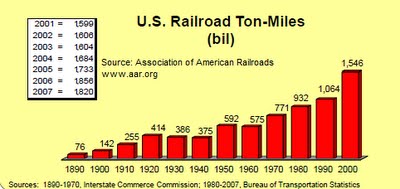
In the sixth paragraph, Kahn suggests that because the composition of the Dow Jones Industrial Index has changed dramatically over the years that we could hardly expect it to be a true reflection of our economy. Kahn implies that because we’re in a services and information-based economy, that there is less transporting of products by rails and trucks and therefore can’t possibly be reflective of the times. The charts below reflecting only the rail sector tells a completely different story.
For 2007, more revenue was generated through rail transportation than any other method of domestic transportation. Not far behind rail was trucking, which, when combined, equaled nearly 74% of total revenue generated for all methods of transportation within the U.S.
In paragraph 7, Kahn succumbs to a common myth about the relationship between commodity prices and the level of the stock market. Kahn suggests that when commodity prices are down then the stock market has every reason to rise because commodities “…are input costs for many large-cap U.S. companies…” Certainly commodities are input costs for most production but there is little to suggest that there is an inverse relationship between the two other than the ebb and flow of bad U.S. monetary policy. As a Dow Theorist, Kahn should know that Charles H. Dow said in his Wall Street Journal column on February 21, 1901:
…the stock market and the commodity market move substantially together” [5].
We have been able to confirm the relationship between commodity prices and the stock market with gold, silver and various commodity processing companies like ConAgra (CAG), Heinz (HNZ), Archers Daniels-Midland (ADM) and Sysco Foods (SYY). Kahn is right about the input costs but wrong about the inverse relationship between the stock market and commodities.
Starting in paragraph 9, Kahn begins to provide technical analysis of the iShares Dow Jones Transportation ETF. Use of an ETF to derive inference of the Dow Jones Transportation Average when the data on the index is freely available comes off as lazy. In the end, the ETF cannot show you what the Dow Jones Transportation Average did in 1946 or 1973 which is important because inevitably you’re going to need that data. If Kahn was going to use the Tranports ETF, he should have shown the 100% correlation to the actual index to justify using the ETF. No such evidence was presented for using the ETF over the actual index.
In the review of the transport ETF, Kahn speaks at length on chart patterns known as gaps and gap reversals. Considerable effort is put into explaining how the gap reversal pattern reflects negatively on the direction of the transport ETF. However, noticeably absent in his discussion of the transport ETF is the obvious “double top” formation. Double tops and double bottoms were indicated to be very important formations according to Charles H. Dow. Alternatively, William Peter Hamilton and Robert Rhea arrived at the conclusion that such formations bear little importance when considering the price movement of the indexes. From our own work on the topic of double tops and double bottoms, we have found that Dow was right about the importance of such a price characteristic and have been able to prove, with significant evidence throughout the history of the Dow indexes, that double tops and double bottoms are critical indicators for determining market direction when applying Dow Theory.
After the discussion of the transports ETF, Kahn goes far afield when he starts to discuss the price action of several illiquid sector specific ETFs from within the transportation industry. Kahn covers the airline and shipping as representative examples of the malaise that he believes reflects the weakness in the transportation sector of the economy. Both the airline and shipping ETFs are reaching new 52-week lows (our favorite point to examine values.) However, such analysis doesn’t seem to add up when compared to the iShares Dow Jones Transportation ETF.
If the Dow Transportation ETF is just coming off of a new high, then what relevance does the airline and shipping ETFs have to do with the discussion of the broader index which contains shipping, rail and airline stocks? From a Dow Theory perspective, such maneuvering to prove a point is in contravention of the theory itself. According to Dow, Hamilton, Rhea and a host of others, though not infallible, the averages discount everything.
Kahn finishes his article by saying that if the Dow Jones Transportation Average (notice the switch to index from the ETF) cannot hold above the March low of 4920 then a sell signal would have been registered. Dow Theory just doesn’t work this way. The theory is all about confirmations. As Hamilton says:
One of the shortest ways of going wrong is to accept an indication by one average which has not been clearly confirmed by the other. [6]”
If the Transportation Average breaks the March low then the only way to get a sell signal is to have the Industrial Average break the March low. For all intents and purposes, the Transportation Average could fall to 3000 or lower without triggering a sell signal. Historically speaking, such a wide divergence on a relative basis has occurred before without triggering a sell signal.
We understand that Kahn is the big money man who can articulate his thoughts in a fashion that is acceptable to publications like Barron’s. However, we know that his interpretation of Dow Theory is incorrect.
Citations:
[1] Hamilton, William Peter. The Stock Market Barometer. Harper & Brothers, New York. 1922. page 133.
[2] ibid. page 177.
[3] ibid. page 154.
[4] Russell, Richard. Richard Russell’s Dow Theory Letters. Issue 166. December 27, 1961. page 1.
[5] Sether, Laura. Dow Theory Unplugged. W&A Publishing. 2009. page 50.
[6] Hamilton, William Peter. The Stock Market Barometer. Harper & Brothers, New York. 1922. page 138.


Please consider donating to the New Low Observer. Thank you.

In the News: July 18, 2011

Please consider donating to the New Low Observer. Thank you.
Nasdaq 100 Watch List: July 15, 2011

Below are the Nasdaq 100 companies that are within 20% of the 52-week low. This list is strictly for the purpose of researching whether or not the companies have viable business models. Although these companies are very risky, based on the current price they are at reasonable values and offer significant opportunity to outperform the market in the coming year.
Symbol Name Trade P/E EPS Yield P/B % from low
CSCO Cisco Systems, Inc. 15.59 12.17 1.28 1.50% 1.8 3.23%
AKAM Akamai Technologies 29.85 31.59 0.95 0 2.51 5.48%
SPLS Staples, Inc. 15.2 12.35 1.23 2.60% 1.49 6.11%
TEVA Teva Pharmaceutical 47.97 12.9 3.72 1.70% 1.87 6.93%
MRVL Marvell Technology 14.87 11.77 1.26 0 1.83 7.21%
URBN Urban Outfitters, Inc. 31.41 20.58 1.53 0 3.81 8.20%
QGEN Qiagen N.V. 18.28 31.52 0.58 0 1.68 8.42%
AMGN Amgen Inc. 55.05 11.44 4.81 0 2.08 9.53%
INFY Infosys Limited 61.39 22.57 2.72 1.40% 5.63 9.74%
BRCM Broadcom Corp 33.27 16.79 1.98 1.10% 3.06 11.27%
YHOO Yahoo! Inc. 14.69 17.26 0.85 0 1.49 13.52%
CERN Cerner Corporation 61.9 42.11 1.47 0 5.14 14.09%
ADBE Adobe Systems 29.29 15.69 1.87 0 2.69 15.09%
ATVI Activision Blizzard 11.91 27.57 0.43 1.40% 1.33 15.41%
LLTC Linear Technology 30.48 12.92 2.36 3.10% 17.46 16.11%
MU Micron Technology 7.41 11.72 0.63 0 0.85 16.51%
MSFT Microsoft Corp 26.78 10.64 2.52 2.40% 4.18 17.82%
LRCX Lam Research 42.06 7.16 5.88 0 2.23 18.85%
Watch List Summary
Sirius XM gets added to Index
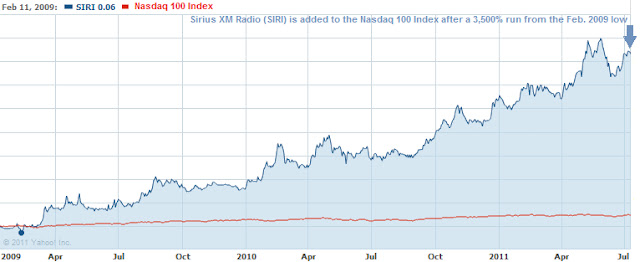
On Monday July 11, 2011, Sirius XM Radio (SIRI) was added to the Nasdaq 100 index. The addition of Sirius defies logic unless there is something about the future prospects for SIRI that the Nasdaq committee knows that we don’t. Typical of many index selection committees, SIRI is being added near its 2 ½-year high as opposed to being added when the stock is near the 52-week low.
Although a low priced stock, Sirius XM (SIRI) is not inexpensive. SIRI currently sports a trailing p/e ratio of 221 but is estimated to have a forward (2012) p/e ratio of 31. There are two ways that this scenario can play out, either the stock price will fall to $0.31 or the earnings will rise from $0.01 to $0.07.
We’re willing to submit to the idea that somewhere in between lays the truth. For example, if earnings rise to $0.04 a share and the p/e multiple comes down to 100 by year end 2012, then the stock would be conservatively price at around $4 a share. However, this is among the rosiest scenarios that could be depicted for this stock at the moment.
SIRI is a speculator’s dream, but it presently relies on the greater fool theory to justify rising another 150% as it had in the last 12 months. Speculators will be richly rewarded for taking unmitigated risk by going long SIRI if earnings doubled or triple. However, with the p/e ratio at 221, nothing less than perfection is expected from SIRI.
Being added to the Nasdaq 100 gives a lifeline that didn’t seem to exist for Sirius (SIRI). With the wind at its back, the odds increase that the SIRI can perform as some bulls expect. However, going into the fourth quarter of the year, if the stock does not perform as planned then Sirius will be summarily dismissed from the index as quickly as it was added.  However, as we said before, maybe the Nasdaq committee knows something we don't which justifies Sirius being added to the index as opposed to the other 49 companies on their list of eligible candidates.
Nasdaq Fritters Away Significant Opportunity
We’re surprise that, out of the 50 alternatives to add to the Nasdaq 100 index, Sirius XM Radio (SIRI) was the prime choice. After all, if a company with an $8 billion market cap, $0.01 of earnings and 221 p/e ratio was all that could be found then something must be awry with the Nasdaq selection committee. In the table below, we found four companies that are among the 50 on the list of companies that should have been selected instead of SIRI.
Our suspicion is that SIRI has been added to the index simply as a means to have a position that rivals the recent IPO of Pandora (P). This will certainly give SIRI a boost but if the post-IPO performance of Pandora (P) is any indication, SIRI gains could become the Nasdaq 100’s pains.
A simple question should be asked, “do you see Sirius XM Radio (SIRI) as the best investment alternative when most major indexes have been in a 2-year cyclical bull market?” Adding Sirius XM Radio (SIRI) to the Nasdaq 100 index under the current conditions reflect a lapse in judgment.
Chip Sector Dip
On July 12, 2011, Microchip Technology (MCHP) fell 12% on news that prospects for the future weren’t as bright as analysts anticipated. The Wall Street Journal seemed to believe that MCHP’s decline was the “…canary in the [chip]sector’s coalmine.” The decline in MCHP has resulted in 4.19% dividend yield.
The last time that we wrote about MCHP, March 20, 2010, the company was yielding 4.80%. At the time we said of the chip sector, “[the] clustering of companies in a specific industry may indicate that the entire sector is undervalued.” Several articles we wrote about the chip sector in March 2010 followed with a particular article of interest on the topic titled “Applied Materials and the Chip Sector Should Be on Your Radar.”
To varying degrees, our assessment was correct. At the 1-year marker after the list of chip stocks was generated, only one stock Intel (INTC) was unable to provide above average returns. All other chip stocks on our March 20th list generated a minimum of 26% as indicated in the chart below. In general, March of 2011 has marked the top on the chip stocks mentioned so far with Microchip Technology (MCHP) and Applied Materials giving back the most from their respective price peak.
Despite the large declines by MCHP, the total return for MCHP has been 20.67% as opposed to the unadjusted return of 11.25%. In the case if Microchip Technology, the total return had been 54.85% at the most recent high set on May 12, 2011.  Microchip Technology (MCHP) and many of its competitors aren’t out of the woods yet. However, as the dividend yields increase, there becomes little justification for ignoring these stocks.
Google Jumps On Usual Earnings Surprise
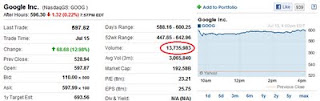
On Friday July 15, 2011, Google’s (GOOG) announcement of 36% profit growth resulted in 13% gain in pre-market trading. As we’ve demonstrated before, pre-market trading rules the rest of the trading day. According to the Nasdaq.com website, 651,141 shares traded in the pre-market and Google rose 13.08% or $69.16.
During the regular market hours on the same day, 13 million shares changed hands with the stock declining $-0.48. We’d view the inability of the stock to move higher during regular market hours on tremendous volume as an overall negative.
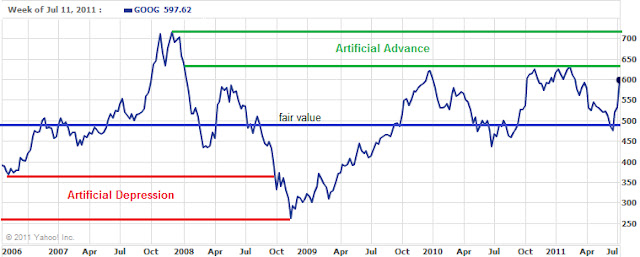
According to S.A. Nelson, the man credited with coining the term “Dow Theory”, “…stocks have recovered after artificial depression and relapsed after artificial advances to the middle point which represented value as it was understood by those who bought or held as investors." Based on the chart pattern below, it appears that Google’s stock price is bumping up against the artificial advance or overvalued range. Since early 2008, Google (GOOG) has had challenges advancing far above the $630 level. The most recent move should provide more clarity on whether GOOG can make a strike for the $715 level.
Google (GOOG) was last on our watch list on June 17, 2011. At that time, GOOG was selling for $500 with a p/e ratio of 19 and a p/b ratio of 3. So far, the stock has risen 19% in exactly one month. From our perspective, there is little need to tempt a stock price that, although it can move higher, has already provided greater than 200% on an annualized basis.
Watch List Performance Review
In our ongoing review of the Nasdaq 100 Watch List, we have taken the top five stocks on our list from July 17, 2010 and have checked their performance one year later. The top five companies on that list can be seen in the table below.
Symbol Company 2010 2011 % change
GILD Gilead Sciences $31.94 $41.00 28.37%
NVDA NVIDIA $10.05 $14.10 40.30%
XRAY DENTSPLY $29.25 $39.26 34.22%
FISV Fiserv, Inc. $45.60 $61.37 34.58%
SPLS Staples, Inc. $19.31 $15.20 -21.28%
- - - - -
- - - Average 23.24%
- - - - -
NDX Nasdaq 100 1803.48 2356.67 30.67%
In the last year there were two outliers when compared to the Nasdaq 100 Index.  First was Nvidia (NVDA) which soared as high as 150% in the first six months of being on our July 15, 2010 list.  On the other end of the spectrum we have Staples (SPLS) which has languished with loses of more than -20% in the last year.  Overall, the top five stocks on our watch list from last year underperformed the corresponding index by -7.43%.  Only three of the stocks (XRAY), (FISV) and (NVDA) were able to exceed the returns of the Nadaq 100.  The 28% return from (GILD) and -20% from (SPLS) dragged the performance of the top 5 down considerably.
Disclaimer:

On our current list, we excluded companies that have no earnings. Stocks that appear on our watch lists are not recommendations to buy. Instead, they are the starting point for doing your research and determining the best company to buy. Ideally, a stock that is purchased from this list is done after a considerable decline in the price and extensive due diligence. We suggest that readers use the March 2009 low (or the companies' most distressed level in the last 2 years) as the downside projection for investing. Our view is to embrace the worse case scenario prior to investing. A minimum of 50% decline or the November 2008 to March 2009 low, whichever is lower, would fit that description. It is important to place these companies on your own watch list so that when the opportunity arises, you can purchase them with a greater margin of safety. It is our expectation that, at the most, only 1/3 of the companies that are part of our list will outperform the market over a one-year period.

Please consider donating to the New Low Observer. Thank you.
Nasdaq 100 Watch List

Below are the top Nasdaq 100 companies that are within 20% of the 52-week low. This list is strictly for the purpose of researching whether or not the companies have viable business models. These companies are deemed highly speculative unless otherwise noted.
Symbol Name Trade P/E EPS Yield P/B % from Low
CEPH Cephalon, Inc. 59.64 11.14 5.35 N/A 1.81 8.44%
CSCO Cisco Systems, Inc. 20.73 15.13 1.37 N/A 2.59 9.08%
QGEN Qiagen N.V. 18.56 29.18 0.64 N/A 1.8 10.08%
TEVA Teva Pharmaceutical 52.86 16.27 3.25 1.30% 2.23 12.49%
ATVI Activision Blizzard, Inc 11.25 38.25 0.29 1.30% 1.29 13.24%
AMGN Amgen Inc. 56.97 12.31 4.63 N/A 2.27 13.35%
CELG Celgene Corporation 56.03 28.3 1.98 N/A 5.06 16.68%
GRMN Garmin Ltd. 30.79 8.42 3.66 4.90% 2.11 17.92%
INTC Intel Corporation 20.82 10.16 2.05 3.00% 2.34 18.30%
DELL Dell Inc. 13.47 12.95 1.04 N/A 3.85 18.78%

Watch List Performance Review

In our ongoing review of the Nasdaq 100 Watch List, we have taken the top five stocks on our list from the closing price of January 22, 2010 and have checked their performance one year later.  The top five companies on that list are provided below with the closing price for January 22, 2010 and January 21, 2011.

Symbol
Company
2010
2011
% change
First Solar
112.39
147.41
31.16%
Gilead Sci.
46.08
38.19
-17.12%
Genzyme
54.38
71.58
31.63%
Apollo Grp
61.19
42.35
-30.79%
Electronic Arts
16.77
15.13
-9.78%
Average Gain
1.02%
NDX
Nasdaq 100
1794.82
2268.32
26.38%

Disclaimer

Stocks that appear on our watch lists are not recommendations to buy. Instead, they are the starting point for doing your research and determining the best company to buy. Ideally, a stock that is purchased from this list is done after a considerable decline in the price and extensive due diligence. We suggest that readers use the March 2009 low (or the companies' most distressed level in the last 2 years) as the downside projection for investing. Our view is to embrace the worse case scenario prior to investing. A minimum of 50% decline or the November 2008 to March 2009 low, whichever is lower, would fit that description. It is important to place these companies on your own watch list so that when the opportunity arises, you can purchase them with a greater margin of safety. It is our expectation that, at the most, only 1/3 of the companies that are part of our list will outperform the market over a one-year period.

Quote of the Day

The following is the conclusion from the Examiner's report on the failure of Lehman Brothers. This full report is a must read for anyone interested in the use of GAAP acounting and its acceptability despite being illegal at times.   The full report is available here.  

"After reaching the tentative conclusion that claims existed against Fuld, O’Meara, Callan, Lowitt, and Ernst & Young, the Examiner reached out to counsel for each, advised them of the basis for the potential finding, and invited each of them to present any additional facts or materials that might bear on the final conclusion. All counsel accepted the Examiner’s offer. In the weeks leading up to the submission of this Report, the Examiner had individual, face to face meetings with counsel for Fuld, O’Meara, Callan, Lowitt, and Ernst & Young, and carefully considered the materials raised by each. While there were credible facts and arguments presented by each that may form the basis for a successful defense, the Examiner concluded that these possible defenses do not change the now final conclusion that there is sufficient evidence to support a finding that claims of breach of fiduciary duty exist against Fuld, O’Meara, Callan, and Lowitt and a colorable claim of professional malpractice exists against Ernst & Young."

Lehman Report
REPORT OF ANTON R. VALUKAS, EXAMINER
VOLUME 3 OF 9 Section III.A.4: Repo 105 Page 990.
Jenner and Block
http://www.jenner.com/

Email our team here.