Category Archives: SRL

Actavis buys Warner Chilcott, Upside Seems Limited

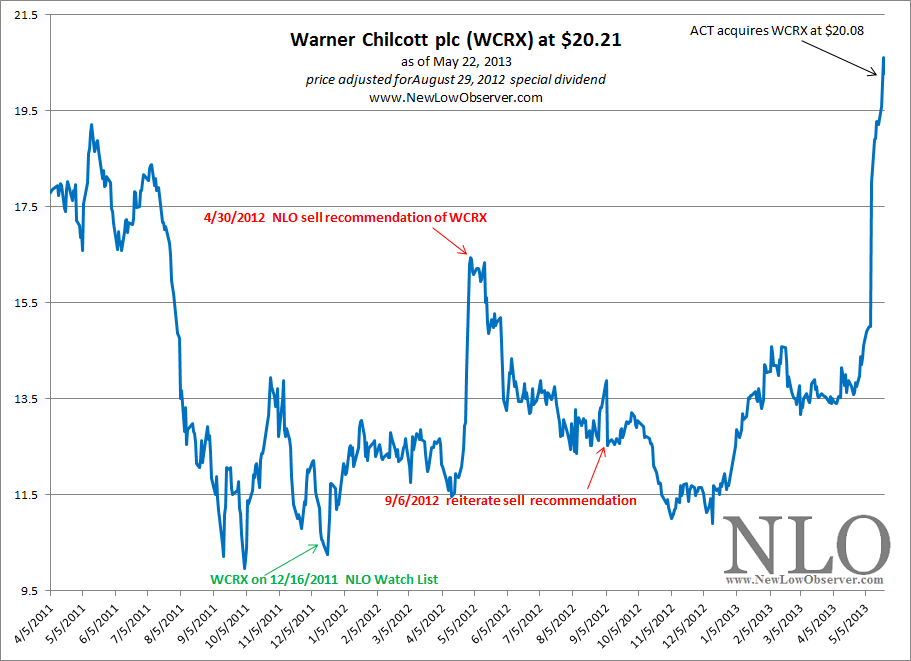
On May 21, 2013,  Actavis (ACT) announced that it would acquire Warner Chilcott (WCRX) for $20.08 per share (found here) and the deal is expected to close by year-end 2013.  This has turned into an incredible string of companies that have been on our New Low Observer Watch Lists and ultimately get acquired.

On April 30, 2012, we gave Warner Chilcott a sell recommendation after the stock gained +57.11% in 3 months(found here).  After that sell recommendation, Warner Chilcott declined –35% by mid-December.  We reiterated our sell recommendation of Warner Chilcott on September 6, 2012 (found here), from that level the stock decline –12.93%, to the December 13, 2013 low.
image

As regular readers of our work know, we compare investments on an annualized return basis.  In the example above, the annualized gain from December 16, 2011 to April 30, 2012 sell recommendation or the December 31, 2013 completion of the merger, are as follows:

  • 12/16/2011 to 4/30/2012:   +276% (excluding special dividend)
  • 12/16/2011 to 12/31/2013:   +80% (including special dividend)

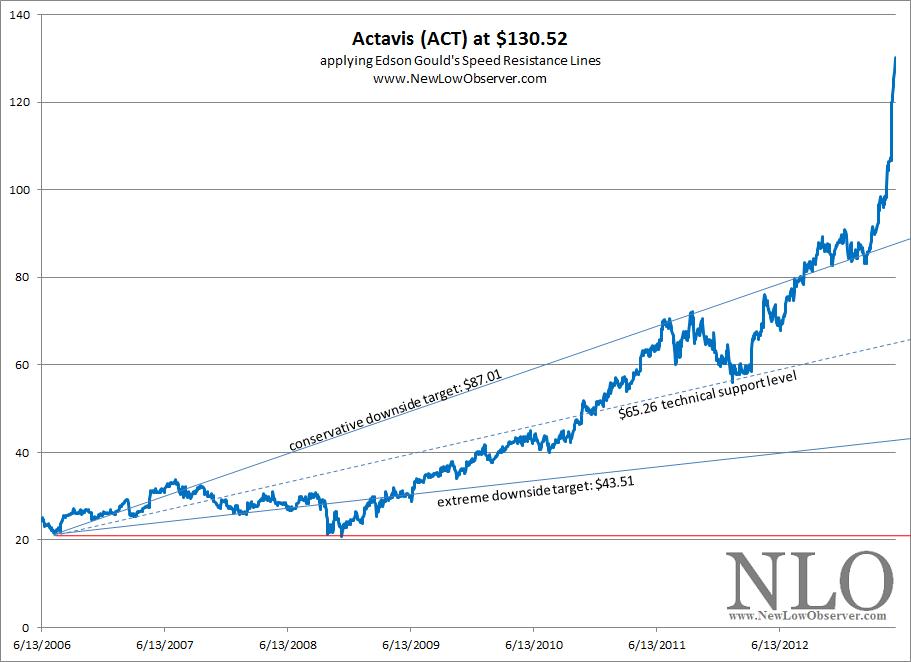
There are several concerns regarding the transaction between Actavis (ACT) and Warner Chilcott (WCRX) that should be taken into consideration.  First and foremost, is the current price action of Actavis stock.  Price action determines a majority of relative fundamental value attributes. Below is the Speed Resistance Lines [SRL] based on the stock price for Actavis since June 2006.
image

Any transaction being carried out by Actavis at the current price is heavily dependent on the stock price remaining at $120 and above.  According to Gould’s SRLs, Actavis has a conservative downside target at $87.01 and an extreme downside target at $43.51.  Our experience indicates that the conservative downside target is a lock, at this point.  This is in spite of the fact that the price could double before getting to such a downside target, as was the case with our April 2012 conservative downside target of $420 for Apple (AAPL) (found here).   While the conservative downside target appears to be a lock, the extreme downside target begs some kind of explanation of how it is possible to decline –50% or more.

The first consideration that comes to our mind is the strategic nature of the purchase.  The Actavis purchase of Warner Chilcott will lower the corporate tax rate from 29% to 17% because WCRX is located in Dublin, Ireland as reported by Bloomberg News (found here).  While the reduction of the tax rate seems to be beneficial, it has done little to contribute to Actavis’ earnings.  Already there has been faux outrage by Congress over the fact that Apple has legally dodged their “fair share” of corporate taxes through entities located in Ireland (found here).  We believe that with Congress spotlighting the issues related to legal tax avoidance, some areas that were once loopholes will be closed.  This will require more time to come up with new legal tax avoidance strategies.  Also, with Warner Chilcott being domiciled in Ireland, the focus of the Apple entities, Ireland may be the first target for changes to the tax loopholes that presently exist.

Another challenge is the dramatic increase in sales and earnings due strictly to the merger (found here).  As reported by Zacks Equity Research, based on the preliminary numbers, sales for Actavis are supposed to jump from 7% to 25% by 2014.  Also, annual earnings are supposed to increase 30% from the current level which stands in the negative for the trailing twelve months.  However, little of the gains for Actavis will be a direct result of internal efficiencies and significant improvement of sales.  This come at a time when Warner Chilcott appeared desperate for a buyer after private equity shareholders cashed in most of their chips after substantial special dividends nearly equal to the IPO price set in 2005.

At the time of Watson Pharmaceutical’s acquisition of Actavis in early 2012, it was announced that, “…Including synergies, Watson anticipates the acquisition will be greater than 30% accretive to 2013 Watson non-GAAP EPS, with accretion accelerating in 2014 through organic growth and further achievement of synergies(found here).  In the announcement of the merger between Actavis and Warner Chilcott (WCRX), the company press release says that it will be “…immediately Accretive With Opportunities for Substantial Operational Synergies and Tax Savings” and “…The transaction is expected to be more than 30 percent accretive to Actavis non-GAAP earnings per share in 2014, including anticipated synergies.(found here).  Aside from using nearly the exact same language in the press releases for two different companies, the set up for 2014 could be a big disappointment.

In spite of the accretion that is suggested, Actavis’ 2013 first quarter earnings was –$0.79, down from the $0.43 in the prior year period (found here). In addition, the 2012 fourth quarter earnings were down –10% from the same quarter in the prior year (found here). The 30% immediate accretive non-GAAP gains due to the acquisition of Actavis has not yet been realized.  Also, non-GAAP earnings are not contributing to the bottom line in the form of positive annual net earnings.  It is possible that the merger with Warner Chilcott is simply covering up the failings of Actavis to come through on promises of “immediately accretive” value for the Watson Pharmaceutial/Actavis merger.

Finally, according to Value Line Investment Survey, based on estimated 2013 cash flow, Actavis has a fair value of $120.28.  Since 2006, Actavis has traded below Value Line’s fair value while never trading above such a level.  This trend persisted even after Watson Pharmaceutical acquired Actavis, which was concluded in October/November 2012.  At the current price of $130, Actavis is 3% above Value Line’s estimated 2016-2018 fair value.  We think the persistence of Actavis to trade at or below Value Line’s fair value estimates will continue to dominate the stock price going forward.

It appears that paper gains due to mergers and acquisitions through the use of tax reductions and non-GAAP reporting is not a fundamental shift in Actavis’ ability to increase shareholder value.  Additionally, the +56% parabolic run-up in the price along with Edson Gould’s Speed Resistance Lines and Value Line’s fair value estimates suggest that the downside risks are significant.
Upside Targets for Individual Gold Stocks

We’ve come to the time when we need to determine the upside targets for gold stocks.  There are a few assumption that we’re making in this assessment.  First, we believe that our Gold Stock Indicator is right about the direction of gold stocks, in general.  Second, we’re assuming that from the current levels there is more downside risk.  Third, we have excluded fundamental analysis (government printing, future earnings capacity, gold as money, etc.) from our assessment of the upside potential for individual gold stocks.

Continue reading

Precious Metals Follow-Up

Silver

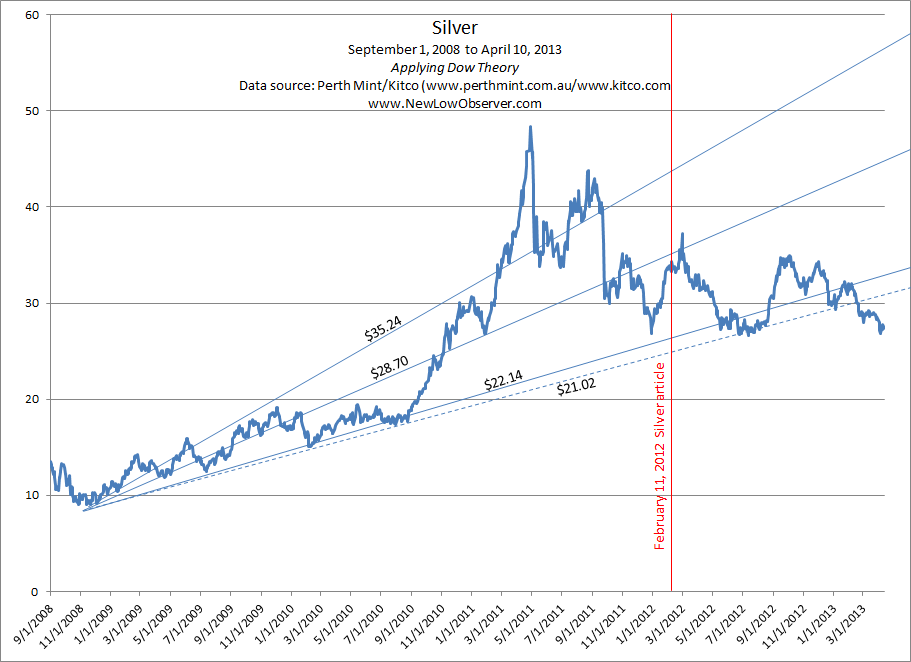
On February 11, 2012, we wrote a piece on Silver and SLV titled “Correction of Errors on iShares Silver Trust (SLV) Interpretation” (found here). In that article, we said the following:

“The current indications suggest that SLV will fall as [low as] the $22.14 support level. Because silver easily fell to the third support level in the period from 2001 to 2008 (within the context of a precious metal bull market), we expect that the $21.02 is a realistic worst case scenario to watch for. We will consider buying silver and related derivatives at $22.25 and below.

“We view the most recent rise from the December 2011 low as running out of steam.Therefore, the rising resistance level established at $28.70 appears to be firmly in place…for now.”

As seen in the chart below, Silver has declined to the rising support level of $21.02 in many instances but broke through to the downside on February 18, 2013.

Silver 4-10-2013

From a technical standpoint, the next downside target for silver may be to the $20 level if the current levels don’t hold. However, under typical circumstances, any point below the $21.02 level is considered undervalued. While it is possible that Silver could fall further we don’t play the short side since we’re in the position to accumulate good values. Values at this point trump the guesswork of when to enter and exit the short. We believe that anyone interested in the upside potential to silver should thoughtfully accept the potential loss of –50% or more and purchase in two stages, once at a predetermine price at or below the current level and a second time at or below the first purchase.

Agnico-Eagle Mines (AEM)

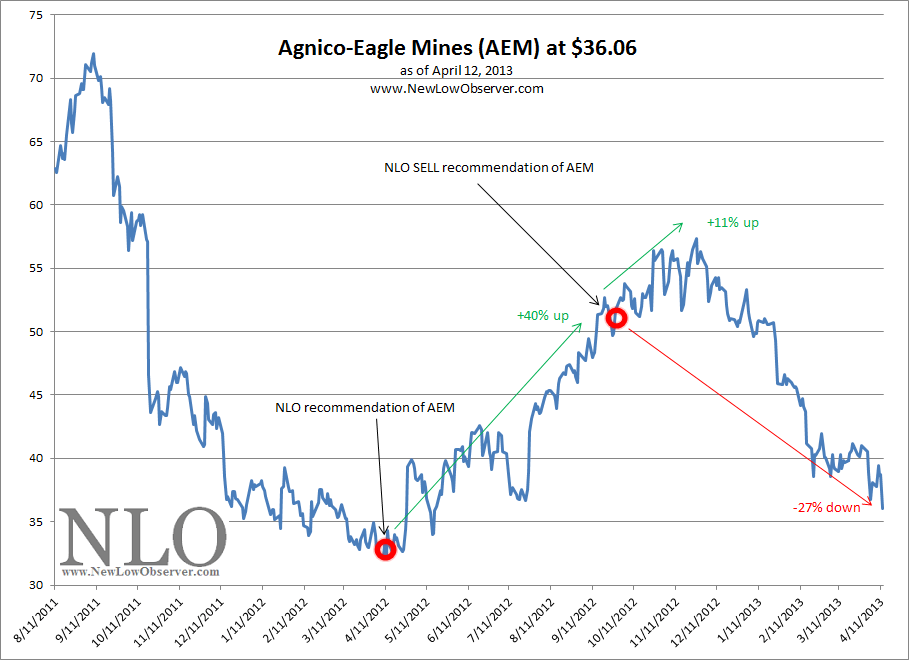
On April 6, 2012, we recommended the consideration of Agnico-Eagle Mines (AEM) (found here). On September 25, 2012, we recommended selling of AEM (found here). While we got a lot of heat from readers of the SELL recommendation, from the less than brilliant to the reasonably rational, our work has proven that precious metal bull markets are vicious and should not be taken lightly.

After our recommendation of AEM on April 6, 2012, the stock rose nearly +40%. When we gave the sell recommendation of AEM on September 25, 2012, the stock increased an additional +11%. However, as of April 12, 2013, AEM is down –27% from our sell recommendation and down –37% from the November 2012 high at $57.33.

image

Never under-estimate the power of a gold bull market. We hope that our work on this topic has been instructive.

Bitcoin Downside Targets

After seeing a discussion of Bitcoin on Bloomberg (found here) we decided to run Edson Gould’s Speed Resistance Lines (SRL) on the “currency.”

image

The most important feature regarding this SRL analysis is precedence.  Without precedence we could not ascribe any amount of confidence to what is in the chart.  Of course, the precedent that we’re referring to is the peak in the price near June 2011.  At that time the peak price was $31.90.  Based on the SRL for that period, the conservative downside target was $17.24 and the extreme downside target was $10.36.  In each case the price of Bitcoin declined below both level and on a resounding basis.  The ultimate low after that parabolic peak was $2.30 in late December 2011, a decline of -92.78% from the peak.

Because the nature of parabolic peaks is to crash disastrously explains why the more moderate peaks of January 2012 and July 2012 did not give up more than 66% of the previous increase.  The current parabolic increase in Bitcoin has a conservative downside target of $89.45 and an extreme downside target of $76.05.  However, if Bitcoin were to experience a -92% decline as it had done in 2011 then there is the potential for a decline as low as $16.45 which is slightly below the technical base of $21.10.

While technical analysis is considered voo-doo at best, we are trying to determine the limits of Edson Gould’s SRL.  So far, Gould’s SRLs have given accurate downside targets for Apple (AAPL), Green Mountain Coffee Roasters (GMCR), Herbalife (HLF), Chesapeake  Energy (CHK), BMC Software (BMC) and Silver or iShares Silver (SLV).  This is 54% of all the SRLs done on our site.  There are two SRLs that are still on their way to providing an accurate downside target and that is Randgold (RGLD) and Philadelphia Gold and Silver Stock Index (XAU), 18% of the SRLs run.  Twenty-seven percent of SRLs that have failed are Priceline (PCLN), Chipotle Mexican Grill (CMG) and Clean Harbors (CLH).  All of the SRLs and their success and failure can be (found here).

Note: Diamond Foods (DMND) has been excluded from the SRL count since DMND was done after the downside targets were achieved.

Technical Review: Carbo Ceramics (CRR)

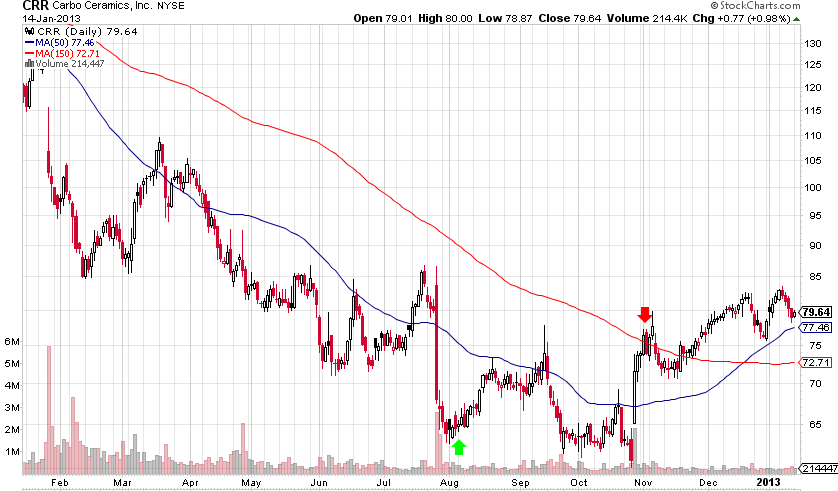
Carbo Ceramics (CRR) was one of the companies that appeared at the top of our dividend watch list for many weeks beginning in February 2012. The watch list served as a beginning point for our research and we took a position in August (found here) at $65.02 (green arrow on chart below). Within three months, we saw shares of CRR rally to $74, a +13.8% gain. As such, we ‘hedged’ our position by selling the principal (found here) and let the profit run (red arrow on chart below).

Recent activity in Carbo Ceramics price suggests that, on a technical basis, the decline is over. Though a rally to its intraday peak of $180 is not expected, we believed there is a good opportunity for those interested in a short to medium-term speculative position in the stock.

image

In our view, the biggest bull case, on a technical basis, is that the 50-day moving average has crossed above the 150-day moving average creating what some call a "golden cross." We rely on the 150-day versus the more popular 200-day moving average for the fact that it is the road less traveled and provides an indication ahead of the crowd.

Currently, shares of Carbo Ceramics are trading just above the 50-day moving average, making this an ideal short-term transaction. For those who wish to trade this generally significant technical pattern, we’d consider selling if shares close below the 150-day moving average or if the stock gains +10% or more.

From a fundamental standpoint, Carbo Ceramics (CRR) provides long-term holders of the stock with the following attributes:

  • According to Value Line Investment Survey, the fair value for CRR is 14 times 2012 cash flow of $6.50, or a stock price of $91, a gain of +14% above the current price of $79.64. As an alternative, if the estimates by Value Line are correct, the 2013 fair value figure is $100.10, a potential gain of +25.69%.
  • Value Line indicates that Carbo Ceramics has increased the dividend for 12 consecutive years in a row.
  • Carbo Ceramics book value has had an annualized growth rate of +14.73%.
  • Carbo Ceramics has no debt

What Is the Downside Risk If I Want to Hold CRR for the Long-Term?

Dow Theory has the following downside targets for Carbo Ceramics:

  • $61.34
  • $44.39
  • $27.43

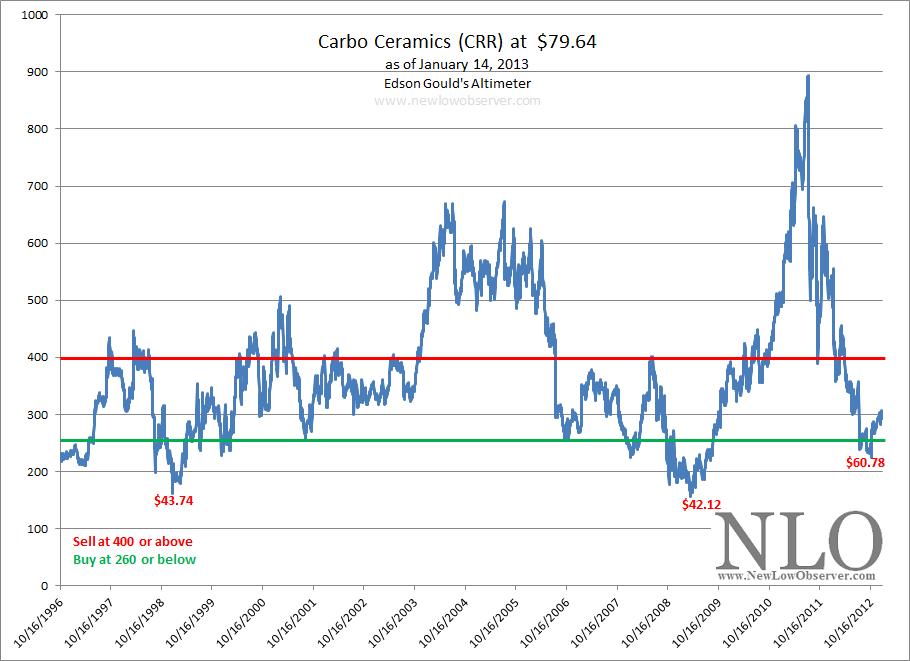
Based on the work of Edson Gould, Carbo Ceramics has the following Altimeter:

CRR 1-14-2013

Carbo Ceramics would have to fall to $70.20 in order to be considered a buy using the Altimeter above. However, as has been the case in the past, seldom does the Altimeter decline to the buy level and then immediately reverse to the upside. therefore we’d expect a push below the $70.20 level for good measure.

image

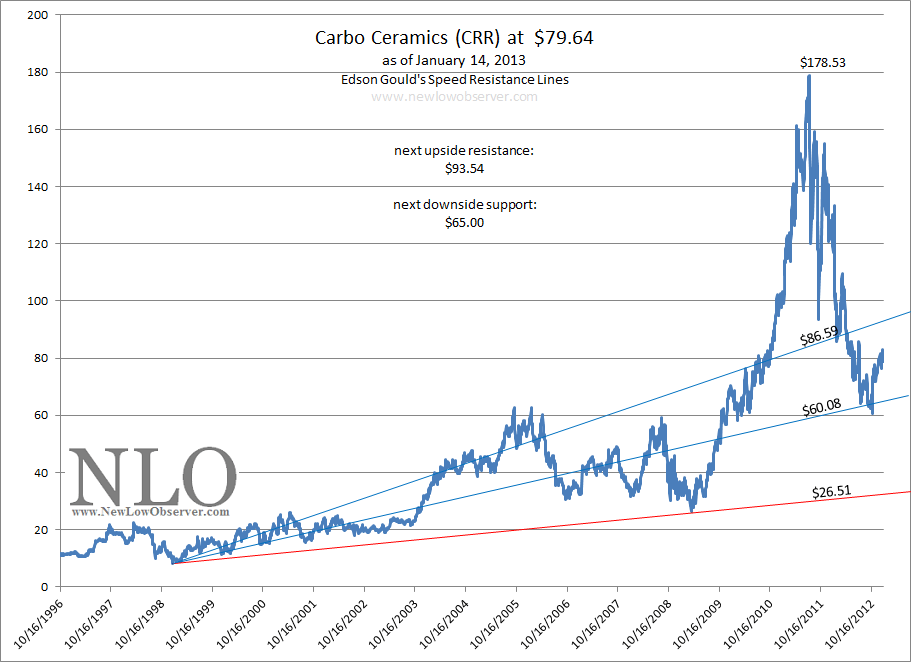
Edson Gould’s Speed Resistance Lines have $65 as the downside support level.

The most conservative of the three downside targets mentioned above is the Dow Theory level of $61. This seems be the most appropriate level to consider a first, or second, purchase if the desire is to hold Carbo Ceramics for the long-term.

Review: Green Mountain Coffee Roasters

This is a follow-up to our May 2, 2012 piece on downside and upside targets for Green Mountain Coffee Roasters (GMCR).

At the time, GMCR had traded as low as $28.50 (-38.9%)  in after-hours trading.  We gave a downside target of $22.53 due to the fact that the stock had declined below our projected support level of $37.21, as indicated on October 25, 2011.  Since our May 2, 2012 article, GMCR has declined as low as $17.11, see chart below.

Continue reading

Review: Netflix and Herbalife

Netflix (NFLX) is the first stock under review.  Our prior work on this stock can be found here (September 22, 2011).

Continue reading

What is Next for Herbalife (HLF)?

On May 2, 2012, Herbalife’s (HLF) stock price closed at $51.71.  At that time, we ran Edson Gould’s Speed Resistance Lines [SRL] to determine what the potential downside price would be (found here).  We determined that the conservative downside target was $45.45 and the extreme downside target was $24.33. 

On December 21, 2012, Herbalife (HLF) has managed to exceed our expectations by falling through the conservative downside target of $45.45 and within 11% of the extreme downside target of $24.33 by closing at $27.27.  The total decline since May 2, 2012 has been –47.26%.

Now we’re ready to re-examine what the prospects are for HLF based on the updated market activity.

image

At the current price of $27.27, HLF has fallen below the ascending extreme downside target of $24.33.   This suggests that a $24.33 handle on this stock is almost guaranteed on an intra-day basis, at minimum. 

After reaching the inevitable low in the current decline, we expect HLF to increase at least +30%.  If $24.33 were the low, then rising to $31.63 would not be out of the question.  This would be similar to the rise of the stock price from the May 2012 low to the late July 2012 high.  However, rising above the ascending $34.89 line (now at $41; ± $3-$4) could be a point where the stock price could stall and then decline dramatically.  In order for us to feel that the rise in HLF is sustainable, we’d like to see the stock rise, at minimum, above the $50.14 level based on Dow’s Theory.

Aside from declining to the $24.33 price, we’re concerned that if the $21.12 price is broken to the downside then HLF might retest the 2009 low of $6-$7 range.  Because the single digit numbers are so extreme, we’d opt to split the difference and say that the potential downside target below $21.12 is $14.06.

Note: Any money committed to HLF, either long or short, should be considered a speculation. This piece is a continuation of the examination of Edson Gould’s speed resistance lines as explained in prior articles (found here). This is not an endorsement to sell short at the current levels nor buy these stocks once falling below the extreme downside targets.

CMG Conservative Support Broken, Is $146 Next?

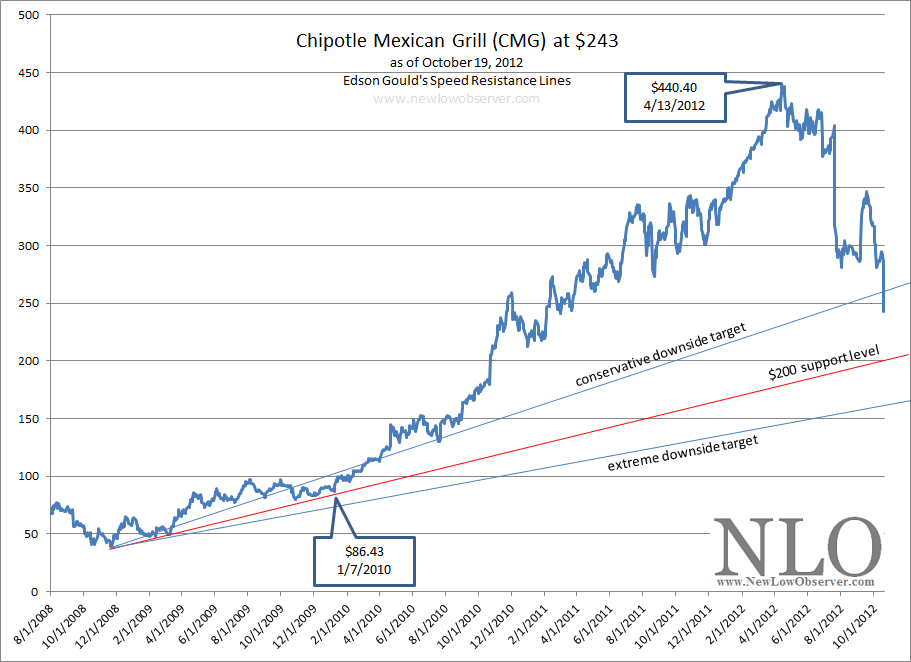
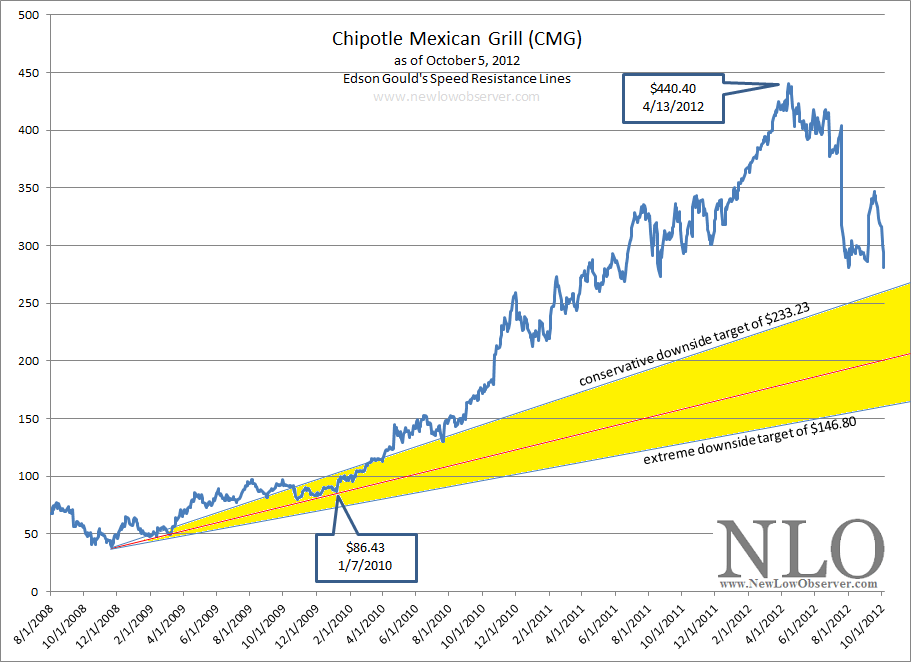
Today Chipotle Mexican Grill (CMG) broke below our conservative downside target support level.  Our downside target for Chipotle is based on Edson Gould’s Speed Resistance Line [SRL] and was initially constructed in our October 25, 2011 article (found here).  In that article, we arrived at a conservative downside target of $200.59.  However, as the price of the stock roses it became necessary to revise the downside target.  A revision of the conservative and extreme downside targets was done on October 6, 2012 (found here).

The chart below graphically represents what we believe is likely to transpire in the short-term:

image

It appears that CMG will decline to $233.23 with a high level of certainty and potentially to the $200 support level as was initially  indicated in our very first SRL analysis done on October 25, 2011.  The only remaining question is whether or not CMG will fall to our extreme downside targets as NFLX and GMCR did when we constructed SRLs for those stocks.

Our extreme downside target of $146 is based on our October 6, 2012 CMG revised target as seen in the chart below:

image

Gold Stock Indicator

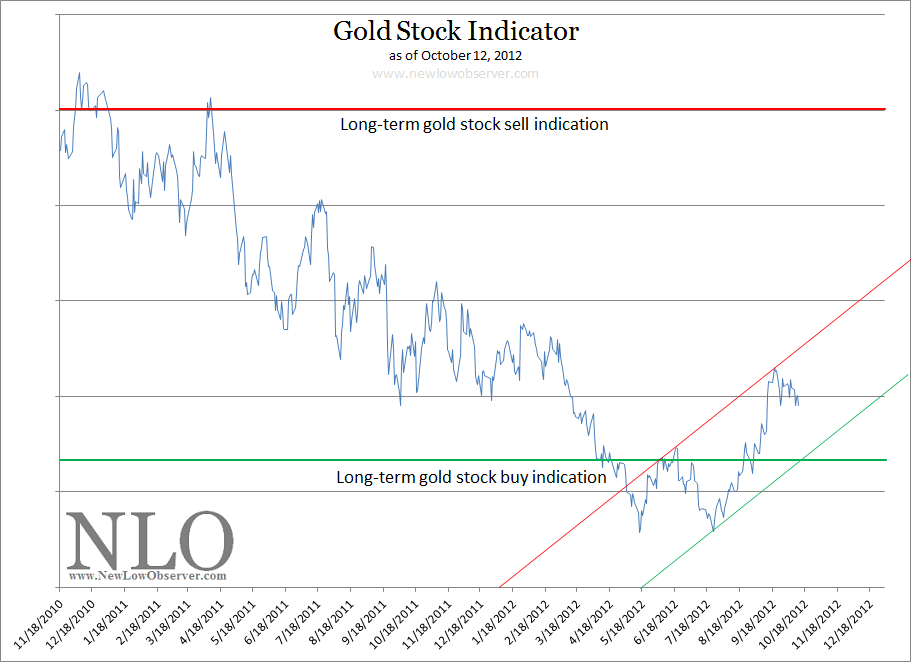
Based on our preliminary work, we believe that gold stocks, as represented by the Philadelphia Gold and Silver Stock Index, will reach our long-term gold stock sell indication between July 15, 2013 and November 25, 2013.

image
This is our best estimate based on the current trajectory of our Gold Stock Indicator. As we get closer to the dates, we will be better able to project the gold stock long-term sell indication with what we believe to be a certain level of accuracy.

This estimate is subject to change if the short-term gold stock buy indication (green diagonal line) is broken to the downside which would bring us back to the long-term gold stock buy indication. The scenario that could easily break the downside trendline is a general stock market decline.  Although Dow Theory indicates that this is a possibility, we're waiting for the appropriate confirmation either up or down. 

The best example of where the stock market is right now is reflected in the chart below, from our September 21, 2012 Dow Altimeter:

Royal Gold (RGLD) Speed Resistance Lines

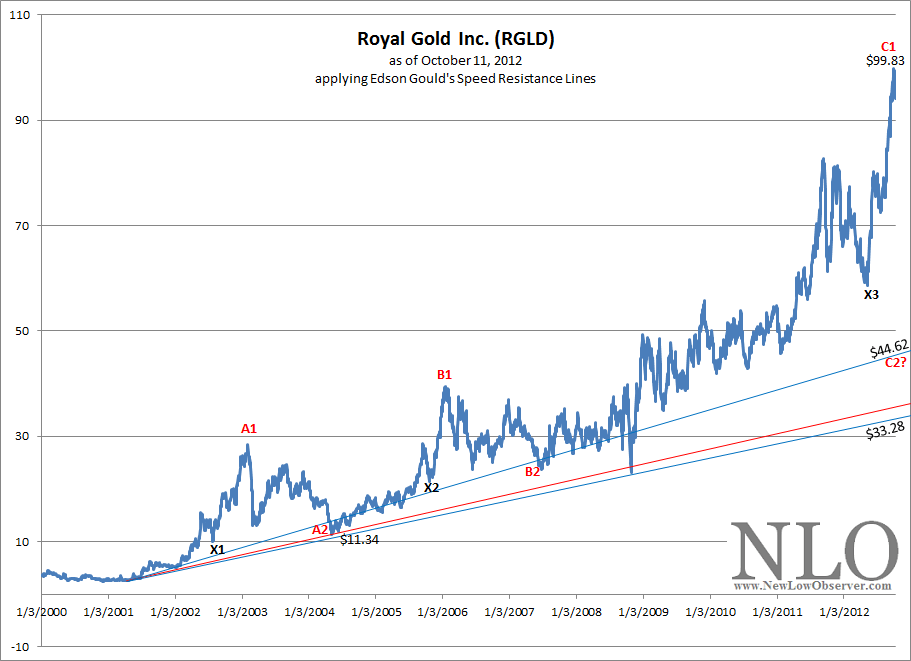
In the chart below we’ve provided Edson Gould’s Speed Resistance Lines (SRL).

image

What is interesting about the above chart is the following:

  • Point A1 to point A2 declined –60%
  • Point B1 to point B2 declined –40%
  • Point C1 to point C2 is a projected decline of –55%

The SRL for Royal Gold at $44.62 doesn’t seem outlandish given what has already occurred in the previous declines from prior peaks.  The X marks the first decline after a “minor” parabolic move that was later exceeded on a larger scale to point A1, B1 and C1.  Additionally, the  X reflects the minimum retracement from the top and has provided consistent support for the price for RGLD.

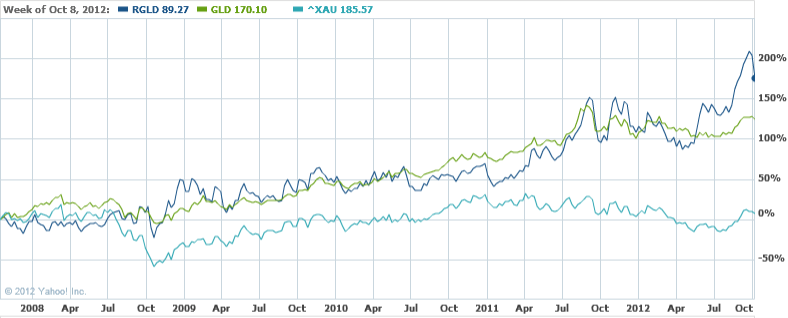
We’d consider buying RGLD if it declines to either of the support levels of X3 or C2.  The movement of RGLD has been consistent with the price of gold (GLD) which is in stark contrast with gold stocks as represented by the Philadelphia Gold and Silver Stock Index (^XAU), as indicated in the chart below.

image

Clean Harbors (CLH): Downside Targets

On February 9, 2012, when the stock was trading at $64.28, we reviewed the Speed Resistance Lines for Clean Harbors (CLH).  At that time we indicated the Clean Harbors had the following downside targets (found here):

  • $43.53
  • $31.00
  • $22.53

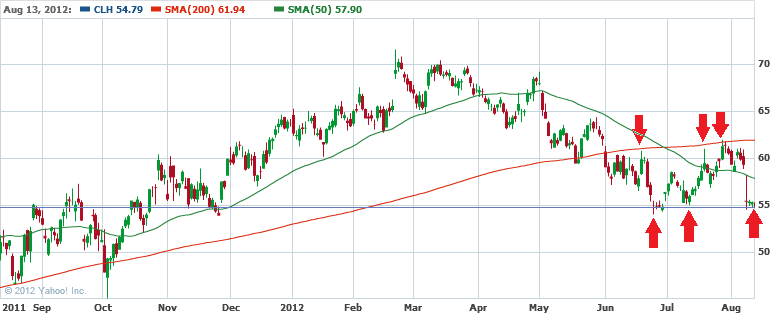
Currently, Clean Harbors (CLH) has declined to the $54.80 level which, in our view, happens to be a critical support level for shareholders of the stock.  As can be seen in the chart below, the price of CLH fell below the 200-day moving average (red line) on June 1, 2012.  Additionally, on three occasions the price of CLH attempted and failed to exceed the 200-day moving average (red line).

image

CLH is now bouncing along the support level of $55 (blue line).  It is not clear whether the stock is going to retest the 200-day moving average which presently sits at $61.94.  However, any additional decline in the stock price will likely lead to falling to $47.83.

Buckle (BKE): A Review

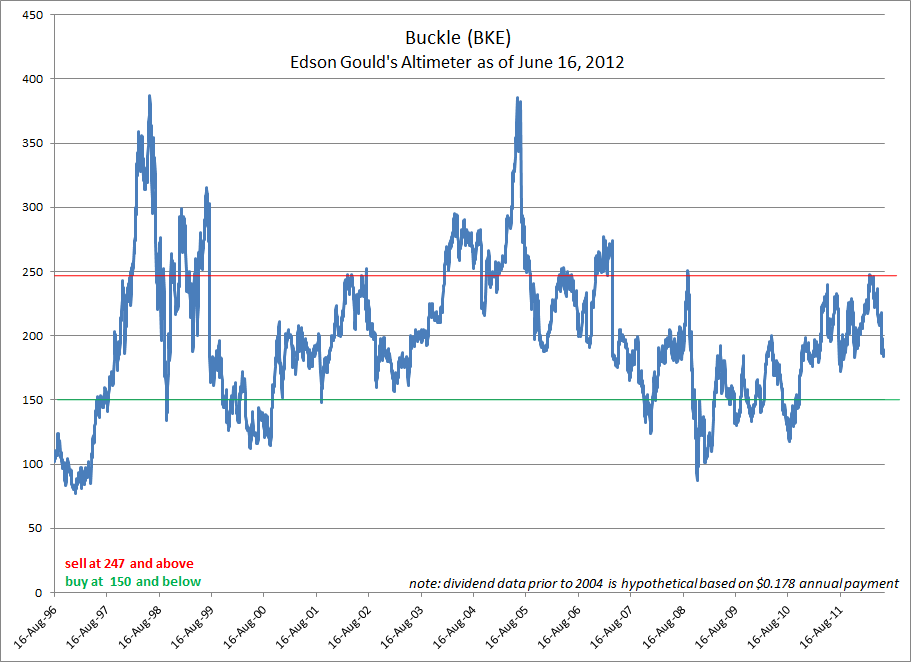
The following is a review of Buckle (BKE) using Edson Gould’s Altimeter.

image

Below is the performance of the buy and sell indications of Edson Gould’s Altimeter based on periods when the indicator first cross below 150 for buy indication, and above 247 for sell indications.

Date Price Altimeter buy/sell % change $1 invested
6/12/1997 6.57 148 buy 69% $1.69
1/28/1998 11.13 250 sell -47%  
10/8/1998 5.95 134 buy 85% $3.13
11/6/1998 11.01 248 sell -41%  
11/4/1999 6.51 146 buy 69% $5.30
3/19/2002 11.01 248 sell 120%  
11/19/2007 24.26 146 buy 72% $9.13
9/18/2008 41.78 251 sell -43%  
10/23/2008 23.94 144 buy 107% $18.90
3/9/2012 49.56 248 sell -39%  
????????? 30 150 buy ?????????  

The consistency of the indicator is amazing.  Only the sell indication of March 19, 2002 resulted in an outcome that was contrary to the desired result.  Even so, A person who only bought BKE based on the buy signal and sold based on the sell indication would have resulted in a gain of 1,890% from June 12, 1997 to the present.  This is compared to the buy and hold total return with reinvestment of dividends (including special dividends) of 766.21%.  Based on capital appreciation alone, the price of BKE rose 498% since June 12, 1997.

  • +1,890% (buy/sell Altimeter)
  • +766% (dividends reinvested)
  • +498% (based on price change only)

In the table above, the section in blue is the tentative estimate of when the next buy signal will be registered and the amount of decline necessary to get to the signal.  It appears that based on the sell indication from March 9, 2012 to the price of $30, BKE would have to decline -39% using the Altimeter.  Such a decline is well within the prior successful sell indications that resulted in losses.

We are very interested in this stock at the right price.  We believe that BKE will be a buy at $30 and below.  However, prior price movement based on Gould’s speed resistance lines indicated that the conservative downside target is $24.47 and the extreme downside target of $16.68.

Historically, based on prior Altimeters, a buy indication does not mean that the price decline has actually ended. Therefore, if the buy indication is triggered then be prepared by making your purchase of the stock in, at least, two stages. Once at the trigger price and again at any desirable price lower than the trigger level.

Downside Targets for Herbalife (HLF)

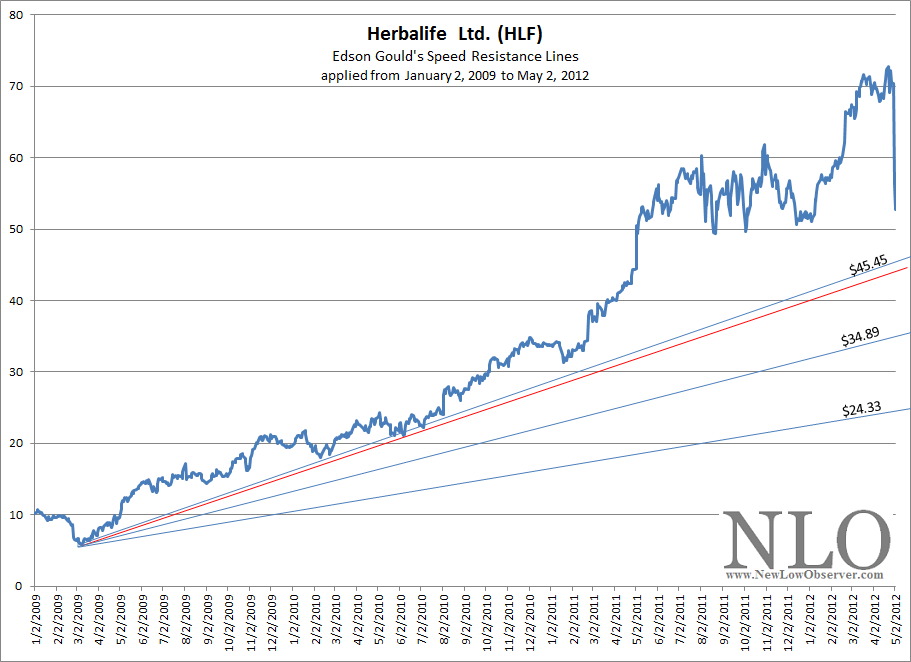
After the news of Herbalife (HLF) getting slammed, we were curious about what the downside targets for the stock might be using Edson Gould’s Speed Resistance Lines.  Below is a chart representing the conservative downside target of $45.45 and the extreme downside target of $24.33.

So far, HLF appears to have support for the stock price at $45.45.  However, if HLF falls below the $45.45 level, it would suggests that HLF will decline to, at minimum, $34.89 before finding stabilization in the stock price.  A decline $24.33 would mean that HLF could revisit the 2009 lows.

image

We believe that it is worth examining whether or not these downside targets are accomplished.  In our view, the downside targets are reasonable estimates of where the stocks could go before initiating new research on whether these companies have viable business models.

Disclaimer: This piece is a continuation of the examination of Edson Gould’s speed resistance lines as explained in prior articles. This is not an endorsement to sell short at the current levels nor buy these stocks once falling below the extreme downside targets.

Green Mountain Establishes New Downside Target

On October 25, 2011, we published a chart of Green Mountain Coffee Roasters (GMCR) that utilized Edson Gould’s Speed Resistance Lines [SRL] to determine what the possible downside targets might be.  At the time, Green Mountain Coffee Roasters was trading at $64.75.  However, our use of the SRL indicated GMCR had a conservative downside target of $59.63 and an extreme downside target of $37.21.

After reach the level of $59.63, GMCR’s stock price rose marginally before falling significantly to the downside resting at the $39.42 level.  Soon afterwards, GMCR rose as high as $70, but did not go above the SRL rising trend established at $59.63.

After reaching the $70 level, GMCR promptly fell to the $37.21 level which established what we believed to be a “support” level (green arrows; definition here).  Support levels, if broken, would result in the stock of GMCR going to the previous downside levels that helped to establish the upside trend at $22.53 and $8.30.

In after-hours trading on May 2, 2012, GMCR plummeted from the closing price of $49.52 to as low as $28.50, a loss of -42%.  We believe that GMCR  has a new support level of $22.53 and upside resistance (definition here) at $42.  If the price of GMCR falls significantly below $22.53 (i.e. $21) then we would expect that the new downside target of GMCR is $8.30.

image

As an investor, if you have a stop-loss order (definition here) at $45, then you’ll only be able to get out of the stock at the next best price.  This means that if GMCR opens at $30 tomorrow, you’re only able to get out of GMCR at $30, not $45-$44 under normal market conditions.  Right off the bat, you’ll lose 33% more than you had planned. 

Typically, when a stock crashes it would usually rebound to a higher level before continuing the declining trend (if it happens to be going lower).  The stop-loss order will trigger automatic selling of GMCR even though we expect that it might rebound from the $28.50 low of today to, at least, $35.50 tomorrow.  If nothing else, selling on the short-lived rebound would reduce the amount of loss while a stop-loss order typically ensures the maximum loss in the shortest period of time.

This explains why we are against the use to stop-loss orders as a means to avoid losses.  The best way to avoid significant lose is to consider the downside targets before buying a stock.  After considering the downside, we recommend putting an amount that you’re comfortable with even if the stock were to decline -50%.