As Ethereum recovers from the low set at $695.08 on February 5, 2018, the expected upside targets are as follows:
- Japan
- Market Indicator
- Price Momentum Indicators
- Richard Russell
- Silver
- Speed Resistance Lines
- U.S. Dividend Watch List
As Ethereum recovers from the low set at $695.08 on February 5, 2018, the expected upside targets are as follows:
Posted in 50% principle, Dow Theory, ethereum
We’re very fascinated by the recent price activity of Duke Energy (DUK) and have decided to outline our thoughts on the downside targets that may exist for the stock. Below we have applied Dow Theory and Gould’s Speed Resistance Lines for what we believe to be conservative estimates that may help investors avoid buying high, allow for buying low, or reduce loses.
Dow Theory says that investors should always refer back to the last time a given stock had performed the worst, on a fundamental basis, as the benchmark for estimating the prospects for going forward.
"The point of importance for those who deal in industrial stocks is whether the capitalization of the companies into which they propose to buy is moderate or excessive, when compared with the aggregate earnings of the various concerns forming the combination in a period of depression. It is probable that consolidated companies will be able to earn as much in the next period of low prices as the companies forming the combine were able to earn in the last one; hence the very foundation of investments in industrials should be knowledge of what these companies earned, say in 1893 to 1896, making, perhaps, reasonable allowances for economies under consolidation. Where the earnings so shown would have provided dividends for industrials now active, the fact must be regarded as a very strong point in favor of those stocks (George W. Bishop Jr., Charles H. Dow: Economist, Dow-Jones & Company,Princeton, 1967, page 11.)"
If price action is a forward reflection of company fundamentals and investor sentiment, then the period from the 2003 low is the best starting point for our review. The decline in DUK from the 2001 peak to the 2003 low was the worst decline in magnitude when the stock fell more than -70%. We’re not suggesting that DUK will fall by that much this time, instead, we’re watching for the intermediate stages that lead up to a possible –70% decline.
Posted in Dow Theory, DUK, Edson Gould, SRL, time target, worst benchmark
Tagged members
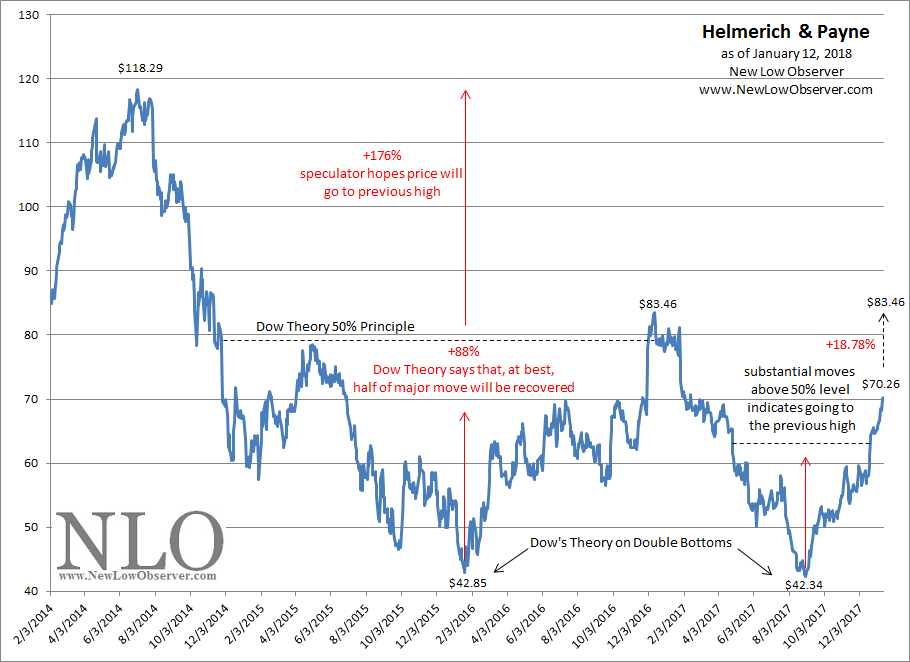
On January 12, 2016, we took a position in Helmerich & Payne (HP) at $47.41. At the time, HP was coming off of a high of $118.29.
According to Dow Theory, an investor should only expect one half of the previous move. With this in mind, we charted an upside target of approximately $79.16 as the likely point for selling the stock as outlined in our July 2, 2016 posting.
On January 13, 2017, we sold our holdings in HP at $78.31 for a gain of +74%. For reasons unknown, HP declined from $78.31 to $43.02 by September 1, 2017, a decline of –45%. An outline of the change from February 3, 2014 to January 12, 2018 is charted below.
The Rationale
Naturally, this is the most ideal transaction that we could engage in. Below we will lay out our observations on how we accomplished this task.
First and foremost, Helmerich & Payne is a high quality oil and gas driller that survived the crash that was experienced after the 1970’s. In our view, if a company can increase their dividend over many years and survive a period that put a lot of competitors out of business, then you’re dealing with a good management team. What follows are the details that we are looking at.
Posted in 50% principle, Dow Theory, Helmerich & Payne, HP, seeking fair profit
Tagged members
Dow Theory attempts to define and identify major moves in markets referenced here as the “primary trend.” In this piece, we will outline the price of gold according to Dow Theory.
We’re going to review and analyze the primary trend that extends from the September 2011 peak to the currently established low in the price of gold in December 2015. We believe that this information is critical to understanding where we are and where we might be going. This interpretation is based on the work of Charles H. Dow, co-founder of the Wall Street Journal and namesake to the longest continuous stock market indexes.
Keep in mind that all of the analysis that follows is done in generalities so that an individual who is curious about Dow Theory can refer to the technical manual on the topic titled The Dow Theory by Robert Rhea. However, the true heart of Dow’s theory is found in his original writing which covered the topic of earnings, dividends, effect of dilution of shares and economic outlook AND NOT lines on a chart. Two books that cover Charles H. Dow’s work as a fundamental analyst and an adept economist are titled Dow Theory: Unplugged and Charles H. Dow: Economist, respectively.
Lines on a Chart
Dow Theory has been synthesized down to a level of lines on a chart, which isn’t all bad. The lines still reflect fundamental economics. The challenge is the accurate interpretation of what is implied by the meaning of those lines.
Below we outline the technical view on Altria (MO) applying Dow Theory, Coppock Curve and the Spare/Tengler models. Dow Theory is a “price as a reflection of value” method which we use to determine downside targets. The Coppock Curve highlights possible buy indications. When we apply the Spare/Tengler methodology, a technical approach to viewing fundamental data, we find some level of coincidence with Dow Theory.
Dow Theory attempts to define and identify major moves in markets referenced here as the “primary trend.” In this piece, we will outline the price of gold according to Dow Theory.
We’re going to review and analyze the primary trend that extends from the September 2011 peak to the currently established low in the price of gold in December 2015. We believe that this information is critical to understanding where we are and where we might be going. This interpretation is based on the work of Charles H. Dow, co-founder of the Wall Street Journal and namesake to the longest continuous stock market indexes.
Keep in mind that all of the analysis that follows is done in generalities so that an individual who is curious about Dow Theory can refer to the technical manual on the topic titled The Dow Theory by Robert Rhea. However, the true heart of Dow’s theory is found in his original writing which covered the topic of earnings, dividends, effect of dilution of shares and economic outlook AND NOT lines on a chart. Two books that cover Charles H. Dow’s work as a fundamental analyst and an adept economist are titled Dow Theory: Unplugged and Charles H. Dow: Economist, respectively.
A Look Back
It is necessary to outline the history of primary trends in the price of gold to ensure clarity of where we are coming from and where we might be now. Below is a graph of the price history of gold with the primary trends.
The dates for the primary trend indication are as follows:
The percentage change for the primary trend indications above are as follows:
Dow Theory Primary Trend Analysis at VI
Posted in 50% principle, Dow Theory, gold
On April 5, 2011, we said the following of the downside targets for Teva Pharmaceutical (TEVA):
“Charles H. Dow indicated that the fair value of a stock is the average price that is paid by investors. The fair value is the point at which an investor, as opposed to speculators, will consider buying or selling a stock. The fair value that we’ve arrived is based on the low of July 2006. If Teva were to decline below $47.06, the prospects for $29.77 become almost inevitable.”
Since that article, as TEVA declined below the $47.06 level, the stock eventually declined to the the ascending $29.77 level by November 2013 as seen in the chart below. After hitting the ascending $29.77 level, the price jumped to just north of $72.
We’ll have to accept that this is all mere coincidence and slight of hand rather than any kind of basis in facts. However, our claim has always been, if the target is achieved then review & decide whether to invest or if it is never achieved then move on to other opportunities.
Let’s review the prospects for TEVA under the current price structure which includes the periods since the November 2013 low to the present. But first, you need to see the July 12, 2013 Speed Resistance Lines that we posted for TEVA as it is instructive and in alignment with the Dow Theory targets.

The long-term downside targets for TEVA based on the SRL indicated that the $32.50 level was the time to consider acquisition of the stock. At that time we said the following:
“We could not determine a conservative downside target. Because of this, we had to run some calculations and came up with the trendline of $43.33 and $32.50 as tentative support levels.”
Since TEVA provided the best indications using Dow Theory and came close using Edson Gould’s Speed Resistance Lines, we’re going to give the Dow Theory perspective in the long and short run and see where it takes us.
The above chart indicates that at the current price Teva Pharmaceutical is considered below fair value ($38.23) as long as the fundamental data confirms what the price suggests. Additionally, TEVA seems poised to achieve the downside target of the ascending $26.86 level (approx. $28.50). Purchases of this stock are best made in stages with 50% of allotted funds at the current price and 25%+25% at predefined lower levels.
Posted in Dow Theory, Edson Gould, TEVA, Teva Pharmaceutical
Intro
There is some need to explain how and why we have chosen to do an assessment of Manuel Blay’s work on Dow Theory published on SeekingAlpha.com. Below is a brief summary of how we went from never commenting about Manuel Blay’s work to “suddenly” bringing to light data that questions his work.
How It All Began
On January 7, 2013, Manuel Blay wrote an article titled “Dow Theory Special Issue: Assessing The Current Primary Bull Market Signal”. In that article, Mr. Blay gave a breakdown of a recent call for a “primary trend bull market signal” according to the dictates of Dow Theory. In summary, Mr. Blay said the following:
“As with any timing device, the Dow Theory ‘detects’ the existence of a new bull or bear market with some lag. No timing system is able in ‘real time’ to spot the emergence of a new trend. However, as I have previously written in this Dow Theory blog, the Dow Theory does a good job at signaling new bull and bear markets in a timely fashion. As I wrote in my post ‘Revisiting the 1987 crash’, which you can find here, ‘the Dow Theory tends to do a remarkable job at getting investors out of investments on a timely manner’. By the same token, the Dow Theory also excels at signaling new bull markets close enough to the bottom.”
In the comment section of the same January 7, 2013 article, we left a response that addressed several issues on the Dow Theory analysis provided by Mr. Blay. We highlighted the following problems:
Mr. Blay’s response was a detailed article titled “Dow Theory Special Issue: An Answer To The New Low Observer (NLO)” dated January 12, 2013. From that point in time, we could not offer an acceptable rebuttal without appropriate data to support our initial claim that such frequent short-term changes in the primary trend require additional study as it is not consistent with Dow Theory and should result in negative performance results.
The Collection of Data and Findings
This brings us to our analysis in a July 13, 2016 article titled “Dow Theory, This is Not” which took data from January 24, 2013 to the present. We felt it was only fair to take all market calls from the date that we questioned the “style” and duration of Dow Theory primary trend calls and examined the actual results based on the work of Manuel Blay.
The following is a reposting of the assessment of Mr. Blay’s work (in chronological order) from January 7, 2013 to the present. The font that is in green or bold is a profitable transaction and the red or unbolded font is an unprofitable transaction, if a transaction were entered into based on the published date of the change in the Dow Theory Primary Trend.
Our Conclusion
Thus far, the data (source citations found at end of July 13, 2016) matched our January 2013 thesis that short duration primary trend calls based on Dow Theory would result in greater than necessary negative performance results. Not only has there been overwhelming negative results from the Dow Theory analysis the frequency of the transactions alone result in unnecessary transaction costs that add to the negative performance.
It could be said that our assessment is selective, whereby we have chosen to ignore calls made prior to January 2013. However, we only used data from the date that we questioned the work. Another criticism is that the exact date of the change in the “primary trend” did not occur at the exact date of the published work or commentary. We stand corrected on the performance numbers if the published start and published end dates are incorrect. It could be said that we have an axe to grind with Mr. Blay. We don’t.
Our Hope
So what is our point? Why bother someone else about their work on a topic that is a theory, at best? Isn’t it possible to be wrong and still enjoy the process? Isn’t is a low blow to tarnish the hard work of another?
The point, as we see it, is to advance the topic of Dow Theory. As we’ve said in the past, Dow Theory is often right about the market it is only the interpretation that is incorrect. We are not excluded from this dilemma as we have been wrong on many occasions in the past. However, when there is a clear learning opportunity, why should we stand on formality when the data is staring us in the face? At least, that is how we see it.
Posted in Dow Theory, Manuel Blay
Dow Theory is only a theory. Therefore, it is necessary to take all indications with a tremendous grain of salt. However, it has been our endeavor to determine the qualitative nature of the work as presented by anyone who writes on the topic. One individual that we’ve found of interest is Manuel Blay on SeekingAlpha.com. Mr. Blay provides commentary on elements of Dow Theory and in this piece we’d like to examine the performance of the market calls associated with the concept of Dow Theory.
How do we arrive at performance data? We take the date that a primary trend bull/bear market is indicated and looked for the date for when the indicated stock, ETF or index next received a change to the primary trend bear/bull market indication. This seems the best way to gauge the concept of performance even though we understand that there are nuances to actual start and end dates. The very end of this article has the internet links and dates associated with the collection of performance data.
Anyone interested in Dow Theory should make it their goal to identify, whenever possible, what the primary trend of the stock market is based on the movements of the Dow Jones Industrial Average and Dow Jones Transportation Average. The goal of identifying the primary trend is to maximize profits while avoiding as much loss as possible. In the case of Mr. Blay, he has applied Dow Theory to ETFs and individual stocks as well as the usual stock market indexes.
For each bullet point below, we only took the date of the call for a “primary bear market” or “primary bull market” and measured the respective stock, ETF, or index for percentage change. If it was a bear market and the percentage change was negative from the primary bear market signal to the subsequent primary bull market signal then, on the whole, we’d consider that Dow Theory met expectations as a tool for profitable investing (green font).
Alternatively, if it was a bear market and the percentage change was positive from the primary bear market signal to the subsequent primary bull market signal then, on the whole, we’d consider that Dow Theory did not meet expectations (red font).
There may be errors in our ability to identify any subsequent bull or bear market article, however, below is our best effort to identify any change to the primary trend based on the work of Manuel Blay (We’d give a margin of error +/-1% to any estimate.):
It could be argued that the date that the primary trend changed was not the same as the publish date of the article. However, as a person interested in Dow Theory, you probably could only act on what is published and not the literal date that the market made a presumed bull or bear market primary trend change.
Among all 25 instances of a bull or bear market primary trend indication, only three (#1, #2 and #17) had performance that was expected of Dow Theory. All of which leads to the obvious question, why would Dow Theory provide such disastrous results when the whole point of Dow Theory is to take advantage of primary trends in the stock market?
Primary Trend Bull Markets
Our view on the lack of performance at the conclusion of a primary trend bull market is best stated by Charles H. Dow himself when he said:
"We have frequently demonstrated that the stock market, while full of short fluctuations [also known as secondary reactions], has a continuing main movement, which often runs in one direction for three or four years at a time. (source: Dow, Charles H. Review and Outlook. Wall Street Journal. September 13, 1900)."
We believe that the primary trend indications provided by Mr. Blay are not long enough to be meaningful and advantageous. The lone exception, in terms of time, HAO from September 13, 2013 to August 21, 2015, still garnered a performance that was counter to the goal of Dow Theory (primary trend bull market but lost –5.24%).
When a signal is given in a period that is less than a year for a primary trend bull market, we would reassess the current and previous interpretation to determine where we went wrong, because clearly, calling a full cycle of a (bull-bear-bull) primary trend WITH negative returns does not augur well for Dow Theory analysis. If the (primary trend bull market) is less than a year then something is wrong.
Primary Trend Bear Markets
Alternatively, it is known that primary trend bear market last ⅓ to ½ as long as the preceding bull market. Therefore, we cannot hold primary trend bear market signals to the same time criteria as primary trend bull markets. A collapse in the market (a la 1987) resulted in a bear market to bull market signal in less than 5 months.
Do you short bear market for additional gains? If the performance data for Mr. Blay is any indication, we wouldn’t recommend short selling primary trend bear markets. Only in the very first case (#1) were we able to see a bear market with declines by the end of the bear market period.
Dow Theory in Three Steps
What does a Dow Theory primary trend bull or bear market look like, in theory?
Again, this is a theoretical look at the way primary trends should transpire. Anyone who plays the “Dow Theory” game will need to accept some missed opportunities like the very top and very bottom of a market move. Notice that each primary trend indication occurs after a peak or trough. This is the point at which a low or peak has been reached, is then retested but not violated, then continues in opposition to the previous primary trend.
What does the above primary trend chart mean? It means that as an investor who attempts to apply Dow Theory, you should see some investment gain no matter which market you’re in. While the amount of the gains will vary, the net result should be positive percentage change in a primary trend bull market and negative percentage change (for short sellers) in a primary trend bear market.
Mr. Blay’s performance of 12% correlation with the primary trend suggests that either Dow Theory doesn’t work, that the analysis was incorrect or that Dow Theory AND the analysis don’t work. We’d argue in defense of Dow Theory being reasonably accurate and the interpretation being incorrect in this instance. An investor cannot be faced with 88% of calls not correlating with the primary trend.
A Line or Trading Range
Missing from the above chart is the period of time that the market wallows in a trading range. The concept of trading range or “line” does get addressed by Charles Dow and is best described by William Peter Hamilton, fourth editor of the Wall Street Journal, as indicated in the following commentary:
“Such a narrow fluctuation, to the experienced student of the averages, may be as significant as a sharp movement in either direction.” Rhea, Robert. The Dow Theory. Barron’s (1932). page 82.
Hamilton suggests that a trading range is equal to or greater than a parabolic move up or market crash. The current market environment has provided us with what we believe is a trading range which began in February 2014.
With a range of 6.70% between the middle of the line and the top/bottom, any breakout above or below the range should result in exceptional change in the index. However, these processes are a function of market sentiment which generally plays out over time. A line can last for quite some time and Dow Theory has been clear in saying that the previous trend is still in effect until the line is broken. (the Dow Jones Industrial Average isn’t the only element necessary to achieve a Dow Theory primary trend change.)
Conclusion
It is very clear that Mr. Blay is dedicated to the work he does in Dow Theory. He writes on the topic almost every other day. However, Dow Theory moves at a glacial pace and requires stepping away from the topic. None of the great Dow Theorists (Russell, Schaefer, Omerod, Fritz, Shumate, Rhea, Hamilton, Nelson, and Charles H. Dow) carried an account of market action with primary trend changes with the frequency that has been displayed by Mr. Blay.
There is no way that a person could be applying Dow Theory and come away with, at least on paper, results that are the exact opposite of each call in the change of the primary trend. As shown in the cycle chart above, there is a theoretical sweet spot where a gain will be made if you go long in a primary trend bull market and go short in a primary trend bear market. Yet, in neither case, except in the three out of 25 instances cited above, was it possible to demonstrate gains.
For anyone interested in Dow Theory, when you see primary trend changes at such a high frequency you have to be very critical of the work. When you see the above performance that is attributed to Dow Theory analysis, then you should know that you’re not witness to Dow Theory at all.
References:
On September 14, 2015, we posted to our site an article about Helmerich & Payne (HP). At the time we had the following investment conclusion:
“We advise that investors consider HP at the ascending $39.43 level or below.”
HP fell to the level indicated in our posting and has since increased +37% from the article date and +50% from the date of when the stock crossed below the ascending $39.43 level. Below is the updated Speed Resistance Lines and our perspective on the potential for the stock going forward.
On September 10, 2015, we posted an article which reviewed the fundamentals of Dover Corp. (DOV). Our conclusion on the stock was as follows:
“Considering that there are only two remaining downside targets, the downside risks are “contained” for the most part. At most, we think that the next downside target is at the ascending $38.51 level. A two stage purchase plan should be entered into at the below the ascending $46.87 and $38.51 levels ($56 and $44, respectively).”
Since September 2015, the following is the updated Dow Theory chart that was referenced in the above quote:
What should stand out is the fact that once DOV declined below the ascending $46.87 downside target, losses have been contained. Subsequently, Dover has risen to the current price of $70.97. Our best guess is that DOV is facing resistance at the ascending $59.40 line (approx. $80).
As best we can tell, the use of Dow Theory could be coincidental to what ultimately happens to the stock. However, depending on the quality of the stock (ideally blue chip stocks), Dow Theory is an appropriate tool for consideration of downside risk.
Posted in DOV, Dover, Dow Theory
In our last Dow Theory assessment dated May 17, 2015, we said the following:
“We’re looking for a bear market indication with a declining of the Industrials, Transports and Russell 2000 below their respective February 2015 lows followed by a decline below the October 2014 lows. In addition, we’re looking for the revised data in the Industrial Production Index to continue in the current declining trend.”
Since May 2015, there has been a lot of action but not a lot of substance. Below is our Dow Theory update explaining why a bear market was not signaled in August of 2015 and what to watch for going forward.
Posted in Dow Theory, Dow Theory Confirmation, Industrial Production Index
Tagged members
According to Yahoo!Finance, “Dover Corporation manufactures and sells a range of equipment and components, specialty systems, and support services in the United States. The company operates in four segments: Energy, Engineered Systems, Fluids, and Refrigeration & Food Equipment. The Energy segment provides solutions and services for the production and processing of oil, natural gas liquids, and gas to drilling and production, bearings and compression, and automation end markets.”
The price of Dover Corp. (DOV) has declined by –32.46% since the early July 2014 peak. Looking at the stock, it appears that the downward spiral is locked in. The following are some thoughts about the stock.
Posted in Altimeter, Charles H. Dow, DOV, Dover, Dow Theory, Edson Gould, Quick Take
On May 20, 2014, we said the following about the Dow Jones Industrial Average Altimeter based on the work of Edson Gould:
“Currently, the Altimeter is closing in on the 2007 peak of 47.37. If the Dow were to attain the 47.37 level in the Altimeter, the index would sit at 17,062.67. There is no rule that says the Dow Industrials must stop at the prior turning point. However, our cautious nature instinctively pushes us to wonders if the run from the 2009 low is about to come to an end.”
Since that time, the Altimeter for the Dow peaked at 47.03 on March 2, 2015, just short of the 2007 level of 47.37, and has declined below the 32.05 support level. From a performance standpoint, the Dow Industrials has fallen -11.95% since March 2, 2015.
Naturally we can’t say that we predicted any of the changes in the market since May 2014. However, our primary goal is to observe indicators that most accurately guides our thinking about possible scenarios for the stock market. In this case, we believe that the best way to assess the possible scenarios is by applying Dow Theory to Gould’s Altimeter, as seen below.
Dow Theory is a fickle beast. While the theory is sound, those that interpret it have their challenges. A recent article dated May 21, 2015 titled “Transportation Average – A Big Concern for Stock Bulls?” by Chris Ciovacco presents some of the difficulties with the topic of Dow Theory. In this article, we’ll attempt to clarify some issues that should be discussed when making interpretations of Dow Theory.
The article by Ciovacco starts off by pointing out the recent divergence between the Dow Jones Transportation Average and the Dow Jones Industrial Average. A divergence exists when one index makes new highs or lows while the other index fails to go in the same direction. According to Dow Theory, if there is a divergence, it could indicate that the previous trend will be reversed. As the prior trend in the stock market from 2009 to 2015 has been bullish, the implication is that the bull market could be coming to an end.
In explaining whether investors should be worried about the “non-confirmation” exhibited by the divergence between the Industrial and Transportation Averages, the article identifies the period from 1989 to 1993 when there appeared to be a divergence between the same indexes. However, at the time of the divergence, according to the author, the S&P 500 managed to gain as much as +25%. What is not shown or discussed are the key indications of a bull or bear market in the period from 1989 to 1993. These elements will complete a picture that is necessary for anyone hoping to understand and possibly benefit from Dow Theory.
Identifying the Bear Market
Below is a charting of the period 1989 to 1993 in smaller segments for a more accurate Dow Theory assessment. First is the indication of a bear market based on Dow Theory which occurred on October 13, 1989.
Our ex post interpretation of when a bear market was signaled by Dow Theory is supported by the Dow Theorist Richard Russell in his Dow Theory Letters publication. In his official investment stance on October 4, 1989, Russell said:
This is contrasted by what Russell said in his October 18, 1989 posting:
Russell made clear that from a Dow Theory perspective, a bear market had been signaled. As a side note, Russell’s PTI or Primary Trend Indicator did not confirm the bearish signal until February 7, 1990 (four months later). The PTI is not a part of Dow Theory but has proven to be a useful market tool.
Identifying the Bull Market
Using our own ex post analysis of the charts of the Dow Jones Industrial Average and the Dow Jones Transportation Average, we find that a new Dow Theory bull market was signaled on January 18, 1991.
Richard Russell was suspicious of the Dow Theory bull market that was signaled on January 18, 1991 and chose to wait for his PTI to give the all clear. Russell said the following on February 6, 1991:
But even the preceding commentary was buried by the following overriding thoughts by Russell:
The question is ultimately asked by Ciovacco, “Would it have made sense to sell all our stocks because the Dow Transports failed to make a new high?” The point being, why get caught up in a “signal” that potentially will result in lost investment gains? After all, the S&P 500 index increased by +25% in the period when it appeared that there was a divergence between the Dow Jones Industrial Average and Dow Jones Transportation Average.
This is where a significant problem comes up in the analysis of Dow Theory. First, if we assume that a divergence did occur in Ciovacco’s selected time frame, rather than a bear market indication, then an adherent of Dow Theory would accept that a divergence is merely a caution signal. This would have meant that whatever the previous trend of the market was, it remains in place until a definitive reversal occurs. In our most recent market action, a bull market was still the indication and thus there would be no need “… to sell all our stocks…”
Another issue not mentioned is that Dow Theory does not give buy or sell signals as we pointed out in our July 25, 2011 article. Among the many things overlooked about Dow Theory is that it is intended to reflect the changes in the stock market, investment values, and the economy. As a barometer, it merely indicates the direction that the stock market and economy might go three to nine months into the future. Those who take bull or bear market indications as buy or sell signals still need to be well versed in understanding values and compounding and their role in investing. If a person, not versed in values and compounding, believes that any indication means that they can haphazardly buy or sell stocks then they are most likely to suffer severe losses and quickly become disenchanted with the accumulation of assets.
Identifying Recessions
In the past, Dow Theory was often heralded as a peek into the future for the economy. In the 1989 example above, the Dow Theory bear market preceded the National Bureau of Economic Research’s (NBER) definition of a recession by nine months. Dow Theory signaled a bear market in October 1989 and the NBER indicated that a recession began July 1990. However, the NBER announced their conclusion about when the recession began on April 25, 1991, a full year and a half after the Dow Theory bear market signal and nine months after their own designation of when the recession began. Additionally, Dow Theory indicated that a new bull market was in place on January 18, 1991 or three months before the NBER announced that the recession ended in March 1991.
Final Thoughts
What some market bears would like to accomplish with Dow Theory is to anticipate scenarios where divergence leads to an actual bear market of significant magnitude like what happened in the period from 1972 to 1974.
![]()
The decline experienced from the respective peaks was –59% and –44% for the Transports and Industrials. Since the outcome of a divergence cannot be accurately anticipated, it is far “safer” to wait for the confirmation of the trend before considering any potential actions. However, if investors had sold their stocks on October 13, 1989 and repurchased stocks on January 18, 1991 (and held until December 31, 1993), the gains would have been +40%, +41% and +76.04% for the S&P 500, Industrials and Transportation Index, respectively.
What some market bulls would like to accomplish without Dow Theory is not selling if the net effect is for the market to ultimately climb well beyond the point of the initial divergence. As an example, if we take the October 13, 1989 date and calculate the returns for the S&P 500, Dow Industrials and Dow Transports until December 31, 1993, we find that the returns were +39%, +46% and +25%, respectively.
Dow Theory only works as a barometer for the stock market when taken in the context of investment values and compounding. As an indicator of coming recessions, as defined by NBER, Dow Theory has an unrivaled track record. The translation of these ideas often get confused as recessions don’t necessarily result in jarring –50% declines in the stock market every time.
Our tactic on the divergence is to dump more funds into the cash portion of the brokerage account so that we can make large purchases if a precipitous decline ensues. If a decline does not materialize, we will continue our slow and selective investment buying program for compounding purposes.
