Below is the revised Altimeter for Starbucks (SBUX).
-
Topics
Archives
-
-
Recent Posts
-
-
-
-

Below is the revised Altimeter for Starbucks (SBUX).
We’ve been watching the fascinating price action of Starbucks (SBUX) since it first appeared on our watch list dated November 10, 2017.
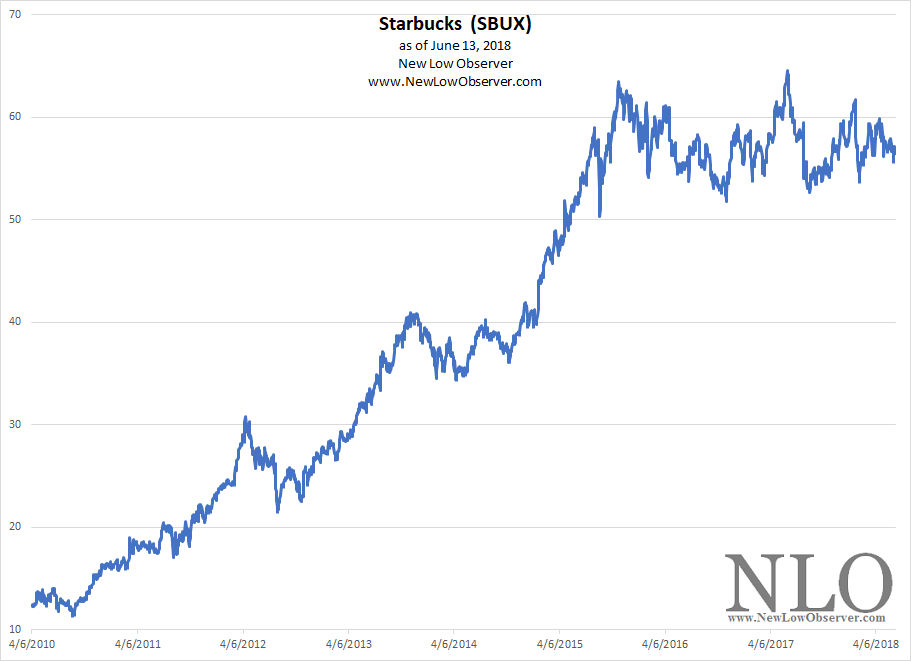
In the period from April 6, 2010 to October 28, 2015, the price of SBUX has increased as much as +418%. This is an exceptional return within a confirmed bull market. Of course, this all falls apart in a bear market and this consideration must be kept in the back your mind when thinking about the future prospects.
Since October 28, 2015, SBUX has traded in a range. However, when looking at SBUX from a different angle, we can see that without a doubt that there are significant changes taking place. Below is the Altimeter for Starbucks (SBUX). We believe that this perspective on the stock clarifies the relative position of SBUX.
On May 18, 2018, Consolidated Edison (ED) fell to a one year low. This is a stock that we had evaluated back in September 2014, when ED was trading at $57.60. At the time, we said the following:
“Based on the Altimeter, ED is considered to be fairly valued at $54.18. This fair value is strikingly similar to the Value Line [Investment Survey] assessment. Also, according to the Altimeter, ED is considered undervalued at or below $44.00. Since 1970, there have been six instances where ED has been undervalued and went to the opposite extreme of being overvalued.
Using the above Altimeter, our observation is that Consolidated Edison has had the tendency to decline from each peak to the corresponding undervalued level without exception. Naturally, this may be the occasion when the exception occurs. Until that time comes, we’re of the view that ED will decline to the lower ascending line by mid- to late 2015. By that time, ED could be undervalued at the $50 level.”
Fast forward to the new 52-week low and we see ED trading at $73.55. This begs the most obvious question, where did we go wrong? After all, we missed out in nearly +78% of total returns in 4 years. Below are the two most glaring errors that we made with many others waiting to be revealed.
Below is the Altimeter for McKesson Corporation as well as the performance data based on the buy indication offered by the Altimeter. The average gain after six buy indications is +46.47%.
Below is a review of the Altimeter for Sanderson Farms.
We saw this article on ValueWalk suggesting that Middlesex Water (MSEX) is overvalued.

After running the numbers found in Value Line Investment Survey from 1998 to the present, we couldn’t find a viable counter claim to the analysis of MSEX. It does appear as though MSEX is overvalued at the current price.
Below we have the Altimeter which reflects the relative value of the stock based on the history of dividend payments. We’ve included potential downside targets for the stock where a review of the company fundamentals should be considered.
On May 3, 2018, it was reported that Cardinal Health (CAH) declined –21% due to:
“…the company's loss of a contract with PharMerica and lower drug prices are responsible for the bearish outlook (TheStreet.com).”
The impact of these issues has resulted in lower 2019 earnings estimates for CAH. Below are some thoughts on our expectations for CAH in the coming year.
Below is the Altimeter for General Electric (GE). The red arrow on the far right indicates the current level of the Altimeter.
Posted in Altimeter, GE, General Electric
The Dow Altimeter, as constructed by Edson Gould, is based on dividend payments made by the constituents of the Dow Jones Industrial Average (DJIA) as reported in the Barron’s section titled “Indexes PEs and Yields.” The Dow Altimeter information provides a graphical representation of fundamental data.
On January 23, 2018, we said the following:
“While the market appears destine for higher ground, it is worth noting that the 24,223 level is the new support level for the DJIA. If the DJIA fails the support level at 24,223 then the next stop is the 18,373 level.”
Below we have updated the Dow Altimeter and included the coincidence of buy indications based on the dividend history of the Dow. We believe this history of dividend payments provides strong evidence of when a bear market has come to an end along with a fair estimate of when a recession should come to an end.
A recession and a bear market is coming. We don’t know when, however, we can prepare ourselves with the necessary insight to better call the bottom (better than our July 2009 call for the stock market, our August 2009 call for the end to the recession and our December 2010 call for the bottom in real estate.
Below is the historical range of the Altimeter for General Electric (GE) from 1962 to the present. The green line represents the mean, which sits at the 143.5 level. If GE were to achieve the historical high of the range then the stock would be priced at $22.44. That would be a +37.84% increase to the all-time high of the longstanding range. Meanwhile, the downside risk, based on the Altimeter, is $11.76 or a decline of –27.76%. A declining stock price with a rising Altimeter is not a good sign.

Posted in Altimeter, Edson Gould, GE
On August 14, 2012, when Mercury General (MCY) was trading at a price of $37.30, we said the following:
According to Morningstar.com, MCY is considered a “buy” at $31 and at fair value at $45. Our own model suggests that MCY is significantly undervalued at $39 and a “buy” at $45. Investment Quality Trends (www.iqtrends.com) indicates that when MCY is at a yield of 4.5% or higher, the stock should be considered for purchase. Currently, MCY has a dividend yield of approximately 6.60%. Keep in mind that we do not buy stocks for their dividend yield. Instead, we use the company’s consistently increasing dividend as the only proof that the company management can:
Since that time, we’ve seen Mercury General increase from $37.30 to as high as $64.52. Along with the increase in price, we’ve been forced to revise our perspective on the stock. Below, we will outline the revisions to our perspective and provide target prices we think MCY should be considered for acquisition.
On October 25, 2017, we said of the Dow Jones Industrial Average Altimeter:
“How in the world do we believe that an already ‘overvalued’ market can possibly go as high as 34,885? We don’t believe it at all, instead, we’re going by the precedent of the extensive history of the stock market in the United States.”
So far, the Dow has exceed the percentage increase of the 1852 low of +284% when it went above 24,844.60 level. Now, the Altimeter is pointing to the next upside target of least resistance en route to the 34,885 level.
On February 5, 2017, we said the following of Berkshire Hathaway (BRK-A) when the stock was trading at $245,646:
“The upside target to fair value is at $287,172.61, be on the lookout for this as the possible upside target for BRK-A in 2017.”
Berkshire Hathaway achieved the upside fair value target on November 30, 2017 and now trades at $297,740. Although the gain has been only +21.20%, there is a high level of predictability in the price action of the stock. Below we outline the overvalued, fair value and undervalued targets of BRK-A for 2018 based on the Altimeter.
It might surprise readers to know that we find fundamental analysis very useful. Leading up to the fundamental analysis is the technical analysis that is necessary to guide our overall perspective of a given stock. In the case of J.M. Smucker (SJM), the stock appeared on our watch list in June 2017 as the price reached a level which led us to pay a little more attention. One fundamental that we like to track is the Altimeter which is best analyzed using a chart.
The Altimeter was first described by Edson Gould in Barron's on February 21, 1968. Gould asserted that the relationship between the price and the dividends paid on that stock, or index, tell investors of under or overvaluation. It is important to make the distinction between Gould’s Altimeter analysis and his Speed Resistance Line [SRL] analysis. Altimeters are based on the dividend payment relative to the stock price while the SRL is based strictly on the price movement.
In the case of J.M. Smucker, the Altimeter appears clear with little need for interpretation.
Below is the Altimeter for Walgreens Boots Alliance (WBA) with fair value (FV) overvalued and undervalued targets.