Monthly Archives: November 2012

Research Request: Exelon (EXC)

A reader has requested that we give our unconventional take on a stock.  Our analysis will not rely on the typical fundamental analysis since such work is a penny a dozen.  However, our work on this topic may overlap with similar fundamental analysis.

The first thing that we notice about Exelon (EXC) is the all too familiar parabolic move in the stock price since 2002.  This always begs the question, “when will entropy set in?”  According to David Maranette, entropy (going from a state of order to disorder) is most present when a stock goes parabolic, the greater the degree of ascent the greater the subsequent collapse (disorder).  Exelon is no exception in this regard, the rise and fall has been spectacular.  The only question now is, how far to the downside.

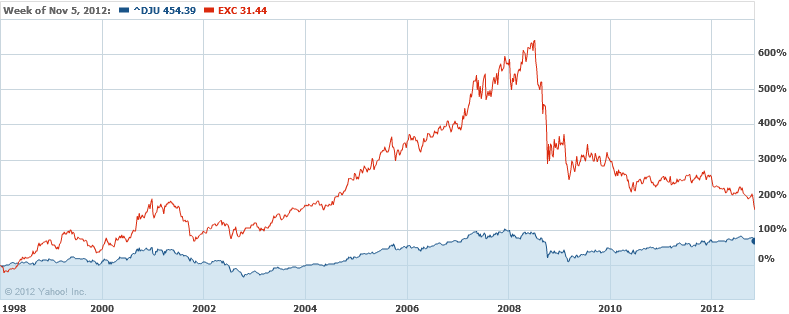
The chart below depicts the relative change that has occurred between the Dow Jones Utility Index (^DJU) and Exelon (EXC).  The run that EXC has had in comparison to the average “high quality” index of utilities seems inordinate.  Especially when we consider that we’re at a historic low point for interest rates.  Any sudden change of interest rates to the upside will decimate all utilities, especially those that have had an excessive run to the upside.  As the market has adjusted the view on the prospects for EXC, the possibility exists that a swing to the opposite extreme is in the making for Exelon.
image

According to Dow Theory, EXC has the following downside targets:

  • $27.84
  • $18.68
  • $9.47

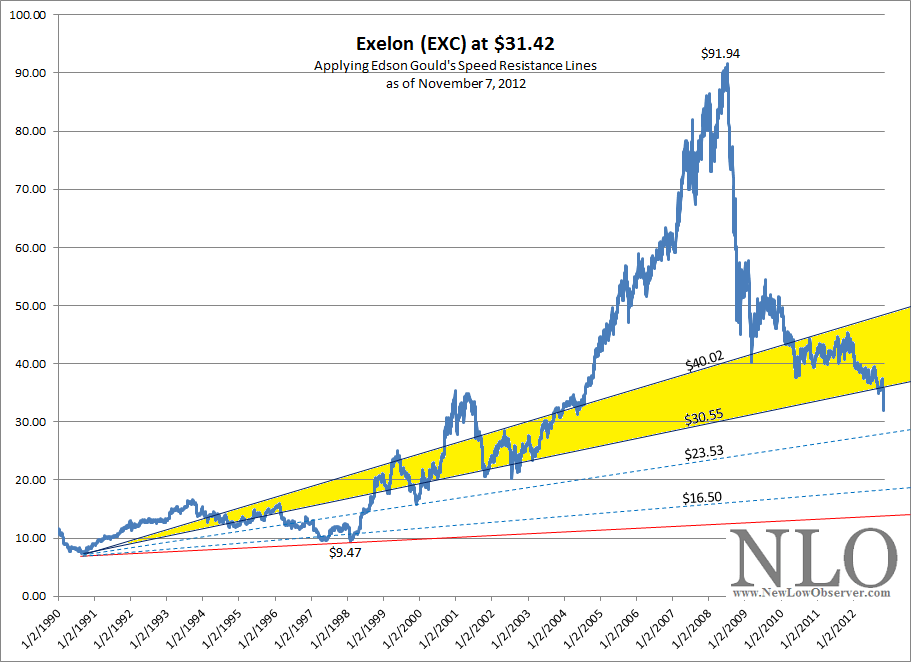
Edson Gould’s Speed Resistance Lines [SRL] project the following downside targets:
image

Already, Exelon has declined below the conservative downside target of $40.02 and is presently on course to hit the $30.55 level.  If EXC does not reverse course at the $30.55 level then the next downside target is $9.47.  We’ve added intermediate reversal points where EXC could change direction if the stock were to decline to the $23.53 and $16.50 levels.

According to Value Line Investment Survey, EXC normally trades around 1x the per share dividend divided by the “interest rate” (1x $2.10/interest rate). Value Line doesn’t tell us by which interest rate we should apply to the company, so we have decided to apply the 30, 20, and 10-year U.S. Treasury rate (found here). The following are the mean prices that EXC would trade at for each interest rate scenario:

  • 30-year rate- $72.66
  • 20-year rate- $84.00
  • 10-year rate- $120.00

Based on the 30-year rate, EXC is selling 56.73% below the historical mean value.  When a stock is trading at such an extreme level of undervaluation, we can only infer that there are more problems beneath the surface in spite  of what is already known. 

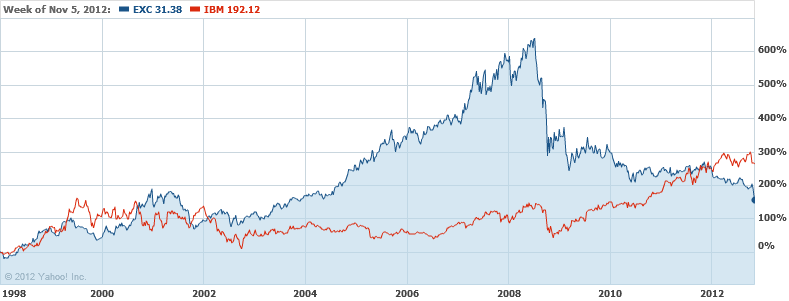
Keep in mind that we’re talking about a utility company with a price peak that, since January 1998, exceeded that of Dow Jones Industrial Average heavyweight IBM.
image

Although the prospects for Exelon could turn around, we’re concerned that there is more downside risk.  We’d patiently watch what the fallout will be.  At the very least, we’d like to see how close EXC comes into alignment with the Dow Jones Utility Average since 1998.
Insurance Watch List: November 6, 2012

The following is one of our personal favorite watch lists. We started tracking the insurance industry in January 2011 and we’re very impressed with the results so far.

Anyone who wishes to be successful in insurance stocks should read the book The Davis Dynasty by John Rothchild. The book starts with Shelby Collum Davis investing approximately $50,000 to $100,000 that ultimately grew to $900 million after 47 years. The strategies employed by Davis seem more accessible to average investors as opposed to Warren Buffett’s leveraged strategies and education from Benjamin Graham.

Symbol Name Price P/E EPS Yield P/B payout ratio % from low
TWGP Tower Group Inc. 17.68 44.4 0.4 4.2 0.66 187.50% 2.43%
PKIN Pekin Life Insurance Company 10.8 59.67 0.18 1.1 1.56 66.67% 4.85%
ASI American Safety Insurance Holdings Ltd. 17.22 33.17 0.52 - 0.52 n/a 4.85%
FRFHF Fairfax Financial Holdings Limited 372.45 - -34.42 - 1.02 n/a 5.13%
NSEC National Security Group Inc. 8.15 - -3.16 1.2 0.65 -3.16% 6.54%
GTS Triple-S Management Corporation 17.72 9.17 1.93 - 0.68 n/a 6.55%
THG The Hanover Insurance Group Inc. 35.61 10.12 3.52 3.4 0.58 34.09% 6.75%
OB OneBeacon Insurance Group, Ltd. 13.01 51.14 0.26 6.5 1.19 323.08% 6.89%
CRVL CorVel Corporation 42.74 20.64 2.06 - 3.99 n/a 8.03%
MHLD Maiden Holdings, Ltd. 8.54 9.02 0.94 3.9 0.74 34.04% 8.30%
ERIE Erie Indemnity Company 66.3 22.84 2.9 3.3 4.53 76.21% 8.35%
MIG Meadowbrook Insurance Group Inc. 5.72 - -0.33 3.4 0.52 -60.61% 8.40%
TDHOY T&D Holdings, Inc. 5.31 21.99 0.24 - 0.86 n/a 8.59%
WSH Willis Group Holdings Public Limited Company 34.87 16.12 2.17 3.2 2.22 49.77% 9.26%
  • Avoid insurance stocks with payout ratios that are in the negative or exceeding 100%
  • Insurance stocks with low average volume have low liquidity and considered high risk

Watch List Summary

Of interest to us on the Insurance Watch List is The Hanover Group (THG).  In the past year, THG has traded as high as $41.52 and as low as $33.42.  Currently,  THG is trading at a price of $35.66, within 7% of the low.

According to Value Line Investment Survey dated September 14, 2012 (www.valueline.com), The Hanover Group is fairly valued at 12x earnings which, if based on normalized 2010 earnings, would be $39.72.  However, Value Line projects 2013 earnings to be $4.40 which translates into a $52 stock price.  Since 1997, THG has managed to trade at, and above, the 12x earnings level whenever the stock has declined significantly below such a level. 

In 2011, Value Line indicates that The Hanover Group had earnings of $0.70.  This is a considerable drop-off from the 2010 and projected 2012 levels.  The last time that THG experienced such a dearth of earnings was in 2002 when the stock price declined from a 2000 high of $74.30 to a 2002 low of $7.  Already, in the trailing twelve months THG has earned $3.52.  This suggest that Value Line’s assessment for 2012 and 2013 is on track so far.

Our worst case scenario for a downside target for The Hanover Group is based on the 2009 low of $28.  Surprisingly, in the period from 2006 to 2009, THG did not decline as much as most insurance stocks in the same period of time.  According to Dow Theory, THG has the following downside targets:

  • $35.00
  • $32.67
  • $30.34
  • $28.00

The next stock that we’re interested in is Burmuda-based Maiden Holdings Inc. (MHLD).  Like The Hanover Group, MHLD has a low payout ratio of 34% which suggests that the company has a manageable dividend that can weather future earnings volatility.

In looking at the background of Maiden Holdings, it reminds us of the relationship that Transatlantic Holdings (TRH) had with AIG (AIG).  To be specific, MHLD received a significant amount of its business from another insurer, in this case AmTrust Financial Services (AFSI).  According to MHLD’s 2011 annual report,

“AmTrust is Maiden’s largest client relationship and we will continue to derive a substantial portion of our business from AmTrust in the near term. We commenced our reinsurance business by providing traditional quota share reinsurance to AmTrust through the Master Agreement with AmTrust’s Bermuda reinsurance subsidiary AII, assuming initially a 40% quota share portion of the net liabilities less recoveries of the policies written by AmTrust.”

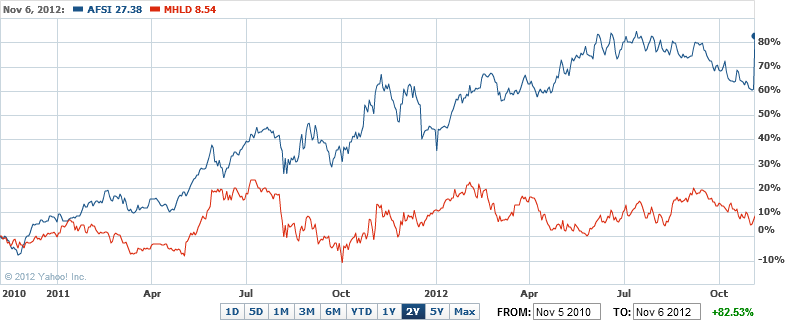
In the last two years, AmTrust Financial Services has been sitting pretty as it has reached a new 52-week high by closing up +14.18% today alone (11/6/2012) while Maiden Holdings has severely underperformed.

image

  However, a side-by-side comparison between the two stocks suggests that MHLD is clearly undervalued, overall.

Valuation Measures AFSI MHLD
Market Cap (intraday): 1.84B 617.83M
Enterprise Value (Nov 7, 2012): 1.92B 883.30M
Trailing P/E (ttm, intraday): 12.15 9.1
Forward P/E (fye Dec 31, 2013): 9.94 7.13
PEG Ratio (5 yr expected): 0.75 1.6
Price/Sales (ttm): 1.03 0.34
Price/Book (mrq): 1.61 0.74
Enterprise Value/Revenue (ttm): 1.23 0.49
Enterprise Value/EBITDA (ttm): 9.05 7.9
     
Financial Highlights AFSI MHLD
Fiscal Year    
Fiscal Year Ends: 31-Dec 30-Dec
Most Recent Quarter (mrq): 30-Jun-12 30-Jun-12
     
Profitability AFSI MHLD
Profit Margin (ttm): 9.87% 3.80%
Operating Margin (ttm): 11.29% 5.84%
     
Management Effectiveness AFSI MHLD
Return on Assets (ttm): 1.94% 1.87%
Return on Equity (ttm): 16.52% 8.65%
     
Income Statement AFSI MHLD
Revenue (ttm): 1.57B 1.80B
Revenue Per Share (ttm): 23.69 24.92
Qtrly Revenue Growth (yoy): 25.50% 16.90%
Gross Profit (ttm): 281.02M 158.57M
EBITDA (ttm): 212.43M 111.81M
Net Income Avl to Common (ttm): 154.29M 68.47M
Diluted EPS (ttm): 2.27 0.94
Qtrly Earnings Growth (yoy): -19.50% N/A
     
Balance Sheet AFSI MHLD
Total Cash (mrq): 390.89M 58.93M
Total Cash Per Share (mrq): 5.85 0.82
Total Debt (mrq): 702.41M 333.79M
Total Debt/Equity (mrq): 65.49 40.47
Current Ratio (mrq): 1.4 0.74
Book Value Per Share (mrq): 14.97 11.41
     
Cash Flow Statement AFSI MHLD
Operating Cash Flow (ttm): 352.27M 304.06M
Levered Free Cash Flow (ttm): 328.54M 64.04M
source: Yahoo!Finance, Captial IQ    

The only problem with the numbers for MHLD is that when and if AMSI falters, as it should, we expect that MHLD will experience a decline in sales and earnings as well.  With this in mind, we’ve run the following downside targets for MHLD, based on Dow Theory:

  • $7.42
  • $5.08
  • $2.75

We’d consider buying MHLD at $7.42 and below.

Investment Strategy: Let Profits Run?

Subscriber M.C. asks:

“I have a couple questions - I know you often let your profit "run" after selling your principal investment in a stock. We're almost certainly investing in different sums, so this is likely a difficult question to answer, but is it worth me hanging to shares if my profit portion is small (maybe only a few K) and only allows me to hang to a handful of shares? Do you always retain your profit portion regardless of %?”

Our Response:

We’re incredibly risk-averse even though we put so much into a single stock and incur transaction fees to buy and sell after a stock has attained a 10% gain (ideally within a year).

The good news is, the amount of the money being invested has little to do with our strategy.  Our approach is calibrated to work with large and small pools of funds since it is based on the percentage of the portfolio and not the dollar amount.  As long as the amount that you’re initially investing is a sizable portion of your overall portfolio (5% and above) for each stock that you buy, then you’re in a good position to see the value of our approach.

Regarding holding on to the profit portion of a couple thousand dollars, more specifically, equaling ½% to 1% of the portfolio, we always recommend taking advantage of the low prices that a stock is acquired. As time has passed we have realized that the best way to do this is to keep the profit portion which allows for compounding by reinvesting the dividend and any capital appreciation that usually occurs after the principal portion is sold.  The added benefit of this strategy is the ability to methodically build a diversified portfolio over time.

There are a couple of nice attributes to this approach that is worth re-iterating.  First, we always participate in any addition increase in the price.  Second, we get to compound our way to long-term wealth.  Finally, the stock that we’ve sold the principal portion on would have to fall to zero in order for us to experience a loss.  This allows us to comfortably wait out the long-term rather than wring our hands about short-term gyrations and possible risk of loss to principal.

The question of whether “…we always retain the profit portion regardless of %…” is not always the case.  The short answer is no, we don’t always retain the profit portion.  With stocks from our dividend list we tend to retain the profit portion while stocks from our Nasdaq 100  list and speculations in gold and silver are usually sold entirely.

Here is a breakdown of the most recent non-speculative transactions that we’ve entered into and actions that we’ve taken once sold (links to articles within stock symbols, if available):

symbol price bought price sold gain/loss % retained current price % change since sold
CRR 64.94 74.18 14.23% 8.16% 77.99 5.14%
WAG 32.94 36.14 9.71% 9.00% 33.95 -6.06%
XEC 54.97 64.15 16.70% 16.00% 63.8 -0.55%
RGA 59.39 62.87 5.86% 6.66% 53.67 -14.63%
RGA 48.42 59.63 23.15% 20.00% 53.67 -9.99%
SYY 27.96 32.14 14.95% 10.00% 30.87 -3.95%
SYY 26.61 29.33 10.22% 9.43% 30.87 5.25%
BOH 38.24 47.15 23.30% 18.91% 44.76 -5.07%
AMAT 11.11 13.8 24.21% 19.21% 11.44 -17.10%
TR 24.05 22.97 -4.49% 3.00% 27.04 17.72%
UNM 18.68 20.63 10.44% 9.33% 21.03 1.94%

Of the stocks listed in our NLO Portfolio, 29.24% is due to acquisitions of INTC, EXPD and MKL that have not yet gained 10% or more.  The Alleghany (Y) position, at 9.52% of the portfolio, is the result of our initial position in Transatlantic Holdings (TRH) being acquired as outlined in our posting dated March 9, 2012.  The remaining shares that we have in the companies listed, comprising 11% of the portfolio, are all strictly the profit portion of our prior investments.  As we’ve said earlier, these stock continue to compound at no additional cost, enjoy the benefit of any additional capital appreciation and would literally have to go to zero before any loss is incurred.

Whenever possible, we hope to eliminate the element of risk when investing in the stock market.  So far, 11% of our portfolio is on that path.  We hope this basic outline demonstrates what we’re trying to accomplish from both a short and long-term perspective.  Thanks for the great question.

Nasdaq 100 Watch List: November 2, 2012

Below are the Nasdaq 100 companies that are within 10% of their respective 52-week lows. Stocks that appear on our watch lists are not recommendations to buy. Instead, they are the starting point for doing your research and determining the best company to buy. Ideally, a stock that is purchased from this list is done after a considerable decline in the price and rigorous due diligence.

Symbol Name Price P/E EPS Yield P/B % from low
WCRX Warner Chilcott plc 11.47 10.07 1.14 0 13.28 0.35%
DELL Dell Inc. 9.15 5.45 1.68 3.5 1.66 0.44%
BBBY Bed Bath & Beyond Inc. 57.1 13.27 4.3 - 3.31 0.67%
FFIV F5 Networks, Inc. 82.59 23.94 3.45 - 5.1 1.87%
ALTR Altera Corp. 30.51 17.05 1.79 1.3 3.1 3.11%
APOL Apollo Group Inc. 19.78 5.69 3.48 - 2.43 3.13%
NTAP NetApp, Inc. 27.74 19.58 1.42 - 2.33 3.39%
INTC Intel Corporation 22.06 9.62 2.29 4.1 2.26 3.96%
ATVI Activision Blizzard, Inc. 11.16 15.9 0.7 1.6 1.18 4.00%
VOD Vodafone Group Public Limited Company 26.91 12.29 2.19 7.4 1.1 4.99%
FLEX Flextronics International Ltd. 5.74 7.81 0.74 - 1.61 5.32%
BIDU Baidu, Inc. 105.09 23.78 4.42 - 10.09 5.40%
MCHP Microchip Technology Inc. 32.14 20.75 1.55 4.4 3.12 6.32%
NVDA NVIDIA Corporation 12.49 16.46 0.76 - 1.75 7.39%
EXPD Expeditors International of Washington Inc. 36.91 21.97 1.68 1.5 3.83 7.92%
AMAT Applied Materials Inc. 10.81 12.98 0.83 3.3 1.62 8.43%
SPLS Staples, Inc. 11.47 8.64 1.33 3.8 1.18 8.51%
GRMN Garmin Ltd. 37.5 12.67 2.96 4.8 2.19 8.98%
MRVL Marvell Technology Group Ltd. 7.98 10.22 0.78 3 0.94 9.02%
DLTR Dollar Tree, Inc. 39.59 17.63 2.24 - 6.11 9.85%
MNST Monster Beverage Corporation 44.03 24.6 1.79 - 6.68 9.91%

Watch List Summary

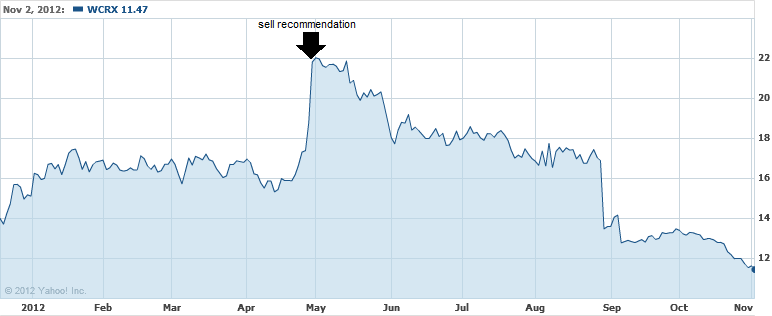
The top stock on our list is Warner Chilcott (WCRX).  On April 30, 2012, we recommended that investors sell WCRX after a +50% increase in the stock price from our December 16, 2011 watch list.  Since our recommendation to sell WCRX, the stock has declined -47.41%.

image

We believe that WCRX will declined to the $10 level before it is worth reconsidering the value attributes of this company.

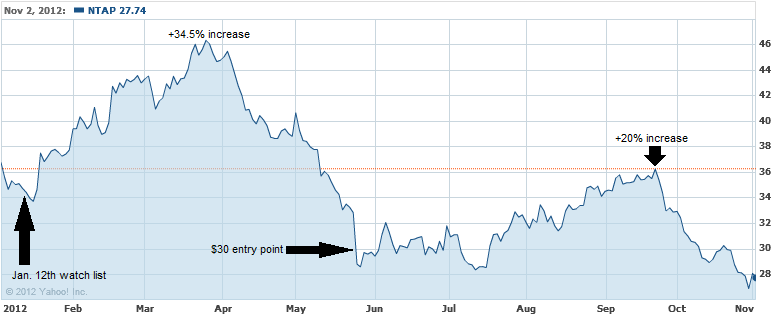
On January 12, 2012, we assessed the points at which an investor could take advantage of the decline of NetApp (NTAP).  At the time, NTAP was trading at $36.85 and we suggested that the stock would be a good buy at $30 and $23.47.  Afterwards, NTAP increased +34.5% to the March high and the fell below the Jan. 12th price.  After falling slightly below the $30 level, NTAP rose +20% to the September high.  Anyone who has not participated in the $30 purchase price can do so at the current price and potentially at the $23.47 level.

image

Nasdaq 100 and Apple Inc.

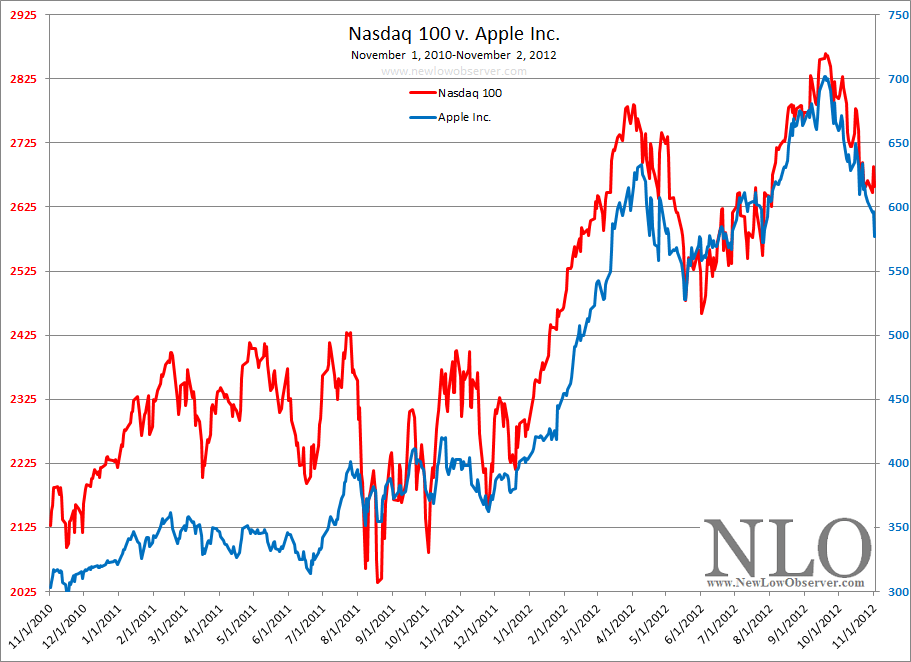
The most important aspect of the movement of the Nasdaq 100 (NDX) is the impact that Apple Inc. (AAPL) has on the index.  Below you can see a comparison between the index and the stock.

image

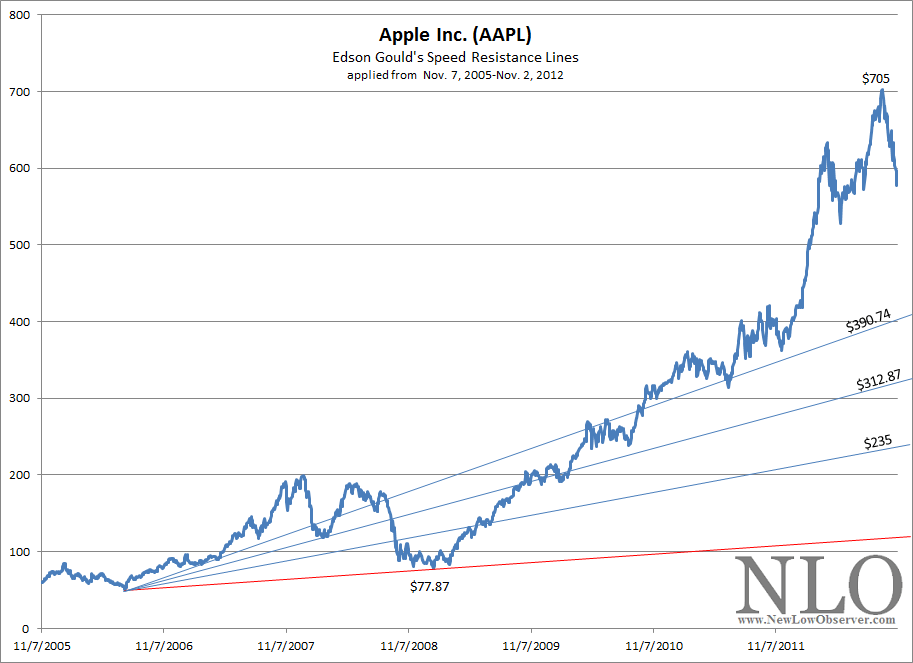
The high level of correlation that exists between the Nasdaq 100 and Apple, since mid-2011, suggests that the tail is wagging the dog and should result in the index declining further if any negative news comes from Apple.  Strictly from a technical standpoint, it would not be unusual for AAPL to retest the May 2012 lows before recovering in price.  In addition, we believe that Apple Inc. could retest the conservative downside target of $312.87 based on the revised Speed Resistance Line below:

image

In order to understand where the Nasdaq 100 might go, consideration of Apple Inc. (AAPL) is required.

Watch List Performance Review

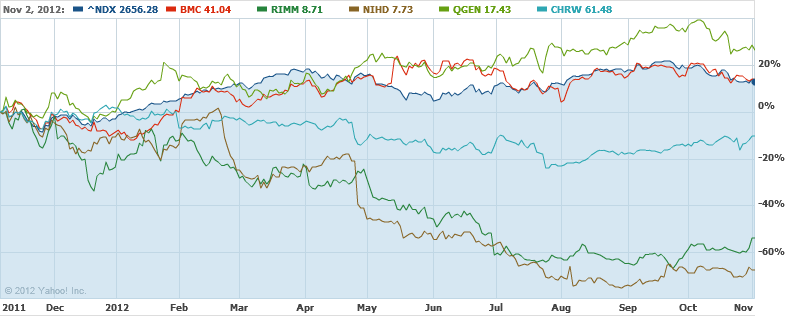
In our ongoing review of the Nasdaq 100 Watch List, we have taken the stocks from our list of November 4, 2011 (found here) and have checked their performance one year later. The top five companies on that list are provided in the chart below from November 4, 2011 to November 2, 2012.

image

Transaction Alert: Sold CRR at the Market

Today we sold the principal portion in shares of Carbo Ceramics (CRR).

  • On August 6, 2012, we posted a transaction alert indicating that we bought Carbo Ceramics (CRR) at the market (found here). The gain has been +17%. The annualized rate of return is nearly 92%.

We continue to hold shares of the company (profit portion) allowing us to slowly build a well diversified portfolio and continue to see capital appreciation and compounding of the income.