Monthly Archives: June 2012

Gold Stock Indicator Update

Our Gold Stock Indicator, as seen below, is going on an interesting ride.

image

On May 27, 2012 (found here), we did an appraisal of the gold situation and said the following:

“…in all instances of an initial ‘short-term buy indication’ [green arrow] (except August 8, 2011), the Gold Stock Indicator was followed by a second opportunity to buy [red arrow] NUGT, sometimes at lower levels.”

In the chart above, we show a red arrow between May 3rd and June 28th.  It is important to take note of the fact that even though the Gold Stock Indicator is currently at the exact same level as on May 3rd, the price of NUGT is more than $1.00 below the May price.

So far, it appears that NUGT is on course to provide us with the second opportunity to take a position, as we have anticipated.  In prior moves from the short-term buy indication to the short-term sell indication, the Gold Stock Indicator has “double dipped.”  By double-dip we mean that the price of NUGT has declined the short-term buy indication a second time before making an assault on the long-term sell indication.

Our only question at this time is how far must NUGT fall before it reaches the short-term buy level.  If the most recent comparison between May 3rd and June 28th is any indication, then it is possible that NUGT could decline as low as $6.

U.S. Dividend Watch List: June 21, 2012

Below are the 34 companies on our U.S. Dividend Watch List that are within 11% of their respective 52-week lows. Stocks that appear on our watch lists are not recommendations to buy. Instead, they are the starting point for doing your research and determining the best company to buy. Ideally, a stock that is purchased from this list is done after a considerable decline in the price and rigorous due diligence.

Symbol Name Price % Yr Low P/E EPS (ttm) Dividend Yield Payout Ratio
UNM Unum Group 19.17 1.05% 25.22 0.76 0.42 2.19% 55%
WAG Walgreen Co. 29.15 2.17% 10.02 2.91 1.10 3.77% 38%
CHRW C.H. Robinson Worldwide  57.83 3.49% 21.58 2.68 1.32 2.28% 49%
PG Procter & Gamble Co.  59.75 3.80% 18.33 3.26 2.25 3.77% 69%
COP ConocoPhillips 52.76 4.23% 5.76 9.16 2.64 5.00% 29%
EXPD Expeditors Int'l 38.67 4.63% 22.35 1.73 0.56 1.45% 32%
BMO Bank of Montreal 53.37 4.75% 9.46 5.64 2.75 5.15% 49%
CRR Carbo Ceramics, Inc. 75.7 5.79% 13.45 5.63 0.96 1.27% 17%
BDX Becton, Dickinson 73.73 5.95% 13.43 5.49 1.80 2.44% 33%
TR Tootsie Roll Industries 22.93 6.01% 30.57 0.75 0.32 1.40% 43%
CWT California Water Service 17.7 6.31% 20.58 0.86 0.63 3.56% 73%
NFG National Fuel Gas Co. 44.29 6.54% 17.44 2.54 1.46 3.30% 57%
NJR N.J. Resources 42.5 7.32% 14.21 2.99 1.52 3.58% 51%
TDS TDS 20.61 7.34% 10.79 1.91 0.49 2.38% 26%
MCD McDonald's Corp.  87.64 7.52% 16.38 5.35 2.80 3.19% 52%
APD Air Products & Chemicals 77.86 7.75% 14.00 5.56 2.56 3.29% 46%
THFF First Financial Corp. 28.12 7.95% 10.34 2.72 0.94 3.34% 35%
MUR Murphy Oil Corp. 43.65 8.02% 9.49 4.6 1.10 2.52% 24%
ANAT American Nat'l Insurance 71.1 8.20% 10.00 7.11 3.08 4.33% 43%
MATW Matthews Int'l  30.94 8.30% 12.95 2.39 0.36 1.16% 15%
TMP Tompkins Financial Corp. 36.44 9.20% 11.75 3.1 1.44 3.95% 46%
SRCE 1st Source Corp.  21.21 9.56% 10.61 2 0.64 3.02% 32%
AROW Arrow Financial Corp.  23.57 9.63% 12.60 1.87 1.00 4.24% 53%
MSEX Middlesex Water 18.21 10.30% 23.05 0.79 0.74 4.06% 94%
CTWS Connecticut Water  27.33 10.38% 21.86 1.25 0.95 3.48% 76%
PPL PP&L Corporation 27.63 10.52% 9.76 2.83 1.44 5.21% 51%
WEYS Weyco Group, Inc.  23.02 10.57% 16.21 1.42 0.68 2.95% 48%
SJW SJW Corp. 23.09 10.64% 20.25 1.14 0.71 3.07% 62%
CAH Cardinal Health, Inc.  41.54 10.68% 14.08 2.95 0.95 2.29% 32%
MGRC McGrath RentCorp.  23.92 10.69% 11.96 2 0.94 3.93% 47%
EGN Energen Corp. 41.2 10.69% 13.38 3.08 0.56 1.36% 18%
LM Legg Mason, Inc.  24.77 10.78% 16.08 1.54 0.44 1.78% 29%
ERIE Erie Indemnity  69.37 10.78% 23.44 2.96 2.21 3.19% 75%
HNZ HJ Heinz Co. 53.41 10.88% 18.74 2.85 2.06 3.86% 72%
34 Companies

Topping our list is Unum Group (UNM) which provides disability, life, and financial protection benefits.  The stock is trading at a 33% discount to its book value.  Our Altimeter study of UNM shows that the stock, while not at its low, UNM is approaching an ideal buy point.  The model shows that $15.54 or below is the best purchase price.

Walgreen (WAG) reported earning along with news that it will be acquiring 45% stake in the U.K.’s largest drugstore-chain, Alliance Boots.  While the weakness in the Euro zone had all the analysts in panic mode, we believe this an amazing deal for Walgreen.  Boots broad exposure in different countries will help diversify the revenue stream for Walgreen.  The company raised its 2013 earnings outlook as a result of the integration.  For all the critic of Walgreen buying a European company at the time that there is upheaval, this is precisely the moment blood is running in the streets. Remember that in January 2012, the greatest investor, Warren Buffett, raised his stake in another UK retail firm, Tesco.  The biggest news for Walgreen, however, is the announcement of a dividend hike.  The company now will pay out $1.10 per share annually, which is a 22% increase from $0.90.  Take the current stock price of $29 and you get a 3.8% yield with wide margin for safety.  We believe Walgreen is a steal at any price below $30.

The C.H. Robinson (CHRW) Altimeter suggests that the stock valuation is close to a bottom.  The five-year dividend yield averages 1.5% but the current yield of 2.2% points to undervalution.  Looking at all other factors, the company is trading at a deep discount (source Morningstar).  Our only concern is the current Dow Theory bear market sentiment which could push the transportation stocks down even further.  If the 2.2% yield provides good compensation, one might want to start dipping their toe into this stock.

Procter & Gamble (PG) also reported earnings that failed to meet analysts’ expectations partly because of the slowdown in Europe.  Currency risk also plays a part in the decline of earnings.  With cosumers trading down to generic brand, it would hurt Procter & Gamble.  However, this may create a great entry point for anyone looking to get into this blue-chip name at bargain price.  IQTrend estimated that Procter is undervalued at 2.5%yield.  The current yield of 3.7%, then, is a good starting point to consider.

Top Five Performance Review

In our ongoing review of the NLO Dividend Watch List, we have taken the top five stocks on our list from June 24, 2011 and have check their performance one year later. The top five companies on that list can be seen in the table below.

Symbol Name 2011 Price 2012 Price % change
NTRS Northern Trust Corp.  44.98 43.29 -3.76%
SYBT S.Y. BanCorp., Inc.  22.5 22.48 -0.09%
TGT Target Corp. 46.33 57.4 23.89%
WEYS Weyco Group, Inc.  22.37 23.02 2.91%
GBCI Glacier BanCorp., Inc.  12.97 14.54 12.10%
Average 7.01%
DJI Dow Jones Industrial 11,934.58 12,573.57 5.35%
SPX S&P 500 1,268.45 1,325.51 4.50%

NLO_2012.6.22

Our top five outperformed the market 2-3%.  Two of the five company fail to reach the 10% mark within a year.

Nasdaq 100 Watch List: June 20, 2012

Below are the Nasdaq 100 companies that are within 10% of their respective 52-week lows. Stocks that appear on our watch lists are not recommendations to buy. Instead, they are the starting point for doing your research and determining the best company to buy. Ideally, a stock that is purchased from this list is done after a considerable decline in the price and rigorous due diligence.

Symbol Name Price P/E EPS Yield Price/Book % from Low
EA Electronic Arts Inc. $12.66 55.04 0.23 0 1.65 3.77%
DELL Dell Inc. $12.30 7.02 1.75 0 2.29 5.31%
CHKP Check Point Software $50.55 19.08 2.65 0 3.14 5.78%
SYMC Symantec Corporation $15.03 9.57 1.57 0 2.12 5.85%
CHRW CH Robinson Worldwide $59.31 22.12 2.68 2.2 7.8 6.14%
INFY Infosys Ltd. $43.95 14.65 3 1.8 3.84 6.16%
MRVL Marvell Technology Group $12.01 12.86 0.93 2 1.38 6.95%
CTRP Ctrip.com International Ltd. $17.54 16.78 1.04 0 2.19 7.94%
RIMM Research In Motion Limited $10.33 4.65 2.22 0 0.55 7.94%
TEVA Teva Pharmaceutical Industries $37.78 11.74 3.22 2.1 1.44 7.94%
EXPD Expeditors Int'l of Washington $39.90 23.06 1.73 1.4 4.08 7.95%
SPLS Staples, Inc. $13.03 9.35 1.39 3.5 1.25 9.13%
WYNN Wynn Resorts Ltd. $104.89 22.24 4.72 2 47.38 9.47%
APOL Apollo Group Inc. $33.96 7.39 4.6 0 3.79 9.80%

Watch List Summary

In our last summary dated June 8, 2012 (found here), we referred to the struggle that we were having in not purchasing NVIDIA (NVDA).  Since that posting, NVDA is up +9.24% (all within the last 3 days) on news that their chips will power Microsoft’s new tablet PC.  We’re not sure that the latest news is going to catapult NVDA as high as the last 120% run after being on our list, however, we believe the chip stocks on the Nasdaq 100 should be closely followed and accumulated over time.

Marvell Technology (MRVL) is another chip manufacturer that is on our radar.  According to Yahoo!Finance, Marvell, “…designs, develops, and markets analog, mixed-signal, digital signal processing, and embedded and standalone ARM-based microprocessor integrated circuits. It offers mobile and wireless products comprising communications processors; modem processors; Wi-Fi and other communication protocols, including Bluetooth and/or FM; mobile computing products; and connected home computing products.”

Dow Theory suggests that the following are the downside targets for Marvell:

  • $10.61
  • $7.54
  • $4.47

So far, Marvell has fallen within 6% of the $10.61 target, however, it has not breached that point thus far.  We’d be buyers of the stock at $8.25 with little regard for downside risk at that point in time.

In a follow-up to a previous piece on Wynn Resorts (WYNN), dated January 20, 2012 (found here), we indicated that Wynn, at $115.47, was likely to decline to $74. 76.  So far, WYNN has managed to decline to the $105 level.  Although the path hasn’t been straight down we are confident that this stock will come through on our downside projections.

Watch List Performance Review

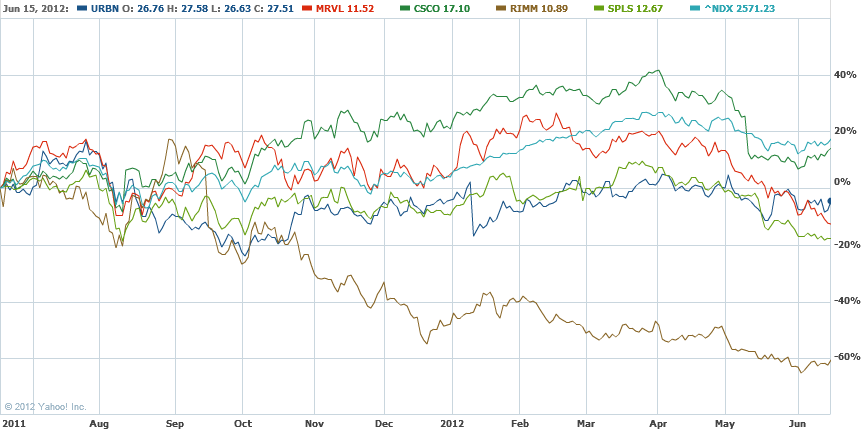
In our ongoing review of the Nasdaq 100 Watch List, we have taken the top 5 stocks from our June 17, 2011 Nasdaq 100 Watch List (found here). The top 5 companies from the watch list are provided below with the closing price from June 17, 2011 to June 17, 2012.

Symbol
Name 2011 2012 % change
URBN Urban Outfitters, Inc. 28.27 27.51 -2.69%
MRVL Marvell Technology 13.79 11.46 -16.90%
CSCO Cisco Systems, Inc. 15.05 17.1 13.62%
RIMM Research In Motion 35.33 10.89 -69.18%
SPLS Staples, Inc. 15.05 12.67 -15.81%
Average -18.19%

image

The top five from our watch list from last last year got blown away by the Nasdaq 100 Index, in the end.  The index went up while the stocks, as a group, went down.  The Nasdaq 100 index outperformed the top 5 by 36.78%.  Amazingly, the top five achieved our minimum goal of +10% gains within the first three months.

Unum Group (UNM) is Closing in on New Low

The latest insurance stock that has caught our eye is Unum Group (UNM) which is closing in on a 3-year low.  Prior to 1998, Unum Group had a dividend increasing history of 11 years at a compounded annual growth rate of 17.66% according to Moody’s Handbook of Dividend Achievers.  After 1998, Unum was challenged significantly resulting in a deep reduction of the dividend.  Most important to investors is the fact that after the -50% reduction of the dividend in 2003, the annual dividend remained at $0.30 for six years until 2009.  Since 2009, UNM has increased the dividend each year thereafter.  The handling of the dividend policy is important for several reasons:

  1. Cutting the dividend in 2003 was an accurate move by management since the book value declined -31% from the 2002 high to the 2008 low.
  2. As a financial services company, keeping the dividend the same through the financial crisis of 2007 to 2009 meant that the management team believed that stability had returned to the company.
  3. Raising the dividend after the financial crisis means that the management team believed the prospects for the company were improving.  After 2008, the book value for UNM has increased +51% which supports management’s decision.

We welcome a dividend cut when appropriately applied, even if the conditions that brought on the cut were based on management’s prior “bad” decisions.  In our view, the true test of any management team is not always generating blowout earnings but handling errors in an appropriate fashion.  UNM’s management has done all the right things at all the right times relative to the economic backdrop that we’ve experienced.

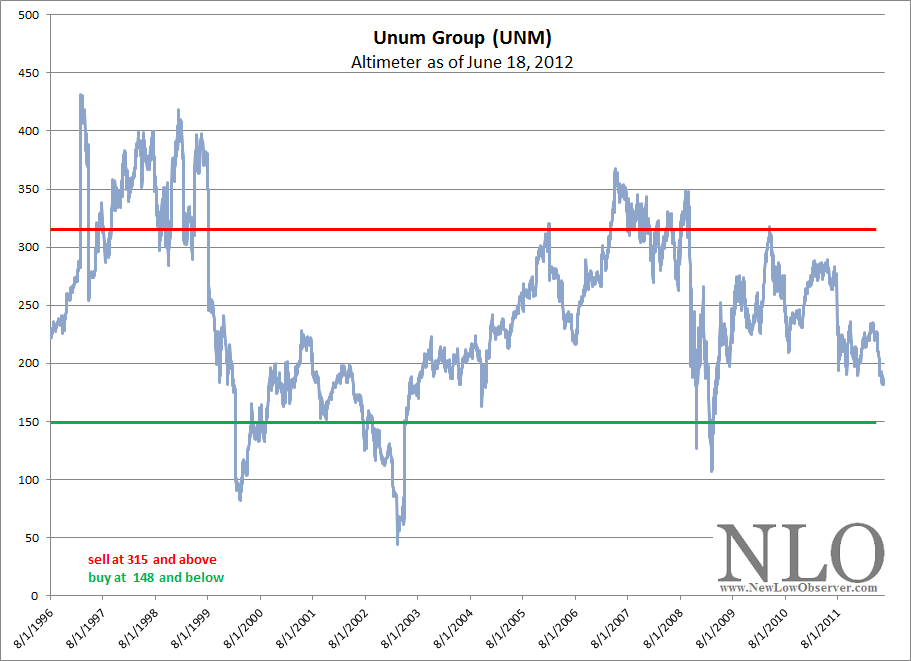
However, while we favor the actions of the management at Unum Group, we also need a sense of perspective on the most opportune time to actually buy the stock.  Two things that never change regarding the historical information on a stock is the dividend paid and the stock price.  This is why we prefer to look at Edson Gould’s Altimeter which reflects the stock price relative to the dividend that is paid.

image

From our perspective, the movements of Gould’s Altimeter indicate that the stock should be bought at or below 148 and sold above 315.  Each time UNM has traded below or above the respective range, the following increase or decline followed:

Date Altimeter stock price buy/sell % change
2/25/1997 431.69 39.5 sell -59.97%
2/10/2000 106.82 15.81 buy 52.12%
1/27/2006 320.67 24.05 sell -60.58%
11/20/2008 126.40 9.48 buy 178.59%
4/14/2010 318.19 26.41 sell ????????
????????? 148.00 15.54 buy  

While we can’t be certain that UNM will replicate prior declines, a decline to the projected level of $15.54 seems well within reach as the stock currently trades at $19.26.  This would only be a decline of -41%, which is far less than previous Altimeter lows of –59% and –60% in 1997 and 2006, respectively.

According to Dow Theory, UNM would reach the 50% level at a price of $17.33.  Typically, the 50% level is the “make or break” level in the stock’s price.  If the stock can manage to stay above $17.33, then a majority of the shareholders since the 2009 low would be satisfied enough not to abandon the stock.  However, if the stock falls materially below the $17.33 level (say $17 or $16.50) then it would mean that most “long-term” holders of the stock are experiencing a loss and are seriously contemplating selling the stock.  The Dow Theory downside targets are as follows:

  • $14.08
  • $10.84
  • $7.60

Although UNM could be bought at $15.54 based on Gould’s Altimeter, it should be understood that there are likely to be further declines.  Therefore, an investor should not become disenfranchised with Dow Theory downside targets.  Instead, investors need to allocate appropriate amounts of capital and break up the intended purchase into 2 or 3 transactions.

U.S. Dividend Watch List: June 15, 2012

Below are the 21 companies on our U.S. Dividend Watch List that are within 11% of their respective 52-week lows. Stocks that appear on our watch lists are not recommendations to buy. Instead, they are the starting point for doing your research and determining the best company to buy. Ideally, a stock that is purchased from this list is done after a considerable decline in the price and rigorous due diligence.

Symbol Name Price % Yr Low P/E EPS (ttm) Dividend Yield Payout Ratio
UNM Unum Group 19.51 2.85% 25.67 0.76 0.42 2.15% 55%
CHRW C.H. Robinson Worldwide, Inc.  58.56 4.80% 21.85 2.68 1.32 2.25% 49%
TR Tootsie Roll Industries Inc  22.76 5.22% 30.35 0.75 0.32 1.41% 43%
FNFG First Niagara Financial Group  8.06 5.50% 13.43 0.6 0.32 3.97% 53%
BDX Becton, Dickinson and Co. 73.59 5.75% 13.40 5.49 1.80 2.45% 33%
BMO Bank of Montreal 53.98 5.95% 9.62 5.61 2.73 5.06% 49%
ANAT American National Insurance 70.08 6.65% 9.86 7.11 3.08 4.39% 43%
WAG Walgreen Co. 31.8 6.71% 10.85 2.93 0.90 2.83% 31%
EXPD Expeditors International 39.48 6.82% 22.82 1.73 0.56 1.42% 32%
CWT California Water Service 17.85 7.21% 20.76 0.86 0.63 3.53% 73%
JW-A John Wiley & Sons Inc. 44.95 7.30% 14.27 3.15 0.80 1.78% 25%
THFF First Financial Corp. 27.96 7.33% 10.28 2.72 0.94 3.36% 35%
NFG National Fuel Gas Co. 44.64 7.39% 17.57 2.54 1.46 3.27% 57%
TMP Tompkins Financial Corp. 36.25 8.63% 11.69 3.1 1.44 3.97% 46%
PG Procter & Gamble Co.  62.88 9.24% 19.29 3.26 2.25 3.58% 69%
COP ConocoPhillips 55.46 9.56% 6.05 9.16 2.64 4.76% 29%
MATW Matthews International Corp.  31.32 9.63% 13.10 2.39 0.36 1.15% 15%
APD Air Products & Chemicals, Inc. 79.48 9.99% 14.29 5.56 2.56 3.22% 46%
SRCE 1st Source Corp.  21.3 10.02% 10.65 2 0.64 3.00% 32%
WEYS Weyco Group, Inc.  23.05 10.71% 16.23 1.42 0.68 2.95% 48%
NJR New Jersey Resources Corp. 43.9 10.86% 14.68 2.99 1.52 3.46% 51%
21 Companies

Watch List Summary

Unum Group (UNM) provides disability, life, and financial protection benefits.  The stock is trading at a 33% discount to its book value.  Our Altimeter study  of UNM displays a noticeable trading range and suggest that we are currently at the middle of that range.

The C.H. Robinson (CHRW) Altimeter suggests that the stock valuation is close to a bottom.  The five-year dividend yield averages 1.5% but the current yield of 2.2% points to undervalution.  Looking at all other factors, the company is trading at a deep discount (source Morningstar).  Our only concern is the current Dow Theory bear market sentiment which could push the transport stock down even further.  If the 2.2% yield provides good compensation, one might want to start dipping their toe into this stock.

Of all these companies, Matthews International (MATW) provide the largest margin of safety with a 15% dividend payout ratio.  Typically, the stock trades at 13x cash flow.  Cash flow estimates are $3.75 and $4.05 for 2012 and 2013, respectively.  Matthews International's fair value calculation is $48.75 for 2012 and $52.65 for 2013.

Top Five Performance Review

In our ongoing review of the NLO Dividend Watch List, we have taken the top five stocks on our list from June 15, 2011 (not published) and have check their performance one year later. The top five companies on that list can be seen in the table below.

Symbol Name 2011 Price 2012 Price % change
HGIC Harleysville Group Inc.  30.41 59.9 96.97%
TGT Target Corp. 46.53 58.5 25.73%
ANAT American National Insurance 74.84 70.08 -6.36%
SYBT S.Y. BanCorp., Inc.  22.96 22.94 -0.09%
BRK-A Berkshire Hathaway Inc. CL 'A' 113,250.00 123,375.00 8.94%
Average 25.04%
DJI Dow Jones Industrial 12,004.36 12,767.17 6.35%
SPX S&P 500 1,271.50 1,342.84 5.61%

NLO.2012.6.15

Our top five outperformed the market by a wide margin thanks to the acquisition of Harleysville (HGIC).  Berkshire (BRK-A) is on our dividend watch list even though it doesn’t pay dividend.  Because Berkshire is a large beneficiary of dividend paying companies we believe it is wise to track it the stock.  As such, you can see that it outperformed the market by 2-3%.

Buckle (BKE): A Review

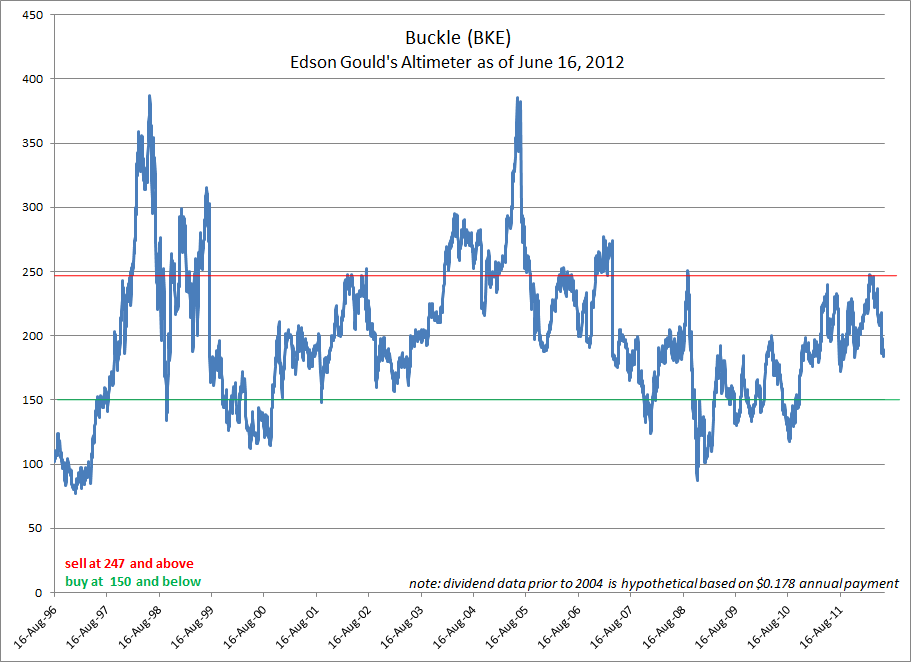
The following is a review of Buckle (BKE) using Edson Gould’s Altimeter.

image

Below is the performance of the buy and sell indications of Edson Gould’s Altimeter based on periods when the indicator first cross below 150 for buy indication, and above 247 for sell indications.

Date Price Altimeter buy/sell % change $1 invested
6/12/1997 6.57 148 buy 69% $1.69
1/28/1998 11.13 250 sell -47%  
10/8/1998 5.95 134 buy 85% $3.13
11/6/1998 11.01 248 sell -41%  
11/4/1999 6.51 146 buy 69% $5.30
3/19/2002 11.01 248 sell 120%  
11/19/2007 24.26 146 buy 72% $9.13
9/18/2008 41.78 251 sell -43%  
10/23/2008 23.94 144 buy 107% $18.90
3/9/2012 49.56 248 sell -39%  
????????? 30 150 buy ?????????  

The consistency of the indicator is amazing.  Only the sell indication of March 19, 2002 resulted in an outcome that was contrary to the desired result.  Even so, A person who only bought BKE based on the buy signal and sold based on the sell indication would have resulted in a gain of 1,890% from June 12, 1997 to the present.  This is compared to the buy and hold total return with reinvestment of dividends (including special dividends) of 766.21%.  Based on capital appreciation alone, the price of BKE rose 498% since June 12, 1997.

  • +1,890% (buy/sell Altimeter)
  • +766% (dividends reinvested)
  • +498% (based on price change only)

In the table above, the section in blue is the tentative estimate of when the next buy signal will be registered and the amount of decline necessary to get to the signal.  It appears that based on the sell indication from March 9, 2012 to the price of $30, BKE would have to decline -39% using the Altimeter.  Such a decline is well within the prior successful sell indications that resulted in losses.

We are very interested in this stock at the right price.  We believe that BKE will be a buy at $30 and below.  However, prior price movement based on Gould’s speed resistance lines indicated that the conservative downside target is $24.47 and the extreme downside target of $16.68.

Historically, based on prior Altimeters, a buy indication does not mean that the price decline has actually ended. Therefore, if the buy indication is triggered then be prepared by making your purchase of the stock in, at least, two stages. Once at the trigger price and again at any desirable price lower than the trigger level.

Investment Observation: Markel (MKL) at $433.72

According to Value Line Investment Survey, “Markel Corp. markets and underwrites specialty insurance products and programs to a variety of niche markets.” When reviewing the Value Line tear sheet on Markel, there are a couple of items that make the stock very compelling.

First, Value Line indicates that the company has a fair value of 1.5 times the book value. Using the most conservative full year data from 2011 provided by Value Line, Markel has a fair value of $528.15 which is a 20% premium above the current market price of $439.77. Value Line estimates that by 2017, Markel would have a book value of $447. This implies a fair value of $670.50. Assuming that Markel only achieves half of the projected growth in the book value, the fair value would be at $599. Considering that Markel typically trades above fair value, the prospects are reasonably favorable.

Next, Markel has increased their book value from $49.16 in 1996 to $352.10 in 2011. With Markel having the ability to consistently increase their book value at double digit rates is phenomenal in our view. As an added benefit, Markel has only increased the number of shares outstanding from 5.46 million to 9.62 million in the period from 1996 to 2011. This suggests that the growth of the company has not come at the expense of the shareholders.

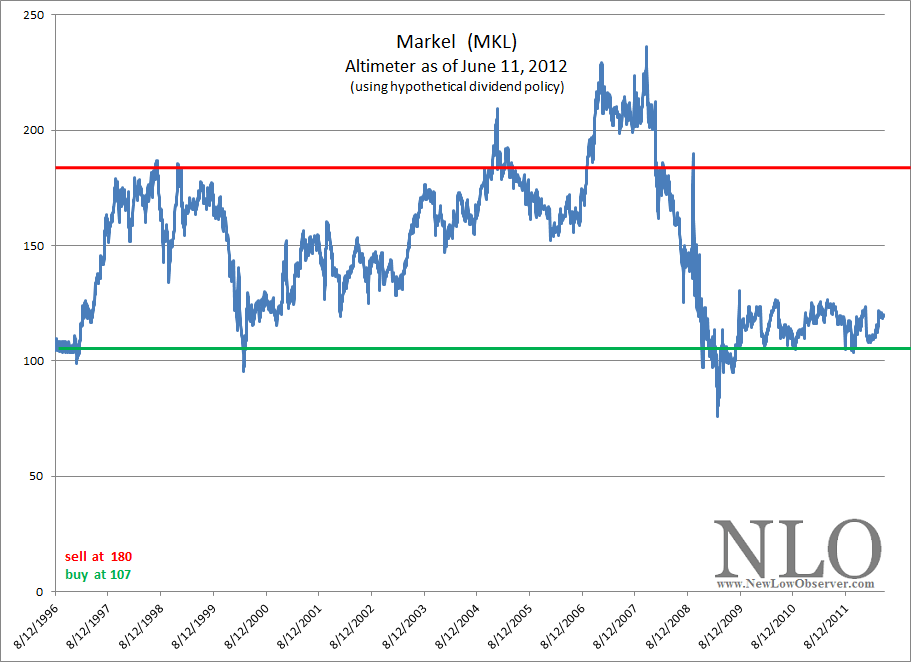
We have constructed an Altimeter for Markel (MKL) that is based on a hypothetical dividend assuming an average payout from earnings of 13%  and a compounded annual growth rate (CAGR) of the dividend at 9.9%.

image

Although hypothetical, our assumptions of a dividend policy is the most conservative possible.  We believe that, if compelled, Markel could easily maintain such a dividend policy while increasing the book value.  Whenever, the Altimeter is above 180, the stock should be sold and whenever it is below 107, MKL should be bought.  Below is the performance of the stock price when it falls within the parameters previously noted.

Date Price Altimeter buy/sell % change
2/23/1996 87 106 buy 106.61%
6/8/1998 179.75 182 sell -31.99%
3/6/2000 122.25 103 buy 157.67%
10/5/2004 315 181 sell -22.14%
11/20/2008 245.25 97 buy ????????

An alternative strategy, for investors with a long-term perspective, could be to accumulate the shares of Markel at or below 107 on the Altimeter (currently $395.90) without consideration of selling.  We feel this would be a prudent stance since the declines experienced by the stock at the “sell” indications are not meaningful enough to warrant actually selling the stock by the time the next “buy” indication is given.

Finally, our concern for the worst case scenario is always in the back of our mind.  For this reason, we assume that the lows of 2009 will be revisited and ask ourselves are we able to handle such a situation.  If based on the Altimeter low of 2009, Markel could decline as low as $281.20.  Our hope is that such a low is not visited again.  However, with the aid of Dow Theory, we are prepared to accumulate additional shares when, and if, such an opportunity arises.

Nasdaq 100 Watch List: June 8, 2012

Below are the Nasdaq 100 companies that are within 10% of their respective 52-week lows. Stocks that appear on our watch lists are not recommendations to buy. Instead, they are the starting point for doing your research and determining the best company to buy. Ideally, a stock that is purchased from this list is done after a considerable decline in the price and rigorous due diligence.

symbol Name Price P/E EPS Yield P/B % from Low
SYMC Symantec Corporation 14.57 9.28 1.57 - 2.06 2.17%
DELL Dell Inc. 12.12 6.92 1.75 - 2.28 2.71%
CHRW CH Robinson Worldwide Inc. 57.92 21.6 2.68 2.3 7.51 3.65%
EA Electronic Arts Inc. 13.47 58.57 0.23 - 1.75 4.74%
INFY Infosys Ltd. 43.62 14.54 3 1.3 3.81 5.36%
NVDA NVIDIA Corporation 12.12 14.8 0.82 - 1.72 5.67%
GMCR Green Mountain Coffee Roasters 23.13 11.11 2.08 - 1.76 6.25%
EXPD Expeditors Int'l of WA 39.36 22.75 1.73 1.4 3.95 6.49%
CTRP Ctrip.com Int'l 18.66 17.86 1.04 0 2.38 6.63%
SPLS Staples, Inc. 12.86 9.23 1.39 3.4 1.24 7.71%
LRCX Lam Research 37.62 16.65 2.26 - 1.72 8.07%
NFLX Netflix, Inc. 65.64 22.22 2.95 - 5.41 8.14%
WYNN Wynn Resorts Ltd. 104.21 22.1 4.72 1.9 46.53 8.76%
NTAP NetApp, Inc. 30.33 19.2 1.58 - 2.65 9.14%
MCHP Microchip Technology Inc. 32.01 19.4 1.65 4.4 3.08 9.25%
VOD Vodafone Group 26.58 12.6 2.11 7.5 1.1 9.34%
MRVL Marvell Technology 12.28 13.15 0.93 2 1.4 9.35%
ORCL Oracle Corporation 27.16 14.23 1.91 0.9 3.16 9.87%
CTSH Cognizant 58.85 19.81 2.97 - 4.14 9.92%

Watch List Summary

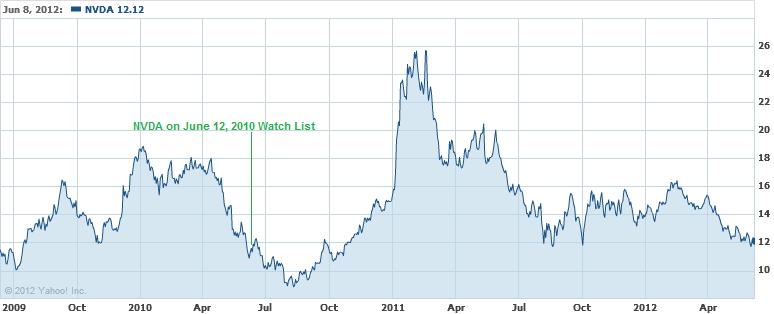
Of interest on our watch list is NVIDIA (NVDA).  According to Yahoo!Finance, “NVIDIA Corporation provides graphics chips for use in smartphones, personal computers (PC), tablets, and professional workstations markets worldwide.”  As we’ve described in the past, we have a strong interest in chip sector stocks and believe that the long-term prospects for companies in the chip industry is very appealing.

NVDA first appeared on our watch list on June 12, 2010.  At that time, NVDA was trading at $11.61.  By February 18, 2011, NVDA was trading as high as $25.68 which was a gain of over +120%.  We’re not certain that NVDA’s decline has ended.  According to Edson Gould’s Speed Resistance Lines, NVDA has already declined below the conservative downside target of $17.87 based on the February 2011 high.  The persistence of the current decline suggests that the stock could decline to the extreme downside target of $8.67.  We’re doing everything we can to hold off buying this stock at the current time.

image

Watch List Performance Review

The following is a performance review of the top five Nasdaq 100 Watch List from June 4, 2010.  Keep in mind that this is a 2 year performance review instead of a 1 year review.

Symbol
Name 2010 2012 % change
GILD Gilead Sciences, Inc. $34.71 49.21 41.77%
SYMC Symantec Corporation $13.92 14.43 3.66%
ERTS Electronic Arts Inc. $15.81 13.07 -17.33%
APOL Apollo Group, Inc. $51.48 32.42 -37.02%
QCOM QUALCOMM $35.30 55.85 58.22%
average 9.86%
NDX Nasdaq 100 1,832.04 2,478.13 35.27%

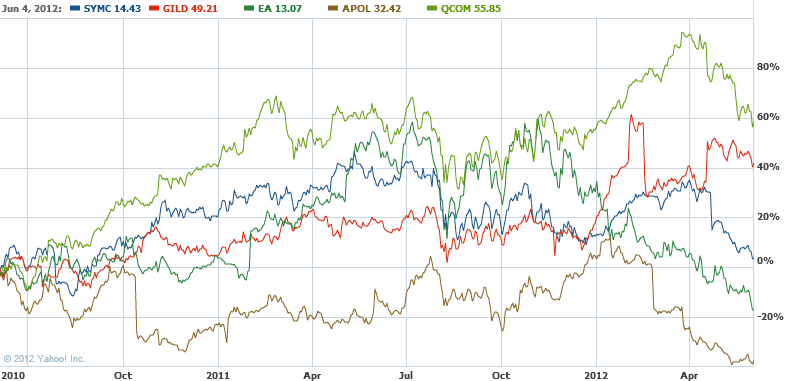
As can you can see, the list of top five stocks significantly underperformed the Nasdaq 100 (NDX), mainly due to Apple Inc. (AAPL) having an outsized impact on the index.  However, underneath the static 2-year performance data is a story to be told, which is the basis of our New Low investment strategy.

In the chart below, take note of the period around July 2011.  At that time, Qualcomm had gains of +60%, Electronic Arts had gains of +55%, Symantec had gains of +42% and Gilead Sciences had gains of +21%.  Only Apollo Group had losses to compare against the other stocks.

image

In the case of Symantec and Electronic Arts, they have come full circle after a 2-year period. This cycle is not unusual for most of the stocks that we track. Even when the stock does not approach the prior low of a watch list, many stocks attain a 52-week low after 2 to 2.5 years (as in the NVDA example above). Be on the lookout for stocks that have similar cycles like EA, SYMC and NVDA since their ability to replicated such moves adds to the prospect that they could pull a repeat performance.

U.S. Dividend Watch List: June 8, 2012

Below are the 23 companies on our U.S. Dividend Watch List that are within 11% of their respective 52-week lows. Stocks that appear on our watch lists are not recommendations to buy. Instead, they are the starting point for doing your research and determining the best company to buy. Ideally, a stock that is purchased from this list is done after a considerable decline in the price and rigorous due diligence.

Symbol Name Price % Yr Low P/E EPS (ttm) Dividend Yield Payout Ratio
CRR Carbo Ceramics, Inc. 73.17 2.25% 13.00 5.63 0.96 1.31% 17%
BMO Bank of Montreal 52.66 3.36% 9.44 5.58 2.73 5.18% 49%
CHRW C.H. Robinson Worldwide 57.92 3.65% 21.61 2.68 1.32 2.28% 49%
UNM Unum Group 19.79 4.32% 26.04 0.76 0.42 2.12% 55%
WAG Walgreen Co. 31.16 4.56% 10.63 2.93 0.90 2.89% 31%
FNFG First Niagara Financial 7.99 4.58% 13.32 0.6 0.32 4.01% 53%
BDX Becton, Dickinson and Co. 73.26 5.27% 13.34 5.49 1.80 2.46% 33%
TR Tootsie Roll Industries 22.8 5.41% 30.40 0.75 0.32 1.40% 43%
TDS TDS 20.4 6.25% 10.68 1.91 0.49 2.40% 26%
EXPD Expeditors International 39.36 6.49% 22.75 1.73 0.56 1.42% 32%
JNJ Johnson & Johnson  62.98 6.60% 17.25 3.65 2.44 3.87% 67%
COP ConocoPhillips 53.97 6.62% 5.89 9.16 2.64 4.89% 29%
ANAT American Nat'l Insurance 70.29 6.97% 9.89 7.11 3.08 4.38% 43%
CWT California Water Service 17.85 7.21% 20.76 0.86 0.63 3.53% 73%
JW-A John Wiley & Sons Inc. 45.02 7.47% 14.29 3.15 0.80 1.78% 25%
NFG National Fuel Gas Co. 44.97 8.18% 17.70 2.54 1.42 3.16% 56%
MATW Matthews Int'l Corp.  30.91 8.19% 12.93 2.39 0.36 1.16% 15%
THFF First Financial Corp. 28.36 8.87% 10.43 2.72 0.94 3.31% 35%
PG Procter & Gamble Co.  62.75 9.02% 19.25 3.26 2.25 3.59% 69%
MCD McDonald's Corp.  87.75 9.16% 16.40 5.35 2.80 3.19% 52%
TMP Tompkins Financial Corp. 36.7 9.98% 11.84 3.1 1.44 3.92% 46%
NJR New Jersey Resources 43.56 10.00% 14.57 2.99 1.52 3.49% 51%
APD Air Products & Chemicals 79.62 10.19% 14.32 5.56 2.56 3.22% 46%
23 Companies

Watch List Summary

Carbo Ceramics (CRR) tops our list and continues to trade lower.  With the current technical picture, the $60 level would be an important support level.  Analysts have taken the CRR earning estimate down since April when they projected Carbo Ceramics will grow by +31%, or $8.28.  The stock has fallen -18% since our April list.  Growth estimates of 25% is a bit rich for us but we will wait and see how the stock holds up at these levels.

Bank of Montreal (BMO) continues to struggle and remains at the 52-week low. We’ve made our “bullish” case for BMO on our June 7th post.  We think that $51.80 and below would be the right price to start accumulating shares.

McDonald’s (MCD) has appeared our list this week.  IQTrends (www.iqtrends.com) estimates that MCD is undervalued when it has a dividend yield of3.6%.  Our model places fair value at $104 but it is considered undervalued at $58.

Given the bearishness of the market, we believe that there a significant chance of MCD moving towards $58 before getting to the $104 fair value level.  The slowdown in China and greater Asia in general should hit the bottom line as consumers seek alternatives.

Walgreen's trading at its historically cheapest level.  That fact hasn’t convinced Morningstar.com to rate this stock favorably.  Morningstar.com suggests that investors buy the shares at the $21 range even though the stock has a fair value at $35.  The analyst at Morningstar.com is concerned about the competitive edge Walgreen has to face with consolidation in the industry.  As such, they see margin contraction coming soon.  Value Line Investment Survey also cites some of the same issues but they placed a more favorable view on Walgreen based on market size and its ability to generate cash flow.  Value Line expects Walgreen to trade around 11.5x cash flow.  With 2013 estimated cash flow per share of $4.30, Value Line has a fair value at $49.45.  That figure is in line with our valuation model.

Top Five Performance Review

In our ongoing review of the NLO Dividend Watch List, we have taken the top five stocks on our list from June 10, 2011 and have check their performance one year later. The top five companies on that list can be seen in the table below.

Symbol Name 2011 Price 2012 Price % change
WEYS Weyco Group, Inc.  22.32 23.22 4.03%
TRH Transatlantic Holdings, Inc. 44.01 61.5 39.74%
CHFC Chemical Financial Corp.  18.13 19.9 9.76%
TGT Target Corp. 46.7 59.2 26.77%
SFNC Simmons First National Corp.  24.38 23.4 -4.02%
Average 15.26%
DJI Dow Jones Industrial 11,637.45 12,554.20 7.88%
SPX S&P 500 1,269.75 1,325.66 4.40%

NLO.2012.6.10

Transatlantic Holdings (TRH) was acquired by Alleghany (Y) after a feeble and failed attempt to acquire by Warren Buffett.  Our top five returned an average of +15% over the last year.  Additionally, the top five easily achieved our minimum target return of +10% within the one year time frame.

Cimarex (XEC) at a New Low

Today, Cimarex (XEC) hit a new 1 and 2-year low as the energy sector continues to fall apart.  We like Cimarex (XEC) because it is a spin-off from Helmerich & Payne (HP) which has had a tremendous dividend increasing history.  Additionally, we have been very fortunate in being able to call most of the peaks and troughs in the price of Helmerich & Payne found at the links below:

Cimarex appears to be willing to continue the conservative management style that got Helmerich & Payne through hard times in the oil drilling industry during the 1980’s and 1990’s.  Therefore, we believe that Cimarex should be on your watch list as well.

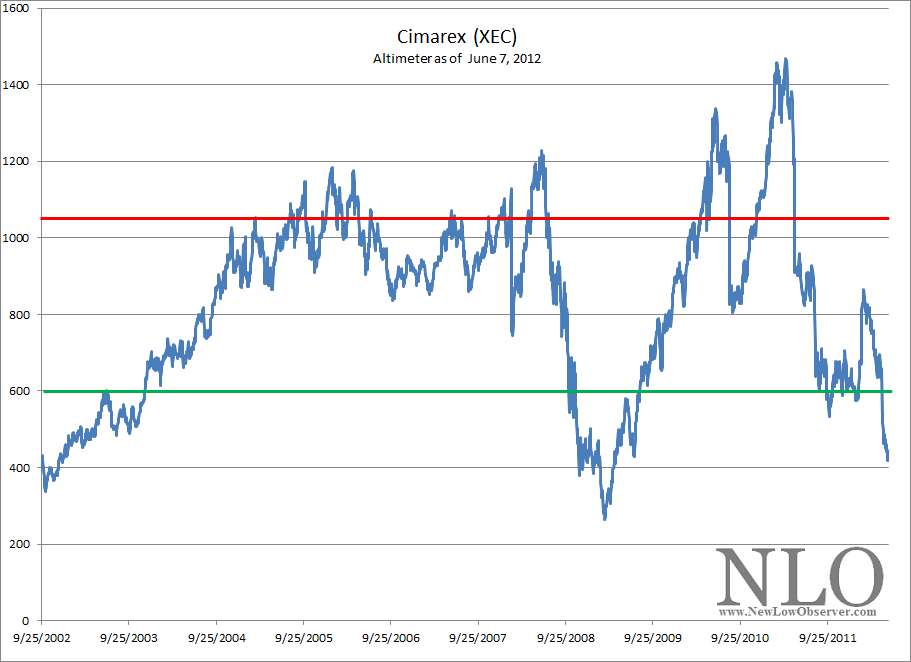
Below is the Altimeter for Cimarex since being spun off from Helmerich & Payne:

image

note: dividend data prior to 2006 is hypothetical based on $0.04 quarterly payment

We believe that whenever the Altimeter is trading at or above 1032 the stock should be sold.  Additionally, whenever Cimarex’s Altimeter is trading at 600 or below, the stock should be considered for acquisition.  Below is the performance of buy and sell indications based on the Altimeter levels just mentioned:

Date Price Altimeter buy/sell % change
6/26/2003 23.96 599 buy 72.29%
3/3/2005 41.28 1032 sell -47.25%
10/10/2008 32.66 544 buy 90.02%
3/11/2010 62.06 1034 sell -42.18%
8/22/2011 59.81 598 buy ??????????

Our expectation is that Cimarex may decline as low as, and possibly lower, than the 2009 level on the Altimeter.  That would equal a price of $31.80, or -30% from the current price.  A purchase of the stock at this time may be warranted, based on the Altimeter.  However, be prepared to buy more at lower prices.

Investment Observation: Bank of Montreal (BMO)

Today’s Investment Observation is Bank of Montreal (BMO).  According to Yahoo!Finance, Bank of Montreal “…provides various retail banking, wealth management, and investment banking products and services in North America and internationally.”

While there is considerable attention to the ability of Canadian banks to grow in spite of the travails of American banks, the premise of our interest in Bank of Montreal is only based on the fact that the company has a solid dividend history, near a new low and has an easily discernable Altimeter.

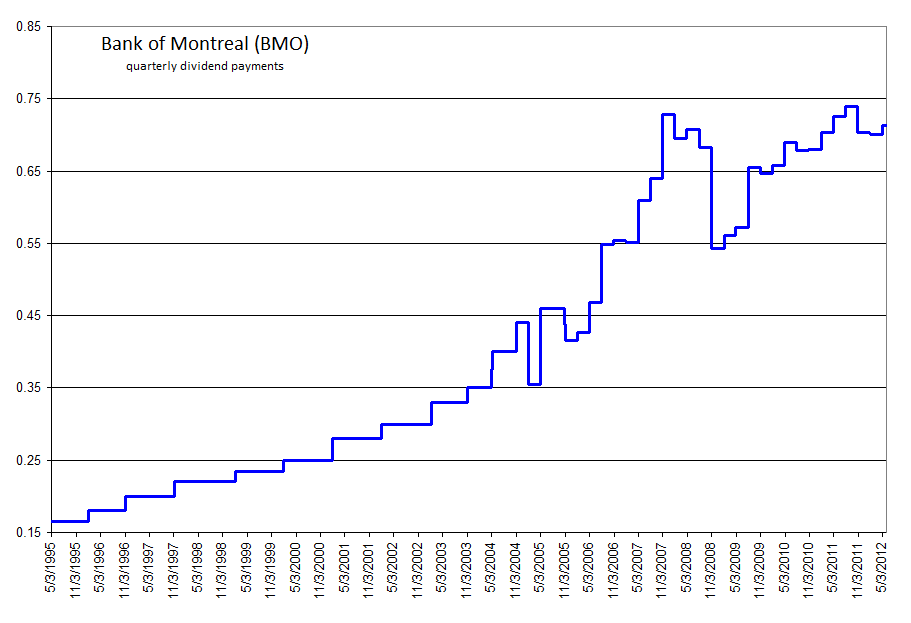
Bank of Montreal has a stellar dividend history which we believe the company has the ability to maintain.

image

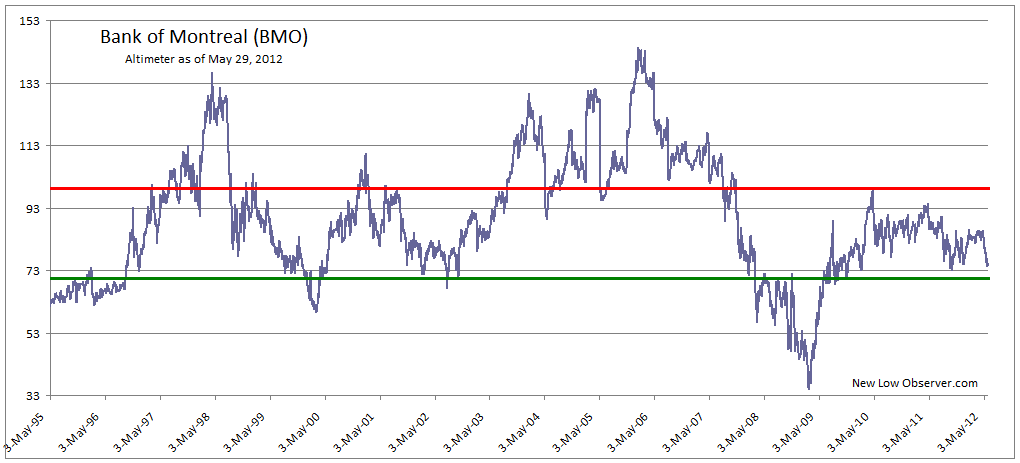
Using Edson Gould’s Altimeter, as seen below, we find that BMO is bouncing along the lower end of the range which would suggest that the stock is approaching the undervalued range.

image

Whenever BMO trades above 99.24 on the Altimeter the stock should be considered for selling and anytime the stock declines below 73 it should be considered for acquisition.  Below is the track record for this indication since 1996:

Date Close Altimeter buy/sell %change
2/5/1996 12 72.73 buy 67.67%
3/10/1997 20.12 100.6 sell -15.81%
8/10/1999 16.94 72.09 buy 48.29%
12/8/2000 25.12 100.48 sell -14.21%
2/6/2002 21.55 71.83 buy 52.25%
8/26/2003 32.81 99.42 sell 61.20%
1/17/2008 52.89 72.65 buy 23.46%
4/26/2010 65.3 99.24 sell -17.53%
10/4/2011 53.85 72.87 buy ?????

In only one instance, August 26, 2003, when a sell indication was given, did the stock rise when it was expected to fall before another Altimeter buy indication was given.  The average gain after a buy indication was +47%.  This excludes any instance where the holder of the stock could have sold at much higher levels other than when the sell indication kicked in.

Dow Theory indicates that BMO has a fair value of $44.85.  This means that BMO is trading approximately 22.83% above fair value.  Our assessment of the Dow Theory fair value is based on the the trading high of 2010 and the trading low of 2009.  From the current price, BMO has the following Dow Theory downside targets:

  • $51.80
  • $37.90
  • $24.00

These downside targets are a broad overview of the potential downside risk, as each target is met we will be glad to provide intermediate and short-term downside targets.

According to Value Line Investment Survey, BMO is considered to be at fair value when the stock is trading 10.5 times earnings.  Using the most conservative figures available, full year 2011 reported earnings of $5.26, BMO would be trading at a fair value of $55.23.  From 1996 to 2011, Value Line indicates that BMO has increased the number of shares outstanding by only 23%.  This is significant because any bank that has managed to get through the banking crisis of 2006 to 2011 with such a “small” increase of shares is in a relatively stable condition.

We are reticent to recommend any kind of banking institution due to the many unexpected risks that occur outside of the purview of regulators and accountants.  However, Bank of Montreal is a reasonable banking investment if bought at the right price.  We believe that the right price begins at $51.80 and below.

Precious Metal Myths: A Metal “Standard” Promotes Economic Stability

As precious metals investors since 1996 (long only) and speculators since 2008 (long and short), we readily admit that when the right price appears we’re going to sell a large portion of our physical inventory.  We have written numerous articles on gold and silver highlighting both the good and the bad associated with investing in precious metals.  We feel that a balanced view of both the risks and rewards of precious metals investment and speculation is critical to the longer term goal of wealth accumulation.

Unfortunately, there is a contingent of precious metal marketers that would rather stretch the truth or even promote myths to inspire undue hope, fear, and reckless optimism.  A common myth by these marketers is that if we have a gold “standard” instead of a U.S. dollar based financial system, our debt laden society would become stable.  Unfortunately, promoters of this claim have not carefully examined a period when there was a gold “standard.”

Below is a chart of gold and silver in the period from 1846 to 1895, this to set the stage for the level of stability that was experienced by most Americans.

image

The chart above is drawn from an article titled “The Relative Stability of Gold and Silver” by Edward Sherwood Meade in the Annals of the American Academy of Political Social Science, 1899.  In the period from 1851 to 1873, there was a bimetallic “standard,” where both gold and silver were used as a monetary base in some countries.  At the same time, either gold or silver was used in other countries as a form of a monetary “standard.”  After the period of 1873, the silver “standard” was abandoned due to “…legislative and industrial” reasons according to Meade.

Unfortunately, both gold and silver “standards” are constructs of legislative actions (fiat) and subject to industrial supply and demand constraints, just as the U.S. dollar is subject to fiscal and monetary policies (etc.).  It should be noted that although gold and silver were the “standards” for a given monetary system, there was still a decline of nearly –33% in the value of gold and silver from 1851 to 1873.  The subsequent dramatic rise of both gold and silver from 1873 and beyond only demonstrates just how little stability there actually was in having gold and silver as the anchor for the monetary system.

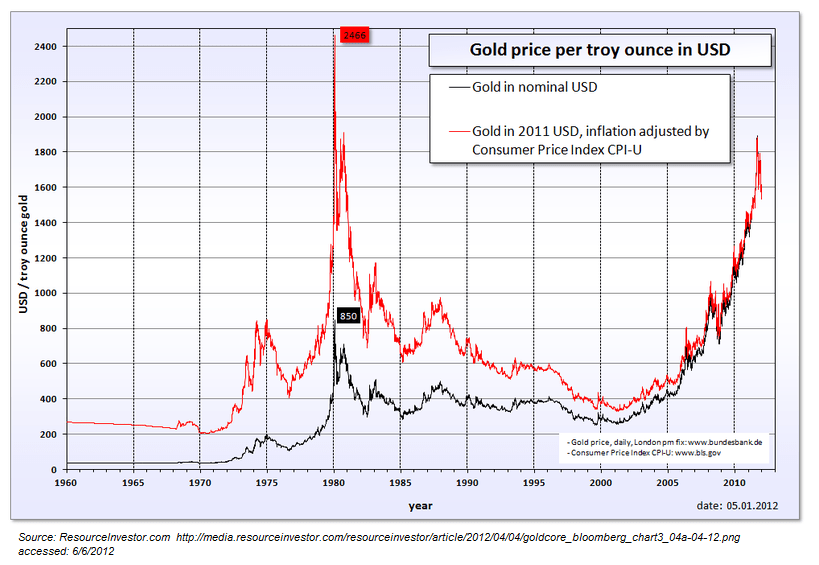
Adding insult to injury, it took 33 years for gold to achieve parity after the decline from 1851.  This is eerily similar to the 31 years it has taken gold to achieve the inflation-adjusted equivalent of 1980 when gold peaked at $1,900 an ounce in 2011.

image

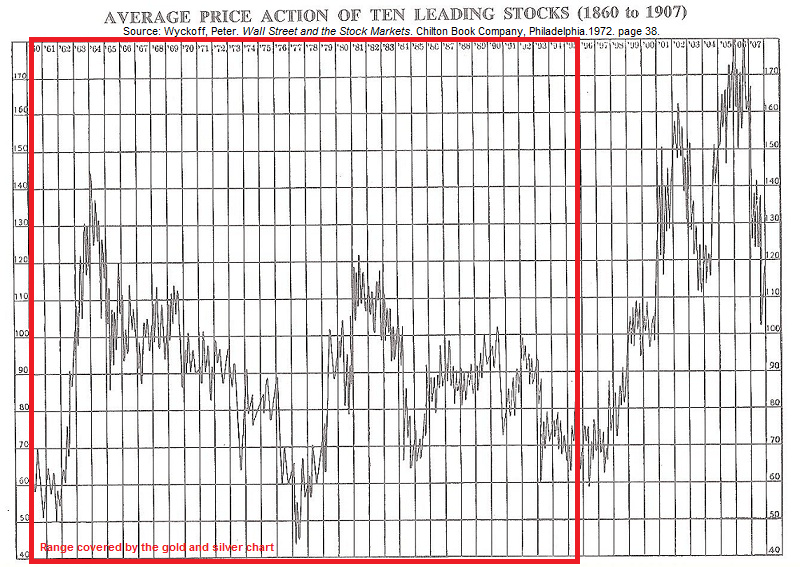
While gold and silver was vacillating wildly as a “standard” in the 1800’s, the stock market, represented by the chart below, was demonstrating its characteristic fluctuations.

image

The stock market increased nearly +300% and declined over -50% on two separate occasions in the period from 1860-1895.  Having a gold and silver “standard” promoted greater volatility in the market since it would take a government edict (fiat) to mitigate massive gains or losses in the price of gold and silver.  Additionally, cornering of the market was much easier then than it is today.

At the same time that the stock market was experiencing wide gyrations, the U.S. economy experienced widespread panics and depressions in the period from 1857 to 1895.  Below are the National Bureau of Economic Research (NBER) dates for economic recessions from 1857 to 1895:

Peak Trough Contraction                                                (peak to trough in months)
June 1857(II) December 1858 (IV) 18
October 1860(III) June 1861 (III) 8
April 1865(I) December 1867 (I) 32
June 1869(II) December 1870 (IV) 18
October 1873(III) March 1879 (I) 65
March 1882(I) May 1885 (II) 38
March 1887(II) April 1888 (I) 13
July 1890(III) May 1891 (II) 10
January 1893(I) June 1894 (II) 17

Amazingly, 47% of the time from 1857 to 1895 was spent in periods of recession with a large dose of panics and crashes mixed in.   The most notable of the U.S. economic contractions started with the panic of 1873 which, spawned by years of railway speculation in the U.S. but sparked by the collapse of banking giant Jay Cooke & Co.,  led to a global economic depression that lasted well beyond 1878 in many other countries.  The panic of 1873 was the longest lasting recession/depression based on NBER data.

Currently, the monopoly role (corner of the market) that government has on monetary and fiscal policy allows investors and speculators a better chance to align their interests within the context of the known.  What we know is that the purchasing power of the dollar will never increase under the current regime.  If governments are allowed to set artificial “standards” then investors and speculators would not know when the policy will be changed/ended.

Again, anyone who feels that the current system is out of whack should carefully consider the prospects of the “legislative and industrial” whims that a gold and silver “standard” could bring.  We believe that whether dollar, gold, yen, silver, yuan, or pesos, the only constant is change itself.

Planning accordingly for the prospects of change is what makes for successful investment and speculation in the precious metals market.  Those marketers who rely on fear and the propagation of myths only serve to ensure the maximum number of unsuccessful speculators.

Note: In terms of gold and silver, the word “standard” following each metal is really a pseudonym for price control, price fixing and propping the market for whatever the “standard” may be.  This means that the market value for whatever the “standard” is will not be realized in the open market in the period that a “standard” is used. 

There is nothing more oxymoronic than the word “standard” being applied to either gold, silver, or the U.S. dollar since the origins of the word “standard” is rooted in the meaning to “stand fast or firm.”  This is something that could never occur in a world that is always seeking a price, unless mandated by government that price seeking is illegal.

Market Outlook: Mixed Signals

On February 7, 2012, we wrote an article on the topic of gold titled “Gold Stock Indicator Points Down” (found here).  In that article, the very last sentence said the following:

“based on the current trajectory, we have May/June 2012 as our tentative reversal period.”

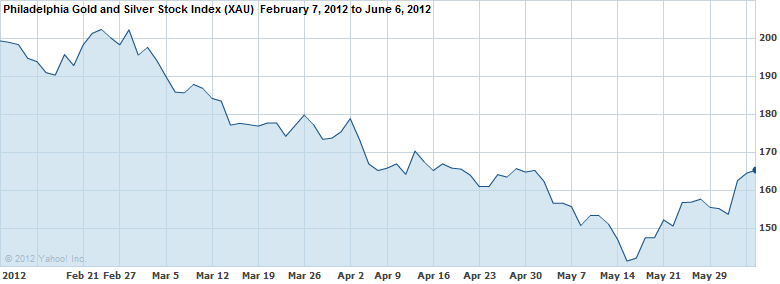
Well, the month of May has passed and we’ve seen an amazing plunge in gold stocks since the posting of our February 7th article, as reflected in the chart below:

image

Since February 7, 2012, the XAU gold stock index declined -28.95% to the May 15th low.  As we had anticipated, the “May/June” bottom was reached, for now. Ordinarily, this would be the time to buy gold stocks, especially those that pay a dividend.  However, in our May 27th transaction review of NUGT (found here), we said that, based on our Gold Stock Indicator, there would be a second opportunity to buy gold stocks at a considerable value.

The recovery in the XAU index has been even more spectacular than the plunge.  Historically, such rapid increases in a stock or index would require a decline of at least -50% of the most recent rise, even if the trend is still higher.  Therefore, based on the most recent price of 168.71 in the XAU index, there should be a decline to the 154.56 level or half of whichever the most recent peak might be.  We’d consider buying dividend paying gold stocks at half of the highest point achieved or lower.  (Please, if you have any questions about this paragraph we’d be more than glad to explain further if we were not clear in any way.)

For now, the direction for gold stocks is up based on our Gold Stock Indicator, until proven otherwise.  However, at the same time the Gold Stock Indicator is pointing up, we have a Dow Theory bear market indication as outlined in our May 19th article (found here) suggesting that stocks in general are supposed to decline.  Our vast amount of research on the topic suggests that if the general stock market were to have a decline of 10%-15% or more, then gold stocks would decline by a greater percentage.  As an example, in 2008, when the general stock market declined –37% as reflected in the S&P 500 (full year decline), the XAU gold stock index declined -66% within the period from March 2008 to October 2008.

We don’t know which indication will take precedence.  Therefore, we are opting for the most conservative stance possible.  We’re waiting for the stock market to confirm the Dow Theory bear market indication or quickly come up with a bull market indication.  We’re holding out for the possibility that gold stocks will provide the second opportunity to buy as has been indicated in our May 27th transaction review.

Questions or thoughts?  Let us know, we’ll do our best to provided a thoughtful response.

U.S. Dividend Watch List: June 1, 2012

Below are 42 companies on our U.S. Dividend Watch List that are within 11% of their respective 52-week lows. Stocks that appear on our watch lists are not recommendations to buy. Instead, they are the starting point for doing your research and determining the best company to buy. Ideally, a stock that is purchased from this list is done after a considerable decline in the price and rigorous due diligence.

Symbol Name Price % Yr Low P/E EPS (ttm) Dividend Yield Payout Ratio
CHRW C.H. Robinson 56.89 0.12% 21.23 2.68 1.32 2.32% 49%
UNM Unum Group 19.3 0.21% 25.39 0.76 0.42 2.18% 55%
FNFG First Niagara 7.74 0.26% 12.90 0.6 0.32 4.13% 53%
BMO Bank of Montreal 52.02 0.37% 9.32 5.58 2.72 5.23% 49%
WAG Walgreen Co. 29.93 0.44% 10.22 2.93 0.90 3.01% 31%
TDS Telephone & Data 19.45 0.62% 10.18 1.91 0.49 2.52% 26%
COP ConocoPhillips 51.19 1.05% 5.59 9.16 2.64 5.16% 29%
EXPD Expeditors International 37.45 1.33% 21.65 1.73 0.56 1.50% 32%
TR Tootsie Roll Industries Inc  21.96 1.53% 29.28 0.75 0.32 1.46% 43%
CRR Carbo Ceramics, Inc. 75.73 1.54% 13.45 5.63 0.96 1.27% 17%
NFG National Fuel Gas Co. 43.14 2.76% 16.98 2.54 1.42 3.29% 56%
ANAT American National Insurance 67.53 2.77% 9.50 7.11 3.08 4.56% 43%
AMAT Applied Materials Inc. 10.01 3.14% 9.91 1.01 0.36 3.60% 36%
BDX Becton, Dickinson and Co. 72.2 3.75% 13.15 5.49 1.80 2.49% 33%
THFF First Financial Corp. 27.09 3.99% 9.96 2.72 0.94 3.47% 35%
CWT California Water Service 17.36 4.26% 20.19 0.86 0.63 3.63% 73%
JNJ Johnson & Johnson  61.78 4.57% 16.93 3.65 2.44 3.95% 67%
MATW Matthews International Corp.  29.99 4.97% 12.55 2.39 0.36 1.20% 15%
NJR New Jersey Resources Corp. 41.63 5.13% 13.92 2.99 1.52 3.65% 51%
APD Air Products & Chemicals, Inc. 76.88 6.39% 13.83 5.56 2.56 3.33% 46%
PG Procter & Gamble Co.  61.55 6.93% 18.88 3.26 2.25 3.66% 69%
SRCE 1st Source Corp.  20.565 7.67% 10.28 2 0.64 3.11% 32%
UTX United Technologies Corp. 72.02 7.70% 15.16 4.75 1.92 2.67% 40%
JW-A John Wiley & Sons Inc. 45.16 7.81% 14.34 3.15 0.80 1.77% 25%
CAH Cardinal Health, Inc.  40.53 7.99% 13.74 2.95 0.95 2.34% 32%
MCD McDonald's Corp.  86.71 8.39% 16.21 5.35 2.80 3.23% 52%
LM Legg Mason, Inc.  24.27 8.54% 15.76 1.54 0.44 1.81% 29%
WEYS Weyco Group, Inc.  22.67 8.89% 15.96 1.42 0.68 3.00% 48%
TMP Tompkins Financial Corp. 36.35 8.93% 11.73 3.1 1.44 3.96% 46%
HNZ HJ Heinz Co. 52.51 9.01% 18.42 2.85 2.06 3.92% 72%
MSEX Middlesex Water Company  18.03 9.21% 22.82 0.79 0.74 4.10% 94%
OMI Owens & Minor, Inc. 28.33 9.51% 15.57 1.82 0.88 3.11% 48%
SJW SJW Corp. 22.91 9.77% 20.10 1.14 0.71 3.10% 62%
IBKC IBERIABANK Corp.  46.67 9.79% 23.45 1.99 1.36 2.91% 68%
STBA S&T BanCorp., Inc.  16.7 9.80% 12.28 1.36 0.60 3.59% 44%
SYY Sysco Corp. 27.55 9.80% 14.13 1.95 1.08 3.92% 55%
AROW Arrow Financial Corp.  23.62 9.86% 12.63 1.87 1.00 4.23% 53%
PPL PP&L Corporation 27.47 9.88% 9.71 2.83 1.44 5.24% 51%
GS Goldman Sachs Group, Inc.  92.64 9.93% 13.70 6.76 1.84 1.99% 27%
CLX Clorox Co. 69.36 9.99% 17.21 4.03 2.56 3.69% 64%
BMS Bemis Co Inc 30.11 10.66% 17.92 1.68 1.00 3.32% 60%
CAG ConAgra Foods, Inc. 24.59 10.77% 13.15 1.87 0.96 3.90% 51%
42 Companies

Watch List Summary

CH Robinson (CHRW) tops our list again this week. We will continue to stress the weakness in the Transportation index because of the bear market signal as noted from our call on May 19th.  As such, anyone interested in purchasing this stock needs to allocate at least three stage purchases at each 10% decline.

Bank of Montreal (BMO) has broken its 52-week low based on the closing price.  The company is of particular interest to us and will be updating our reader on its altimeter this week.  Based on IQ Trend, anytime the stock breach the 4.7% yield mark, it is deem undervalued.  Current yield of 5.23% suggest that the company is undervalue by 11%.  More on Bank of Montreal in last week’s list.

There’s no need to introduce Walgreen (WAG).  The company is at its historically cheapest level.  That fact alone hasn’t convinced Morningstar.com to rate this stock favorably.  The research firm suggests that investor to buy the shares at the $21 range but has a fair value at $35.  The analyst at Morningstar.com is concerned about the competitive edge Walgreen has to face with consolidation in the industry.  As such, they see margin contraction coming.  Value Line Investment Survey also cited some of the same issues but they placed a more favorable view on Walgreen based on market size and its ability to generate cash flow.  Value Line expects Walgreen to trade around 11.5x cash flow.  With 2013 estimated cash flow per share of $4.30, we have a fair value at $49.45.  That figure is in line with our valuation model.

Carbo Ceramics (CRR) continue to struggle and we expect it to keep trading down.  Our Altimeter study shows that stock could hit $62.40 which would make a great buying opportunity.

We’ve added Applied Materials (AMAT) because we view this company as a dividend contender.  The company started paying dividends in 2005 and has been raising that at 21% annually.  While that rate of increase isn’t sustainable, we believe that the 3.6% yield provides a good cushion for such a cyclical stock.  We do expect more weakness in the name and could easily see the price fall to the $7-8 range.  Semiconductor equipment is in a cyclical downturn and we are closer to the bottom in sales growth.  The dividend payout ratio of 35% suggests a good margin of safety.

Top Five Performance Review

In our ongoing review of the NLO Dividend Watch List, we have taken the top five stocks on our list from June 3, 2011 (not published) and have check their performance one year later. The top five companies on that list can be seen in the table below.

Symbol Name 2011 Price 2012 Price % change
HTLF Heartland Financial USA, Inc.  13.49 18.12 34.32%
CHFC Chemical Financial Corp.  18.31 19.31 5.46%
TGT Target Corp. 47.4 57.2 20.68%
WABC Westamerica BanCorp.  47.53 43.68 -8.10%
BXS BanCorp.South Inc. 11.75 12.85 9.36%
Average 12.34%
DJI Dow Jones Industrial 12,151.26 12,118.57 -0.27%
SPX S&P 500 1,300.16 1,278.04 -1.70%

NLO_20120601

As has been typical of our U.S. Dividend Watch List, the performance in the last year was stellar.  Our top 5 stocks gained more than +12% on both the Dow Jones Industrial Average and S&P 500.  All but one company reached our goal of gaining +10% within one year.

Dow Jones Industrial Average: Where To Now?

Dow Theory Review

  • On August 2, 2011 (article here), we said that a new bear market had begun.
  • On August 9, 2011 (article here), we announced that, based on the closing price of August 8, 2011, a bear market rally would ensue (stock prices would rise.)  That call was 2 months ahead of the ultimate market bottom set in October 2011 and off the actual low by 1.43%.
  • On March 16, 2012 (article here), we warned about the lack of participation of most stocks in the rise of the stock market from the 2009 low.  Additionally, we cited the divergence between the Dow Jones Industrial Average and Dow Jones Transportation Average as confirmation that we were still in a bear market.  This was less than 1% from the actual top in the market.
  • On May 19, 2012 (article here), we pronounced that the bear market rally had ended.  This call came 7.41% below the actual peak in the market on May 1, 2012.

Charting a Path for the Dow

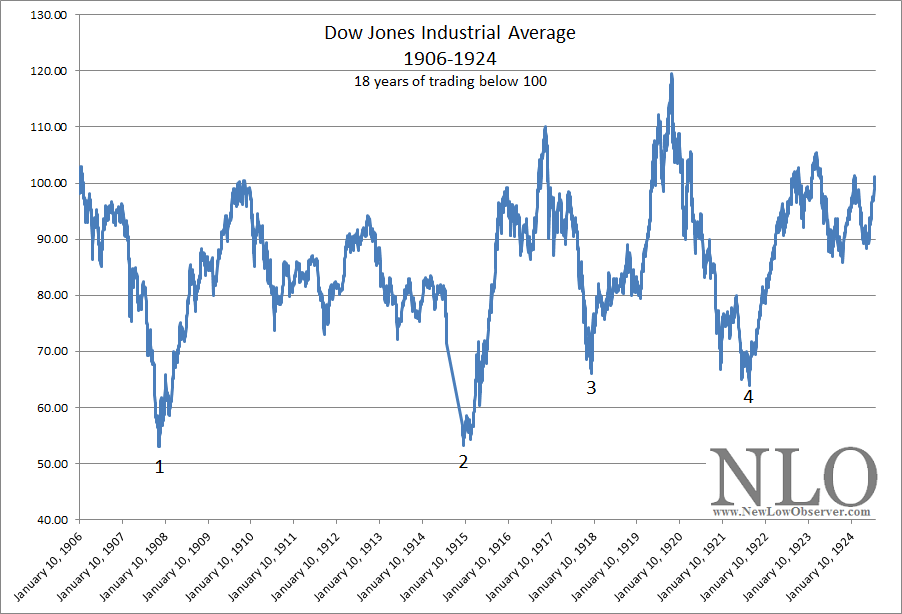
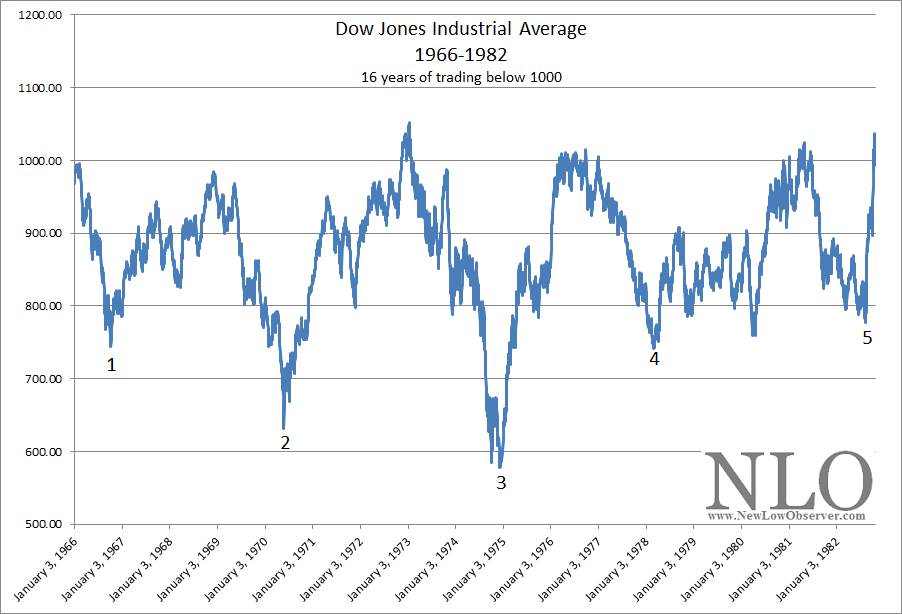
Now comes the challenge of determining the downside targets for the Dow Jones Industrial Average.  To accomplish this task, we’ve gone back to the secular bear markets of 1906-1924 and 1966-1982 for some insight as to what might occur going forward.  It is important to understand that the signature of a secular bear market is that it will not increase very much above the initial peak and declines significantly below the initial peak multiple times.

In the chart below, we have the price action of the Dow Jones Industrial Average from 1906 to 1924.

image

In the chart below, we have the price action of the Dow Jones Industrial Average from 1966 to 1982.

image

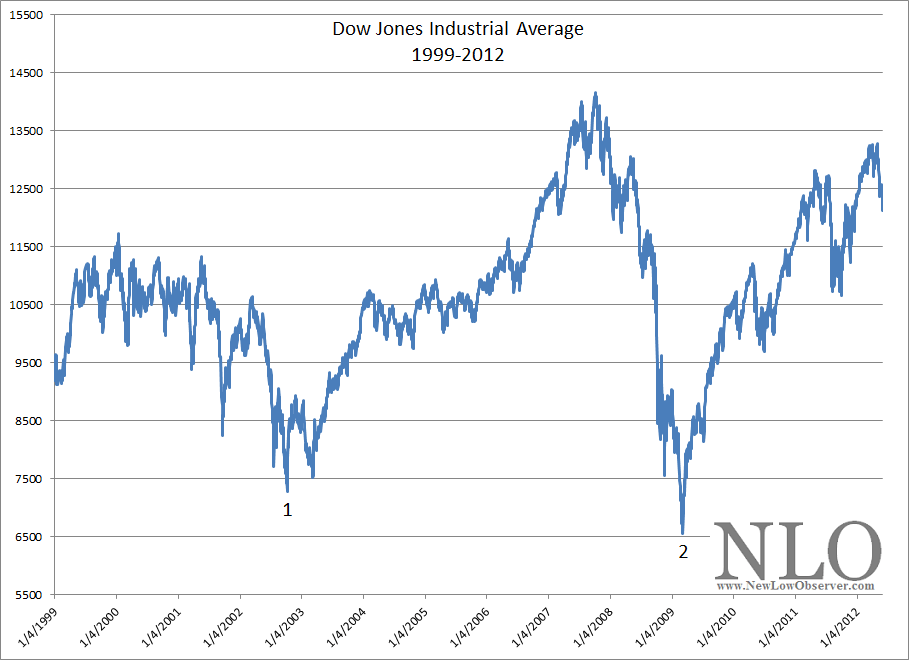
There is considerable debate about where the peak of the current secular bear market began.  Although we believe that the secular trend began at the 2007 peak,  we’re being conservative by considering that the most recent secular bear market began at the 2000 peak, as represented in the chart below.

image

Beneath each trough is the number corresponding to the major declines within the secular bear market. In each chart there are at least three major market declines while the peaks remain in close proximity to the original market peak.

It is our view that the first decline of the Dow Jones Industrial Average in the secular bear market trend later becomes a minimum downside target.  In the current market, we believe that the Dow Jones Industrial Average will revisit the 8,200 level.  If the Industrials were to revisit the 8,200 level, the total decline would be approximately -32% from the closing price of June 1, 2012.