
Monthly Archives: January 2011

NLO Dividend Watch List

The Dow hit 12,000 intra-week but closed decisively lower at 11,823. The S&P 500 was flat for the week. Our watch list has 16 companies that are within 10% of their 52-week low.

January 28, 2011 Watch List

Symbol Name Price % Yr Low P/E EPS (ttm) Dividend Yield Payout Ratio
ABT Abbott Laboratories 45.49 2.02% 15.01 3.03 1.76 3.87% 58%
WABC Westamerica BanCorp.  50.13 2.94% 15.62 3.21 1.44 2.87% 45%
WEYS Weyco Group, Inc.  22.78 3.03% 19.64 1.16 0.64 2.81% 55%
SHEN Shenandoah Telecom. 16.31 4.82% 17.92 0.91 0.33 2.02% 36%
CL Colgate-Palmolive Co. 76.99 5.29% 17.99 4.28 2.12 2.75% 50%
JNJ Johnson & Johnson   60.01 5.54% 12.32 4.87 2.16 3.60% 44%
CAG ConAgra Foods, Inc. 22.44 6.76% 15.06 1.49 0.92 4.10% 62%
NWN Northwest Natural Gas 44.02 7.24% 15.72 2.80 1.74 3.95% 62%
UVV Universal Corp. 37.99 7.44% 7.46 5.09 1.92 5.05% 38%
MRK Merck & Co., Inc 33.07 7.72% 12.77 2.59 1.52 4.60% 59%
CLX Clorox Co. 63.79 8.10% 13.72 4.65 2.20 3.45% 47%
SYY Sysco Corp. 29.19 8.15% 14.97 1.95 1.04 3.56% 53%
CWT California Water Service 36.58 8.19% 19.35 1.89 1.19 3.25% 63%
LLY Eli Lilly & Co. 34.77 8.59% 7.97 4.36 1.96 5.64% 45%
AWR American States Water 33.9 8.65% 23.06 1.47 1.04 3.07% 71%
PEP PepsiCo Inc. 64.4 9.62% 16.22 3.97 1.92 2.98% 48%
16 Companies


Watch List Summary

Abbott (ABT) topped our list this week after falling 5%. Wall Street wasn't happy with the company's short-term outlook even after the company guided for double digit growth in the coming year. With Abbott trading close to its historically high yield, we couldn't help but to accumulate some on its way down. Given an estimated double digit growth, we speculate that the company could easily raise its dividend from $0.44 to $0.48 (9% increase) in the coming months. At current price, estimated dividend yield will be north of 4%.

Some other noteworthy names on this list are Colgate-Palmolive (CL), Johnson & Johnson (JNJ), Clorox (CLX), Sysco (SYY), and Pepsi (PEP). All of them have dividend yield that are higher than 7-year T-Bill and are trading near their historical high yield. According to the book, Dividends Don't Lie by Geraldine Weiss, this mark great value proposition for long-term holder.

Top Five Performance Review

In our ongoing review of the NLO Dividend Watch List, we have taken the top five stocks on our list from January 29, 2010 and have check their performance one year later. The top five companies on that list can be seen in the table below.

Name Symbol 2010 Price 2011 Price % change
First Financial Corp. THFF 27.6 31.46 13.99%
Exxon Mobile XOM 64.43 78.99 22.60%
Shenandoah Telecom SHEN 17.2 16.31 -5.17%
Aqua America WTR 16.59 23.18 39.72%
California Water CWT 36.32 36.58 0.72%


Average 14.37%


Dow Jones Industrial DJI 10,067.33 11,823.70 17.45%
S&P 500 SPX 1,073.87 1,276.34 18.85%

Our top five under performed both the Dow and S&P. Only Exxon (XOM) and Aqua America (WTR) beat those two indices. Although Shenandoah (SHEN) fell 5% over one-year, it rose above 15% in less than two months, giving investors an opportunity to take some profit off the table.

Disclaimer
On our current list, we excluded companies that have no earnings. Stocks that appear on our watch lists are not recommendations to buy. Instead, they are the starting point for doing your research and determining the best company to buy. Ideally, a stock that is purchased from this list is done after a considerable decline in the price and extensive due diligence. We suggest that readers use the March 2009 low (or the companies' most distressed level in the last 2 years) as the downside projection for investing. Our view is to embrace the worse case scenario prior to investing. A minimum of 50% decline or the November 2008 to March 2009 low, whichever is lower, would fit that description. It is important to place these companies on your own watch list so that when the opportunity arises, you can purchase them with a greater margin of safety. It is our expectation that, at the most, only 1/3 of the companies that are part of our list will outperform the market over a one-year period.

Please revisit New Low Observer for edits and revisions to this post. Email us.

Market Review and Analysis

As the Dow Jones Industrial Average (DIA) approaches the 12,000 level, we believe it is necessary to review our analysis leading up to this point. There have been indications that the market would knock on the door of 12,000. And we’ve been at the forefront of this analysis very early on.
Starting as early as February 12, 2009 (article here), we warned that despite the declining trend in the markets, history has proven that declines of 40% or more tend to retrace 60% to 100% of the previous decline.
In September 2009, after reviewing the Coppock Curve (article here), we pointed out that if the market held up in October 2009 that 12,000 on the Dow would not be an unrealistic price target.
In January 2010, we mistakenly thought that the Dow had a good chance to reach 12,000 by February 2010 (article here). Although we were woefully inaccurate in the timing of our estimate, we were convinced that 12,000 as an upside target was not unreasonable.
On March 23, 2010, we came out with an article that highlighted what we thought was confirmation of a cycle low in the market on February 8th (article here). In retrospect, although it was a major low for the year 2010, it was not as significant as the July 2010 low. However, we reiterated 12,000 as the target for the Dow.
Our eyes are now trained on the next target for the market. This is where our “analysis” is put to the test. All along we’ve thought that a rise from 6,400 to 12,000 would not be very unusual. However, getting back to even, or 14,164, will be very challenging. There are many who feel that external forces have falsified the markets rise.
As far as we’re concerned, we’ve accomplished the target that was long since projected and is now upon us. As we’ve indicated in a recent article, the Dow Industrials’ upward trend has less to do with the actions of the Federal Reserve and more to do with the corrective nature of markets after a significant plunge like in the period from October 2007 to March 2009 (article here).
We’ve noted in the article titled “Diversification Doesn’t Matter” that declines in the Dow will be amplified in the S&P 500 and Nasdaq Composite Index (article here). Exposure to these diversified indexes through the use of index funds and ETFs will result in surprising losses that defy the theory of diversification as was the case in 2008.
We believe that as long as the price of gold keeps moving higher in conjunction with the Philadelphia Gold and Silver Index (XAU) and Dow Theory confirmations of the bullish trend continue, there is a good chance that the market will retrace 100% of the previous decline from 2007 to 2009. At times like these, the rise and fall of the price of gold may be a leading indicator for where the market might be headed. Our numerous articles on the correlation between gold and the stock market have proven to be correct for those willing to accept the data from an unemotional standpoint (article link).
Although it is not unusual for markets to retrace 100% of a prior decline of 40% or more, we’re more than willing to figuratively step aside and watch what happens next. However, we cannot help taking another stab at when, and not at what exact level, the Dow Industrials will peak. Two prior articles on the topic are the basis for our thoughts on the prospects for where the top may occur.
On June 14, 2010, we wrote an article titled, “A Market Cycle Worth Observing” (article here). In that article, we reminded readers of the consistency of 4-year cycles to provide key markers for tops and bottoms in the market. We included referenced from Charles H. Dow’s era, founder of the Wall Street Journal, from 1901 and prior. We gave examples as provide by Richard Russell from 1953 to 1979. We were even able to provide examples from the period between 1987 and 2009.
If there really are 4-year cycles, as we contend, then October 2007 would stand as the marker for the last peak in the cycle. In theory, the mid-point for the peak would be some point in 2009. For us, March 9, 2009 represents the low or mid-point for the 4-year cycle. Our estimate is that the full 4-year cycle should be completed with the Dow Jones Industrial Average peaking at some point in 2011.
According to Dow Theory, the downside target is set at 9,273.50. If this level is breached in conjunction with the Dow Transports, then we could consider a bear market has been initiated.
The second article that we derived our view of the market is dated April 11, 2010 on the topic of Dow Theory (located here). In that market analysis, we proposed, in addition to the fact that the Dow Industrials “…could go to 11,574.59 with no problem,” we outlined three hypothetical scenarios under which the Dow Industrials would reach 14,164.
In retrospect, and upon further analysis, we realized that those projections were really indications for when the market would top irrespective of the exact level that the top would occur. It seems to us that the period from January 31, 2011 to June 18, 2011 is the timeframe for when the completion of the cycle should take place.
Despite our concerns for an eminent top in the market, we will continue to buy and sell individual stocks. From our experience in 2008, gains can be obtained from individual stocks within the context of a declining trend in the market. In fact, during 2008 there were only three months where losses were registered which were June, October and November. Although these months incurred substantial losses, 2008 ended with overall gains of 14% in our portfolio (article link).


Please revisit New Low Observer for edits and revisions to this post. Email us.

Nasdaq 100 Watch List

Below are the top Nasdaq 100 companies that are within 20% of the 52-week low. This list is strictly for the purpose of researching whether or not the companies have viable business models. These companies are deemed highly speculative unless otherwise noted.
Symbol Name Trade P/E EPS Yield P/B % from Low
CEPH Cephalon, Inc. 59.64 11.14 5.35 N/A 1.81 8.44%
CSCO Cisco Systems, Inc. 20.73 15.13 1.37 N/A 2.59 9.08%
QGEN Qiagen N.V. 18.56 29.18 0.64 N/A 1.8 10.08%
TEVA Teva Pharmaceutical 52.86 16.27 3.25 1.30% 2.23 12.49%
ATVI Activision Blizzard, Inc 11.25 38.25 0.29 1.30% 1.29 13.24%
AMGN Amgen Inc. 56.97 12.31 4.63 N/A 2.27 13.35%
CELG Celgene Corporation 56.03 28.3 1.98 N/A 5.06 16.68%
GRMN Garmin Ltd. 30.79 8.42 3.66 4.90% 2.11 17.92%
INTC Intel Corporation 20.82 10.16 2.05 3.00% 2.34 18.30%
DELL Dell Inc. 13.47 12.95 1.04 N/A 3.85 18.78%

Watch List Performance Review

In our ongoing review of the Nasdaq 100 Watch List, we have taken the top five stocks on our list from the closing price of January 22, 2010 and have checked their performance one year later.  The top five companies on that list are provided below with the closing price for January 22, 2010 and January 21, 2011.

Symbol
Company
2010
2011
% change
First Solar
112.39
147.41
31.16%
Gilead Sci.
46.08
38.19
-17.12%
Genzyme
54.38
71.58
31.63%
Apollo Grp
61.19
42.35
-30.79%
Electronic Arts
16.77
15.13
-9.78%
Average Gain
1.02%
NDX
Nasdaq 100
1794.82
2268.32
26.38%

Disclaimer

Stocks that appear on our watch lists are not recommendations to buy. Instead, they are the starting point for doing your research and determining the best company to buy. Ideally, a stock that is purchased from this list is done after a considerable decline in the price and extensive due diligence. We suggest that readers use the March 2009 low (or the companies' most distressed level in the last 2 years) as the downside projection for investing. Our view is to embrace the worse case scenario prior to investing. A minimum of 50% decline or the November 2008 to March 2009 low, whichever is lower, would fit that description. It is important to place these companies on your own watch list so that when the opportunity arises, you can purchase them with a greater margin of safety. It is our expectation that, at the most, only 1/3 of the companies that are part of our list will outperform the market over a one-year period.

Federal Reserve Isn’t to Blame for the Current Market Run

The phrase “this time is different” is often associated with a blithe understanding of the past and an unwillingness to accept time tested facts. Most often this phrase is uttered at stock market tops as an indication that basic rules of economics no longer apply. Unfortunately, there is a back door reference to “this time being different” when market analysts, of the bearish perspective, make claims that this “exceptional” market run is being fuel by the Federal Reserve.

The thought is that, with all the printing of money and “quantitative easing”, the only reason that the market could possibly rise as much as it has is because of the Federal Reserve. In this piece, we’re going to show that Fed or not, the market, after a large decline of nearly -50% in one stretch, retracing +50% to +100% of the prior losses is typical of the market.

Starting with the period from 1861, the average price of the ten leading stocks (rails), based on trading volume, went from the level of 50 to as high as 141 in early 1864. The subsequent decline from 141 in 1864 to as low as 43 incurred a loss of -69% by 1877. The following rise, from 43 in 1864 to the level of 121 in 1881 was an increase of over +79%.

After the 1881 peak in the ten leading stocks at the 121 level, the stock average promptly dropped to the 65 level in 1884, a loss of over -46%. The rise in the ten leading stocks from the bottom in 1884 took the index to 102 in 1890, or an increase of +66%.

The peak of 1890 at 102 was quickly followed by a decline of the leading stocks to 60, a decline of -41%. After trading in a tight range until 1898, the leading stocks rose to 180 by 1905, a gain of +200% in eight years.

The preceding examples were derived from the book “Wall Street and the stock markets: A chronology (1644-1971)” by Peter Wyckoff on pages 38 and pages 39. For those interested, Wyckoff specifics exactly which stocks were initially included in the leading stocks and which stocks were added and dropped in the period following.

Switching to the Dow Industrials from 1906 to 1922. Below, we are republishing the data from our timely article dated February 12, 2009 titled “Misinformed Market Observations” (found here). In that article we show that declines of -40% or more resulted in rebounds of +50% to +100% of the previous decline.

  • Jan 19, 1906 to Nov. 15, 1907 decline of -48.3%
  • Nov. 15, 1907 to Nov. 19, 1909 increase of +89%
  • Sept. 30, 1912 to Dec. 24, 1914 decline of -43%
  • Dec. 24, 1914 to Nov. 21, 1916 increase of +107%
  • Nov. 21, 1916 to Dec. 19, 1917 decline of -40%
  • Dec. 19, 1917 to Nov. 03, 1919 increase of +81%
  • Nov. 3, 1919 to Aug. 24, 1921 decline of –46%
  • Aug. 24, 1921 to Oct. 14, 1922 increase of +61%

The most important element that should be taken away from all this data is that the current Federal Reserve did not exist prior to January 1914. There was no way to ascribe the gains of the market to a central bank. All iterations of a central bank with the First Bank of the United States (1791-1811) and the Second Bank of the United States (1816-1836) did not have any effect on the data sets that we have provide from the period of 1860 to 1914. In order for the claim that the current market run is based on the monetary policies of the Federal Reserve, we’d need to be able to demonstrate that the stock market would have performed differently without the existence of a Federal Reserve.

Unfortunately, those that claim “this time is different” aren’t trying hard enough to prove their claim false. A cursory review of market data during the periods from 1860 to 1914 makes it clear that declines of nearly -50% or more are likely to retrace +66% to +100% of prior declines. This pattern has been easily demonstrated in the periods after 1914. However, we’re only trying to illustrate that the acceptance of the Federal Reserve’s role as the leading cause of the current +69% retracement of the prior decline (2007-2009) is false.

Portfolio Turnover: An Important Consideration

In the article, “The Pre-Tax Costs of Portfolio Turnover” by David Blanchett dated May/June 2007 there is important discussion of the topic of portfolio turnover. Investopedia.com defines portfolio turnover as:
“A measure of how frequently assets within a fund are bought and sold by the managers. Portfolio turnover is calculated by taking either the total amount of new securities purchased or the amount of securities sold - whichever is less - over a particular period, divided by the total net asset value (NAV) of the fund. The measurement is usually reported for a 12-month time period.”
Blanchett frames the topic of portfolio turnover in the context of institutional investors such as mutual funds and/or pension funds.
According to Blanchett, the negative impact of turnover is most clearly demonstrated in four specific categories. First, through the spread between the bid and ask which was traditionally higher (more expensive) when stocks were quoted in fractions. Second, through the commissions paid for entering and exiting a transaction which is relatively low compared when using a discount brokerage. Third, through the higher cost of short-term tax rates for positions held for less than a year. Stocks held for less that a year are currently taxed as high as 35% whereas stocks held for a year or longer are currently taxed at rate of 15%. Finally, Blanchett considers the market impact of buying or selling a stock in relatively illiquid stocks which impacts the ability to enter or exist a stock on favorable terms. All of these factors negatively impact the return on a given stock as the level of turnover increases thereby reducing gains or increasing losses.
The article by Blanchett concludes that for every 100% of turnover in the portfolio there is a pre-tax loss from 19 basis points (-0.19%) to 98 basis points. Other studies mentioned in the article demonstrate that for every 100% of portfolio turnover there is a pre-tax loss of 225 bps (-2.25%).
Overall, the article by Blanchett is clear and succinct allowing for a justification as to why buy-and-hold investing is the preferred strategy for institutional fund managers. The New Low Observer portfolio is susceptible to high turnover due to the willingness to take large initial positions and sell when the stock attains a 10% gain. In addition, the size of our portfolio cannot be measured in the billions and therefore amplifies the effects of commissions and minimizes the effect of market impact. The topic of portfolio turnover is worth considering if you plan to buy and sell stocks with positions that comprise less that 5% of the portfolio.

Please revisit New Low Observer for edits and revisions to this post. Email us.

2010 Performance Review

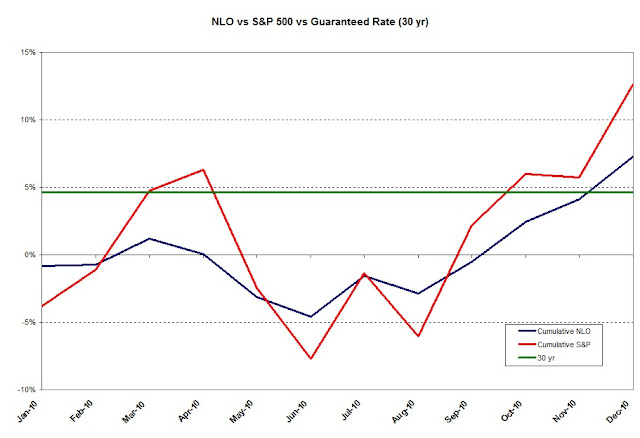
This year was the worst performing year for the New Low Observer in the last five years since our investment approach was codified.  Despite our lackluster performance, you can see that our portfolio incurred less volatility that the S&P 500 index.  We believe this has a lot to do with our philosophy, or the lack thereof, on diversification.  Although our portfolio did not beat any of the major indexes (Dow Industrials, S&P 500, and Nasdaq Composite) we did manage to exceed the return of our primary target, the 30-year U.S. treasury. 
Below is the end of month performance chart of the NLO portfolio and the S&P 500 during 2010.  Throughout the entire year we averaged 50% of the portfolio in stocks and 50% in cash.  The period from January to June reflects partial implementation of our strategy.  The second half of the year, June to December, reflects the full use of our investment strategy.
New Low Observer performance for 2010 (http://www.newlowobserver.com/)
Our new target to beat in the coming year is the 30-year treasury yield as of January 3, 2011 at a rate of 4.39%.  Although this is a modest target, we cannot easily justify the buying and selling of stocks if we cannot exceed the return of a guaranteed rate. 
Below is the performance of our portfolio since the end of 2005:

Dow
S&P
NASDAQ
NLO
2006
16.29%
15.74%
9.52%
18.30%
2007
6.43%
5.46%
9.81%
19.80%
2008
-33.84%
-37.22%
-40.54%
14.35%
2009
18.82%
27.11%
43.89%
36.65%
2010
11.02%
14.32%
16.91%
7.14%

NLO Dividend Watch List

We began the year with a very strong market that also included a Dow Theory confirmation of the bullish trend and our watch list now contains 19 companies that are within 15% of their 52-week low.

January 14, 2011 Watch List

Symbol Name Price % Yr Low P/E EPS (ttm) Dividend Yield Payout Ratio
ABT Abbott Laboratories 46.89 5.16% 15.48 3.03 1.76 3.75% 58%
CL Colgate-Palmolive Co. 78.31 7.10% 18.30 4.28 2.12 2.71% 50%
CLX Clorox Co. 63.98 8.51% 13.76 4.65 2.20 3.44% 47%
LLY Eli Lilly & Co. 34.91 9.03% 8.01 4.36 1.96 5.61% 45%
KMB Kimberly-Clark Corp. 63.64 9.25% 14.40 4.42 2.64 4.15% 60%
CAG ConAgra Foods, Inc. 23.11 9.94% 15.51 1.49 0.92 3.98% 62%
JNJ Johnson & Johnson   62.55 10.01% 12.84 4.87 2.16 3.45% 44%
UVV Universal Corp. 39 10.29% 7.66 5.09 1.92 4.92% 38%
NWN Northwest Natural Gas Co. 45.71 11.35% 16.33 2.80 1.74 3.81% 62%
CWT California Water Service 37.68 11.45% 19.94 1.89 1.19 3.16% 63%
MRK Merck & Co., Inc 34.23 11.50% 13.22 2.59 1.52 4.44% 59%
SYY Sysco Corp. 30.45 12.82% 15.70 1.94 1.04 3.42% 54%
AWR American States Water Co. 35.24 12.95% 23.97 1.47 1.04 2.95% 71%
PEP PepsiCo Inc. 66.78 13.67% 16.82 3.97 1.92 2.88% 48%
TGT Target Corp. 55.07 14.18% 14.42 3.82 1.00 1.82% 26%
ALL Allstate Corp.   30.71 14.33% 14.49 2.12 0.80 2.61% 38%
WMT Wal-Mart Stores, Inc. 54.81 14.74% 13.57 4.04 1.21 2.21% 30%
WABC Westamerica BanCorp.  55.9 14.78% 17.52 3.19 1.44 2.58% 45%
MCY Mercury General Corp. 42.97 14.95% 11.22 3.83 2.40 5.59% 63%
19 Companies


Watch List Summary

Some of these companies have been "stuck" on our list for quite some time. Clorox (CLX) has been stuck in the $62 and $64 range for about 10 weeks. For six months Colgate (CL) has spent most of its time trading between $80 and $75.  According to Charles Dow, this biding of time by trading in a "line" creates values  (article here) and may be the first sign of accumulation by institutional investors. Moreover, if the price remains constant while the underlying fundamentals improve (i.e. earnings, dividend, cash flow, book value etc.), the shares could be deemed screaming buys. Conservative and patience investors may want to start their research on these names.

Insurance names are of particular focus by our team currently.  According to Yahoo!Finance, Allstate (ALL) sports a price to book ratio (P/B) of 0.86 while Mercury General (MCY) has a P/B of 1.27.  We are actively buying up many insurance company stocks that have exceptionally low price to book ratios on a relative basis.

Northwest Natural Gas (NWN) is again creeping towards its annual cycle of bottoming in February and March.  Our October 3, 2009 article (located here) on this topic provides what we believe is extensive reseach on the pattern of cycle bottoms for NWN going as far back as 1970. As a follow-up, another article (located here) that we did on NWN provides technical insights on Edson Gould's Altimeter by comparing the stock price movement between 1995-1997 and 2000-2009.  These elements may assist in your fundamental analysis of a great stock with a decent dividend yield.

Top Five Performance Review

In our ongoing review of the NLO Dividend Watch List, we have taken the top five stocks on our list from January 15, 2010 and have check their performance one year later. The top five companies on that list can be seen in the table below.
Name Symbol 2010 Price 2011 Price % change
Shenandoah Telecom. SHEN 17.18 19.19 11.70%
First Financial Corp. THFF 28.97 33.12 14.33%
1st Source Corp. SRCE 15.14 19.88 31.31%
Exxon Mobil XOM 69.11 77.84 12.63%
California Water CWT 37.7 37.68 -0.05%


Average 13.98%


Dow Jones Industrial DJI 10,706.99 11,787.38 10.09%
S&P 500 SPX 1,147.72 1,293.24 12.68%

While our average return was greater than the market, only two companies, First Financial (SRCE) and Shenandoah (SHEN), accomplished the 10% benchmark in less than six months. It's also interesting to note that while ExxonMobil (XOM) underperformed the market for the majority of the year, it managed to track the market at the end of the one year mark. Taking the dividend into consideration, Exxon may have outperformed the market by about one percent.

Disclaimer

On our current list, we excluded companies that have no earnings. Stocks that appear on our watch lists are not recommendations to buy. Instead, they are the starting point for doing your research and determining the best company to buy. Ideally, a stock that is purchased from this list is done after a considerable decline in the price and extensive due diligence. We suggest that readers use the March 2009 low (or the companies' most distressed level in the last 2 years) as the downside projection for investing. Our view is to embrace the worse case scenario prior to investing. A minimum of 50% decline or the November 2008 to March 2009 low, whichever is lower, would fit that description. It is important to place these companies on your own watch list so that when the opportunity arises, you can purchase them with a greater margin of safety. It is our expectation that, at the most, only 1/3 of the companies that are part of our list will outperform the market over a one-year period.
Please revisit New Low Observer for edits and revisions to this post. Email us.

Nasdaq 100 Watch List

Below are the top Nasdaq 100 companies that are within 20% of the 52-week low. This list is strictly for the purpose of researching whether or not the companies have viable business models. These companies are deemed highly speculative unless otherwise noted.
Symbol Name Price P/E EPS Yield P/B % from Low
ISRG Intuitive Surgical $267.40 31.8 $8.40 - 5.26 8.68%
CEPH Cephalon, Inc. $60.32 11.3 $5.35 - 1.81 9.67%
CSCO Cisco Systems $20.97 15.4 $1.36 - 2.62 10.37%
APOL Apollo Group, Inc. $37.98 10.5 $3.62 - 4.30 12.54%
AMGN Amgen Inc. $56.98 12.3 $4.63 - 2.24 13.37%
ERTS Electronic Arts $16.05 - -$0.48 - 2.04 14.17%
QGEN Qiagen N.V. $19.32 30.4 $0.64 - 1.89 14.59%
TEVA Teva Pharma. $54.01 16.6 $3.25 1.30% 2.22 14.94%
VRTX Vertex Pharma. $36.16 - -$3.73 - 11.31 15.71%
GRMN Garmin Ltd. $30.53 8.3 $3.66 4.80% 2.10 16.93%
INTC Intel Corporation $20.66 11.2 $1.85 3.00% 2.43 17.39%
GILD Gilead Sciences $37.50 11.0 $3.42 - 5.36 18.18%
SHLD Sears Holdings $70.18 41.9 $1.68 - 0.94 18.53%
^NDX Nasdaq 100 2,276.70
***Read our Chapter 2 review of Seth Klarman's book Margin of Safety here***

Watch List Summary
From the current watchlist we are considering the prospects for Intuitive Surgical (ISRG), Intel (INTC) and Garmin (GRMN).  Garmin is interesting simply for the fact that the moving feast known as their dividend should be announced in the coming months.  We're curious if Garmin will eliminate, raise, lower or keep the dividend the same.  As has been the case in the last four years, Garmin has paid their dividend all at once.  This will be very interesting considering the 4.80% payment. 
In the Nasdaq 100 Watch List of 15 companies from December 12, 2010 to the closing price January 7, 2011, the average return from all of the companies was +3.65%.  This is compared to the NDX (Nasdaq 100 Index) which had a gain of +2.77%.
Dish Network (DISH) registered the largest gain of +12.45%. Adobe Systems (ADBE) rose 11.60% since December 12th.  Cisco (CSCO) came in third on the list with a gain of 6.45%.
Watch List Performance Review
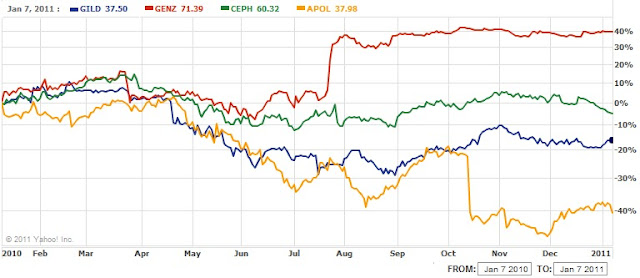
In our ongoing review of the Nasdaq 100 Watch List, we have taken the top four stocks on our list from the closing price of January 7, 2010 and have checked their performance one year later. The top four companies on that list are provided below with the closing price for January 7, 2010 and January 7, 2011.

Symbol Name 2010 2011 % change
GILD Gilead Sciences 44.54 37.50 -15.81%
CEPH Cephalon, Inc. 63.01 60.32 -4.27%
GENZ Genzyme Corp 53.81 71.39 32.67%
APOL Apollo Group 60.50 37.98 -37.22%
Average -6.16%
^NDX Nasdaq 100 1892.59 2276.70 20.30%
Only one stock, Genzyme (GENZ), was able to to show a positive return.  This was of little consolation as the three other stocks on our watchlist fell, on average, -19%.  The Nasdaq 100 outperformed the watchlist with a gain of 20% in the last year. 
Disclaimer
Stocks that appear on our watch lists are not recommendations to buy. Instead, they are the starting point for doing your research and determining the best company to buy. Ideally, a stock that is purchased from this list is done after a considerable decline in the price and extensive due diligence. We suggest that readers use the March 2009 low (or the companies' most distressed level in the last 2 years) as the downside projection for investing. Our view is to embrace the worse case scenario prior to investing. A minimum of 50% decline or the November 2008 to March 2009 low, whichever is lower, would fit that description. It is important to place these companies on your own watch list so that when the opportunity arises, you can purchase them with a greater margin of safety. It is our expectation that, at the most, only 1/3 of the companies that are part of our list will outperform the market over a one-year period.

Please revisit New Low Observer for edits and revisions to this post. Email us.

NLO Dividend Watch List

Watch List Summary

We end 2010 and begin 2011 with 10 companies on our Dividend Watch List. The table below provides investors with some great prospects for the new year.
December 31, 2010 Watch List

Symbol Name Price % Yr Low P/E EPS (ttm) Dividend Yield Payout Ratio
CLX Clorox Co. 63.28 7.33% 13.61 4.65 2.20 3.48% 47%
CAG ConAgra Foods, Inc. 22.58 7.42% 14.29 1.58 0.92 4.07% 58%
ABT Abbott Laboratories 47.91 7.45% 15.81 3.03 1.76 3.67% 58%
KMB Kimberly-Clark Corp. 63.04 8.22% 14.26 4.42 2.64 4.19% 60%
JNJ Johnson & Johnson   61.85 8.78% 12.70 4.87 2.16 3.49% 44%
SYY Sysco Corp. 29.40 8.93% 15.15 1.94 1.04 3.54% 54%
LLY Eli Lilly & Co. 35.04 9.43% 8.04 4.36 1.96 5.59% 45%
CL Colgate-Palmolive Co. 80.37 9.92% 18.78 4.28 2.12 2.64% 50%
CWT California Water Service 37.27 10.23% 19.72 1.89 1.19 3.19% 63%
AWR American States Water 34.47 10.48% 23.45 1.47 1.04 3.02% 71%
10 Companies


Looking at the current watch list, it appears to have good elements of a "diversified" portfolio.  Below is how we would manage the distribution of an investment portfolio of the above stocks in the coming year:
As each position achieves a 10% return within a year, we consider selling the stock and rolling the funds into cash or the next best alternative.  It could be said that the watchlist above is one of the most compelling portfolios for new investors. We've broken down the positions into industry groups so that each industry (water, big pharma, food producers/distributors, household products) gets approximately 25% of invested funds or 12.5% of the entire portfolio.  The cash is for any dividend stock (in the universe of those stocks that had a history increasing annual dividends every year for a minimum of 10 years in a row) that suddenly becomes underpriced and could be verified to be a viable going concern based on fundamental metrics.  We'd label this the portfolio for 2011. 

Top Five Performance Review

In our ongoing review of the NLO Dividend Watch List, we have taken the top five stocks on our list from January 1, 2010 and have check their performance one year later. The top five companies on that list can be seen in the table below.

Name Symbol 2009 Price 2010 Price % change
SUPERVALU Inc. SVU 12.71 9.63 -24.23%
California Water Service CWT 36.82 37.27 1.22%
Exxon Mobil Corp.   XOM 68.19 73.12 7.23%
CR Bard, Inc. BCR 77.9 91.77 17.80%
Aqua America Inc WTR 17.51 22.48 28.38%


Average 6.08%


Dow Jones Industrial DJI 10,520.10 11,577.51 10.05%
S&P 500 SPX 1,126.48 1,257.64 11.64%
It is interesting to note that we've had personal experience will all of the stocks mentioned above within the last 18 months.  Although SuperValu (SVU) shows a major decline of over -30% at one point in the last year, we were able to achieve an annualized return of nearly 400% with our recommendation and subsequent sell recommendation in the month of January 2010 (article here).  This is one instance where buy and hold wasn't the most exciting policy.
California Water (CWT) was recommended on January 3, 2010 (article here) and we suggested that, based on cycle analysis, the prospects of CWT making a substantial move above the prior high would be between 2011 and 2012.  CWT proved to be an income generater in 2010 for investors who managed to hold the stock understanding that the price probably wouldn't take off immediately.  Our downside target are still in place for anyone considering the stock.
ExxonMobil (XOM) was another recommendation that we made in January of 2010.  The stock fell 15% during the year and recovered to return 10% on a total return basis which prompted our sell recommendation in December 2010 (article here).
Bard Corp (BCR) provided annualized returns of 29% at the time of our August 2009 sell recommendation (article here). We had held the stock for approximately 4 months with satisfactory results.  As noted in all or our recommendations, we seek modest annualized returns of between 9% and 12%.  Therefore, accomplishing 29% allows us to take advantage of other opportunities that may exist at the time.
AquaAmerica (WTR) was a runaway success in the past year considering the performance of the market overall and that a water utility is only expected to provide income to investors.  As indicated in the chart above, WTR's total return exceeded over 30% (dividends plus appreciation).  In December 2010, we provided our sell recommendation of AquaAmerica (article here) after garnering an annualized total return of nearly 80%.

Disclaimer

On our current list, we excluded companies that have no earnings. Stocks that appear on our watch lists are not recommendations to buy. Instead, they are the starting point for doing your research and determining the best company to buy. Ideally, a stock that is purchased from this list is done after a considerable decline in the price and extensive due diligence. We suggest that readers use the March 2009 low (or the companies' most distressed level in the last 2 years) as the downside projection for investing. Our view is to embrace the worse case scenario prior to investing. A minimum of 50% decline or the November 2008 to March 2009 low, whichever is lower, would fit that description. It is important to place these companies on your own watch list so that when the opportunity arises, you can purchase them with a greater margin of safety. It is our expectation that, at the most, only 1/3 of the companies that are part of our list will outperform the market over a one-year period.

Please revisit New Low Observer for edits and revisions to this post. Email us.