Below is Barrick Gold (GOLD) from 1990 to 2024 applying the Price Momentum Indicator. Continue reading

-
Topics
Archives
-
-
Recent Posts
-
-
-
-

Below is Barrick Gold (GOLD) from 1990 to 2024 applying the Price Momentum Indicator. Continue reading
Below is Agnico Eagle Mines (AEM) from 1990 to 2024 applying the Price Momentum Indicator. Continue reading
On February 13, 2024, we received a thoughtful response from Hanif Bayat to a comment that we made about the rise in real estate prices in Canada.

This response was preceded by the comment from Hanif Bayat, “Maybe Bank of Canada’s too many rate cuts in 2008, while Canadian home prices didn't crash unlike U.S.”
First and foremost, neither the Bank of Canada or the Federal Reserve of the United States have any say in the direction of interest rates. Rate policy is dictated by the markets. The only issue is how long before the central banks respond to the market rates.
We start with the longest running and continuously reported data series [a must for good analysis] on interest rates found at the Federal Reserve Bank of St. Louis (FRED).

Using the “Monthly, Percent, Not Seasonally Adjusted” (TB3MS) data from January 1934 to January 2024, we can compare that to the “Interest Rates, Discount Rate for United States” (INTDSRUSM193N) data from 1950 to 2021.

The “Interest Rates, Discount Rate for United States” is the actual Federal Reserve response to market rates.
What you’ll notice between to the two data sets from 1950 and after is that the Federal Reserve never led the directions of interest rates from a prior peak or trough.


Pick your period and you’ll see the same outcome. Let’s expand this concept beyond the limited period offered by FRED.

If the 90 year history of the data is consistent with the Federal Reserve Bank following the market then we can expand that to the period from 1915 to 1960 for a reasonable period of overlap to confirm the consistency of the claim [THE CLAIM: neither the Bank of Canada or the Federal Reserve of the United States have any say in the direction of interest rates. Rate policy is dictated by the markets] and the data.
The claim of the Fed holding rates at any level “too long” or “too short” is nullified. This extends to the Bank of Canada. Why?
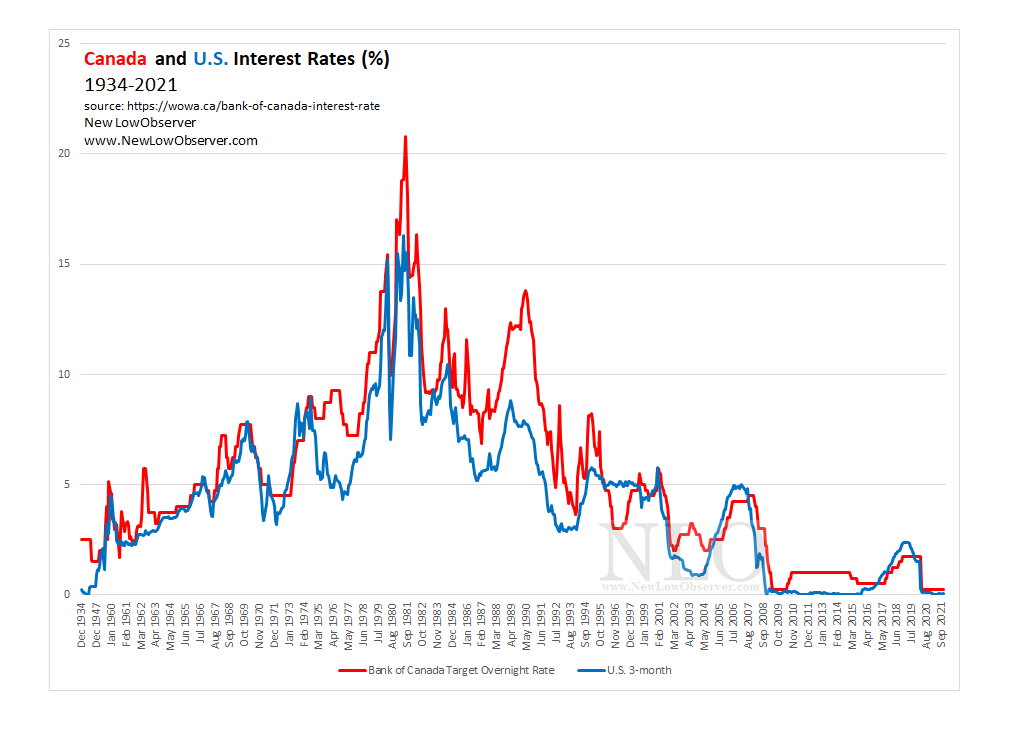
Autonomy of interest rates is a nuanced topic. However, when we zoom out, we can clearly see that the overall direction of interest rates, on a secular basis, between Canada and the U.S. are joined at the hip. This confirms the words of Charles H. Dow (co-founder of the Wall Street Journal) in October 1, 1901:

For this reason, when we see that the Canadian rate environment following the same secular trend as the U.S., then we don’t have to worry about whether or not Canada has any control over their rates. For this reason, the Bank of Canada didn’t hold down rates artificially or too long.
Let’s solidify the idea that central banks have zero say over the secular trend in interest rates. Why? Because we haphazardly referred to the idea earlier but did not nail down the concept.

In the 1947 book titled “Cycles: The Science of Prediction”, Edward Dewey and Edwin Dakin present the idea that there would be a peak in inflation and interest rates in 1979. This assessment is based on the cyclical pattern of rates from 1790 to 1947. In addition to the idea of a peak in 1979 that would be followed by a decline, Dewey had a low set at 2006. Years of work with cycles has taught us that there will be slippage that pushes out any expected peak or trough.
Most important to understand about Dewey’s work ( founder, Foundation for the Study of Cycles) is that it was premised on the data from 1790 and earlier. For the Wholesale Prices from 1790 to 2000 above, the period in red indicates before the modern central bank.
Let’s reinforce the idea that central banks have little impact on the direction of interest rates. The chart below was generously provided by @WinfieldSmart on Twitter from October 12, 2020. Our update to the chart was to simply indicate the period before the Federal Reserve in red.

As can be plainly seen, the direction of interest rates, on average, has been on a vigorous declining trend for the period in question. That interest rates would possibly go to zero and stay there for an extended period of time should not surprise anyone.
Some have proposed that central bank policy is moving the needle for interest rates in the short term and therefore, they do have an impact on interest rates. More specifically, this claim is often associated with the concept of Quantitative Easing (QE) as a remedy for the housing crisis (GFC). Let’s put that idea to rest with the following review of the data.
The concept of modern Quantitative Easing (QE) is thanks to the work of the Bank of Japan. The perceived manipulation of markets with the uses of QE surely must have been the reason that interest rates were held down for so long, right?

In a piece by Henry McMillan and Jerome Baesel from 1988, they projected the direction of interest rates from near double digits rates to negative rates by 2008 to 2022. Remember, this was before the implementation of QE in Japan and the U.S.
Nothing that central banks have done is out of line for what could have been expected from 1988 or 1310. This brings us to the topic of home prices in Canada. That will be our follow-up article in the commentary with Hanif Bayat.
See also:
Posted in Canada, Central Bank, Federal Reserve Bank, interest rates, QE
Three years ago, it was hailed as a second coming and the dawn of a new age. Hidden underneath was an appeal to the primal instincts of goldphiles everywhere.
On February 13, 2021, Idaho Bill H0007 was passed by 51-19. The bill states, “Amends existing law to provide that idle moneys may be invested in physical gold and silver in certain instances.” What is most important about this bill is the timing.

It was introduced just after the runup in the price of gold from the late 2015 low.

Whoever the legislator is that proposed such a law is keenly aware of the foibles of followers of gold but also doesn’t have the acumen to know when such a law, in the best interests of the citizens, should have been proposed (2015 or 1999).
The law (found here in PDF format) itself reads as a mockery of the concept of gold as money, go on, read it and laugh…

The costs of maintaining a facility that is either in state, or in an adjacent state, while the price of gold goes nowhere in the face of mounting inflation really begs the question, to whose benefit is this charade?
See also:
Below are the price projections for the Price Momentum Indicator stocks based on analyst LOW earnings estimates in the coming year. These stocks can be found on our February 2, 2024 U.S. Dividend Watch List.
We’re watching with a sense of awe as the Dow Jones Industrial Average and Nikkei 225 Index gravitate toward the same closing price.

The last time the two indexes were at or near the same level (on the way up) the Nikkei embarked on an epic boom.

This coincides with the apparent inflation cycle that we are entering (versus the disinflation period of 1980-2015). As we said on SeekingAlpha, the inflationary period was good for Japan and we may see something similar this time around.

See also:
Posted in Dow Jones Industrial Average, inflation, Nikkei
Q: “With respect to your last sentence, more specifically about the stock market, should it not be more consistent to have seen the stock market return to its prepandemic level, like in (1918-)1921 (The Forgotten Depression)?”
A: In almost every economic measure, we have seen what we have called the pandemic roundtrip. This means seeing a spike or dramatic drop from March 23, 2020 followed a the opposite move from either the peak or trough back to the March 23, 2020 level. A small sampling below.


We have seen this same phenomenon in many, but not all, stocks. With almost every box checked for what you would see during a pandemic, we believe that the exceptional performance in the stock market is acceptable.
Our January 29, 2024 posting clarified in detail, based on the Dow Theory, the issue of when a market is rangebound and how it can be more significant than a crash (presumably to the pandemic low point of March 23, 2020).
See also:
Posted in COVID-19, Pandemic Roundtrip
Some are calling Stephen Roach’s article dated February 11, 2024 in the Financial Times the bottom in the decline for the Hang Seng Index.

Dow Theory is very clear on this claim.

It appears that we’re seeing a double bottom in the Hang Seng Index. If the Index can remain above the October 23, 2022 low then we can feel confident about the possibility for a reversal. However, a decline below the 2022 level will mean more declines should not surprise anyone.
Posted in Hang Seng Index, Hong Kong, Stephen Roach
On February 11, 2024, we posted the following chart to Twitter:

What is our take on this chart? To find out we had to regenerate the same data to the current period, as seen below:

Russell suggests that the chart indicates that the Dow was cheap when at the lows and housing is cheap when the indicator is higher. Can housing really be that cheap as the ratio continues to climb higher?
We don’t think so. Instead, we think that the indicator is merely reflecting the inverse relationship with interest rates. What we should see is the indicator ultimately getting down to the 1980 level as interest rates rise.
This highlights the importance of obtaining a full cycle before drawing any meaningful conclusions.
We continue to break down our watchlists by the analysts earnings estimates, as recently seen here:
Our thesis is premised on the work of many. Our latest example is shown in the piece below from David Dreman dated December 29, 1997.

Our 2017 piece confirms much of the claims by Dreman.
See Also:
Posted in Analyst Estimate, David Dreman
Jim Bianco of Bianco Research says the following:
“Money management just crossed the Rubicon.”

We’ve heard the language before. The belief being that an arbitrarily set parameter has triggered something. What has been triggered? We don’t really know since it hasn’t been defined. The lack of a specific claim is intentional since it leaves it open to any interpretation. When we look at the prior claims along the same lines, we can see why there is little in the way of what this rise in “passive money” really means.

From the above November 1997 article:
“While Wall Street paints 401(k) members as indifferent to short-term swings, the evidence of a few days in October suggests the opposite. They appear far more attuned to the ebbs and flows of the market than the experts realized.”
Likewise, the further you go back the more we see the same worry about new money entering the market.

This from Richard Russell’s Dow Theory Letters dated April 12, 1995:
“With stocks clearly overvalued, the funds move into the very liquid big-cap Dow type stocks (the “safe” stocks) and the Dow plows higher.”
What is implied by crossing “the Rubicon” is that a big crash is coming because dumb money is coming into the market regardless of values.
Welcome to the nature of markets for thousands of years. A Rubicon hasn’t been crossed, instead, we should expect more of the same from markets which is merely a reflection of human behavior.
Posted in Bianco, dumb money, ETF, Index Funds, Twitter Tape
It was mentioned that in order to save the banking system, it is necessary to raise interest rates.
“Either they raise rates rapidly to save the bond market — or they lose the whole banking system. This will become obvious and existential (soon)”

As we’ve noted in the past, the history of rising rates has been very good for markets under the right conditions. However, the real question is, how is it beneficial to have Quantitative tightening (QT) or a balance sheet unwind?
One of our favorite examples is found in the unwind of the Reconstruction Finance Corporation.

When the government gets out of the business of bailing out, the reverse of the “crowding out effect” takes place. As noted by us:

This is consistent with Dow Theory which says, when the government gets involved, they take away the risk portion of the market. This could mean that the market crashes due to government meddling. However, according to Dow Theory, it typically means that whatever the government got involved in will trade more like a government bond, flat to middling at best.

This concept of trading like a bond can best be seen in nationalization of railroads during the period 1918-1921. This is also seen in the performance of Fannie Mae.

In this case, the wild upside potential before government control in 2008 cannot and will not be seen after government control. This in spite of the fact that from the 2009 lows, Fannie Mae has jumped +600%. Again, contrast that with +6,000% move before 2005.
See also:
Posted in Dow Theory, interest rates, QT, Quantitative tightening, Twitter Tape
The question is asked:
“What’s your CPI forecast for tomorrow?”

To answer this question, the context matters. There is little in the way of debate. As we’ve outlined since the beginning of the pandemic (February 25, 2020), inflation has a specific trajectory.

Nothing that we’ve seen, either for the stock market or inflation, has been inconsistent with the extensive history of Plagues or Pandemics.
See Also:
Posted in inflation, Twitter Tape
Here is something that weighs on our mind:

Our experience says this is a warning, as accurately presented by Micheal A. Gayed. Our concern is that this only implies one scenario, the tech sector ultimately crashing as the other half already have.
An alternative prospect is that the lagging sectors skyrocket without the tech sector falling. This is typically a warning of a coming crash.

The rationale is that investors might follow the advice of Garzarelli and “Buy Catch-Up Indexes.” Investors typically buy these indexes because they have failed to be in the initial runup in the tech stocks. Seeing all the gains and missing out, they attempt to make up for lost time.
This was best represented by buyers of gold in Japan in January 1988.

Note how buyers went on a spree in an attempt to make up for lost time. We all know how this was resolved.
Posted in Catch-Up Indexes, Twitter Tape