FTSE 100 Watch List: May 29, 2013

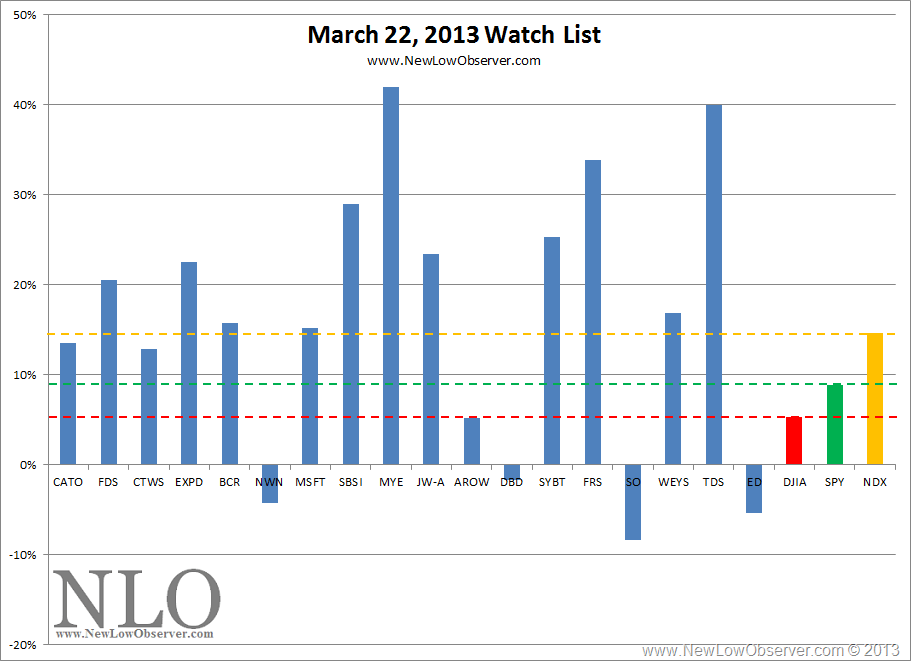
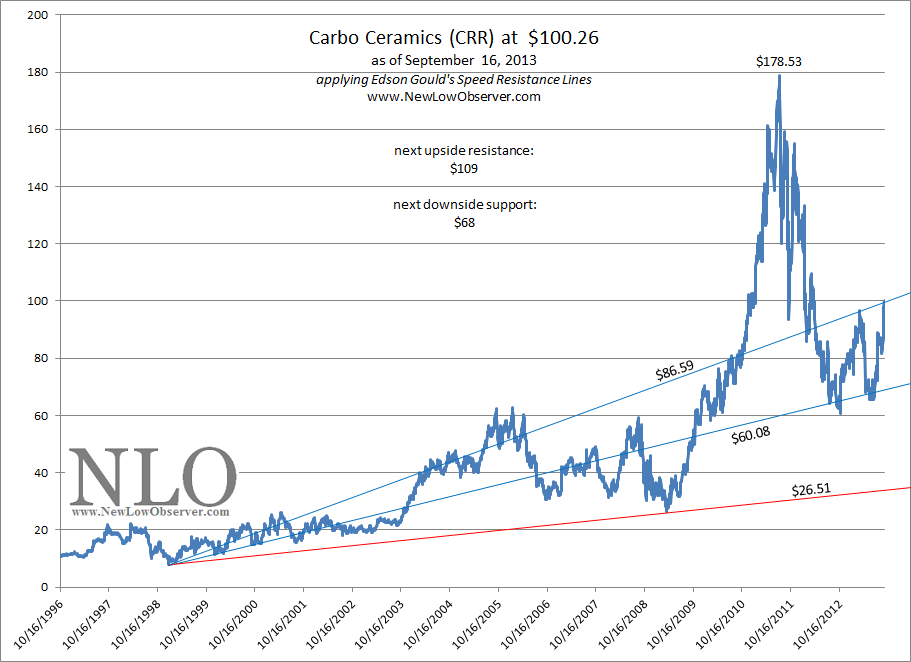
Below is a list of the Financial Times Stock Exchange 100 (FTSE 100) companies that are within 10% of the one year low based what we believe to be reliable sources.  To get a some ideas on different investment strategies that can be employed with these stocks we recommend reading the book Free Capital by Guy Thomas.

Continue reading

Dividend Watch List: May 24, 2013

Below are the 9 companies on our U.S. Dividend Watch List that are within 11% of their respective 52-week lows. Stocks that appear on our watch lists are not recommendations to buy. Instead, they are the starting point for doing your research and determining the best company to buy. Ideally, a stock that is purchased from this list is done after a considerable decline in the price and rigorous due diligence.

Continue reading

Nasdaq 100 Watch List: May 24, 2013

Below are the Nasdaq 100 companies that are within 11% of their respective 52-week lows. Stocks that appear on our watch lists are not recommendations to buy. Instead, they are the starting point for doing your research and determining the best company to buy. Ideally, a stock that is purchased from this list is done after a considerable decline in the price and rigorous due diligence.

Continue reading

Actavis buys Warner Chilcott, Upside Seems Limited

On May 21, 2013,  Actavis (ACT) announced that it would acquire Warner Chilcott (WCRX) for $20.08 per share (found here) and the deal is expected to close by year-end 2013.  This has turned into an incredible string of companies that have been on our New Low Observer Watch Lists and ultimately get acquired.

On April 30, 2012, we gave Warner Chilcott a sell recommendation after the stock gained +57.11% in 3 months(found here).  After that sell recommendation, Warner Chilcott declined –35% by mid-December.  We reiterated our sell recommendation of Warner Chilcott on September 6, 2012 (found here), from that level the stock decline –12.93%, to the December 13, 2013 low.

image

As regular readers of our work know, we compare investments on an annualized return basis.  In the example above, the annualized gain from December 16, 2011 to April 30, 2012 sell recommendation or the December 31, 2013 completion of the merger, are as follows:

  • 12/16/2011 to 4/30/2012:   +276% (excluding special dividend)
  • 12/16/2011 to 12/31/2013:   +80% (including special dividend)

There are several concerns regarding the transaction between Actavis (ACT) and Warner Chilcott (WCRX) that should be taken into consideration.  First and foremost, is the current price action of Actavis stock.  Price action determines a majority of relative fundamental value attributes. Below is the Speed Resistance Lines [SRL] based on the stock price for Actavis since June 2006.

image

Any transaction being carried out by Actavis at the current price is heavily dependent on the stock price remaining at $120 and above.  According to Gould’s SRLs, Actavis has a conservative downside target at $87.01 and an extreme downside target at $43.51.  Our experience indicates that the conservative downside target is a lock, at this point.  This is in spite of the fact that the price could double before getting to such a downside target, as was the case with our April 2012 conservative downside target of $420 for Apple (AAPL) (found here).   While the conservative downside target appears to be a lock, the extreme downside target begs some kind of explanation of how it is possible to decline –50% or more.

The first consideration that comes to our mind is the strategic nature of the purchase.  The Actavis purchase of Warner Chilcott will lower the corporate tax rate from 29% to 17% because WCRX is located in Dublin, Ireland as reported by Bloomberg News (found here).  While the reduction of the tax rate seems to be beneficial, it has done little to contribute to Actavis’ earnings.  Already there has been faux outrage by Congress over the fact that Apple has legally dodged their “fair share” of corporate taxes through entities located in Ireland (found here).  We believe that with Congress spotlighting the issues related to legal tax avoidance, some areas that were once loopholes will be closed.  This will require more time to come up with new legal tax avoidance strategies.  Also, with Warner Chilcott being domiciled in Ireland, the focus of the Apple entities, Ireland may be the first target for changes to the tax loopholes that presently exist.

Another challenge is the dramatic increase in sales and earnings due strictly to the merger (found here).  As reported by Zacks Equity Research, based on the preliminary numbers, sales for Actavis are supposed to jump from 7% to 25% by 2014.  Also, annual earnings are supposed to increase 30% from the current level which stands in the negative for the trailing twelve months.  However, little of the gains for Actavis will be a direct result of internal efficiencies and significant improvement of sales.  This come at a time when Warner Chilcott appeared desperate for a buyer after private equity shareholders cashed in most of their chips after substantial special dividends nearly equal to the IPO price set in 2005.

At the time of Watson Pharmaceutical’s acquisition of Actavis in early 2012, it was announced that, “…Including synergies, Watson anticipates the acquisition will be greater than 30% accretive to 2013 Watson non-GAAP EPS, with accretion accelerating in 2014 through organic growth and further achievement of synergies(found here).  In the announcement of the merger between Actavis and Warner Chilcott (WCRX), the company press release says that it will be “…immediately Accretive With Opportunities for Substantial Operational Synergies and Tax Savings” and “…The transaction is expected to be more than 30 percent accretive to Actavis non-GAAP earnings per share in 2014, including anticipated synergies.(found here).  Aside from using nearly the exact same language in the press releases for two different companies, the set up for 2014 could be a big disappointment.

In spite of the accretion that is suggested, Actavis’ 2013 first quarter earnings was –$0.79, down from the $0.43 in the prior year period (found here). In addition, the 2012 fourth quarter earnings were down –10% from the same quarter in the prior year (found here). The 30% immediate accretive non-GAAP gains due to the acquisition of Actavis has not yet been realized.  Also, non-GAAP earnings are not contributing to the bottom line in the form of positive annual net earnings.  It is possible that the merger with Warner Chilcott is simply covering up the failings of Actavis to come through on promises of “immediately accretive” value for the Watson Pharmaceutial/Actavis merger.

Finally, according to Value Line Investment Survey, based on estimated 2013 cash flow, Actavis has a fair value of $120.28.  Since 2006, Actavis has traded below Value Line’s fair value while never trading above such a level.  This trend persisted even after Watson Pharmaceutical acquired Actavis, which was concluded in October/November 2012.  At the current price of $130, Actavis is 3% above Value Line’s estimated 2016-2018 fair value.  We think the persistence of Actavis to trade at or below Value Line’s fair value estimates will continue to dominate the stock price going forward.

It appears that paper gains due to mergers and acquisitions through the use of tax reductions and non-GAAP reporting is not a fundamental shift in Actavis’ ability to increase shareholder value.  Additionally, the +56% parabolic run-up in the price along with Edson Gould’s Speed Resistance Lines and Value Line’s fair value estimates suggest that the downside risks are significant.

Gold Stock Indicator

Continue reading

W.R. Berkley: Raises Dividend +11%

After our May 11, 2013 recommendation (found here) to consider W.R. Berkley (WRB), we get the news that WRB has announced that they will be increasing their dividend by +11% (found here).  Below is the history of dividend increases for WRB since 1982.  Please consider WRB for your long-term investment objectives.

image

Gold Stock Indicator

Today the Gold Stock Indicator increased over +12% as the Philadelphia Gold and Silver Index increased +5.71% while the actual price of gold declined -1.02%.  Keep in mind that, in the past, we’ve demonstrated that the price of gold stocks going counter to the price of gold (on the upside) can be a warning of more downside risk.

Continue reading

Canadian Dividend Watch List: May 17, 2013

This is a list of Canadian dividend stocks that currently, or in the past, had a history of consecutive dividend increases. For those wishing to find the most complete fundamental information on these companies, we recommend visiting one of Canada’s leading financial websites, the Financial Post (found here). However, Yahoo!Finance probably has the better long-term charts and historical dividend data.

Continue reading

Dividend Watch List: May 17, 2013

Below are the 6 companies on our U.S. Dividend Watch List that are within 11% of their respective 52-week lows. Stocks that appear on our watch lists are not recommendations to buy. Instead, they are the starting point for doing your research and determining the best company to buy. Ideally, a stock that is purchased from this list is done after a considerable decline in the price and rigorous due diligence.

Continue reading

Gold Stock Indicator

Early indications are that the Gold Stock Indicator is at the same level as the “panic 2 level.”  Only a little more to go before the we’re below the “stage 4 buy” level. Continue reading

Our Visit to the 2013 Berkshire Hathaway Shareholder Meeting

This year, the New Low Observer team (including our ten year old daughter) went to Omaha, Nebraska for the 2013 Berkshire Hathaway shareholder meeting.  The following are some observations based on the comments of Warren Buffett and Charlie Munger:

According to Buffett, Burlington Northern Santa Fe is running on all cylinders.  Carloading of freight for BNSF exceeded that of the top four competitors in the industry combined. It could not be ignored that carloading is a metric for determining the health of the rail industry.  In regards to getting oil from remote regions, oil travels faster by rail than by pipeline.  Although this  point was reiterated in the meeting, there was not enough explanation of why this is the case.  Some possible explanations were that pipes require constant maintenance.  Upkeep of the pipeline requires stopping the flow in order to repair the system.

A shareholder asked about book value per share growing at less than average as compared to the price of the S&P 500, to which Warren said [paraphrasing]: “…the last ten years have not been very good, 2013 will be the first 5 year period Berkshire has fallen short of the S&P 500 [index]. Berkshire Hathaway is likely to do better in down years rather than up years. Book value is the best ‘approximate’ value that is closest to intrinsic value.” Munger [paraphrasing]: “…of course, annual gain is going to be a little less than before, because of the substantial growth in prior years.”  On the topic of Berkshire’s book value, we found this little tidbit in the 1979 Letter to Shareholders that is of critical concern on the topic:

“If we should continue to achieve a 20% compounded gain – not an easy or certain result by any means - and this gain is translated into a corresponding increase in the market value of Berkshire Hathaway stock as it has been over the last fifteen years, your after-tax purchasing power gain is likely to be very close to zero at a 14% inflation rate. Most of the remaining six percentage points will go for income tax any time you wish to convert your twenty percentage points of nominal annual gain into cash.

“That combination - the inflation rate plus the percentage of capital that must be paid by the owner to transfer into his own pocket the annual earnings achieved by the business (i.e., ordinary income tax on dividends and capital gains tax on retained earnings) - can be thought of as an “investor’s misery index”. When this index exceeds the rate of return earned on equity by the business, the investor’s purchasing power (real capital) shrinks even though he consumes nothing at all. We have no corporate solution to this problem; high inflation rates will not help us earn higher rates of return on equity.” (source: Buffett, Warren. 1979 Berkshire Hathaway Letter to Shareholders. March 3, 1980. page 3. http://www.berkshirehathaway.com/letters/1979.html.)

It seems that the shareholder’s concern about the failure of the book value to keep pace  with the price of the S&P 500 in the last 10 years isn’t as significant as the threat of a high inflation period.  Buffett closes on the topic with the following thought:

“We intend to continue to do as well as we can in managing the internal affairs of the business. But you should understand that external conditions affecting the stability of currency may very well be the most important factor in determining whether there are any real rewards from your investment in Berkshire Hathaway.” (source: Buffett, Warren. 1979 Berkshire Hathaway Letter to Shareholders. March 3, 1980. page 3. http://www.berkshirehathaway.com/letters/1979.html.)

We've already expressed our belief that Warren Buffett expects that inflation is coming in our March 10, 2013 article titled “Warren Buffett Leverages Up on Inflation Hedge” (found here).  If inflation comes, Berkshire Hathaway shareholders will not have to worry about trailing the S&P 500 as a primary concern.

Regarding the recent Heinz deal, it was asked, “…do you expect the market to underperform based on the favorable terms set up with the Heinz?”  Buffett said [paraphrasing]: “actually, just the opposite, we would have paid more if Charlie and I took a less leveraged position in the Heinz deal.”  We believe the Heinz deal was a constructive effort to circumvent the issues that high inflationary or relative market underperformance may present going forward.

On the topic of reinsurance, Buffett said, “reinsurance is very unfavorable and other companies will find this out over time.”  This reminds us of the following quote, also  from the 1979 shareholder letter:

“We think the reinsurance business is a very tough business that is likely to get much tougher. In fact, the influx of capital into the business and the resulting softer price levels for continually increasing exposures may well produce disastrous results for many entrants (of which they may be blissfully unaware until they are in over their heads; much reinsurance business involves an exceptionally ‘long tail’, a characteristic that allows catastrophic current loss experience to fester undetected for many years). It will be hard for us to be a whole lot smarter than the crowd and thus our reinsurance activity may decline substantially during the projected prolonged period of extraordinary competition” (source: Buffett, Warren. 1979 Letter to Shareholders. March 3, 1980. page 6. http://www.berkshirehathaway.com/letters/1979.html.)

The assessment by Buffett that, “…softer price levels for continually increasing exposures may well produce disastrous results for many entrants…” seems to have been proven correct as noted in the 1985 Shareholder Letter with the following commentary:

“We correctly foresaw a flight to quality by many large buyers of insurance and reinsurance who belatedly recognized that a policy is only an IOU - and who, in 1985, could not collect on many of their IOUs. These buyers today are attracted to Berkshire because of its strong capital position. But, in a development we did not foresee, we also are finding buyers drawn to us because our ability to insure substantial risks sets us apart from the crowd.” (source: Buffett, Warren. 1985 Letter to Shareholders. March 4, 1985. page 13. http://www.berkshirehathaway.com/letters/1985.html .)

A shareholder asked Buffett if the Progressive Insurance (PGR) snap-shot selection method was a threat to the GEICO model.  Buffett said, “We’re confident that GEICO is a successful model based on our sales and ability to generate profit.”  Buffett also said that it was too early to tell whether the new approach by PGR was in fact a viable option over the long-term.  Buffett emphasized the fact that each company has their own model for running a successful business.  Buffett said that he is one to wait 2-3 years to see if the new model for issuing insurance works.  Our take on this matter is that if the new PGR snap-shot selection method is successful and not over-reaching then BRK will buy Progressive.

A question was asked about the corporate profits as a percentage of GDP and whether the current ratio was any indication of an over-valued stock market.  Buffett’s reply was that there is no magic formula for what level was too high or too low.  Buffett then referenced a 1999 Fortune article (found here) which highlighted his concerns about the long term prospects of the stock market based on the relative level of U.S. GDP.  One question related to the efforts of the Federal Reserve in staving off deflation.  Buffett said that the best way to increase nominal GDP is through inflation. However, as far as Buffett and Munger are concerned Bernanke’s action are a huge experiment.  Buffett said that it is like a good book, especially when you don’t know the ending.  Buffett said that “…the next century will be harder (was this a forecast?) due to the current policies.”

Buffett also mentioned that the primary interest for Berkshire Hathaway, on the acquisition front, was the purchase of companies that they already have a stake in.  Buffett made it clear that as a bank holding company, American Express (AXP) was not under consideration because Berkshire is already at the limit according to federal banking regulations.

It was asked, “has Fed policy hurt BRK holdings and companies?” Buffett replied that it has helped BRK holding companies. They’ve been able to borrow to buy out companies that were of particular interest but there will be other problems that come with it. On this topic, Charlie Munger said “I suspect that interest rates will not stay this low for very long, with $48 billion in short-term securities it is earning nothing, if rates get back to 5% then we will have income that we didn’t already have.”

Warren Buffett said something that stood out in our mind and that was “…[I] do not like holding 50 stocks…”  We have always understood Buffett to feel that diversification wasn’t the goal when it comes to investing.  The goal was to seek out large positions when he felt confident about an investment opportunity.  Below are some reiterations of this concept of concentration over diversification:

“As our history indicates, we are comfortable both with total ownership of businesses and with marketable securities representing small portions of businesses. We continually look for ways to employ large sums in each area. (But we try to avoid small commitments – ‘If something’s not worth doing at all, it’s not worth doing well’.)” (source: Buffett, Warren. 1982 Berkshire Hathaway Letter to Shareholders. February 26, 1982. page 1. http://www.berkshirehathaway.com/letters/1982.html .)

“With our financial strength we can own large blocks of a few securities that we have thought hard about and bought at attractive prices. (Billy Rose described the problem of overdiversification: “If you have a harem of forty women, you never get to know any of them very well.”) Over time our policy of concentration should produce superior results, though these will be tempered by our large size.” (source: Buffett, Warren. 1984 Berkshire Hathaway Letter to Shareholders. February 25, 1985. page 17. http://www.berkshirehathaway.com/letters/1984.html .)

“John Maynard Keynes, whose brilliance as a practicing investor matched his brilliance in thought, wrote a letter to a business associate, F. C. Scott, on August 15, 1934 that says it all: “As time goes on, I get more and more convinced that the right method in investment is to put fairly large sums into enterprises which one thinks one knows something about and in the management of which one thoroughly believes. It is a mistake to think that one limits one's risk by spreading too much between enterprises about which one knows little and has no reason for special confidence. . . . One's knowledge and experience are definitely limited and there are seldom more than two or three enterprises at any given time in which I personally feel myself entitled to put full confidence.’” (source: Buffett, Warren. 1991 Letter to Shareholders. February 28, 1992. page 11. http://www.berkshirehathaway.com/letters/1991.html)

The strategy we've adopted precludes our following standard diversification dogma. Many pundits would therefore say the strategy must be riskier than that employed by more conventional investors. We disagree. We believe that a policy of portfolio concentration may well decrease risk if it raises, as it should, both the intensity with which an investor thinks about a business and the comfort-level he must feel with its economic characteristics before buying into it. (source: Buffett, Warren. 1993 Letter to Shareholders. March 1, 1994. page 9. http://www.berkshirehathaway.com/letters/1993.html)

“…if you are a know-something investor, able to understand business economics and to find five to ten sensibly priced companies that possess important long-term competitive advantages, conventional diversification makes no sense for you. It is apt simply to hurt your results and increase your risk. I cannot understand why an investor of that sort elects to put money into a business that is his 20th favorite rather than simply adding that money to his top choices - the businesses he understands best and that present the least risk, along with the greatest profit potential.” (source: Buffett, Warren. 1993 Letter to Shareholders. March 1, 1994. page 11. http://www.berkshirehathaway.com/letters/1993.html)

Buffett mentioned that the insurance industry allows for being able to afford to wait for competitors to do stupid things like underprice the product, which ordinarily forces well managed firms in other industries to exit the business. Instead, in the insurance industry, the prudent firms can wait for the stupid to fail. This is not usually the case for most industries.

“A particularly encouraging point about our record is that it was achieved despite some colossal mistakes made by your Chairman prior to Mike Goldberg's arrival. Insurance offers a host of opportunities for error, and when opportunity knocked, too often I answered. Many years later, the bills keep arriving for these mistakes: In the insurance business, there is no statute of limitations on stupidity.” (source: Buffett, Warren. 1990 Letter to Shareholders. March 1, 1991. page 11. http://www.berkshirehathaway.com/letters/1990.html )

Regarding a question about whether or not he would bring his elephant gun to the European Union, Buffett said that he did not specialize in investment opportunities in foreign markets.  In spite of this fact, Buffett said that if he were seeking opportunities in Europe,  he would be interested in farm equipment companies. Below are previous references to farm equipment in the Letter to Shareholders:

“CTB, which operates worldwide in the agriculture equipment field, has now picked up six small firms since we purchased it in 2002. At that time, we paid $140 million for the company. Last year its pre-tax earnings were $89 million. Vic Mancinelli, its CEO, followed Berkshire-like operating principles long before our arrival. He focuses on blocking and tackling, day by day doing the little things right and never getting off course. Ten years from now, Vic will be running a much larger operation and, more important, will be earning excellent returns on invested capital.” (source: Buffett, Warren. 2008 Letter to Shareholders. February 27, 2009. page 10. http://www.berkshirehathaway.com/letters/2008ltr.pdf )

“CTB, our farm-equipment company, again set an earnings record. I told you in the 2008 Annual Report about Vic Mancinelli, the company’s CEO. He just keeps getting better. Berkshire paid $140 million for CTB in 2002. It has since paid us dividends of $160 million and eliminated $40 million of debt. Last year it earned $106 million pre-tax. Productivity gains have produced much of this increase. When we bought CTB, sales per employee were $189,365; now they are $405,878.” (source: Buffett, Warren. 2010 Letter to Shareholders. February 26, 2011. page 13. http://www.berkshirehathaway.com/letters/2010ltr.pdf )

In closing, there are two concepts that left the most impression on our visit to Omaha.  First, Buffett and Munger made a concerted effort to debunk questions that related to what most people hear in popular media about their investing style.  When asked about what fundamental metrics they look for when selecting a stock Buffett said, “…understanding the math of company fundamentals is not how I select a company.”  When going through the shareholder letters, it is clear that the defining element is the management of the company that makes the difference when deciding to invest in any company.  The numbers can look great but if the managers aren’t of a certain caliber then Berkshire Hathaway will take a pass on the opportunity to invest.

Second, Buffett iterated something that we’ve understood but have had difficulty in conveying to others.  Buffett said [paraphrasing], “the stock market offers the only option to buy [companies] at exceptionally low prices.”  Basically, [stock] markets are inefficient.  Those who take the time to understand the stock market have the opportunity to participate and succeed over an extended period of time.  Those who happen to step into a systematic approach to investing at an early age are the most likely to succeed, all things being equal.

Technical Failure for Apple?

On May 8, 2013, Apple (AAPL) reached as high as $463.84 on a closing basis.  Since that time, Apple has been in a declining trend.  The failure of Apple to materially exceed the previous intermediate peak of $463.58 could indicate that there is significant downside risk. 

For now we believe that Apple has established a “line” where either accumulation or distribution of the stock is taking place.  The failure to exceed the $463.58 indicates, for now, that the next technical test is at the $420 level.

image

One of the primary issues with the current run from the April 2013 low is the fact that trading volume has been in a declining trend.  Declining volume with a rising price is a very unhealthy situation.  Typically, falling volume in the face of a rising price is resolved with rising volume and a declining price.  In the chart below, the last two instances of rising trading volume resulted in exceptional price declines.  (Keep in mind that these rising volume occurrences have taken place within a –50% decline in average trading volume since the bull market began March 2009.)

image

We’d be cautious about the prospects for Apple in light of the fact that the stock appears to be on the cusp of a rising trend in the trading volume which happens to coincide with a declining price.  A decline below $384 would mean that Apple could decline to our extreme downside target.

Gold Stock Indicator

Continue reading

Sell Electronic Arts and Symantec

On our April 27, 2012 Nasdaq 100 Watch List, we highlighted Electronic Arts (EA) and Symantec (SYMC) as stocks of interest out of the 17 equities listed (found here).  Now that both stocks have gained just under +50% in 13 months, we believe the value component has been taken out of these companies.  In keeping with Dow’s Theory of seeking fair profits and while there are still willing buyers, we recommend selling these stocks at the earliest opportunity.

image

Electronic Arts achieved two of the three downside targets that we had while Symantec achieved two of the four downside targets.  Anyone interested in maintaining positions in these stocks should consider selling the principal only.

Insurance Watch List: May 10, 2013

The following is one of our favorite watch lists. We started tracking the insurance industry in January 2011 and we’re very impressed with the results so far.

Anyone who wishes to be successful in insurance stocks should read the book The Davis Dynasty by John Rothchild. The book starts with Shelby Collum Davis investing approximately $50,000 to $100,000 that ultimately grew to $900 million after 47 years. The strategies employed by Davis seem highly accessible to average investors.

Continue reading