U.S. Dividend Watch List: October 2, 2015

The market roared back this week and started the month of October strong.  However, this is after a 7% decline in 3rd quarter.  Trading this market can be difficult but long-term investors should find some value from out watch list.  Below, you will find 39 companies that may be worth exploring. Continue reading

GoPro: Extreme Downside Target Achieved

On October 8, 2014, when GoPro (GPRO) was trading at $89.93, we said the stock had a conservative downside target of $68.93 and an extreme downside target of $31.28.  On December 23, 2014, after falling to the mid-range target of $45.50, we thought that the rout in the stock was over, for the most part.  Although we thought that there was resistance at the $60 level, we figured an investment from the December 23rd level was acceptable with only a portion of the intended investable funds.  We suggested “…putting only ¾ of the intended amount into GPRO with the remaining ¼ for the ‘unlikely’ event of falling to $31.28.”

Unfortunately, GPRO was never able to sustain the initial $60 level and fell as low as $37 before making a discernable rebound.  It was from this level ($37), that GPRO did make a surge to $65.  However, the $65 level was not to last as GPRO declined to the extreme downside target that was indicated as early as October 2014.

image

Now that GPRO has declined to the extreme downside target, a cursory review of Value Line Investment Survey is in order.  Based on the October 2015 Value Line, GPRO is short on meaningful data.  However, the analyst for Value Line has the following thoughts:

  • Sales are surging
  • costs and expenses are declining
  • Bottom line figures are now in the positive
  • 2015 earnings have been increased

The analyst for Value Line has the closing remark that “…the recent price correction may afford risk-tolerant accounts an attractive entry point…”  At the current price, we can’t argue about attractiveness but the future risks are the only concern.

Nasdaq 100 Watch List: September 25, 2015

Dow Industrials Additions and Deletions

On September 23, 2013, the committee that makes changes to the Dow Jones Industrial Average added and dropped three companies from the index.  The three companies dropped were Alcoa Co. (AA), Hewlett-Packard (HPQ) and Bank of America (BAC).  The three companies added to the index were Nike (NKE), Goldman Sachs (GS) and Visa (V).  Below is the price performance of all six companies since those changes to the Dow Jones Industrial Average were made.

image

Worth noting is the fact that Alcoa Co. and Hewlett-Packard exceeded the price performance of all three additions to the index until June 2015.  Nike and Visa have recently achieved outperformance of all three stocks dropped from the index, however, if the current decline in the stock market continues, we suspect that the recent gains of Nike and Visa could be short lived, until the eventual rebound in the market.

On March 19, 2015, Apple Co. (AAPL) was added to the Dow Jones Industrial Average while AT&T (T) was dropped from the index.  The performance of the two stocks since that time shows Apple down –10.06% and AT&T down –3.10%.

image

The outperformance of stocks dropped from an index is not as unusual as it would seem.  Typically, index managers tend to drop stocks that appear weak in price performance and going through a transition to resolve the internal issues contributing to their weakness.  At the same time, stocks that are added to an index just coming off a period of exceptional growth and are about to experience a readjustment period resulting in a decline in their stock price.  The result is stocks being added to the index will adjust lower in price while the timing of the companies dropped from the index coincides with a resurgence in earnings surprises and increased stock price.

Real Estate: Cycle Analysis

On December 9, 2010, we wrote an article titled “Real Estate: The Verdict Is In”.  At the time, we said the following:

“As we come to the close of 2010, it appears that based on the narrow scope of sources that we’ve selected, the bottom in real estate has come and gone.”

Our call of a bottom was a bold claim at the time because of the following points against a rise in real estate:

Each of the above ideas were probably legitimate on their own and in a vacuum.  However, financial markets tend to discount all of the issues that are generally known.  Only a “black swan” event can take away the discounting mechanism of the markets.  Thankfully, it is precisely because a “black swan” can’t be predicted that makes it out of the purview of any market analysis.

Through the passage of time, we have been able to see that our guess for a bottom in the real estate cycle was fairly close, based on the indicators presented at the time.  This article will review the indicators that we cited in previous works.  Finally, we’ll review the real estate cycle as described by Roy Wenzlick, which is the basis for much of our projections on this topic.

The first indicator is the Housing Starts of New Privately Owned Housing Units.  Since our December 2010 article, the indicator has increased +124.44%, or more than double.

image

The next indicator is the Real Estate Loans at All Commercial Banks.  This indicator should be clear, if banks aren’t lending then homes won’t be sold.

image

The next indicator plots the price of real estate for the U.S.  Although there are regional differences, the general trend is the most important for assessing if a “rising tide is lifting all boats”.

image

Real Estate Cycle Analysis

Below we’ve included a revised and adjusted chart of Roy Wenzlick’s cycle of real estate based on the low of 2010/2011.

Continue reading

Canadian Dividend Watch List: September 2015

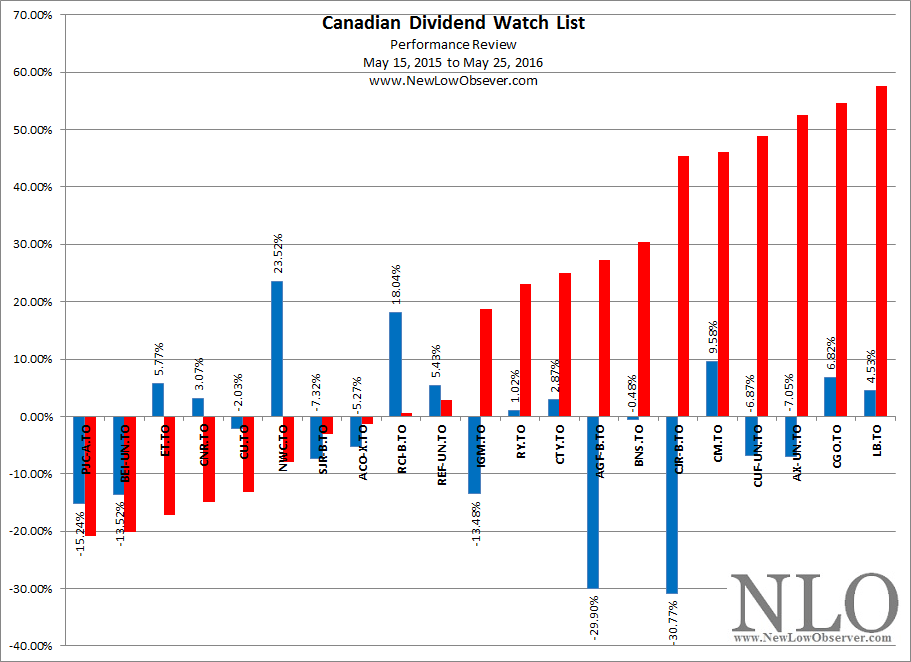
The performance of the Canadian Watch List from September 2014 is listed below:

image

From left to right, the first five stocks on the list averaged a gain of +5.88% in the last year while the entire list averaged a loss of –8.90% compared to the Toronto Stock Exchange decline of –7.95%.

Of the companies listed, Just Energy (JE.TO), Transcontinental (TCL-A.TO) and North West Co. (NWC.TO) were the top three performers with an average gain of +36%.  At the bottom of the performance scale were Crescent Point Energy (CPG.TO), TransAlta (TA.TO) and AGF Management (AGF-B.TO) with an average loss of –51%.

Canadian Dividend Watch List September 2015

Shanghai Composite Index: Testing Critical Support

It could get bad if the Shanghai Composite Index cannot sustain the brief increase that it has experience since the August 26, 2015 low.

image

As we touched upon this topic on August 23, 2015, the next downside target could be a long way down from the current level at 1,722.12.  If the current support level of 2,867.34 cannot be maintained then the only downside supports levels are 2,294.73 and 1,722.12.

Quick Take: Helmerich & Payne

It is clear that the commodity market is in the dumps.  The chart below outlines the course of the Bloomberg Commodity Index since the July 2008 peak.

image

With the decline that has occurred in the index, it would be obvious to any long-term investor that there are values to be had.  Yeah, there are risks but we’re investors not savers (anyone confused about the difference between saving and investing?  Savers expect the money to be there no matter what, investors are taking the risk that more or less will be there, after the passage of time).  One idea that we think is worth entertaining (or researching) is a stock that we’ve followed for many years.

U.S. Dividend Watch List: September 11, 2015

Top Five Watch List Performance Review

In our ongoing review of the NLO Dividend Watch List, we have taken the top five stocks on our list from September 12, 2014 and have checked the performance one year later. The top five companies on that list can be seen in the table below.

Symbol Name 2013 Price 2014 Price % change
SCL Stepan 47.11 41.61 -11.7%
WSO Watsco Inc. 89.31 123.00 37.7%
FLO Flowers Foods Inc 18.63 24.22 30.0%
VIVO Meridian Bioscience 18.67 17.78 -4.8%
GTY Getty Realty Corp. 17.94 15.44 -13.9%
      Average 7.5%
         
DJI Dow Jones Industrial 16,987.51 16,433.09 -3.3%
SPX S&P 500 1,985.54 1,961.05 -1.2%

We didn't have much to say about last year's watch list. However, the average gain for the top five companies was +7.5% compared to -1.2% for the S&P 500. The biggest contributors were Watsco (WSO) and Flowers Foods (FLO). We made a quick note on Stepan (SCL) and said that the stock was getting somewhat intriguing at the current level. The stock has fallen -11.7% over the year so we would venture to say the stock is even more intriguing at the current level.

U.S. Dividend Watch List: September 11,2015

Below are 48 companies that are on our watch list. Continue reading

Nasdaq 100 Watch List: September 11, 2015

Quick Take: Dover Corp.

According to Yahoo!Finance, “Dover Corporation manufactures and sells a range of equipment and components, specialty systems, and support services in the United States. The company operates in four segments: Energy, Engineered Systems, Fluids, and Refrigeration & Food Equipment. The Energy segment provides solutions and services for the production and processing of oil, natural gas liquids, and gas to drilling and production, bearings and compression, and automation end markets.”

image

The price of Dover Corp. (DOV) has declined by –32.46% since the early July 2014 peak.  Looking at the stock, it appears that the downward spiral is locked in.  The following are some thoughts about the stock.

Continue reading

Netflix Downside Targets

It’s that time again.  We’re going to see what the effectiveness of Gould’s Speed Resistance Lines (SRL) is in predicting the downside for Netflix (NFLX).  But first we’re going to review the last time that we ran an SRL on Netflix.  The very first time we ran numbers on NFLX was on December 3, 2010 when the stock was trading at the pre-split price of $185.45. 

image

At the time, we were testing out the quality of Gould’s work.  We came up with a conservative downside target of $117.76 and an extreme downside target of $68.63.  The most challenging part of the assessment was the fact that Netflix increased +50% before achieving the first downside target.

A follow-up review of the SRL on Netflix was done on September 22, 2011 where we had the following to say:

“…in reviewing the chart pattern of Netflix (NFLX), we have the peak of NFLX at $298.73. The conservative estimate for the stock is that it would fall to $148 which has already taken place. The extreme downside target would be $99.58. Because of the nature of the rise, we believe that Netflix (NFLX) is slated to fall at least to the $99.58 level.”

At the time, we proposed that NFLX would decline at least -66% from the peak of $298.73.  The actual decline was -79.89%.  Will it happen again? We don’t know.  However, if it does, there will be good buying opportunities ahead.

Dow Altimeter Review

On May 20, 2014, we said the following about the Dow Jones Industrial Average Altimeter based on the work of Edson Gould:

“Currently, the Altimeter is closing in on the 2007 peak of 47.37.  If the Dow were to attain the 47.37 level in the Altimeter, the index would sit at 17,062.67.  There is no rule that says the Dow Industrials must stop at the prior turning point.  However, our cautious nature instinctively pushes us to wonders if the run from the 2009 low is about to come to an end.”

Since that time, the Altimeter for the Dow peaked at 47.03 on March 2, 2015, just short of the 2007 level of 47.37, and has declined below the 32.05 support level.  From a performance standpoint, the Dow Industrials has fallen -11.95% since March 2, 2015.

image

Naturally we can’t say that we predicted any of the changes in the market since May 2014.  However, our primary goal is to observe indicators that most accurately guides our thinking about possible scenarios for the stock market.  In this case, we believe that the best way to assess the possible scenarios is by applying Dow Theory to Gould’s Altimeter, as seen below.

Oil and Gas Stock Index Update

On January 6, 2015, we said the following about the NYSE Oil and Gas Stock Index (XOI):

“The conservative downside target of 1,454.79 has been constructed while the mid-point of 1,015.10 is also indicated.  However, we did not include the extreme downside target of 575.41.  We did indicate in red the 812.08 level which was the extent of the decline in the period from the 2008 high to the 2009 low.

“Suffice to say that we expect the XOI index could easily fall to 1,015.10 and subsequently to the 812.08.  Those interested in the oil sector should start initiating positions at or below the ascending 1,015.10 level. ”

At the time, the NYSE Oil and Gas Stock Index was trading at 1,287.66.  The September 4, 2015, XOI close was 1,085.81, down –15.67%.  At least from the perspective of the last posting, the SRL achieved the expected downside target.

image

However, lurking in the background is the extreme downside target of 575.41.  Since our experience has been that the extreme downside target is commonly achieved, we hazard to guess what would happen globally to the oil market in order to decline to such a low point.

For now, we’ll resign ourselves to the idea that the 812.08 is the next downside target.  If that target is achieved we believe that the 575.41 level is highly achievable.  Given our concern for the downside risk, oil sector stocks should be bought in three stages at 958, 812 & 575.

Coppock Curve: August 2015

It didn't take long for the market to cave in after our July post on the Coppock Curve. The Dow Jones Industrial Average shed -6.5% in August alone. Immediately, we were curious what type of damage this decline did to the indicator and how close are we to that negative territory. As a reminder, the Coppock Curve serves as a buy signals only. Continue reading