Below are the valuation targets for Amerisafe Inc. (AMSF) for the next 10 years. Continue reading
- Japan
- Market Indicator
- Price Momentum Indicators
- Richard Russell
- Silver
- Speed Resistance Lines
- U.S. Dividend Watch List

Below are the valuation targets for Amerisafe Inc. (AMSF) for the next 10 years. Continue reading
Below are the valuation targets for Harley-Davidson (HOG) for the next 10 years. Continue reading
Below are the valuation targets for Southwest Gas Holdings (SWX) for the next 10 years. Continue reading
Below are the valuation targets for Silgan Holdings (SLGN) for the next 10 years. Continue reading
Below are the valuation targets for Best Buy (BBY) for the next 10 years. Continue reading
Below are the valuation targets for Parker-Hannifin Corp. (PH) for the next 10 years. Continue reading
Below are the valuation targets for Magna International (MG.TO) for the next 10 years. Continue reading
Below are the valuation targets for Gentex Corp. (GNTX) for the next 10 years. Continue reading
Below are the valuation targets for Ross Stores Inc. (ROST) for the next 10 years. Continue reading
Below are the valuation targets for Trinity Industries (TRN) for the next 10 years. Continue reading
Below are the valuation targets for Independent Bank Corp. (INDB) for the next 10 years. Continue reading
Top Five Watch List Performance Review
In our ongoing review of the NLO Dividend Watch List, we have taken the top five stocks on our list from March 16, 2018 and have checked the performance one year later. The top five companies on that list can be seen in the table below.
| Symbol | Name | 2015 Price | 2016 Price | % change |
| CVS | CVS Caremark Corp | 65.65 | 55.60 | -15.3% |
| TR | Tootsie Roll Industries Inc | 30.25 | 36.16 | 19.5% |
| HAS | Hasbro Inc | 87.74 | 86.72 | -1.2% |
| PG | Procter & Gamble | 78.97 | 102.44 | 29.7% |
| HOG | Harley-Davidson Inc | 44.14 | 36.60 | -17.1% |
| Average | 3.1% | |||
| DJI | Dow Jones Industrial | 24,946.51 | 25,848.87 | 3.6% |
| SPX | S&P 500 | 2,752.01 | 2,822.48 | 2.6% |
The top five companies gained +3.10% outperforming the S&P 500 by 0.5%. The top performer with a +30% return on investment is Procter & Gamble (PG). When we look back at the valuation of Procter & Gamble then, we can see (in hindsight) that the stock reached its lower limit of valuation based on dividend yield and altimeter. One can review the 10-year valuation on Procter, you will see that we placed an undervalue price at $75 and the price reached $79 at the time of the posting. By no means are we suggesting that our 10-year valuation is the key to timing the market, we're simply using it as a tool to assess the risk and reward profile of a quality company with a dependable dividend history.
U.S. Dividend Watch List: March 15, 2019
Below are companies on our watch list for the week. Continue reading
Posted in Dividend Achiever Watch List, Dividend Achievers, Dividend Watch List
Tagged members
Price conveys knowledge, that is the conclusion of Russ Roberts in an EconTalk podcast with Don Boudreaux dated October 28, 2013.
More specifically, Roberts was citing the work of F.A. Hayek’s “The Use of Knowledge in Society” dated 1945 and concluded that “price conveys knowledge” is the overall point of the paper.
Additionally, F.A. Hayek says:
“It is more than a metaphor to describe the price system as a kind of machinery for registering change...”
No reputable economist would want to associate their work with the actions or intentions of a speculator or investor. However, Charles H. Dow, co-founder of the Wall Street Journal and namesake of the Dow Jones Industrial Average, has said as much about price only 43 years before the work of F.A. Hayek.
On February 25, 1902, Dow said:
"The one sure thing in speculation is that values determine prices in the long run. Manipulation is effective temporarily, but the investor establishes price in the end. The object of all speculation is to foresee coming changes in values. Whoever knows that the value of a stock has run ahead of price and is likely to be sustained can buy that stock with confidence that as its value is recognized by investors, the price will rise (Dow, Charles H. Review and Outlook. Wall Street Journal. February 25, 1902.)."
This aligns with F.A. Hayek’s claim that:
“…the shipper who earns his living from using otherwise empty or half-filled journeys of tramp-steamers, or the estate agent whose whole knowledge is almost exclusively one of temporary opportunities, or the arbitrageur who gains from local differences of commodity prices, are all performing eminently useful functions based on special knowledge of circumstances of the fleeting moment not known to others.”
As Dow Theorist Richard Russell has repeatedly said, the only constant is change. The work of Charles H. Dow reminds investors that the “special knowledge of circumstances” around price helps to determine values, which are constantly changing. This explains why:
“…the major consideration for the investor is not when he buys or sells but at what price (Benjamin Graham, David L. Dodd, Sidney Cottle. Security Analysis, Fourth Edition. 1962. Page 70.).”
Graham would never tell an investor to time the market. However, a “special knowledge of circumstances” would compel an investor to determine a price (based on values) that is appropriate for consideration. This period for consideration is usually a “fleeting moment not known to [many] others.”
The work of Charles H. Dow covers almost all of the topics discussed by Hayek and Graham and thirty years beforehand.
More:
Posted in Charles H. Dow, Dow's Value Theory, Graham and Dodd, Hayek, values
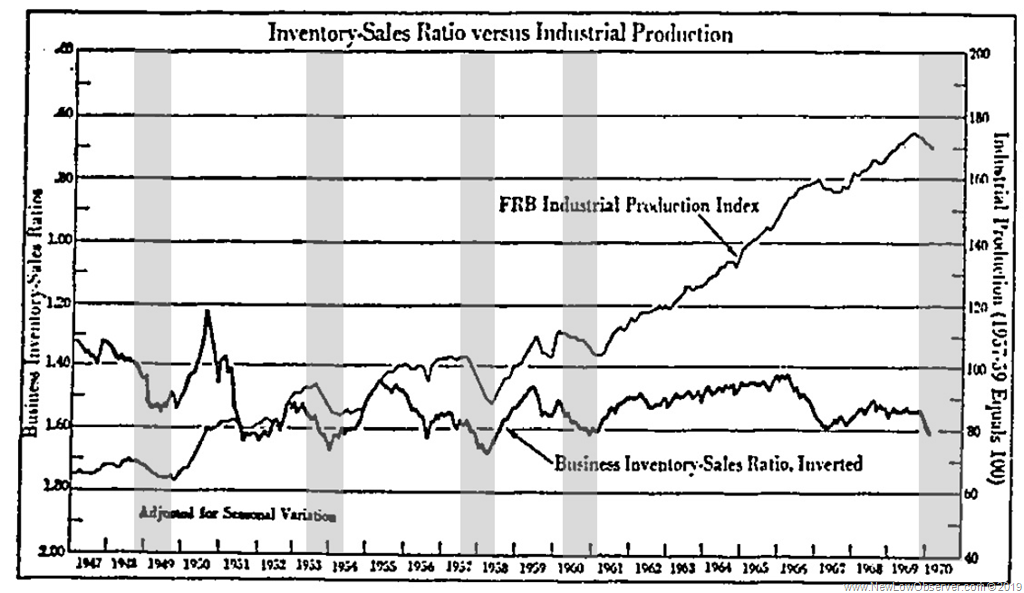
Richard Russell’s Dow Theory Letters dated March 20, 1970:
“Sales and Inventories: The accompany chart from the Journal of Commerce (thanks to Humphrey Neill) shows an interesting picture, the critical sales to inventory ratio. When business is expanding, and we note on the chart that the long upward rise in the FRB production index [Industrial Production Index] signifies that it has been expanding, manufacturers tend to become increasingly bullish. Consequently, they also seek to build up their inventories in anticipation of increasing business (and as a hedge against inflation.)
“Then, as a slowdown in sales appears, it usually catches manufacturers either unaware or unable to adjust their inventories fast enough. Those who see the slowdown coming may cut back their inventory building in anticipations. This is termed to voluntary inventory cutting. But in most cases a belated recognition of a sales slowdown hits manufacturers. Then they are faced with a problem; sales are declining, and they have far too many goods coming in on order. The next step is canceling unwanted orders and cutting back on future orders. This is the process known as in voluntary inventory cutting, and it is undoubtedly happening now (page 5).” Continue reading
On October 30, 2017, we said the following of the Industrial Production Index:
“As each peak is exceeded, we’d expect that the prospects for a recession will be pushed out longer in time (though not necessarily a good thing for the economy, it gives time to prepare for the next recession).
“On the whole, we expect that the trend is in fact our friend and therefore believe that the February 2018 date would be a reasonable expected date for a recession, until proven otherwise.”
Any half decent analysis suggests that we change our tune with the actual conditions of the market. After all, we were wrong about the first two of four expected dates for a recession. In this case, the February 2018 and May 2019 expected recession dates have come and gone. This leave the last two of four (“average” and “longest”) expected dates for recession remaining, based on the historical data from 1920 to the present. Continue reading