Category Archives: SRL

Synopsys Downside Targets

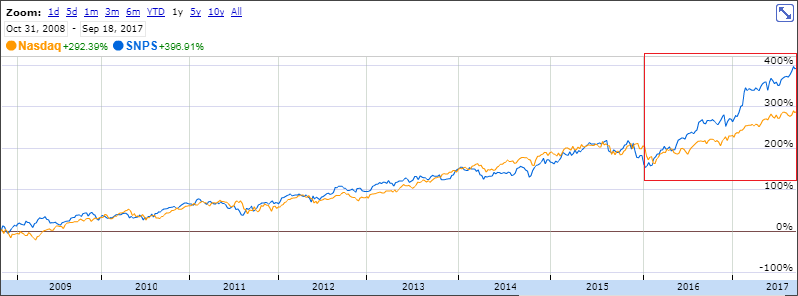
Since the beginning of the bull market in 2009, Synopsys Inc. (SNPS) is a stock that has perform in line with the Nasdaq Composite Index until early 2016.  Since February 2016, SNPS has accelerated well outside of the historical trend for the stock.  While there are many fundamental reasons for excessive gains in the last two years, the gains are still excessive and therefore should, at minimum, revert to the mean. 

image

The challenge with reversion to the mean is that the stock price will likely overshoot on the downside.  With this in mind we have provided the Speed Resistance Lines indicating the conservative, mid range, and extreme price targets below.

Equifax: Downside Targets

Equifax is on a tear, to the downside.  Let’s see what happened to the stock in the last decline from an all-time high and see if there is any precedence for what we can expect going forward.

2002-2009

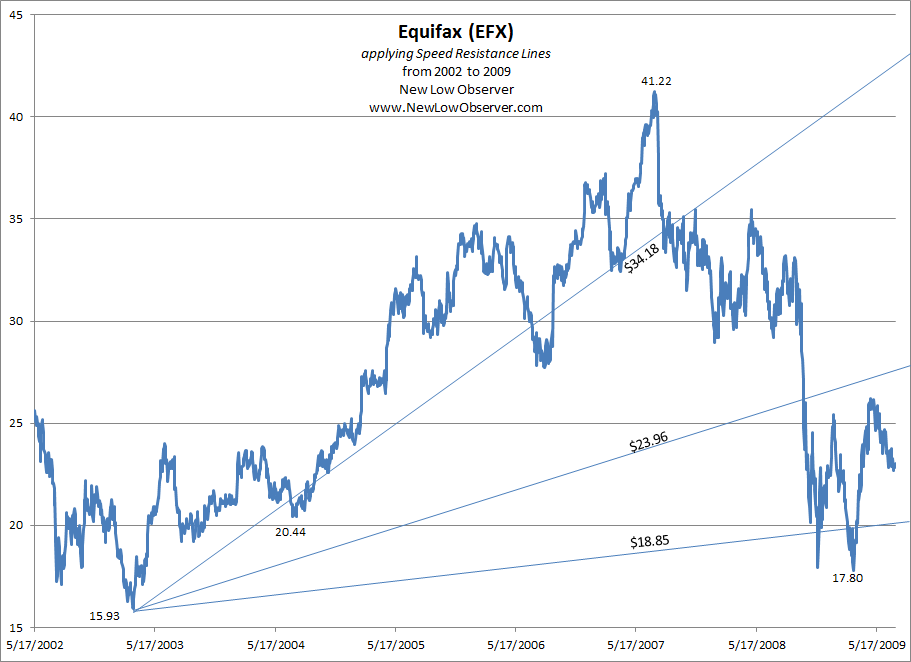
In the period from 2002 to 2009, the price of Equifax (EFX) increased +158% to a high of $41.22.  the decline that followed brought the stock to $17.80.

image

Equifax fell to the conservative downside target ($34.18) and the mid range downside target ($23.96).  At the time, Equifax had an extreme downside target of ($13.74) but somehow didn’t manage to decline to that level, in spite of the fact that the housing crisis was co-opted by credit bureaus changing their standards which materially affected FICO scores.

“…the higher the credit score, the larger the increase in serious delinquency rates between 2005, 2006 and 2007. For example, for borrowers with the lowest credit scores (FICO scores between 500 and 600), the serious delinquency rate in 2007 was twice as large as in 2005—an increase of nearly 100 percent over the two years. For borrowers with the highest credit scores (FICO scores above 700), the serious delinquency rate in 2007 was almost four times as large as in 2005—an increase of nearly 300 percent. In addition, the serious delinquency rate in 2007 for the best-FICO group was almost the same as the rate in 2005 for the worst-FICO group.(Demyanyk, Yuliya. ‘Did Credit Scores Predict the Subprime Crisis?’ . Federal Reserve Bank of St. Louis. October 2008. link.).”

Bending of rules towards what was considered a prime rated credit score contributed significantly to lenders justifying the approval of home loans which later failed.  With all this in mind, Equifax and their competitors should have fallen much more than they did.  In fact, under normal conditions, at least one of the leading credit bureaus should have gone out of business.

Now, Equifax has declined based on a recent hack of their data systems.  The resultant decline in the stock price seems natural.  However, given the resilience  of the stock price after the housing crisis, we have to default to the view that the company won’t go out of business but will be severely impacted in the short-term.

Continue reading

Activision Blizzard: Downside Targets

Review

The following is the pattern of price appreciation and decline for Activision Blizzard (ATVI) from 1993 to 2017 with the application of Speed Resistance Lines [SRL].

1993 to 1996

image

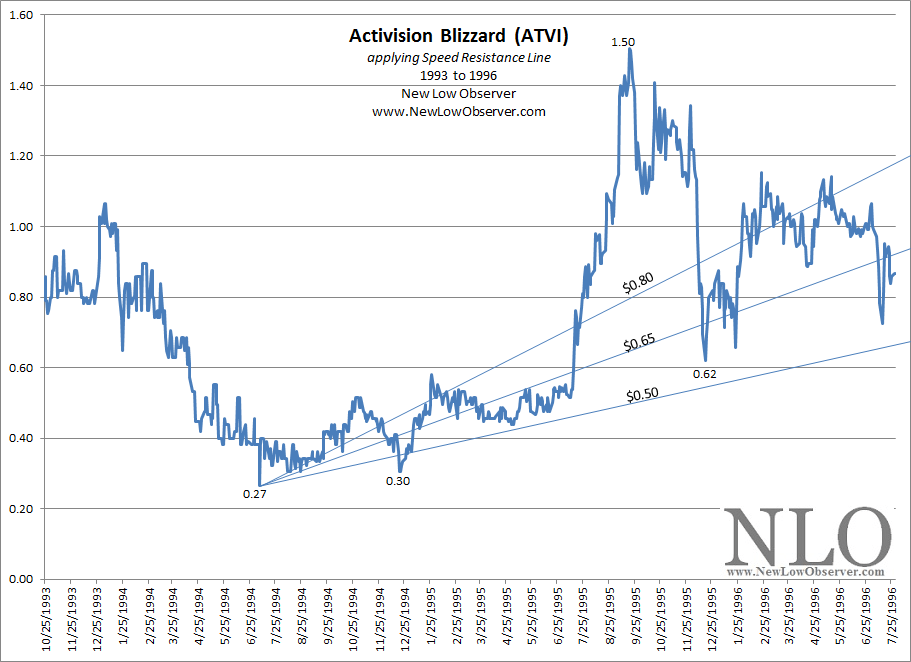
In the period from 1993 to 1996, we can see that Activision Blizzard (ATVI) increase from $0.27 to as high as $1.50 or a gain of +455%.  The decline that followed saw ATVI fall –58%, achieving the conservative downside target of $0.80 and the mid range downside target of $0.65.  Although the chart doesn’t show it, ATVI did not rises above the 1995 level and subsequently fell as low as $0.43 by 2000 and ultimately achieving the extreme downside target of $0.50 in the process.

1999 to 2003

image

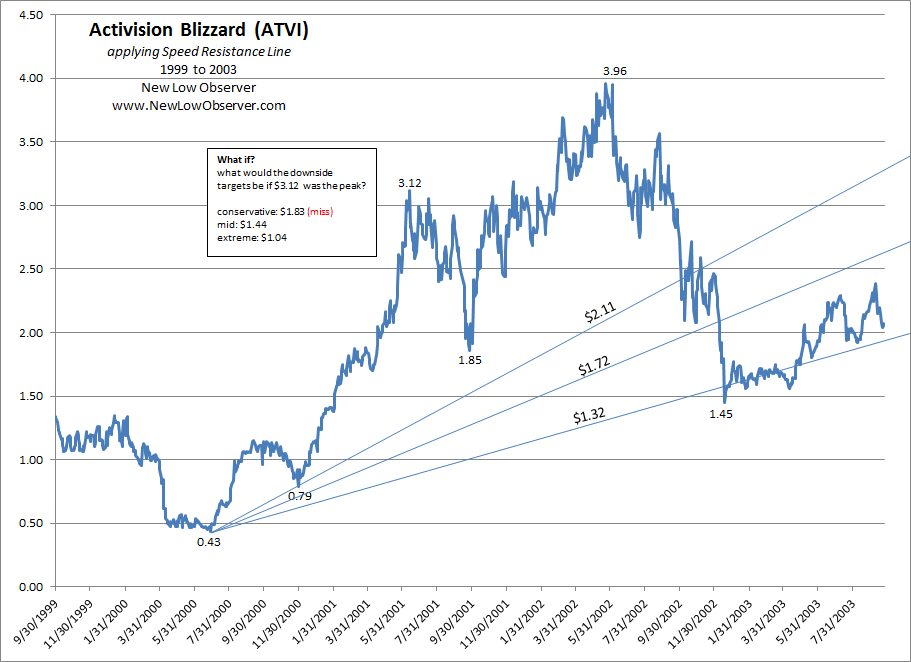
In the period from 1999 to 2003, ATVI rose from $0.43 to as high as $3.96, a gain of +821%.  The resulting decline saw ATVI drop –63%.  In the chart above we do note a possible scenario that the SRL is run on the stock at the $3.12 peak, assuming you don’t know where the ultimate peak would be.  In such an instance, a conservative downside target of $1.83 and a mid range target of $1.44 were calculated. 

In the big scheme of things, the conservative downside target was achieved and the mid range target was one penny short of the mark in 2002. The point of this exercise is to see, what would have been the outcome if there was an error in the timing of the calculation of the downside targets.  As we shall see, these situations are all too real with outcomes that are generally surprising. However, in the immediate decline after the $3.12 price peak, the conservative downside target of $1.83 was $0.02 cents short of the $1.85 low set in September 2001.

2002 to 2009

image

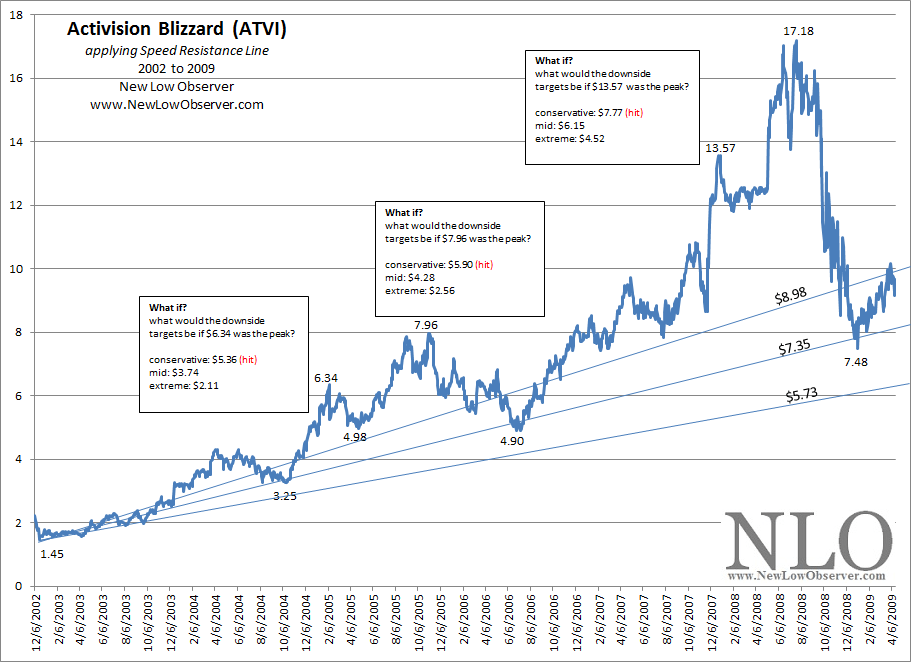
In the period from 2002 to 2009, ATVI increased in price by +1,084%.  The decline that followed brought the stock down as much as –56% before a recovery ensued.  Again, we have marked off the points where an error of early use of the SRL could have been applied.  In each of the three examples, the conservative downside target was achieved.  Suffice to say, in the case of the SRL and price peaks, the conservative downside target is a reasonable point of reference for consideration of ATVI.

2012 to 2017

The price action of ATVI has seen the stock price increase from a 2012 low of $10.08 to the 2017 high of $66.16.  The gain in the stock price has been +556%.  Our SRL has the following downside targets:

Bitcoin: How Much Pain Before Fear Sets In?

Bitcoin is going through the customary pullback in the price.  The new threshold to watch for is –35.77% on the downside.  This was the amount of loss that speculators and investors were willing to accept from the June 11, 2017 high of $3,018.55 to the July 16, 2017 low of $1,938.94 before a new bull run to the upside ensued.  Most traditionalist say that a bear market starts at or near a decline of –20% or more.  At which point, it takes some time before the “investment” gets back to the previous high (example: Nasdaq Composite took 15 years to get back to the 2000 high). 

In this case, we’re not talking about a stodgy technology stock index, we’re talking about a potentially new currency mechanism which will likely supplant many existing currencies.  Bitcoin is only one among many competing to be the final choice of a new money.  However, in order to get that prize, Bitcoin will need to survive the high risk phase of speculative boom and bust.

Right now, we’re watching Bitcoin investors test their tolerance for pain as the price swoons from the high of $4,950.72, as report by Coindesk.com, to the current level of $3,390.  As we said in our August 21, 2017 posting:

“…participants will accept even larger declines if the expectation is that it will exceed the prior peak.  So far, Bitcoin participants accepted a –14.94% decline followed by a –35.76%.  In each instance, these declines were followed by new highs in the price of Bitcoin. By our rationale, Bitcoin will now fall as much as –35% and possibly more as participants become inured to the pain of loss in anticipation of new highs.”

Continue reading

Adobe Systems: Downside Targets

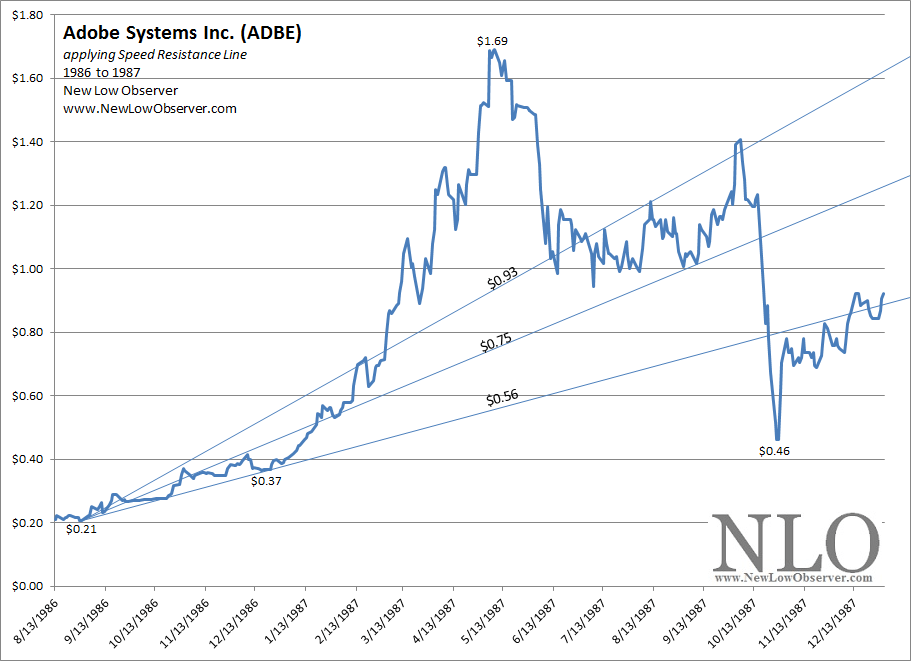
In determining downside targets for Adobe Systems Inc. (ADBE), we have applied Speed Resistance Lines [SRL] to the stock price over multiple periods of increase and subsequent decline. Starting in the 1986 to 1987 period, we see Adobe Systems Inc. increase from $0.21 to as high as $1.69.  In the decline that followed, the SRL indicated that the downside targets from the peak price of $1.69 were as follows:

  • $0.93
  • $0.75
  • $0.56

As seen in the chart below, ADBE declined as low as $0.46 from the $1.69 high.

image

Much of the decline could have been attributed to a new company and speculative fervor for the stock taking it up +700%.  However, the inevitable decline was due and took investors down –72% before a recovery was seen in the stock price.  The stock achieved the conservative ($0.93), mid range ($0.75), and extreme ($0.56) downside targets.

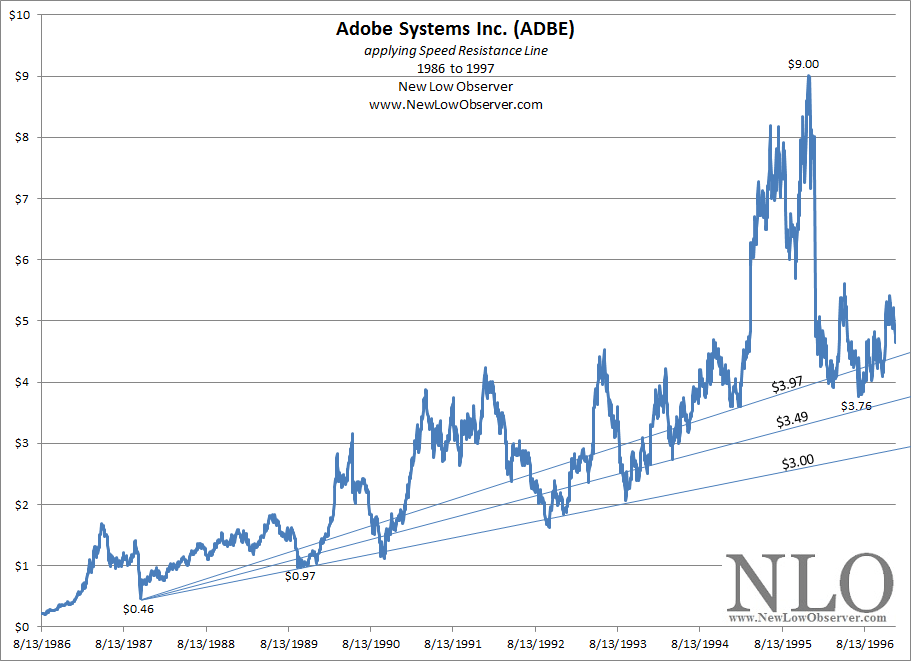
In the period from 1987 to 1997, we see ADBE stock price increase from the $0.46 low to a high of $9.00, a whopping increase of +1,856%.  In the subsequent decline, ADBE fell “only” –58% from 1995 to 1996.  Adobe achieved only the conservative downside target ($3.97).

image

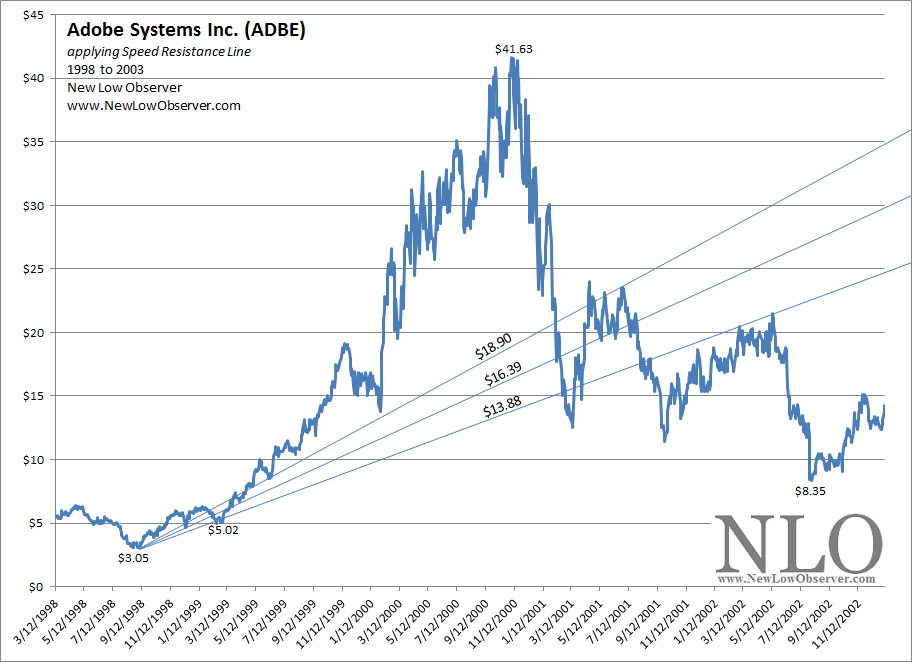
In the period from 1998 to 2002, Adobe rose as much as +1,264%.  In the decline that followed, ADBE notched a –79% drop. In this instance, ADBE achieved all of the downside targets of $18.90 (conservative), $16.39 (mid range), and $13.88 (extreme).

image

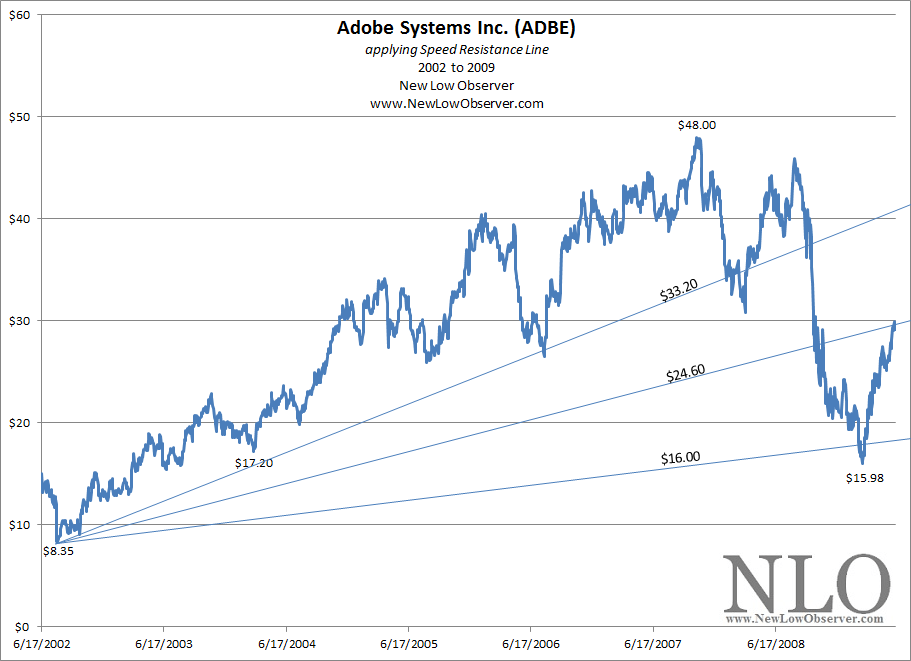
The next period that we track is from 2002 to 2008.  In that period, ADBE rose as much as +474%.  The decline that followed saw Adobe slide –66%.  Again, all downside targets achieved at $33.20 (conservative), $24.60 (mid range), and $16.00 (extreme).

image

Worth noting is the fact that in all cases, Adobe Systems (ADBE) declined at least to the conservative downside target. Additionally, in 3 of the four cited examples, ADBE managed to fall to the extreme downside target as established by the Speed Resistance Lines.

Is the past a fair indication of what to expect in the future?  What do we believe the future to hold?

Our take on the future prospects for ADBE stock price are that we can reasonably expect the price to decline to the conservative downside target in accordance with past declines.  However, expecting that ADBE will achieve the extreme downside target is overly ambitious at present.   After all, ADBE is a mature, well-established company that dominates several categories in their respective product lines (by a wide margin as compared to the next closest competitor).

With this in mind, after an increase in price of +881%, from the 2009 low, we have outlined the Speed Resistance Lines from 2009 to 2017.

Swiss National Bank: Downside Targets

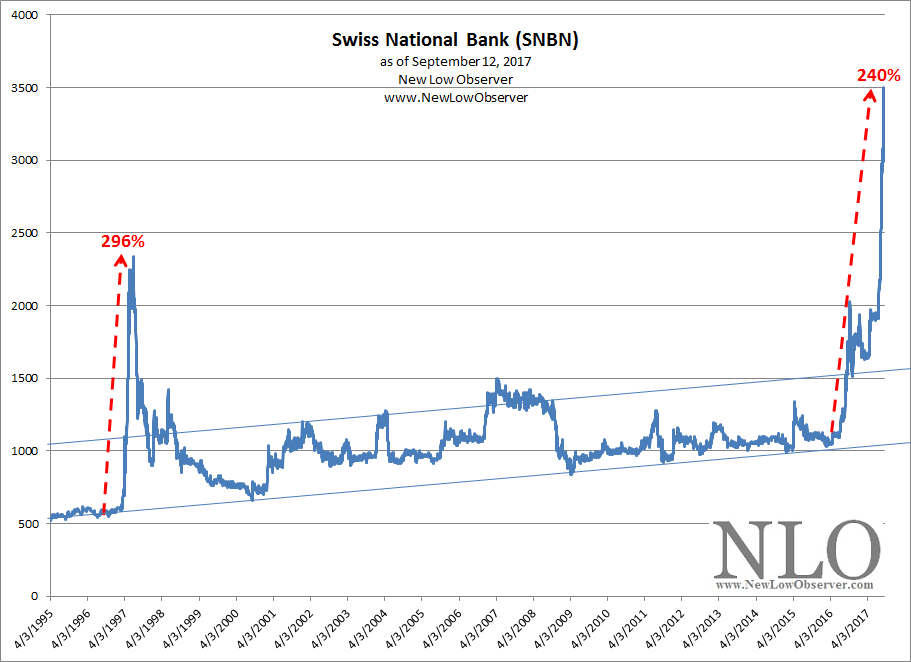
In a posting on ZeroHedge there is mention of Swiss National Bank (SNBN) and the “bubble” that seems to be percolating in the stock.  We don’t know whether or not the price of the stock is in a bubble.  However, what does resonate with us is any sign of a parabolic rise in price.  In the case of SNBN, we believe that we can attribute Speed Resistance Lines (SRL) that are consistent with viable downside targets.

First, whenever applying SRLs, we like to find out if there has been any precedence on the matter. In the case of SNBN, we have obtained data from Yahoo!Quotes (ChartIQ), which goes back to 1995.  It is just our luck that there is a prior period when SNBN has a similar rise and subsequent decline.

image


Considering that there is a reasonable amount of precedent in the stock price movement of SNBN in the period from 1995 to 1997, we have taken the liberty in projecting what the current level of price increase could result in, if history is any guide. 

Continue reading

Review: Lumber Liquidator

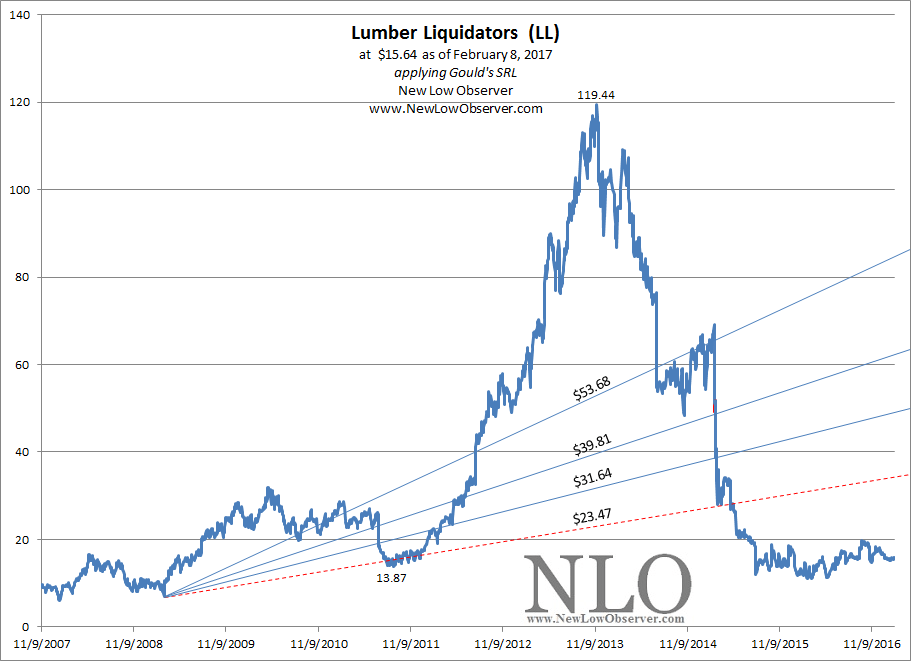
As early as February 2015, when the stock price of Lumber Liquidator (LL) was trading at $50, we had indicated that there was a risk that Lumber Liquidator could decline below $23.47.  Since that time, LL had declined as low as $11.

In March 2015, we outlined our own theory of a coincidence indicator that would help investors know when the price of LL should recover.  Since that time, LL has fallen in line with our theory and has subsequently increased in price along with our proposed coincidence indicator.

From the low in LL stock price in 2016, we have seen the stock price climb as much as +200%.  The actual gain based on our recommended purchase price would be approximately +16% (8% annualized) assuming equal share amounts at/or below the recommended levels.

So what does the coincidence indicator say about LL and the prospects going forward?  The chart below is clear on this matter:

Review: O’Reilly Automotive

On July 5, 2017, O’Reilly Automotive (ORLY) suffered a substantial decline in share price when the company reported that same store sales decline –1.7% as contrasted with consensus expectation of +3.90%.  Below we outline the downside targets and a Coppock Curve analysis.

Craft Brew Alliance Meets Our Target

On September 1, 2016, we said the following of Craft Brew Alliance (BREW):

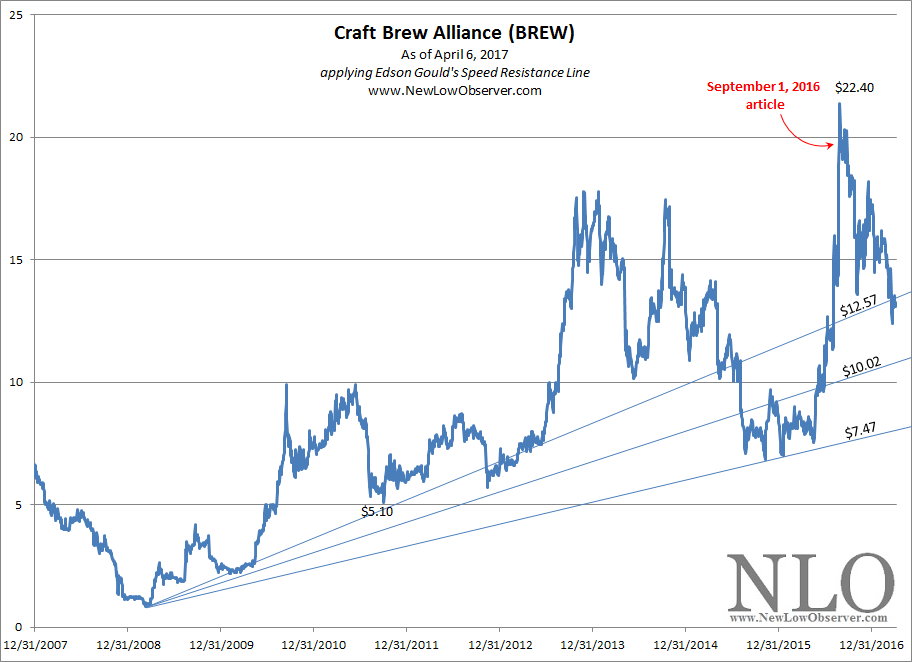
“Although there is no assurance that the stock needs to decline to the referenced downside targets, any parabolic move must be watch closely as entropy will kick in at some point.  In this case, we believe that the ascending conservative target [$12.57] is a lock.  With established history as an indication, the mid-range target [$10.02] looks to be a safe “bet” as well.  We’ll check back in on this as more time has passed.”

We don’t necessarily believe it but here we are, with BREW at a price of $13.15 and well within the range of the conservative downside target set at $12.57 as established in our piece dated September 1, 2016.

image

The September 1, 2016 article lays the groundwork for what a person interested in BREW should look for and expect.

Review of 2015 Assessment of LL & SAM

On February 25, 2015, we posted Edson Gould’s Speed Resistance Lines [SRL] for Lumber Liquidator (LL) and Boston Beer Company (SAM).  Starting with LL, we said the following:

“Those interested in LL and willing to perform appropriate due diligence could engage in a three phase purchase plan beginning below $39.81, $31.64 and $23.47.  Investors, as opposed to speculators, should be willing to accept that there is no compensation for the wait when holding LL and that the decline to the ascending $23.47 level is a real risk.”

Since February 2015, LL has declined to the current level of $15.64.  While we might know the exact reasons why LL fell to the current level, we don’t know what to make of the dramatic decline other than the fact that the SRL gave every indication that this was possible.  Below is the updated SRL on Lumber Liquidator.

image

Upon further reflection, we examined the price of Lumber Liquidator and attempted to propose an alternative view on the stock price decline.  On March 3, 2015, we proposed the following thesis:

“The coincidence of Lumber Liquidator (LL) declining significantly at the same time as the futures price of lumber (as traded on the Chicago Mercantile Exchange) seems difficult to ignore.  Investors should take note of the fact that in three prior periods indicated in blue, LL has lost a minimum of –35% and as much as –53% when the price of lumber declined –33% or more. 

“So far, from December 2013 to March 2015, the price of lumber has declined –23% while LL has declined as much as –67.49%.  Much of the decline in LL has been exacerbated by concerns related to quality and sourcing of the flooring.  However,  the current decline is only slightly out of alignment from what has happened in the past.”

Continue reading

Clean Harbors: Coincidence Confirmed, Again

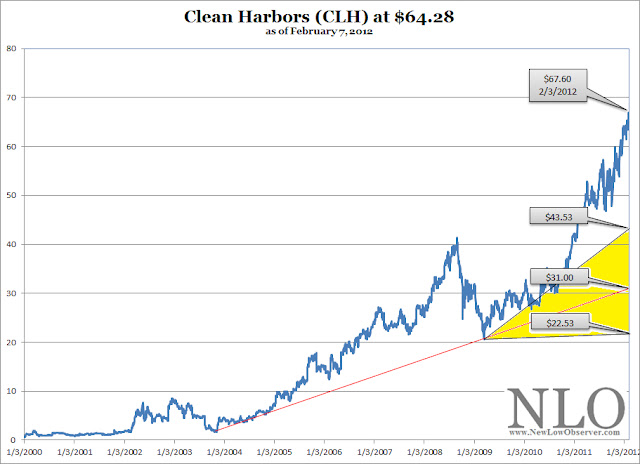
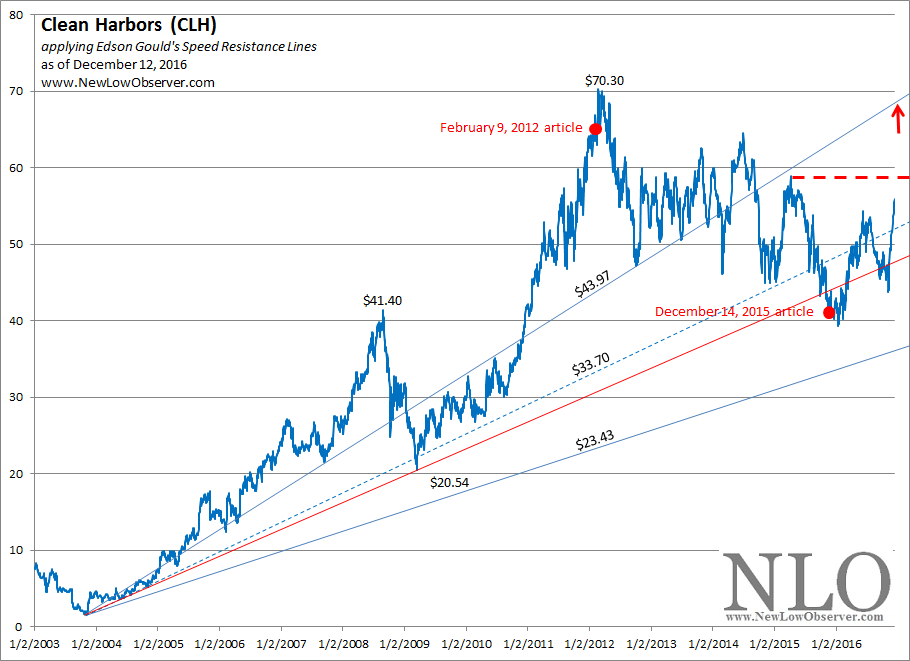
On February 9, 2012, we posted Edson Gould’s Speed Resistance Lines [SRL] regarding Clean Harbors (CLH).  Our hope at the time was that our prior work on the top of Gould’s work would be handily refuted or confirmed.  At the time we posed the following SRL:

For us, our expectation was that the Clean Harbors would, at minimum, descend to the conservative downside target of $43.53.  Well, the timing and coincidence were in our favor as CLH fell –40% to the appointed levels that we thought the stock should descend.

As with all Speed Resistance Lines, there is a chance that the stock will continue to move higher.  However, at each point higher we readjust the SRL and arrive at new downside target.  In the case of CLH, the stock increased from the $67.60 price to as high as $70.30 thereby requiring an adjustment of the downside targets higher as well.  Remember, if the stock does not hit downside targets avoid it.  When and if the stock falls to the target, review for potential investment.

Finally, for no explicable reason, when all seemed in favor of the stock, CLH declined from the $70.30 peak to the low of $37.09 achieved in January 2016.  By achieving such an improbable low (improbable to those who were buying CLH in February 2012) CLH stock price appeared to be worth considering.  For this reason, we iterated a review of CLH for investment consideration on December 14, 2015. Since our mid-December 2015 review, CLH has increased by +39%.

image

At this point, we’d consider our general analysis of CLH a success from the December 2015 posting.  What do we see going forward?  We see two critical upside resistance levels to watch for.  The first upside resistance is at $59.00 and the second upside resistance level is at $69.00.  Obtaining a +39% gaining in a 1-year period might suggest that an investor consider selling all of their CLH holdings and reinvesting the funds somewhere else.

The Cold Hard Truth

Granted, luck and timing have a lot to say in any and all the work that we produce, however, that does not mean that our efforts on the topic should be dismissed as there may be some value in what we’re trying to accomplish.  Since the very first of our SRLs we’ve had more than 80% of the SRL downside targets achieved at the point of the initial examination.  This generally could could be considered a success.  However, of the 20% that have not been successful are positions that we’ve taken a real world investment in, which totally sucks.

In spite of the prevailing reality we continue to attempt to mitigate the available information with the stocks of interest to us.  We’ll narrow down this situation to a point where the SRL will work and/or we’ll still be able to benefit regardless of whether an immediate rebound is experienced.

Nasdaq Biotechnology ETF

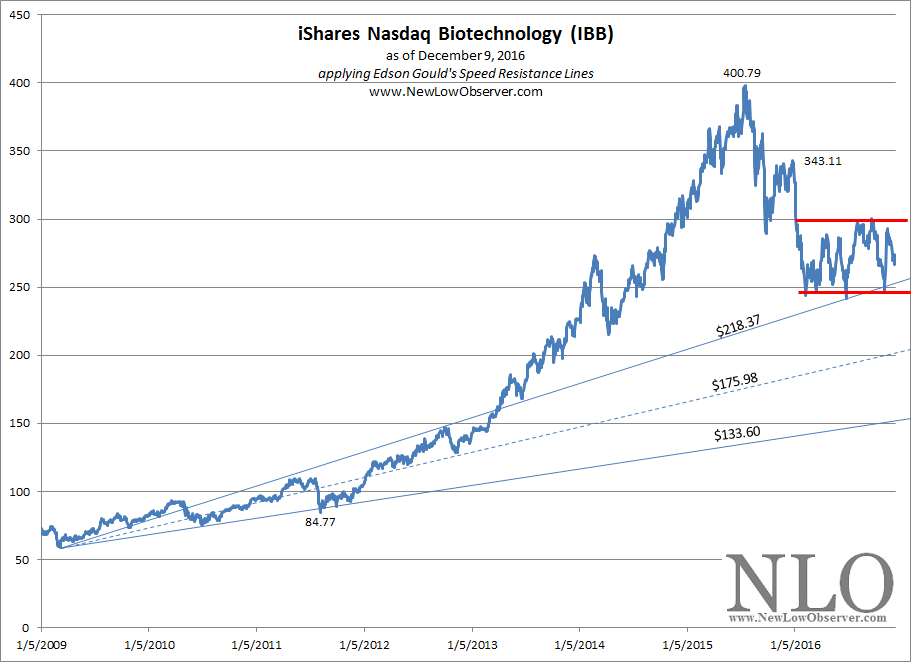
The iShares Nasdaq Biotechnology ETF (IBB) is trading in range that ultimately needs to be resolved.  The outcome is either falling dramatically below $240 or striking the $343 level before doing a retest of the prior high around $400.

image

Already, IBB has managed to resist falling below the ascending $218.37 level.  This is in defiance of our belief that a highly volatile sector and fund should retest the extreme downside target of $133.60.  Those wanting to have exposure to the biotech sector but unwilling to take on the individual risk should consider the prospects of this ETF.

Nvidia Downside Targets

Below are the downside targets based on the work of Edson Gould and the precedent setting periods from 1999 to the present.

Downside Targets for Craft Brew Alliance

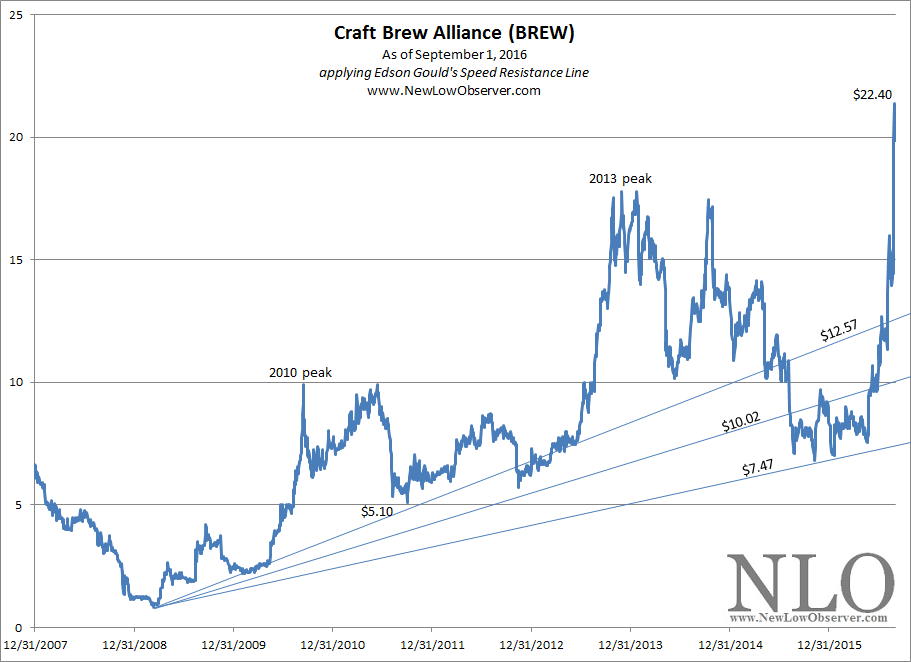
The latest run for Craft Brew Alliance (BREW) from the low set in November 2015 to the most recent peak on August 2016 requires that we check for the downside targets.

image

 A parabolic peak is one thing.  However, having them play out in a consistent fashion is something else.  In the case of BREW, we’ve had two prior parabolic peaks since 2008 that were true to form and function.  In the period from the 2008 low to the 2010 peak, BREW declined to below the mid-range Speed Resistance Line [SRL].  In the period from the 2008 low to the 2013 peak, BREW declined below the extreme downside target.  In the chart above, we have the following downside targets:

  • conservative: $12.57
  • mid-range: $10.02
  • extreme: $7.47

Although there is no assurance that the stock needs to decline to the referenced downside targets, any parabolic move must be watch closely as entropy will kick in at some point.  In this case, we believe that the ascending conservative target is a lock.  With established history as an indication, the mid-range target looks to be a safe “bet” as well.  We’ll check back in on this as more time has passed.

Review: HP Achieves Downside Target and Rebounds

On September 14, 2015, we posted to our site an article about Helmerich & Payne (HP).  At the time we had the following investment conclusion:

“We advise that investors consider HP at the ascending $39.43 level or below.”

HP fell to the level indicated in our posting and has since increased +37% from the article date and +50% from the date of when the stock crossed below the ascending $39.43 level.  Below is the updated Speed Resistance Lines and our perspective on the potential for the stock going forward.