Category Archives: SRL

ShotSpotter Inc. : Downside Targets

According to Yahoo!Finance, ShotSpotter Inc. (SSTI) is, “…provides software-as-a-service based gunshot detection solutions for law enforcement officials and security personnel in the United States, South Africa, and internationally.”

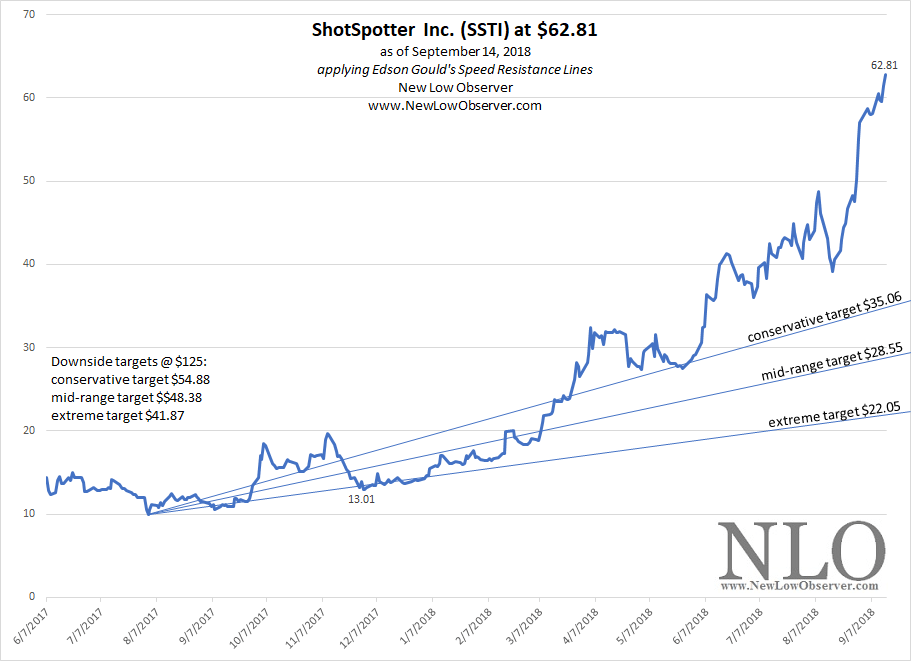
ShotSpotter IPO’d on June 7, 2017 and was priced at $11.  In the last 15 months, SSTI has managed to increase the share price +471%. Based on the closing price of $62.81, we have the following downside targets:

  • $35.06
  • $28.55
  • $22.05

image

The downside target for SSTI are included in case the stock were to double for the current level.  SSTI could increase to $85.65 and still be within range of the $35.06 downside target.

AeroVironment: Downside Targets

AeroVironment is described on Yahoo!Quotes as:

“AeroVironment, Inc. designs, develops, produces, supports, and operates a portfolio of products and services for government agencies and businesses.”

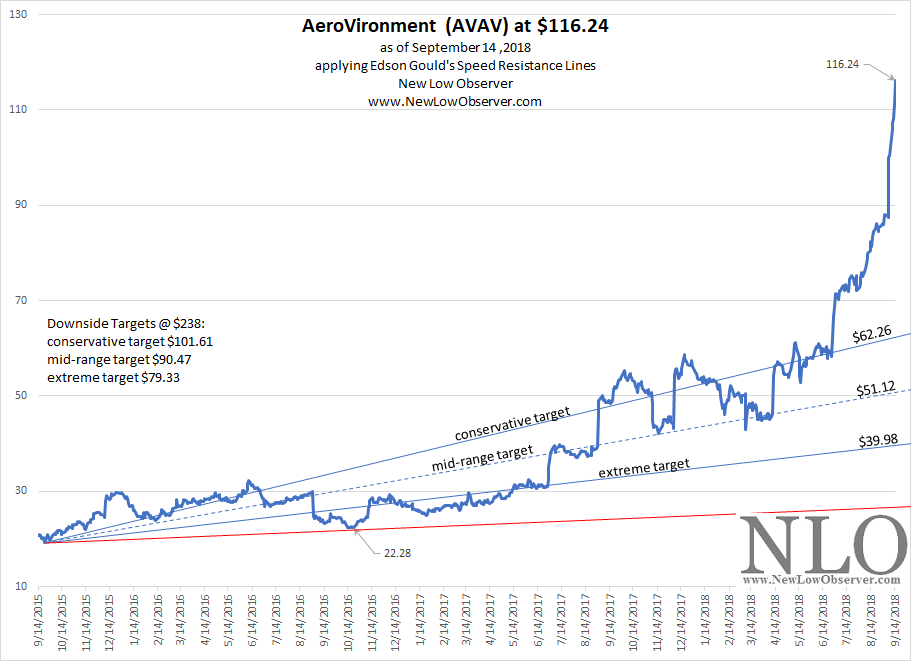
Below are the downside targets as a consequence of the parabolic rise that has occurred since the September 2015 low.

image

The conservative downside target of $62.26 is a lock in our view.  To put this in perspective, AVAV would have to increase to $160.62 before the $62.26 level isn’t a normal “dip.”

Tilray Inc.: Downside Targets

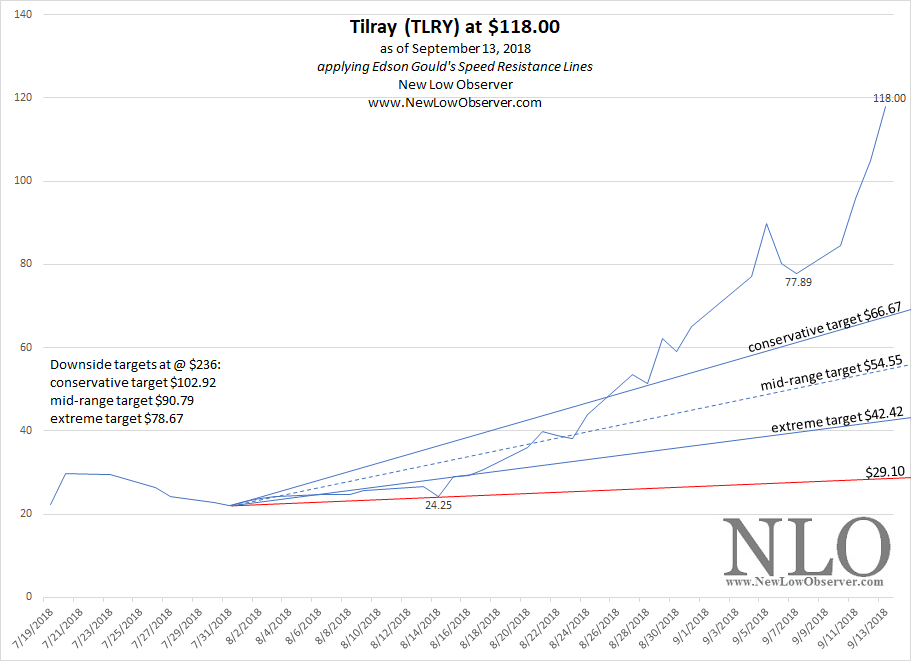
The recent IPO and explosion of Tilray Inc. (TLRY) has investors both worried and excited.  Tilray is in the emerging corporate cannabis industry, which has high prospects.  Below we outline the downside targets for both current price of $118 and $236 for when/if the stock doubles from the current price.

image

The conservative downside target is fairly assured to occur in either case.  From the $118 level, a decline to the $66.67 level would be a natural retest of the $77.89 level set on September 7, 2018.

Tesla: Downside Targets

In this posting, we’ll covered the topic of downside targets for Tesla (TSLA).  We’re going to apply Speed Resistance Lines [SRL] and George Lindsay’s “Three Peaks and a Domed House.” 

The SRL downside targets are fairly conservative, in our view, while the 3 Peaks and a Domed House model (3PDh) appears fairly drastic.  We’ll do our best to introduce the 3PDh concept in the most general way possible, leaving out some of the nuances that we believe inhibit the qualitative elements to the overall concept.

Continue reading

Starbucks Downside Target

Below are the downside targets for Starbucks (SBUX) based on the work of Edson Gould.

Continue reading

Review: The Buckle Inc.

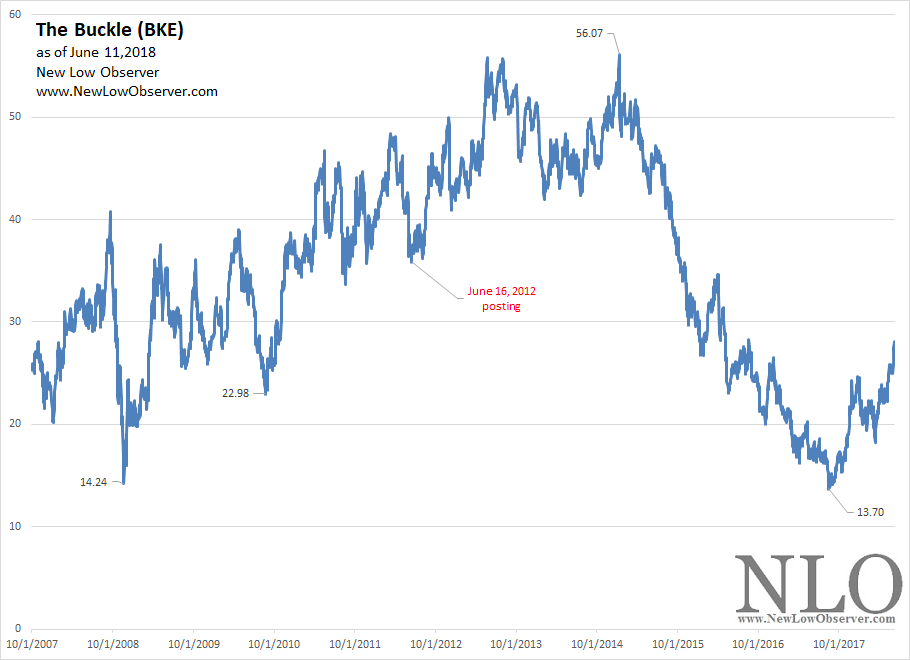
On  June 16, 2012, we posted the following commentary on The Buckle Inc. (BKE) when the stock was trading at $36.79:

“We are very interested in this stock at the right price.  We believe that BKE will be a buy at $30 and below.  However, prior price movement based on Gould’s speed resistance lines indicated that the conservative downside target is $24.47 and the extreme downside target of $16.68.”

Since that time, The Buckle (BKE) managed to increase as high as $56.07 by January 12, 2015.  However, since January 2015, BKE fell as low as $13.70 on August 2017, on a closing basis.

image

One of the fascinating elements of the work of Edson Gould is that it can be extremely accurate in spite of incomplete data.  When we ran the figures for downside targets, BKE’s peak price was $48.39.  The peak price is part of the equation that helps to generate the downside targets.  In spite of this fact, BKE managed to decline below the extreme downside target based on the speed resistance lines (SRL).

Interest Rate Monitor: May 2018

Below are the revised downside targets base on the latest peak in interest rates.

Quick Take: Cardinal Health

On May 3, 2018, it was reported that Cardinal Health (CAH) declined –21% due to:

“…the company's loss of a contract with PharMerica and lower drug prices are responsible for the bearish outlook (TheStreet.com).”

The impact of these issues has resulted in lower 2019 earnings estimates for CAH.  Below are some thoughts on our expectations for CAH in the coming year.

Ethereum: Downside Targets

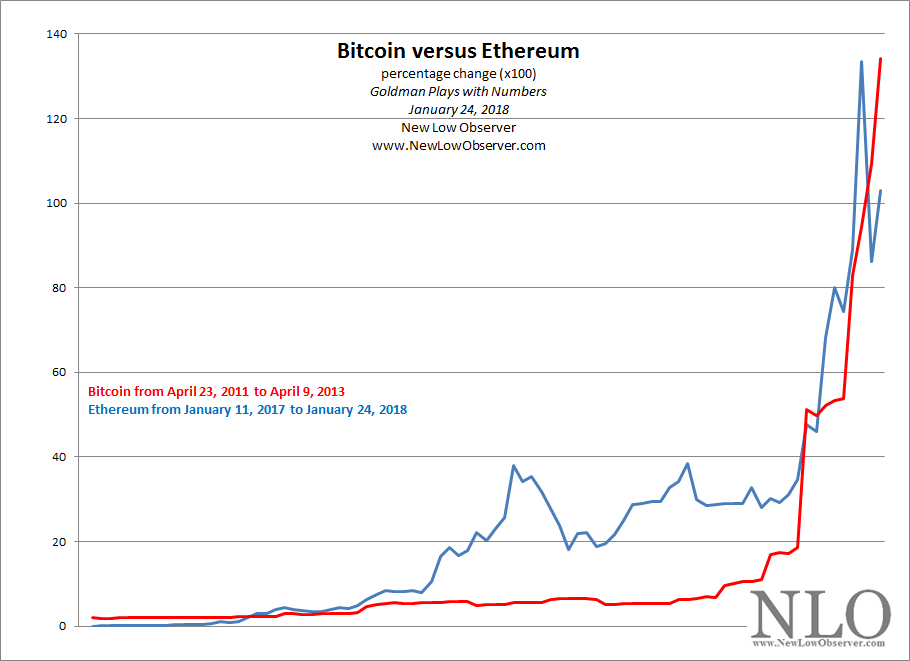
In a previous posting titled “Goldman Plays with Numbers,” we did a side-by-side comparison between Bitcoin and Ethereum in two different periods.  The periods in question happens to have the same percentage change, approximately +13,400%.

image

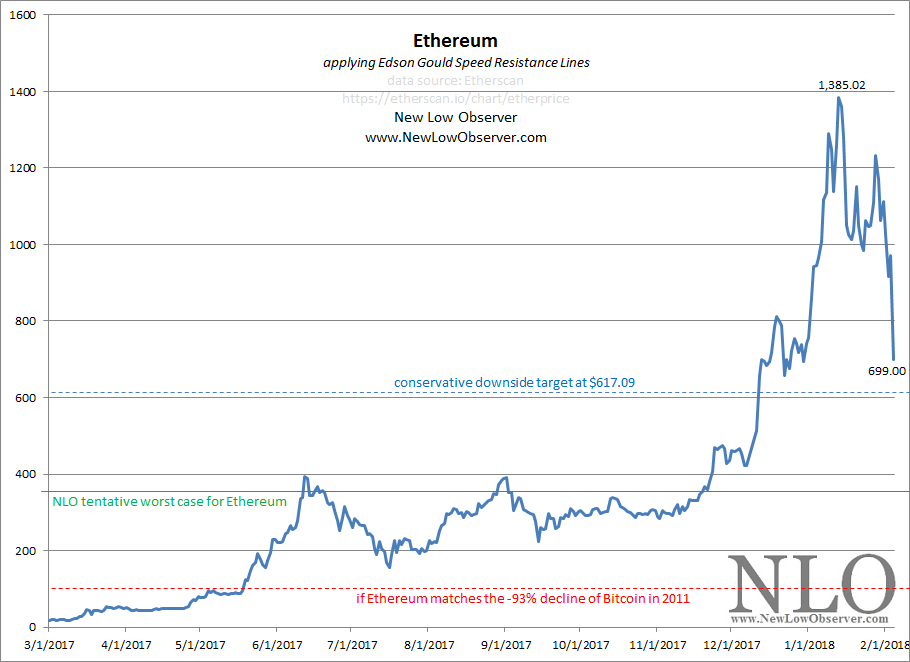
As with the same percentage increase, it is reasonable to expect the same percentage decreased that followed.  For the price of Bitcoin, it plunged –93.07% from June 8, 2011 to November 18, 2011.  Below is our charting of three scenarios for downside risk to Ethereum.

image

Based on the work of Edson Gould, the conservative downside target for Ethereum is at $617.09 (blue line).  However, due to the extremely volatile nature of cryptocurrencies, we have to expect that the extreme downside target is more than likely.  The purpose of putting the conservative downside target at all is to demonstrate that it will be achieved after a given peak in price is established and the trend is clearly to the downside.

In addition to the conservative downside target, we have indicated the level Ethereum would be at if it lost –93% (red line) as Bitcoin did in the period from June 2011 to November 2011 (yeah, it took only five months).  Such a decline in Ethereum would bring the price to $96.95.  We don’t expect this but must be realistic about the prospects regardless of our own personal expectations.

Finally, we have included our own worst case scenario (green line) based on one half the difference between Gould’s extreme downside target at $461 and the –93% experienced by Bitcoin in 2011.  This would bring the price of Ethereum to $279.31.  Although this seems like a dire call for Ethereum, in reality it is not unusual to see an –80% decline in price from such extreme parabolic moves.  Additionally, we don’t expect Ethereum to succumb to the same amount of pressure that Bitcoin did as the concept of blockchain technology is more salient to the general public today than it was in 2011.

DJIA: Downside Targets

Based on the nature of the decline in the market on February 2, 2018, it is worth examining the downside targets for the Dow Jones Industrial Average (DJIA).  Below are the downside targets based on the work of Edson Gould’s Speed Resistance Lines.

Bitcoin: February 1, 2018

On December 22, 2017, we said the following of Bitcoin:

  • “We believe that there is going to be limited upside in the near term.”
  • “We think that the conservative downside target ($6,884.31) will be achieved before a new high is seen.”
  • “In all prior booms, the subsequent bust AVERAGED –70% (data found here).”

Below is the updated chart for Bitcoin along with our expected downside target.

Review: Western Digital SRL

On November 25, 2015, we posted the following SRL for Western Digital (WDC):

image

Implied in the posting is that WDC would decline, at minimum, to the $49.70 level with the potential of going all the way to the $37.45 level.  Falling below the extreme downside target ($37.45) is where we always recommended consideration of the fundamentals of a stock for a potential purchase. Below is the updated price action for WDC.

image

Much of the price action of WDC has conformed to the SRL which, from our experience, has been amazing in calling downside targets.  The current price action suggests considerable weakness in the stock if WDC cannot maintain the ascending $61.16 level.

The Rise and Fall of GE

General Electric (GE) appears to be spiraling into oblivion.  As we’ve suggested last year, we think that GE is going to be booted from the Dow Jones Industrial Average (DJIA).  In this article, we’ll take a look at how GE got to this point and what might be in store for the stock price going forward.

1975-1981

It is possible that the beginning of the end for GE could have been marked by the acquisition of Utah International on December 16, 1976, in a deal that was dubbed “one of the largest acquisition proposals in the nation’s history.”  That transaction set in motion the machinations of a complex set of accounting deals and dealings from which GE never seemed to extract itself from.

In the bid to acquire Utah International, General Electric, “…was able to use the pooling method [of accounting] to help boost its profits…” For GE, the “…unrecorded asset value would be reported as a gain…” when the eventual sale of those assets came due.  Another benefit for GE would be that “…even if the assets were not later sold, their below market valuation allowed GE to understate its expenses (cost of sales and depreciation) and thereby overstate net income.”  The problem with these methods of accounting slight-of-hand is that GE would not be able to wean itself from these strategies.  In fact, this approach to acquisition and growth only increases as time went on.

Alarmingly, the acquisition of Utah International came after GE had exited the computer business.  As noted at the time, “the computer business proved too much for Fred Borch [GE Chairman & CEO, 1967-1972].  Reg Jones [GE Chairman & CEO 1972-1981] made his mark getting us out of it. Will someone have to bail him [Reginald Jones] out of Utah International?”  The combined Borch and Jones years are compared to the period from 2003-2018 during the tenure of Jeff Immelt in the chart below (using the approximate number of trading days going backward from January 19, 2018).

image

The entrance into the computer business followed by the entry into the mining business was simply one failure after the other.  Adding insult to injury is the fact that the period from 1967 to 1981 was a confirmed secular bear market for stocks.  However, the Utah International failure introduced the rampant and widespread use of creative accounting which would augment Jack Welch’s [GE Chairman & CEO 1981-2001] tenure during a secular bull market that began when the Dow Jones Industrial Average was trading at the 1,000 level and peaked at above 11,000.

1981-2001

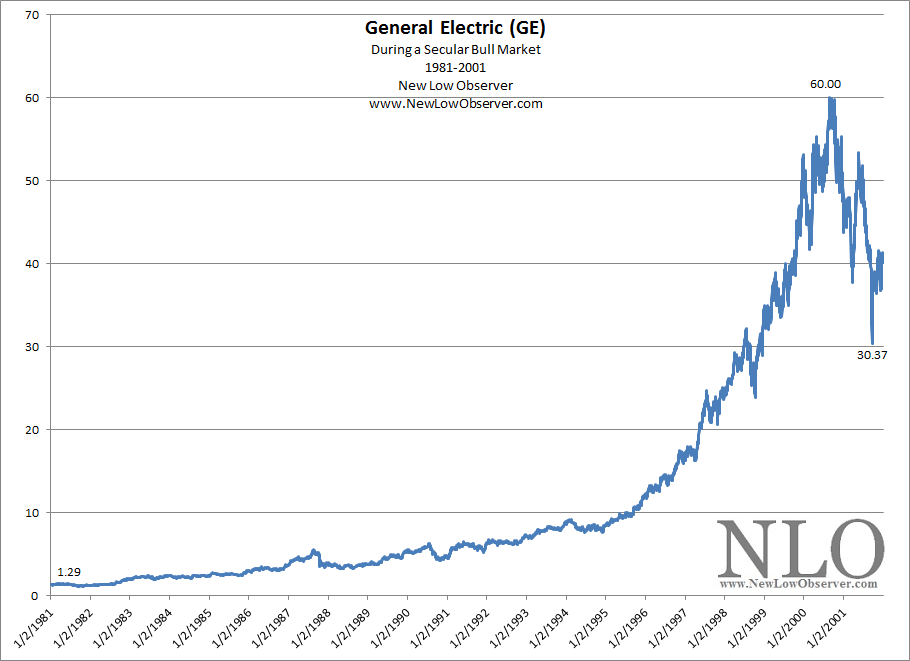
Below is the stock price of GE during the Jack Welch years from 1981 to 2001 which coincided with a secular bull market in the same period of time.

image

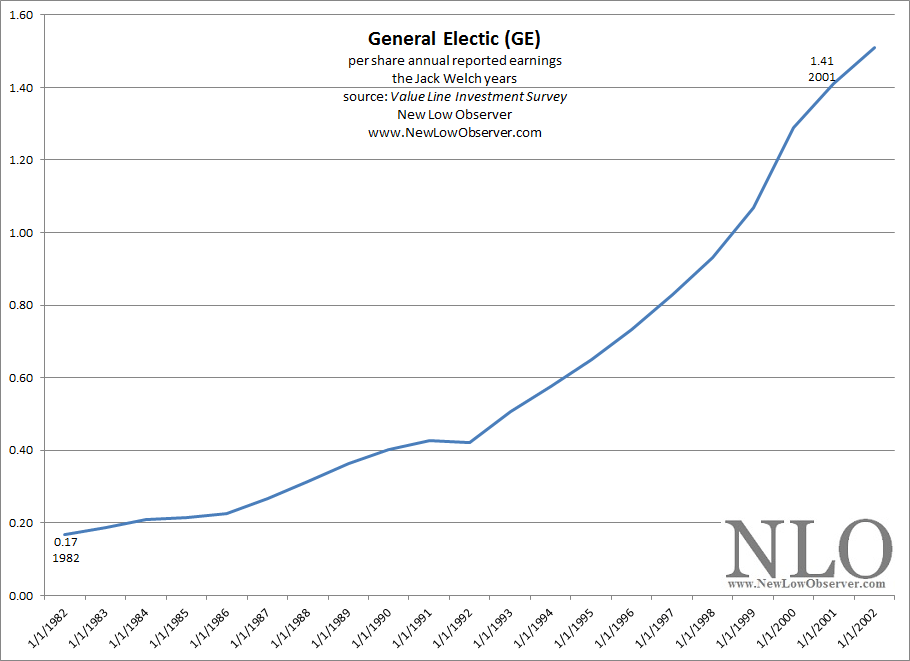
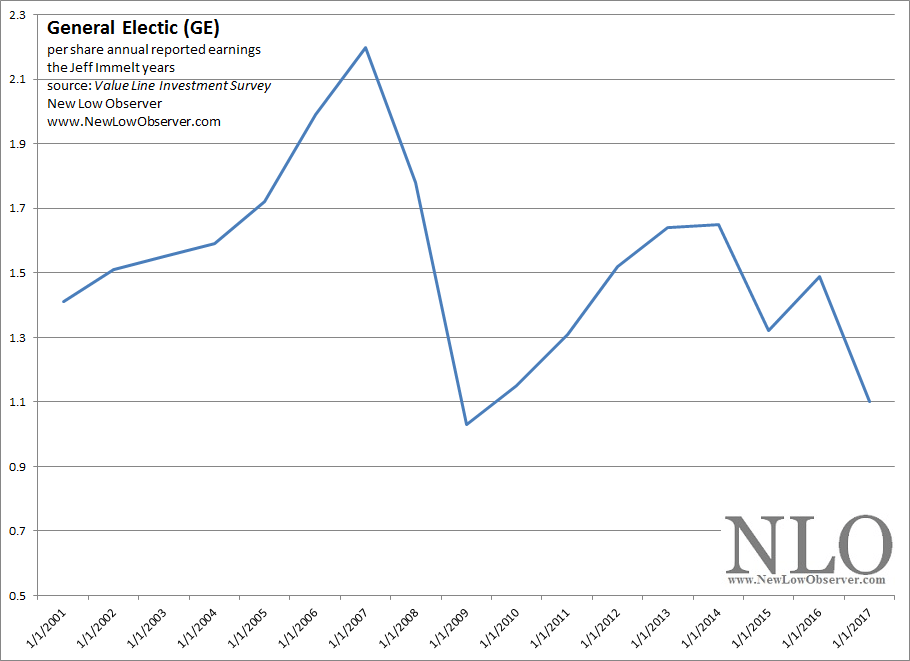
The nature of secular bull markets often see company fundamentals improve and hopefully the stock price will follow.  As shown above, the price of GE increased more than 45 times in the period from 1981 to 2000.  However, when looking at the per share reported earnings, as provided by Value Line Investment Survey from 1982, we can see that earnings “only” increased a little less than 8 times.

image

While fundamentals, stock price, and market sentiment often coincide there is no rule that the stock price has to match the fundamentals in any way, shape, or form.  However, seeing an “industrial” company’s stock price out-distance the reported earnings by such a wide margin suggests that the stock price might gravitate towards a more “realistic” mean eventually.  The perfect setup for this reversion to the mean is a secular bear market, which in our view began in 2000 to 2016 period.

It could seem that choosing the year 2000 as the beginning of secular bear market is arbitrary, at best.  However, as noted before, the well established stock market secular cycles and Warren Buffett’s November 1999 commentary of below average market performance for the 2000 to 2016 period is enough to convince us that the period in question isn’t random.

2001-2018

This leads us to the Jeff Immelt era as Chairman & CEO of General Electric from 2001 to 2017.  There could not have been a worse period to be in charge of a hobbling industrial giant that is hamstrung with well entrenched accounting methods that work against the company when the stock price isn’t in a rising trend.

Remember, when Immelt took over at GE as Chairman & CEO on September 7, 2001, the stock price was already in the beginning stages of collapse after having fallen –34% up to that point.  Even of the price of GE were to trade in range it would be bad news for the company.  A falling stock price spelled disaster for investors who were hoping and expecting a rebound to the prior highs.

image

Many GE investors attribute the decline of GE’s stock price to the management practices of Jeff Immelt.  However, much of this view is simply the mistaken attribution of correlation as causation.

If Warren Buffett thought, in late 1999, that we’d be lucky to see average market returns of +4% and GE fundamentals are calibrated to do better when the stock price rises then there is no evidence to suggest that Immelt did anything that was materially harmful (actual inflation adjusted CAGR of the S&P 500 return was +2.27%).  Instead, what we’ve witnessed in GE stock price has been a reversion to the mean from the prior period of excess.

Price & Time Targets

Based on Edson Gould’s “Three Step” rule, GE has one more leg down.  In theory, this should bring the GE stock price below the 2009 low.  However, there is a lot of ground to cover for GE to get to the 2009 low and there is no guarantee that it will happen.  With this in mind, we’ll outline the previous two declines, 2000-2002 & 2007-2009, to establish any possible precedent that might emerge.

  • 2000-2002
    • The decline from the 2000 peak did not see any respite until 2002.  That decline saw General Electric fall –63%.  The period of decline lasted 530 trading days.
  • 2007-2009
    • The decline from the 2007 peak ended in early 2009 and was approximately –84%.  The period of decline lasted 359 trading days.
  • 2016-present
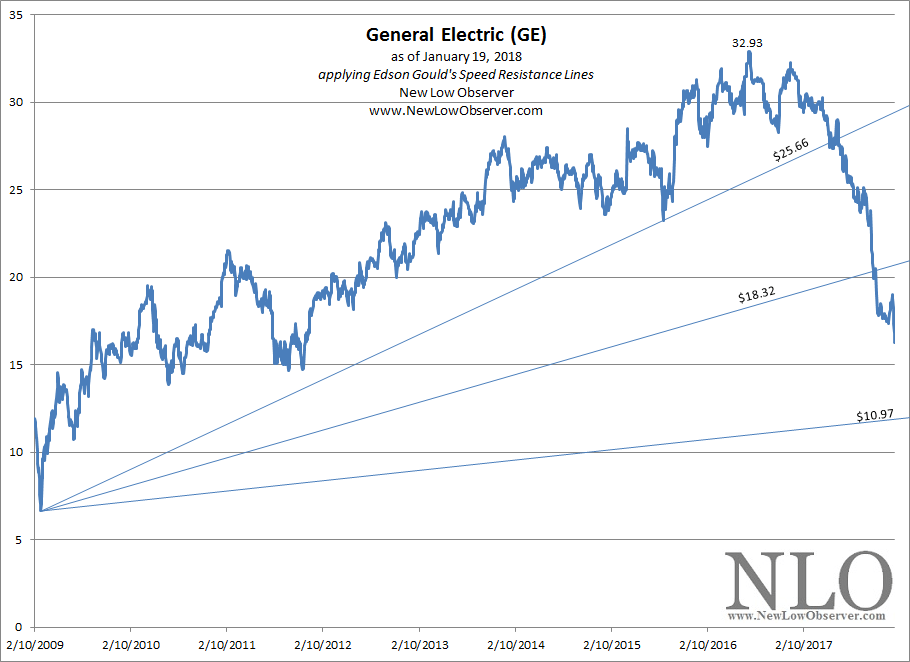
    • So far, the price of General Electric (GE) has declined approximately –50.62% and has lasted 381 trading days.  As seen in the chart below, GE has blasted through Gould’s Speed Resistance Lines at $25.66 and $18.32.

image

From what we can tell, the price target at the ascending $10.97 level is a lock (approximately $12.18).  This would match the decline that was experienced by GE in the period from 2000-2002.  The question becomes, will GE match the decline of 2007-2009, on a percentage basis.  If so, then GE would decline to as low as $5.27.  This would fit exactly with the nature and pattern of declines expressed by Gould in his “Three Step” rule.

Time targets seem to indicated that General Electric will reach the $10.97 or $5.27 low on April 20, 2018.  The speed at which the current decline is taking place indicates that sentiment will push the stock to the $5.27 price and the elimination from the Dow Jones Industrial Average is eminent.  We see the possible replacements for General Electric in the Dow Jones Industrial Average (DJIA) to be Adobe (ADBE), Expedia (EXPE), Google (GOOG) or Amazon (AMZN).  In the case of Google and Amazon, their inclusion into the DJIA is predicated on a 10:1 stock split.

sources:

  • Stuart, Reginald. $1.9 Billion G.E. Bid in Mining Merger. New York Times. December 16, 1975. page 1.
  • Smith, Gene. Acquisition Set Today of Utah International. New York Times. December 20, 1976. page 67.
  • Schilit, Howard. Financial Shenanigans,2nd edition. McGraw Hill. 2002. page 103.
  • Value Line Investment Survey. General Electric. 1982-2018.

Duke Energy: Downside and Time Targets

We’re very fascinated by the recent price activity of Duke Energy (DUK) and have decided to outline our thoughts on the downside targets that may exist for the stock.  Below we have applied Dow Theory and Gould’s Speed Resistance Lines for what we believe to be conservative estimates that may help investors avoid buying high, allow for buying low, or reduce loses.

Dow Theory says that investors should always refer back to the last time a given stock had performed the worst, on a fundamental basis, as the benchmark for estimating the prospects for going forward. 

"The point of importance for those who deal in industrial stocks is whether the capitalization of the companies into which they propose to buy is moderate or excessive, when compared with the aggregate earnings of the various concerns forming the combination in a period of depression. It is probable that consolidated companies will be able to earn as much in the next period of low prices as the companies forming the combine were able to earn in the last one; hence the very foundation of investments in industrials should be knowledge of what these companies earned, say in 1893 to 1896, making, perhaps, reasonable allowances for economies under consolidation. Where the earnings so shown would have provided dividends for industrials now active, the fact must be regarded as a very strong point in favor of those stocks (George W. Bishop Jr., Charles H. Dow: Economist, Dow-Jones & Company,Princeton, 1967, page 11.)"

If price action is a forward reflection of company fundamentals and investor sentiment, then the period from the 2003 low is the best starting point for our review.  The decline in DUK from the 2001 peak to the 2003 low was the worst decline in magnitude when the stock fell more than -70%.  We’re not suggesting that DUK will fall by that much this time, instead, we’re watching for the intermediate stages that lead up to a possible –70% decline.

Continue reading

Lam Research: Downside Targets

Review

The following is the pattern of price appreciation and decline for Lam Research (LRCX) from 1990 to 2017 with the application of Speed Resistance Lines [SRL].

1990 to 1998

image

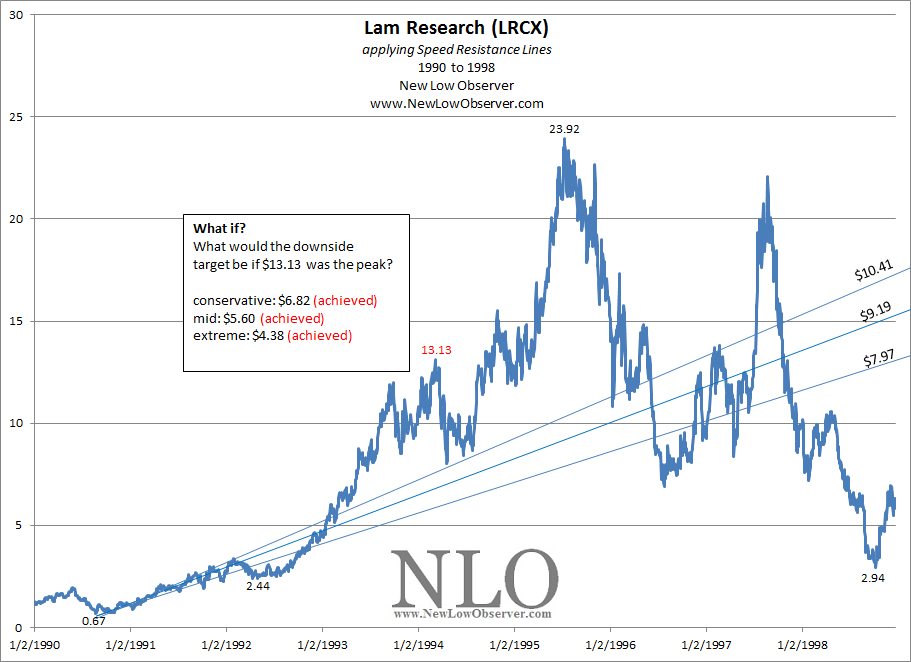
In the period from 1990 to 1995, Lam Research (LRCX) increased more than +3,470%.  From the peak of 1995, LRCX declined by –87.70% by 1998.  Based on the peak at $23.92, all of the Speed Resistance Lines [SRL] achieved their downside targets.

In addition, we’ve included the scenario for if the peak in the price were to have been the $13.13 level.  We included this because much of the analysis is based on parabolic moves to the upside.  Because we couldn’t possibly know where the peak in the price would be in real-time, we attempt to take the view, “what would happen if we were wrong about the peak?” Amazingly, even if we had chosen the $13.13 peak and used the downside targets based on the SRLs, we would have seen all of them achieved and would have been otherwise pleased if only the conservative target was met.

1998 to 2003

image

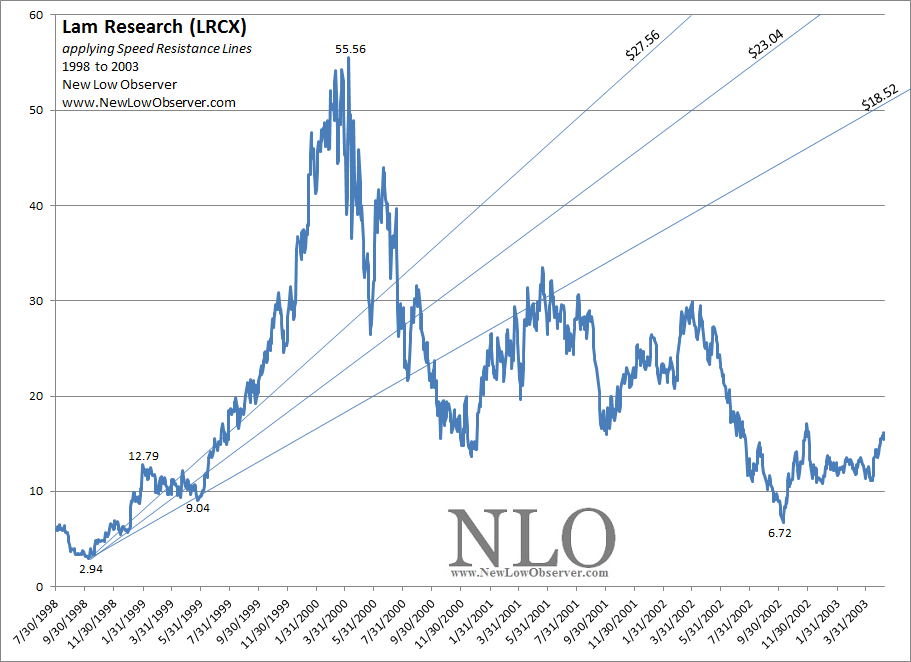
In the above chart, from 1998 to 2000, LRCX increased +1,789%.  in the following decline, LRCX fell as much as –87.90%. 

There weren’t many “fake peaks” to initiate “what if” scenarios.  However, let’s assume that along the way up we had run the SRL and tried to project downside targets.  Any price above $14.00 would have generated a conservative downside target that the price action later achieved.  Also note that the period when LRCX rose from $2.94 to $12.79 and then fell to $9.04 would have generated a conservative downside target of $9.72.  This would have easily achieved the downside target.

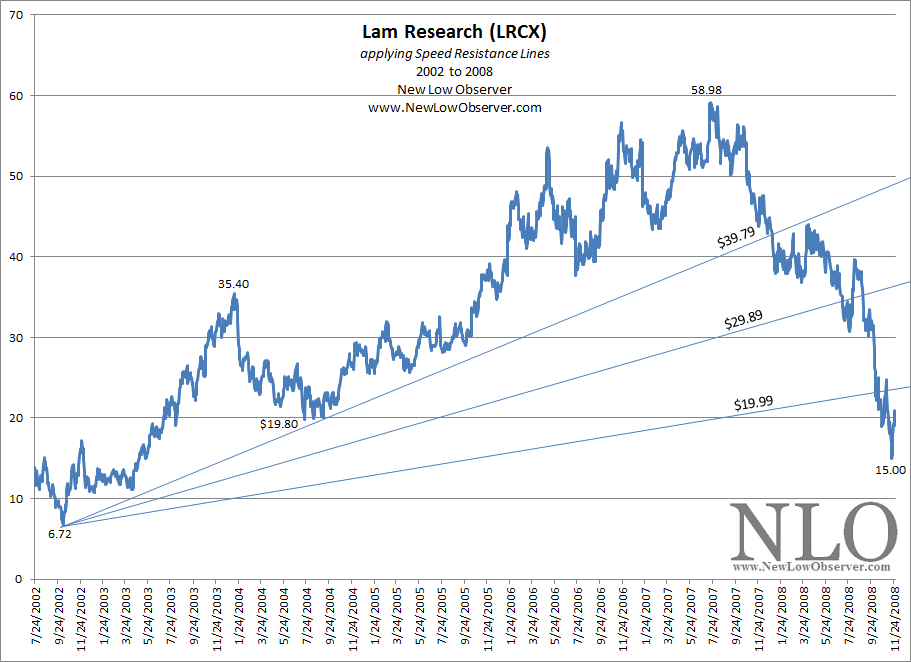
2002 to 2008

image

In the period from 2002 to 2007, LRCX increased +777.67% and later declined as much as –74.56%.

Not much can be said other than all downside target being achieved of the course of a six year period.  Again, in an attempt to prove our calculations wrong, we ran the $35.40 peak to see if the $19.80 number would have been an expected downside target. In the short term, the conservative downside target and mid range targets would have been accomplished.  In the long term, from the $35.40 level to the $15.00 in 2008, the low in 2008 would have met the SRL parameters for downside targets being achieved.

2008 to 2017