


- Japan
- Market Indicator
- Price Momentum Indicators
- Richard Russell
- Silver
- Speed Resistance Lines
- U.S. Dividend Watch List
Category Archives: real estate
Canadian Real Estate Review
Posted in Canada, Coppock Curve, Coppock Index, Dow/House Price Index, real estate, Real Estate Analyst, Roy Wenzlick
Tagged members
Real Estate Timing Targets
Posted in Home Prices, Housing, real estate, Real Estate Analyst, Roy Wenzlick, Wenzlick
Tagged members
Canadian Real Estate Review
Posted in Canada, Coppock Curve, Coppock Index, Dow/House Price Index, real estate, Real Estate Analyst
Tagged members
The Bears Should Be Bullish on Real Estate
Posted in Purchase Application Index, real estate, Real Estate Analyst, Roy Wenzlick
Tagged members
Undoing The Work of Those Who Got it Right in Real Time
On August 3, 2024, Kathleen Tyson, a former central banker, said the following:
“Chinese authorities and resolution experts have been managing down the real estate bubble for over four years. The IMF is frustrated that they can’t collapse China today as they collapsed Japan in 1990. Japan never recovered. China is avoiding that trap skilfully. Growth at 5% is stable.”

We unpack this commentary because it reveals much about efforts to end speculation in real estate and stock markets and highlights how a false narratives can gain traction in our world of revisionist history.
First, the follow-up commentary to the original posting from Kyle Ferrana:

If “…the IMF didn’t offer to give/loan China money, they suggested that China pay $1 trillion of its own money” then the IMF only suggested a policy that China has been implementing on its own for a very long time when it come to declining markets. So, there was no implied snub of the recommendations from the IMF. Instead, it was simply a recommendation that will emerge on the scene eventually.
Now to the commentary of Kathleen Tyson:
“Chinese authorities and resolution experts have been managing down the real estate bubble for over four years.”
If we count back to four years ago, that would bring us back to 2020. However, we do know of the October 17, 2017 speech by Xi Jin Ping where he said that property is not for speculation.

“…The principle was first introduced by China's top leaders at an economic conference last December, as the country sought to crack down on rampant speculative buying in its property market through a flurry of government curbs (Reuters).”

"Houses are built to be inhabited, not for speculation," Xi said in his address at the 19th Party Congress Wednesday in Beijing.”
The October 2017 reference to the December 2016 commentary gives us the impression that the beginning policy to ease prices and end speculation began in 2016, at least.
What is the point of determining when China started “managing down the real estate bubble?” If China is doing a great job controlling their economy and real estate market downward, then how did it become a real estate bubble to begin with?
When and what did the government do to manage down the property market? China initially tried to suppress real estate speculation back in 2003/2004 & 2010:
So how did that 2003/2004 effort to end speculation of real estate go in China?

The impression from the chart above should suggest that though well intended, housing prices in China continued to climb higher. Worth noting is the fact that the peak in China coincided with most global real estate markets, in spite of the government’s efforts to suppress rising prices and speculation.
As is standard practice of governments at the lows, in 2009, China introduced policies to offset prior speculation curbs, which of course had no impact on the inexorable trend.
"There are two short time periods of exceptions when home purchases were encouraged. One happened in 2009, just after the global financial crises, and the other was in 2015 when the government intended to mitigate the problem of housing storage." (page 387)
Jia, Shijun jiashj@gzhu.edu.cn Wang, Yourong rewangyr@cufe.edu.cn Fan, Gang-Zhi fan10@konkuk.ac.kr. “Home-Purchase Limits and Housing Prices: Evidence from China.” Journal of Real Estate Finance & Economics, vol. 56, no. 3, Apr. 2018, pp. 386–409.
The 2009 policy to prop the falling housing market was as follows:
“The central bank has lowered interest rates significantly, and the banking authority has loosened conditions on mortgage agreements, including lowering the down-payment requirements. (Clouse, Thomas. “Fuel For the Growth Engine.” Global Finance, vol. 23, no. 2, Feb. 2009, pp. 34–35.)."
After 2009, the property speculation continued as it did for much of the world.

We’re almost certain that the government in China thought, “look how quickly the market turned based on a minor tweaking of the policy on housing.” The conclusion must have been that if they can manage a reversal from the 2009 low, then they certainly can manage a reversal from a rising trend.
So, let’s go back to our feeble attempt at determining the beginning of the government efforts to end or curb speculation in real estate. Remember, we said, “…the beginning policy to ease prices and speculation began in 2016…” However, we already know that as early as 2003, China was trying to slow down the speculative nature of the property market and yet, property prices increased anyway.
This brings us back to the comment by Tyson:
“Chinese authorities and resolution experts have been managing down the real estate bubble for over four years. The IMF is frustrated that they can’t collapse China today as they collapsed Japan in 1990. Japan never recovered.”
How is it possible that the government couldn’t manage the speculation and rise but suddenly can manage the decline? This, coincidentally, is exactly the process that Japan took in trying to deal with their property bubble. We’re reminded of the words of the great Dow Theorist Richard Russell on this specific topic in 1990, well in advance of actual total collapse of Japan.

“History tells us that deflation has a habit of getting out of control.”
Keep in mind that, at the time, the Bank of Japan promised to end speculation in stocks and real estate before 1990. Except, after 1990, the theme of the central bank for Japan was one of doing everything they could to get real estate back to the former levels.

This parallel history between China in 2007 and Japan in 1989 (U.S. in 1929 & Germany in 1926) highlights how institutions think that they can alter the outcome.
Interestingly, suggesting that the IMF is the reason for the fall of Japan is a denial of Japan’s strength and weaknesses. Japan actually did earn the rise that followed from 1950 to 1989. Also, the rise ran too high and too far. That is how bubbles work, historically.
Suggesting that the IMF is the reason for the decline in Japan denies all the experts who accurately predicted the subsequent crash. Experts like Tetsuo Tsukimura, who predicted that the Nikkei would decline to 8k-6k while the index was at or above 30k.
Or Bill Emmott, with his 1989 book titled The Sun Also Sets who suggested that “"Japan is, despite all that has been written and said to the contrary, a country that, just like any other, is affected by human nature and market forces…”

People worked really hard for the accomplishment of analyzing the situation correctly. To suggest that the reason for the decline of Japan’s economy was due to a global government agency like the IMF, which many agree, routinely gets their analysis and policy wrong, undoes all the hard work of those who got it right in real time.
See also:
-
August 3, 2024 Kathleen Tyson
-
October 17, 2017 Reuters
-
October 17, 2017 Bloomberg
-
October 30, 2017 Taipei Times
Posted in bailout, bubble, China, Japan, real estate, speculation
Q & A on Real Estate
Q: “I would be curious as to your current view on real estate market in USA. As someone who is looking to purchase something in the Southeast USA I’m trying to grapple with now or wait.”
Dow/House Price Index Ratio
On February 11, 2024, we posted the following chart to Twitter:

What is our take on this chart? To find out we had to regenerate the same data to the current period, as seen below:

Russell suggests that the chart indicates that the Dow was cheap when at the lows and housing is cheap when the indicator is higher. Can housing really be that cheap as the ratio continues to climb higher?
We don’t think so. Instead, we think that the indicator is merely reflecting the inverse relationship with interest rates. What we should see is the indicator ultimately getting down to the 1980 level as interest rates rise.
This highlights the importance of obtaining a full cycle before drawing any meaningful conclusions.
National Home Price Targets
Our first housing target from January 22, 2023 have been achieved.
Real Estate Cycle
Below is our estimate of where we are in the Real Estate Cycle based on the work of Roy Wenzlick.
National Home Price Targets
Based on the data below, there are four stages of decline to watch for: Continue reading
Housing Prices and the Attack on Speculators
After reading a recent piece by Ann Pettifor titled “House Prices & Global Wall of Borrowed Money” dated January 18, 2023, we were struck by a point that was made to explain the increase in housing prices. Pettifor says:
“As I wrote back in 2018: House prices have been blasted into the stratosphere, not by a shortage of supply, but by the excess of a potent propellant – finance.”
According to Peittifor, it is this “propellant” that, once withdrawn, should generate a decline in prices.

Pettifor’s citation of The Guardian article from 2018 is noteworthy in one of the solutions to rising home prices that is proposed:
“The best way to do this is through the tax system. First for consideration should be a property speculation tax (PST), as in Germany.”
Leaving aside the Panama Papers showing all the different organizations and people that create shell companies for the sole purpose of getting around the tax system, a look at the German House Price Index after Pettifor’s 2018 article, as provided by Trading Economics (https://tradingeconomics.com/germany/housing-index), we can see that there is little material change in the trajectory in the price of homes. The period of 2018 is indicated by the red arrow on the chart below. After 2019, house prices appear to rise at an accelerated pace.

Was there a failure in the PST? Should the Germans have been more aggressive to stem the tide of speculation? We don’t know. However, what we do know is that previous attempts at curbing the rapid rise in real estate prices, aimed specifically at speculators, from Singapore to the United States, have all failed.
Let’s cover a few of the attempts at curbing speculation from a very interesting article titled “Special Capital and Real Estate Windfall Taxes (SCREWTS) in CANZEUS: A Phenomenon.” by Donald G. Hagman and Dean Misczynski published in December 1975. The key takeaways are:
-
Australia: The Land Development Contribution Act, April 8, 1970.
-
“But land prices kept soaring…”
-
“The Liberal-Country Government repealed its own tax…”
-
Vermont: The Tax on Gains from the Sale or Exchange of Lands, May 1, 1973.
-
“If the theory is correct, land prices should increase less rapid…”
-
“The reduction is apparently mostly due to to the recessed economy rather than to any changes in the law.” This shows how windfall taxes mark the top in speculative environments and generate less revenue that initially anticipated and don’t stop the speculation as was intended.
-
New Zealand: The Property Speculation Tax Act of 1973
-
“Specifically aimed at curbing speculation in land…”
-
“But that tax is so focused on ‘speculators’ that relatively few transactions are actually caught.”
-
Canada: The Land Speculation Tax Act, 1974
-
Spiraling land prices blamed on foreign speculators prompted the tax.
-
Thought to generate $25 million in the first year, $55,450 in the first four months.
By all appearances, the legislative efforts to reduce land speculation has failed. in addition, it is noted by Hagman and Misczynski that “these taxes have largely been imposed in turbulent, initially booming land markets, under dynamic circumstances that complicate realistic analysis and render all conclusions moot.”
In 2013, Singapore, after the doubling in property prices:
“…added measures to curb speculative buying - Singaporeans have to pay additional tax when they buy their second homes. Three years ago, the government modified loan schemes for select housing projects and asked foreigners and companies buying properties to pay additional taxes.”

The red circle in the Price Index of HDB Resale Flats highlights when the tax was added. As with the history of windfall taxes, they generally occur at a natural peak in the market. The problem with this is that it is thought that the tax alone is the reason for the decline in prices. Additionally, once the decline arrives it is realized that there are insurmountable losses in the economy rendering it more unlikely that those who were supposed to benefit from the tax legislation can’t due to their inability to qualify for new stricter loan standards, caused by the decline.
To better understand the role of government in the effort to address the needs to the public, an important step is understanding of past failures. Too often, strategies are devised in reaction to public outcry and once implement at significant cost, are retracted meekly and hardly with as much pomp. Market forces are out of the control of government and even when the government thinks it is in control a black market or workaround is devised.
Critical Points
-
Tax schemes are already circumvented by those who can afford to hire the experts (big accountants and consulting firms). This leaves only those who can’t afford to pay experts to either break the tax law or become the primary targets of the law.
-
Government isn’t the problem, but it isn’t the solution on these challenging housing issues.
-
Windfall taxes are usually instituted at the top in the market.
-
When windfall taxes aren’t at the top in the market, they show little or no effect on the trajectory of the price increase that follows.
-
A person unable to afford an overpriced property is more likely to get a loan from a bank in a booming market (high prices) than the same person in a declining market (low prices).
-
Markets work in spite of the government, not because of the government.
Sources:
-
Pettifor, Ann. “House Prices and the Global Wall of Money.” System Change. January 18, 2023. https://annpettifor.substack.com/p/house-prices-and-the-global-wall
-
Pettifor, Ann. "Why Building More Homes Will Not Solve Britain's Housing Crisis." The Guardian. January 27, 2018. https://www.theguardian.com/commentisfree/2018/jan/27/building-homes-britain-housing-crisis
-
German House Prices. https://tradingeconomics.com/germany/housing-index
-
Andrew Heywood and Paul Hackett. “The Case For a Property Speculation Tax.” The Smith Institute. September 2013. https://smithinstitutethinktank.files.wordpress.com/2014/11/the-case-for-a-property-speculation-tax.pdf
-
Donald G. Hagman and Dean Misczynski. “Special Capital and Real Estate Windfall Taxes (SCREWTS) in CANZEUS: A Phenomenon.” National Tax Journal. December 1975, pp. 437–44.
-
A. Srivathsan. “Curbs on Speculative Property Buying.” TheHindu.com. April 2, 2013. https://www.thehindu.com/opinion/blogs/blog-datum-line/article4573506.ece
Posted in 1974, real estate, REIT
1870-2033: Real Estate Cycles
The history of real estate cycles should inform how to analyze the market. However, there is an abundance of analysis without a review of the history, which generates conclusions that are unrelated to how the real estate market works. Additionally, symptoms are given more prominence than the causes leading investors, speculators, buyers, and sellers down a path of misunderstanding.
Below is a chart of the real estate cycle from 1870 to 2033. Continue reading
Posted in cycle analysis, Cyclical Trends, Market cycles, real estate, Wenzlick
San Diego City Building Permits
Below is a chart of San Diego City building permit from 1894 to 1989 as found in Jon Strebler’s San Diego Housing Prices, 1887-1989: The Myth of Invincibility.
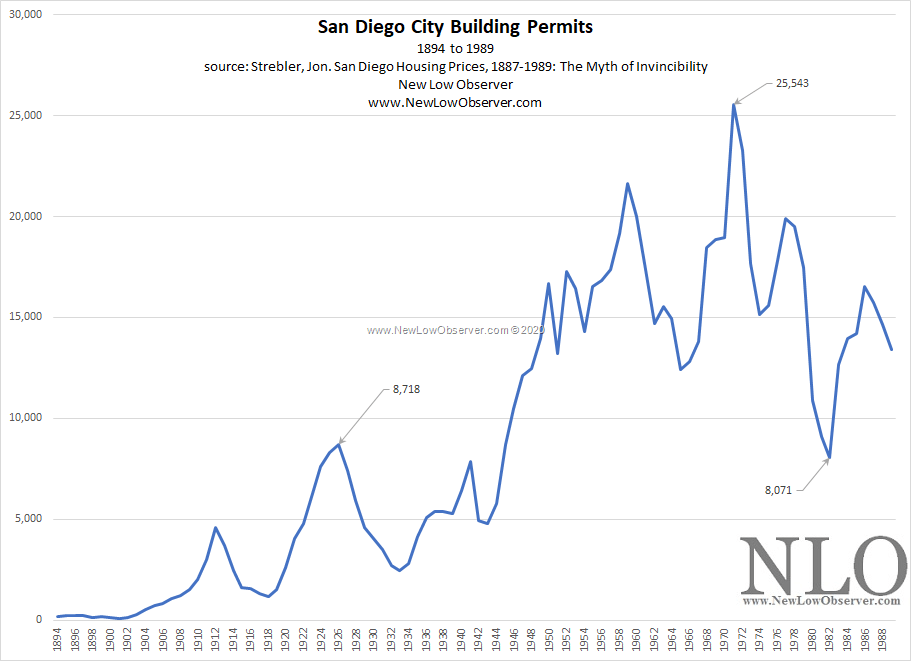
Strebler was often quoted in Richard Russell’s Dow Theory Letters and was kind enough to send us a copy of his Myth of Invincibility many years back.