Below is a chart of Gold from January 2002 to July 2023, reflecting Price Momentum data.
-
Topics
Archives
-
-
Recent Posts
-
-
-
-

Below is a chart of Gold from January 2002 to July 2023, reflecting Price Momentum data.
Below are the thoughts we have on the price of Gold based on several indicators. Continue reading
Below is a chart of Gold from 2002 to 2022, reflecting Price Momentum data.
Below is the price chart of Dome Mines (DM) from 1918 to 1968. Continue reading
Posted in DM, Dome Mines, gold
Below are the valuation targets for Barrick Gold Corp. (GOLD) for the next 10 years. Continue reading
Below is the annual 52-week low for Dome Mines (DM) from 1960 to 1968. We’ve also included the Effective Fed Funds Rate as a comparison to show how gold mining stocks perform against the backdrop of rising interest rates.
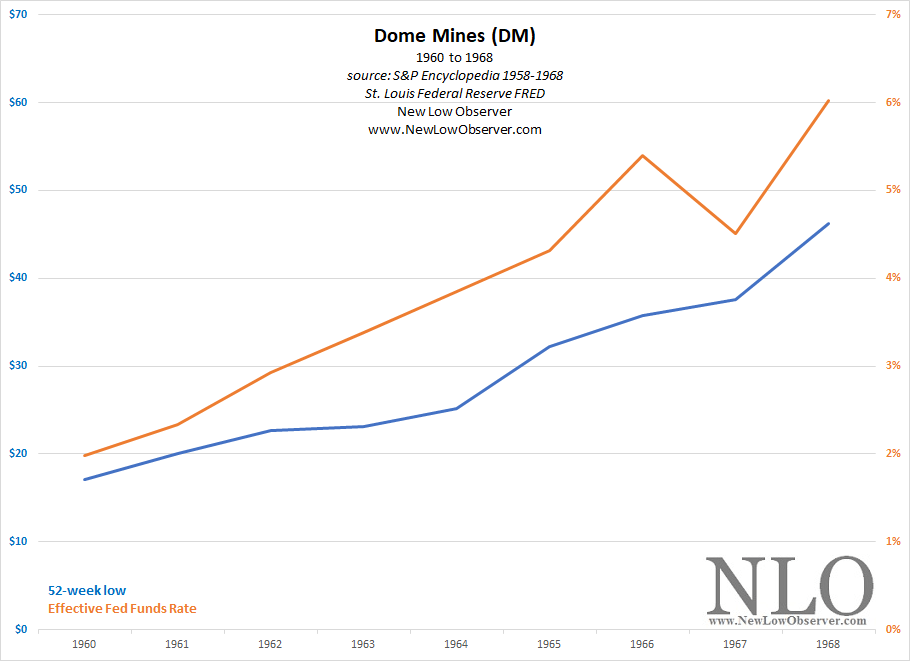
In this example, the Effective Fed Funds Rate increased from 1.98% to 6.02%. Meanwhile, Dome Mines (DM) had a 52-week low range from $17.12 to $46.25.
Posted in 1958-1968, Chart of the Day, Dome Mines, gold, interest rates
Below is the annual 52-week low for Campbell Red Lake Mines (CRK) from 1960 to 1968. We’ve also included the Effective Fed Funds Rate as a comparison to show how gold mining stocks perform against the backdrop of rising interest rates.

In this example, the Effective Fed Funds Rate increased from 1.98% to 6.02%. Meanwhile, Campbell Red Lake Mines (CRK) had a 52-week low range from $9.63 to $24.00.
We like the comparison between the “freely” traded price of gold compared to the Nasdaq Composite index because it really shows the difference between the performance in the two over the years.
Most importantly, gold began trading “freely” at around the same time of the initial trading of the Nasdaq Composite Index. Therefore, there is little in the way of distortion in the data. Below is the daily price of gold versus the Nasdaq Composite.
Posted in gold, Nasdaq Composite
Charles H. Dow, co-founder of the Wall Street Journal, once said:
“For the past 25 years the commodity market and the stock market have moved almost exactly together. The index number representing many commodities rose from 88 in 1878 to 120 in 1881. It dropped back to 90 in 1885, rose to 95 in 1891, dropped back to 73 in 1896, and recovered to 90 in 1900. Furthermore, index numbers kept in Europe and applied to quite different commodities had almost exactly the same movement in the same time. It is not necessary to say to anyone familiar with the course of the stock market that this has been exactly the course of stocks in the same period ( source: Dow, Charles. Review and Outlook. Wall Street Journal.February 21, 1901.)”
There is no exactness between the relative percentage change in the Dow Jones Industrial Average and the price of a commodity like gold. However, since the January 26, 2018 peak in the DJIA, there has been a lot of sympathy moves in the price of gold and the DJIA.

Posted in Charles H. Dow, DJIA, gold
We have been quoted here on many occasions saying that when the general equity market takes a dive of –10% or more, so too does gold stocks by a greater margin. Our point, gold stocks are not a hedge from general market drops.
In our September 24, 2014 article titled “Gold Stocks: Risks and Remedies” we highlighted the numerous instances from 1939 to 2011 of when the Dow declined by more than -10% and showed how either the Barron’s Gold Mining Index or the Philadelphia Gold & Silver Stock Index declined by a greater percentage.
In the recent decline of the DJIA from January 26, 2018 to February 8, 2018, the index declined –10.36%. So how much did the Philadelphia Gold & Silver Stock Index (XAU) decline? The XAU declined –11.57%.
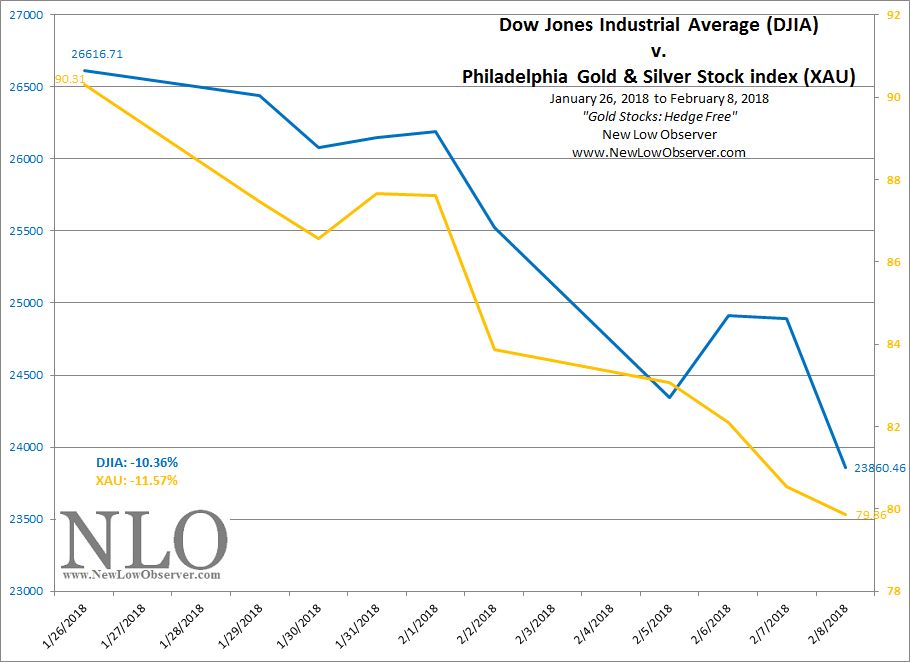
In the chart above, we have excluded the decline of –14.75% from January 24, 2018 to February 9, 2018 in the XAU index. Add this to the growing list of instances of when the DJIA declines more than –10% and gold stocks also decline by a greater percentage.
Posted in DJIA, gold, gold bugs, Gold Stock Indicator, XAU