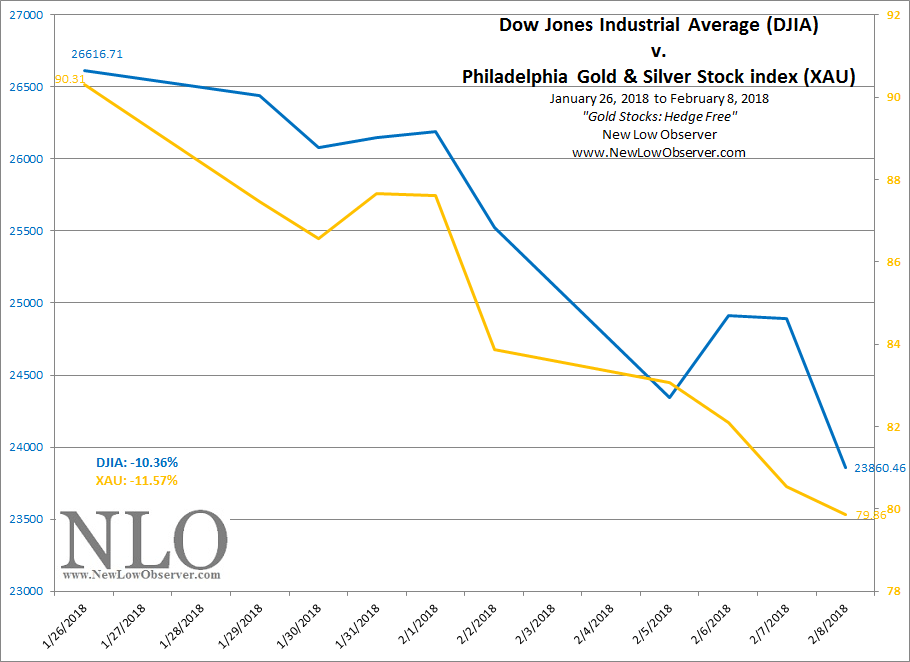
Saw this headline and almost did a spit-take.

Fortune Magazine claimed to “fact check” whether history shows that this was the fastest 1,000 points.

Sadly, Fortune never actually compares the current +4.17% gains to any other in the 122-year history of the DJIA. You have to wonder if Fortune included the 15 years after 1972, when the Dow finally crossed over 2,000.
To their credit, Fortune does say, “…the Dow has grown larger over time, meaning a 1,000 point move today is less significant percentage-wise compared to such a movement 20 years earlier.”
Again, for the Dow Jones Industrial Average (DJIA), going from 24,000 to 25,000 is equal a +4.17% change. As noted in Fortune, on a percentage basis, +4.17% isn’t much. However, we have listed the gains above +4.18% that took less than 34 calendar days since 1896. Although there are too many to show, we’ve only relegated this to the last 45 incidents from the lowest percentage gain excluding multiple events in the same year.
| Date |
DJIA % change |
days |
| July 21, 1897 |
4.21% |
10 |
| June 29, 1938 |
4.21% |
1 |
| November 27, 1905 |
4.22% |
1 |
| April 5, 2001 |
4.23% |
1 |
| November 30, 2011 |
4.24% |
1 |
| March 4, 1926 |
4.38% |
1 |
| December 24, 1902 |
4.43% |
8 |
| November 1, 1978 |
4.46% |
1 |
| November 2, 1904 |
4.50% |
7 |
| November 26, 1963 |
4.50% |
1 |
| January 15, 1934 |
4.52% |
1 |
| January 17, 1991 |
4.57% |
1 |
| February 9, 1931 |
4.62% |
1 |
| June 19, 1930 |
4.63% |
1 |
| May 29, 1962 |
4.69% |
1 |
| October 28, 1997 |
4.71% |
1 |
| October 9, 1974 |
4.71% |
1 |
| June 12, 1940 |
4.73% |
1 |
| February 11, 2010 |
4.75% |
3 |
| August 17, 1982 |
4.90% |
1 |
| March 16, 2000 |
4.93% |
1 |
| November 16, 1933 |
4.93% |
1 |
| November 12, 1896 |
4.93% |
8 |
| September 8, 1998 |
4.98% |
1 |
| May 17, 1915 |
5.02% |
1 |
| May 27, 1970 |
5.08% |
1 |
| October 16, 1903 |
5.11% |
1 |
| January 27, 1899 |
5.36% |
20 |
| August 17, 1898 |
5.41% |
12 |
| August 11, 1909 |
5.43% |
22 |
| December 22, 1916 |
5.47% |
1 |
| November 22, 1920 |
5.51% |
1 |
| February 5, 1917 |
5.77% |
1 |
| October 20, 1987 |
5.88% |
1 |
| October 20, 1937 |
6.08% |
1 |
| January 19, 1906 |
6.08% |
14 |
| October 7, 1929 |
6.32% |
1 |
| July 24, 2002 |
6.35% |
1 |
| May 10, 1901 |
6.37% |
1 |
| March 15, 1907 |
6.69% |
1 |
| March 23, 2009 |
6.84% |
1 |
| January 6, 1932 |
7.12% |
1 |
| November 10, 1911 |
8.27% |
14 |
| January 14, 1908 |
8.61% |
11 |
| September 5, 1939 |
9.52% |
1 |
|
|
|