Monthly Archives: September 2012

U.S. Dividend Watch List: September 28, 2012

Below are the 20 companies on our U.S. Dividend Watch List that are within 11% of their respective 52-week lows. Stocks that appear on our watch lists are not recommendations to buy. Instead, they are the starting point for doing your research and determining the best company to buy. Ideally, a stock that is purchased from this list is done after a considerable decline in the price and rigorous due diligence.

Symbol Name Price % Yr Low P/E EPS (ttm) Dividend Yield Payout Ratio
CRR Carbo Ceramics, Inc. 62.92 1.80% 11.02 5.71 1.08 1.72% 19%
IBKC IBERIABANK Corp.  45.80 3.01% 20.63 2.22 1.36 2.97% 61%
EXPD Expeditors International  36.35 4.36% 21.64 1.68 0.56 1.54% 33%
ERIE Erie Indemnity Company  64.27 5.14% 22.55 2.85 2.21 3.44% 78%
UNM Unum Group 19.22 5.14% 25.97 0.74 0.52 2.71% 70%
CAH Cardinal Health, Inc.  38.97 5.58% 12.49 3.12 0.95 2.44% 30%
MATW Matthews International Corp.  29.82 6.96% 13.43 2.22 0.36 1.21% 16%
MCY Mercury General Corp. 38.65 7.33% 14.75 2.62 2.44 6.31% 93%
FRS Frisch's Restaurants, Inc 19.85 7.65% 46.16 0.43 0.64 3.22% 149%
ABM ABM Industries, Inc. 18.93 8.11% 19.52 0.97 0.58 3.06% 60%
ANAT American National Insurance 71.83 8.65% 10.63 6.76 3.08 4.29% 46%
PPL PP&L Corporation 29.05 8.88% 9.88 2.94 1.44 4.96% 49%
WGL WGL Holdings, Inc. 40.25 9.26% 20.43 1.97 1.60 3.98% 81%
RLI RLI Corp. 66.66 9.28% 12.97 5.14 1.28 1.92% 25%
ED Consolidated Edison, Inc.  59.89 9.45% 16.54 3.62 2.42 4.04% 67%
MCD McDonald's Corp.  91.75 9.57% 17.25 5.32 3.08 3.36% 58%
JW-A John Wiley & Sons Inc. 45.95 9.69% 14.14 3.25 0.80 1.74% 25%
VLY Valley National BanCorp.  10.02 10.11% 14.74 0.68 0.65 6.49% 96%
LM Legg Mason, Inc.  24.68 10.38% 22.85 1.08 0.44 1.78% 41%
CWT California Water Service 18.65 10.95% 21.19 0.88 0.63 3.38% 72%
20 Companies              

Watch List Review

Carbo Ceramics (CRR) came back to top our watch list this week.  August 3 was the last time the company topped our list, traded at $64.69.  After falling 2.7%, the stock has a yield of 1.8%, the second highest yield this company has seen.  We saw the stock traded at the highest yield at 2.32% at the market low in 2008.  Our valuation model suggests a fair value of $88 but with possible downside to $45.  While risk/reward of 28/40 is somewhat attractive, we are not comfortable taking position while the Transport is weakening.

IberiaBank (IBKC) reached the top five for the first time on our list.  We know little about this Southeast Regional bank thus we won’t elaborate much about its fundamental.  Technical level shows that $45 is the next support level while a break below that will lead a stock to see $42 support level.  Over the past three years, the stock has been compressing and a break above or below its trend line will determine the major move of the stock.

Top Five Performance Review

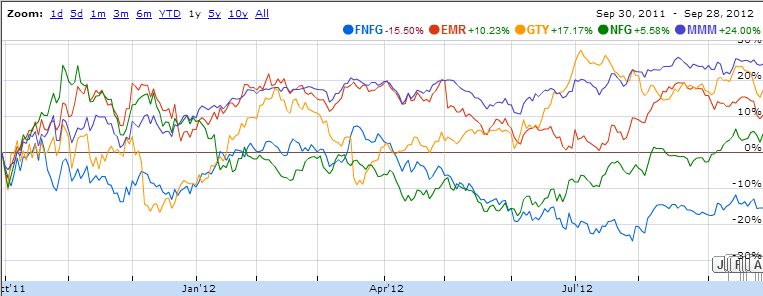
In our ongoing review of the NLO Dividend Watch List, we have taken the top five stocks on our list from September 30,  2011 and have check their performance one year later. The top five companies on that list can be seen in the table below.

Symbol Name 2011 Price 2012 Price % change
FNFG First Niagara Financial Group 9.15 8.07 -11.80%
EMR Emerson Electric Co. 41.31 48.27 16.85%
GTY Getty Realty Corp. 14.42 17.95 24.48%
NFG National Fuel Gas Co. 48.68 54.04 11.01%
MMM 3M Co 71.79 92.42 28.74%
      Average 13.85%
         
DJI Dow Jones Industrial 10,913.38 13,437.13 23.13%
SPX S&P 500 1,131.42 1,440.67 27.33%

NLO_20120928

Our top five  under underperformed the market by nearly 10% partly due to the loss from First Niagara (FNFG).  Despite that, other four stocks managed to reach 10% mark within one year time frame.
Gold Stock Indicator: Performance Review

Article Summary

  • Our Gold Stock Indicator is currently in a rising trend.
  • The XAU Index could rise another +25%, IF prior indications are correct.
  • Gold stocks have registered solid gains since our “blanket” recommendation to buy on July 31, 2012.
  • Our preference for NEM, ABX and GG exceeded returns of FCX, BVN and GFI.
  • NUGT increased +88.19%

Our Take

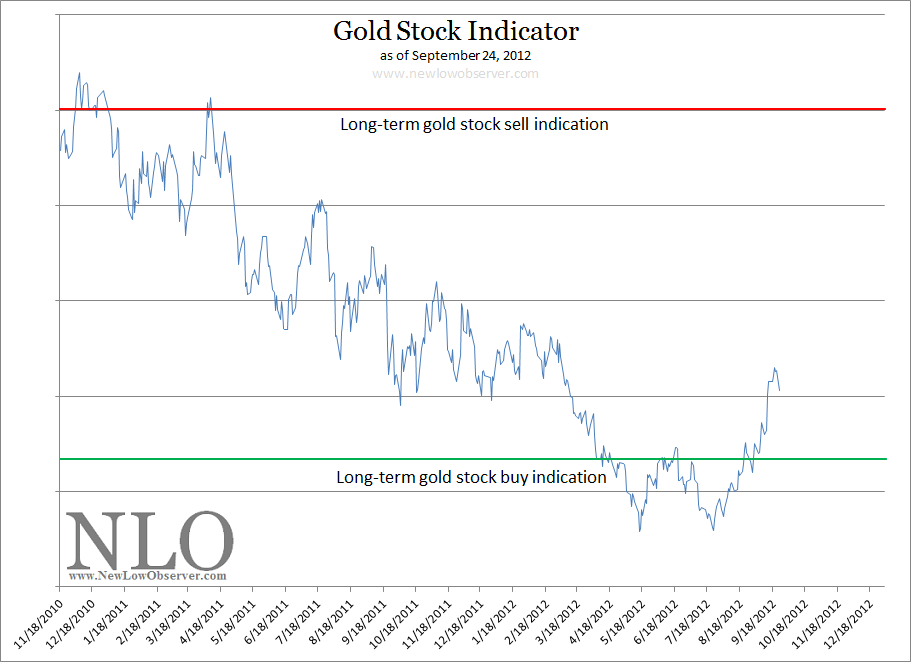
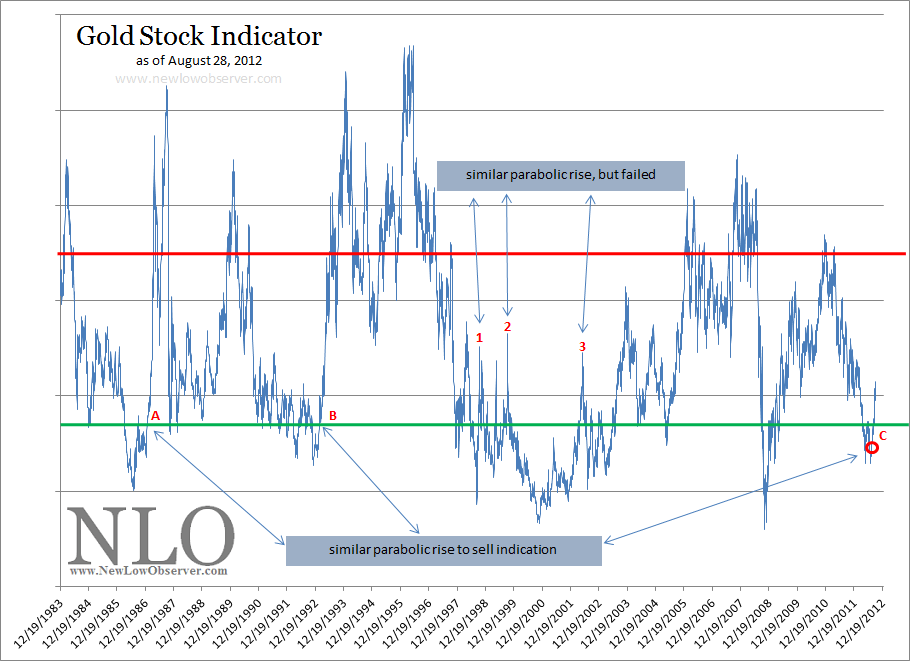
Gold stocks have registered solid gains since our recommendation on July 31, 2012 (found here).  This recommendation was based on the fact that our Gold Stock Indicator was clearly in the long-term buy range as indicated by the red circle in the chart below:

image

We have a few observations that are worth considering regarding our Gold Stock Indicator.

The current parabolic rise at point (C) is matched by the rise the took place at point (A) and point (B).  Point (A) took place from January 12, 1987 to April 9, 1987.  The rise in the Philadelphia Gold and Silver Stock Index (XAU) at that time was +55.98%.  To put this into perspective, during the same four months, Barrick Gold (ABX) rose +77.36% Newmont Mining (NEM) rose +60.86% and Agnico-Eagle (AEM) rose +33.87%.

At point (B), from February 5, 1993 to June 25, 1993, the Philadelphia Gold and Silver Stock Index rose +54.14%.  Barrick Gold rose +43.29%, Newmont Mining rose +20% and Agnico-Eagle rose +98.34%.

So, what is the message in all this data? In theory, based on the two prior moves at point A and B, The XAU Philadelphia Gold and Silver Index could rise another 25%. If you believe in a further rise in gold stocks, then Barrick Gold is the one to own. You now have the date ranges so you can now compare any other gold stocks that are out there and see if there is a consistent performer out there other than Barrick.

Another observation is that there were three similar powerful parabolic moves that failed at points 1, 2 and 3. Because we really don’t know how much further this rise will go, we always advise that investors take the gains and rotate into whichever gold stocks are currently trading near a new low.

One thing you must remember, gold itself did not perform well in comparison to gold stocks.  In 1987 and 1993 periods mentioned above, gold rose only +2.43% and +14%, respectively.  This is why we call it the Gold Stock Indicator, it reflects the relative outperformance to the upside and downside, as compared to the actual precious metal.

For those willing to accept the risks, two alternatives to owning individual gold and silver stocks could consider Exchange Traded Funds (ETFs) in the form of Global X Silver Miners ETF (SIL) or Market Vectors Junior Gold Miners ETF (GDXJ).  In the period from July 31st to September 28th, SIL increased +36.34% while GDXJ increased +28.46%.  It is important to note that when you eliminate the individual stock risk with these ETFs, you inherit and assume brand new risks that may have not been fully revealed due to the relatively short history  of ETFs.

The performance of all the gold stocks since the July 31, 2012 recommendation are as follows (our picks in yellow):

Symbol
Name 7/30/2012 9/28/2012 % change
PAAS Pan American Silver Corp. $15.18 $21.44 41.24%
SLW Silver Wheaton Corp. $28.27 $39.71 40.47%
GOLD Randgold Resources Ltd. $91.18 $123.00 34.90%
RGLD Royal Gold, Inc. $76.63 $99.83 30.28%
AUY Yamana Gold, Inc. $15.17 $19.11 25.97%
ABX Barrick Gold Corporation $33.17 $41.76 25.90%
GG Goldcorp Inc. $36.70 $45.85 24.93%
NEM Newmont Mining Corp. $45.06 $56.01 24.30%
SSRI Silver Standard Resources Inc. $13.07 $16.03 22.65%
KGC Kinross Gold Corporation $8.59 $10.21 18.86%
AEM Agnico-Eagle Mines Ltd. $44.16 $51.88 17.48%
FCX Freeport-McMoRan $34.01 $39.58 16.38%
BVN Buenaventura SA $36.89 $38.96 5.61%
AU AngloGold Ashanti Ltd. $34.55 $35.05 1.45%
GFI Gold Fields Ltd. $13.09 $12.85 -1.83%
HMY Harmony Gold Mining Co. Ltd. $10.07 $8.41 -16.48%

As a follow-up, the Direxion Daily Gold Miners Bull 3X Shrs (NUGT) increased by the staggering amount of +88.19%.

What a Time to Issue a Sell Rating

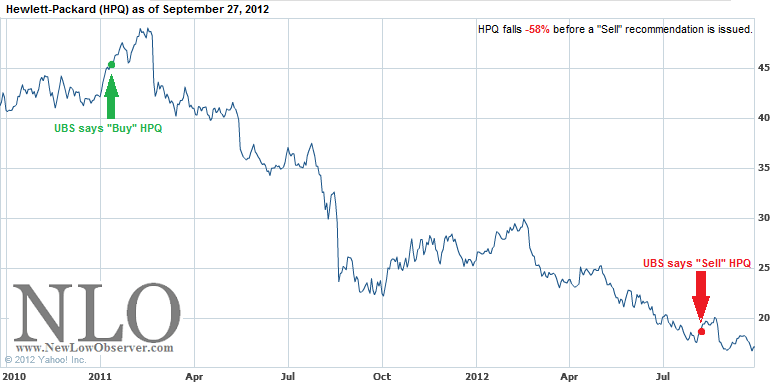
In honor of the latest “sell” rating on Hewlett-Packard (HPQ), this time coming from Jefferies and Co. (article found here), we’d like to give the “Stock Quote of the Day” to UBS for their sell recommendation of HPQ at the worst possible time (sell recommendation here).  On January 11, 2011, UBS gave a “buy” recommendation of HPQ when the stock was trading at $44.86 (buy recommendation here).  On August 7, 2012, over a year later and after a -58% decline, UBS finally gave a “sell” rating on HPQ.

image

A “sell” rating on HPQ after the stock has decline so much in the last two years does not do justice to the use of a buy or sell rating.  We’re not suggesting that HPQ is a “buy” at this point in time.  However, this is traditionally when values are confirm through additional due diligence.  If a person had already held shares of HPQ, the only reason to sell at this point is if you believe the company is going out of business within the next twelve months.

Is it any wonder that investors tend to buy high and sell low?

Agnico-Eagle Is Now A Sell

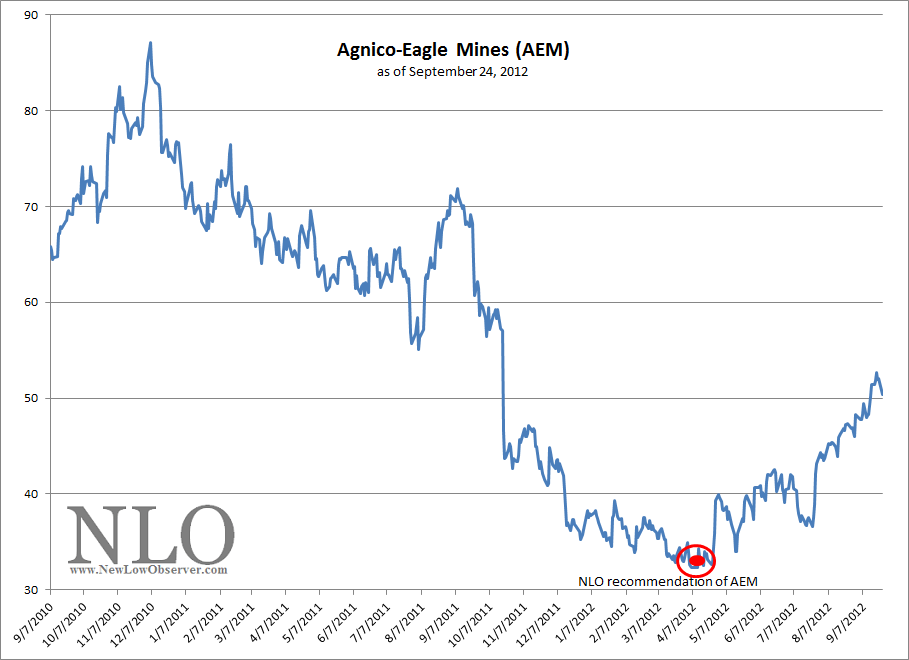
On April 8, 2012 (article found here), we recommended Agnico-Eagle Mines (AEM).  At the time, we were basing our first individual recommendation of gold stocks on our Gold Stock Indicator.  Our Gold Stock Indicator had been in a declining trend since November 2010 suggesting that no purchase of gold stocks should take place. However, once our Gold Stock Indicator declined below the long-term buy indication in early April 2012, it was a clear signal to start acquiring gold stocks.

image

The reversal of the declining trend has been reflected in gains in the gold stock sector across the board.  In our initial analysis of Agnico-Eagle Mines (AEM) we projected that, based on Edson Gould’s Altimeter, the stock price was likely to increase from +100% to +175% over a two year period.  Since our recommendation on April 8th, Agnico-Eagle has gained just over +45%.  Our experience indicates that there will be many opportunities to re-acquire Agnico-Eagle at better relative prices.

image

According to Value Line Investment Survey, Agnico-Eagle trades at a fair value of $39.  The current price of Agnico-Eagle, at $49.76, is 27% above the fair value price.  Stocks that are selling above fair value and that have had above market returns should be sold.  Yahoo!Finance and Morningstar.com indicate that Agnico-Eagle is operating at a loss for the trailing 12-months.  We will re-consider Agnico-Eagle when the stock approaches an undervalued range based Edson Gould’s Altimeter.

Those not interested in following through with our sell recommendation can feel comfortable knowing that Agnico-Eagle (AEM) is a reasonable holding until our Gold Stock Indicator crosses above the long-term sell level.  So far, AEM has a 45% downside cushion since our investment observation. It should be noted that the stock faces significant upside resistance at $52 and $60.

“Apple-Less Dow” is a Good Thing

An article titled “Apple-less Dow faces changes to make-up,” found in the Financial Times, suggests that the current owners responsible for the composition of the Dow Industrials are considering ways to make it possible to add Apple (AAPL) to the 116-year old index. The myopic view of changing the Dow Industrials simply for the purpose of adding AAPL will haunt the index managers and investors alike.

In the past, the changes in the composition of the Dow have been ill-timed to begin with.  In our article titled "Dow Jones' Decline Largely Impacted by Index Changes," we highlight the fact that composition changes routinely negatively impacted the Dow Industrials. Additionally, we have demonstrated that the changes to the Dow Industrials from 1929 to 1932 was the sole contributor to the decline of the index by -89%, when compared to the Barron's 50 Index in the same time frame.

In a follow-up article titled “After the Crash, Recovery was Faster Than Most People Think” we show how the irresponsible changes to the Dow Industrials from 1929 to 1932 was the reason for the index to take 25 years to get back to the 1929 high.

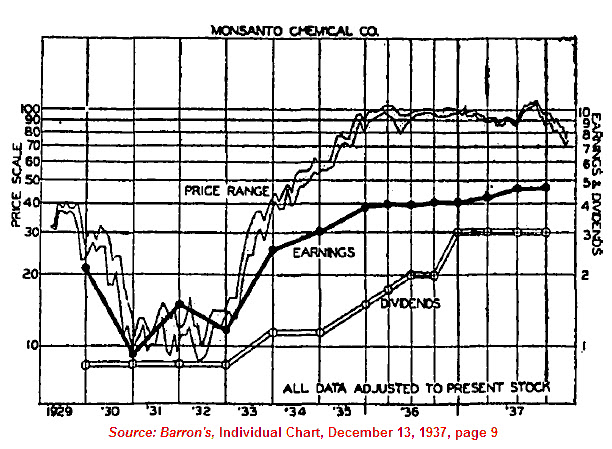
We’ve shown that many high quality stocks (the purpose of the Dow Industrials is to represent “high quality” stocks) were able to reach their 1929 high in 8-9 years instead of 25 years like with the Dow Industrials (as reflected in the Monsanto Chart below).  The extended delay in getting back to the prior high was due solely to a losing trader's mentality of buying high and selling low applied to addition and subtractions to the Dow Industrials.

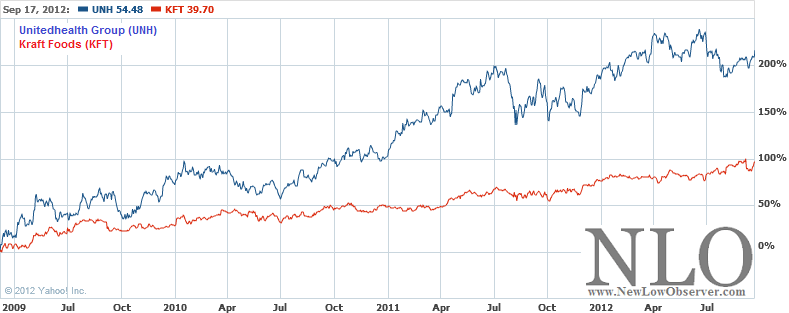
The recent addition of Unitedhealth Group (UNH) to the Dow Industrial Average, replacing Kraft Foods (KFT) exemplifies the "buy" high mentality of those who manage the index. United Health is being added after nearly 215% gains in the stock since the March 2009 low. This compares to "only" a 100% gain in Kraft Foods since the same starting point, see chart below.

image

To emphasize our point, since the March 9, 2009 low, the following are the major index returns:

  • NYSE Composite: +98.22%
  • Dow Industrials: +107.41%
  • S&P 500: +115.98%
  • Dow Tranports: +128.74% (does not contain AAPL)
  • Russell 2000: +149.23% (does not contain AAPL)
  • Nasdaq Composite: +150.66%

As the theory goes, the performance of a well diversified index should achieve moderate gains and moderate declines.  The Dow Industrials have performed as though it was a well diversified index, rather than one composed of only 30 companies.  On the flip side of the diversification theory, a highly concentrated portfolio should have higher volatility both up and down.  For a sense of perspective, the Russell 2000 does not contain Apple while the Nasdaq Composite does.  The absence of Apple in the Russell index did not inhibit its ability to effectively match the performance of the Nasdaq Composite.

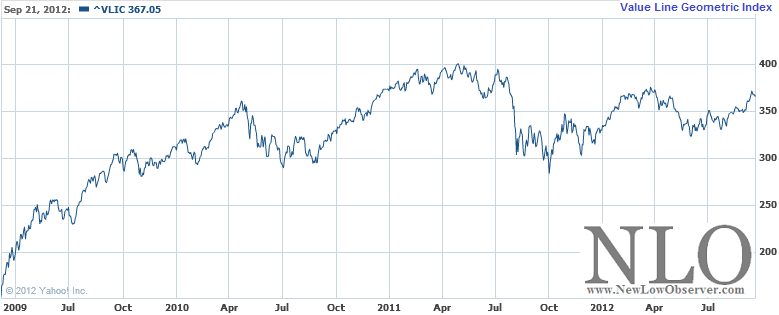
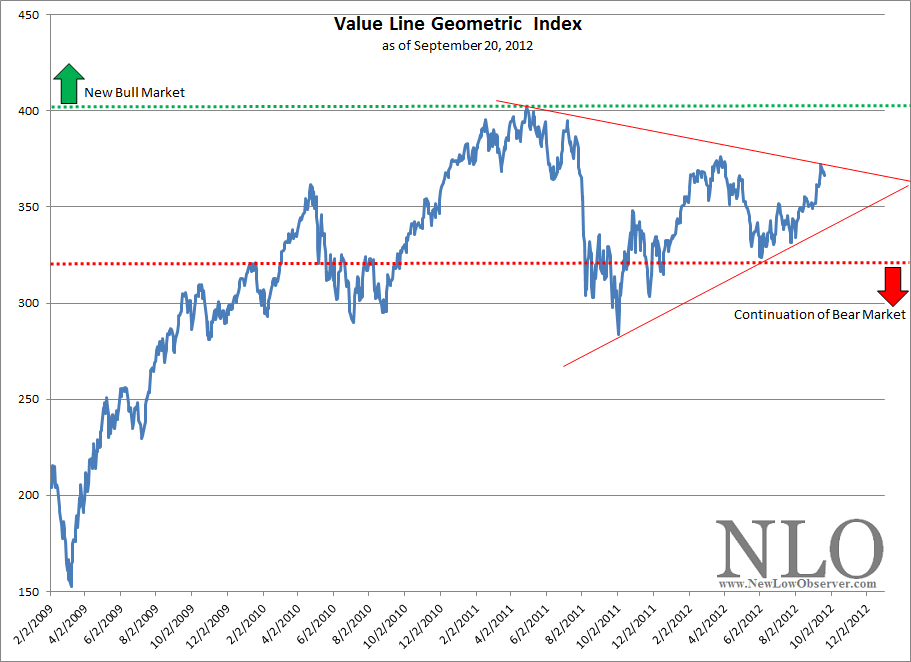
As we’ve pointed out in our article titled “Broader Market And Dow Theory Suggest Proceeding With Caution,” if the Value Line Geometric Index is any indication, broad participation of the rise from 2009 is faltering (see chart below).

image

This is a warning that the narrow focus on a few companies at the top (based strictly on market cap) is going to collapse upon itself or more focus on values not related to the largest cap stocks is necessary.  Market history suggests that broad based equal-weighted indexes that don't make new highs is the canary in the coal mine.  Anyone seeking Apple’s (AAPL) inclusion to the Dow Industrials are fated to repeat the mistakes of the past with unsurprising outcomes to follow.

Canadian Dividend Watch List: September 21, 2012

This is a list of Canadian dividend stocks that currently, or in the past, had a history of consecutive dividend increases. For those wishing to find the most complete fundamental information on these companies, we recommend visiting one of Canada’s leading financial websites, the Financial Post (found here). However, Yahoo!Finance probably has the better long-term charts and historical dividend data.

Symbol Name Price P/E EPS P/B % from low Downside risk*
FFH.TO Fairfax Financial Holdings 359.99 35.54 - - 0.99% -28.01%
FTS.TO Fortis Inc. 33.05 18.78 1.73 1.6 5.52% -15.10%
IGM.TO IGM Financial Inc. 39.05 11.83 3.3 2.29 6.09% -33.42%
SJR-B.TO Shaw Communications, Inc. 20.1 13.4 1.52 2.61 6.18% -12.94%
RBA.TO Ritchie Bros. Auctioneers Incorporated 19.02 24.7 0.77 3.12 6.61% -36.91%
CCA.TO Cogeco Cable Inc. 37.25 7.3 5.06 1.55 8.13% -28.46%
TCL-A.TO Transcontinental Inc. 8.66 - -1.77 0.7 8.66% -7.97%
PWF.TO Power Financial Corporation 25.75 10.55 2.43 1.58 9.02% -8.27%
GS.TO Gluskin Sheff + Associates, Inc. 14.42 10.6 0.6 5.58 9.49% -58.32%
IFC.TO Intact Financial Corporation 58.59 15.71 3.82 1.95 9.78% -20.91%
  1. stocks are in Canadian dollars.
  2. *based on Dow Theory 50% Principle

Watch List Summary

This month’s list has one important feature that is an added benefit for those wondering about our take on the downside risk for these stocks.  We’ve added a downside risk column to suggest what an investor might reasonably be able to expect for the listed companies in the coming year.  Our estimate for the downside risk is based on the Dow Theory 50% Principle.

The Dow Theory 50% Principle is based on the midpoint between the low, after a significant decline in price, and the most recent peak in the price.  According to Charles H. Dow, the 50% Principle, also known as the law of action and reaction, works in the following fashion:

“The market is always responsive to the great law of action and reaction. The longer the swing one way the longer it will be the other. One of the best general rules in speculation is the theory that the reaction in an advance or a decline will be at least one-half of the primary movement.” (Dow, Charles H. “Review & Outlook.” Wall Street Journal. October 19, 1900.)

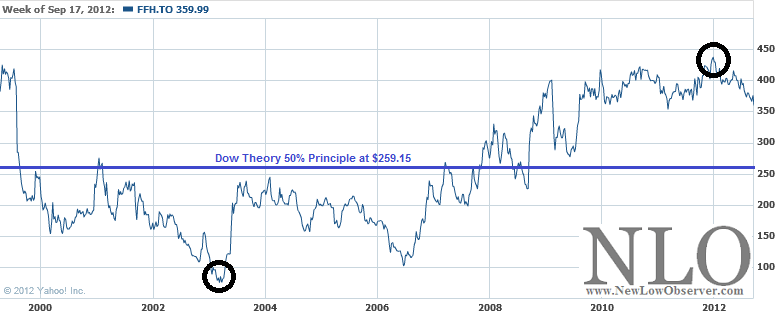
In the chart below, we have circled the low and high for Fairfax Financial (FFH.TO).  The mid-point between the high and the low is $259.15 or –28.01% below the current trading price.

image

We believe that the downside targets are a necessary consideration before the purchase of any stock. This become even more of an issue when we believe that the stock market appears to be topping and Dow Theory currently indicates that we are in a bear market.

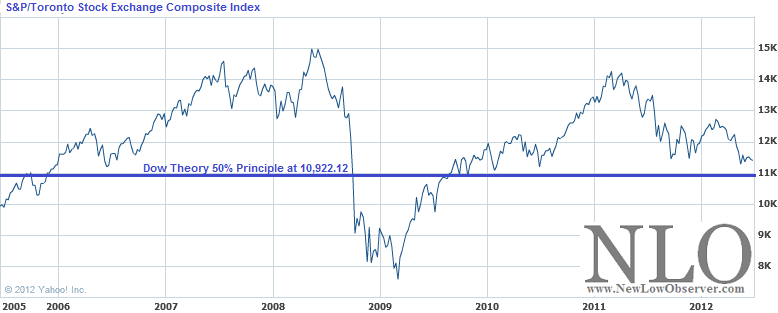
For good measure we have applied the 50% Principle for the Toronto Stock Exchange Composite Index.  Our expectation is that if the TSX manages to stay above 10,922.12 then the market will go back to the 2012 high.  However, if the TSX cannot stay above the mid-point, then we expect it to decline to the 9,747 level.  Anything below the 9,747 level will result in a decline to the 2009 low.

image

Dow Industrials Altimeter

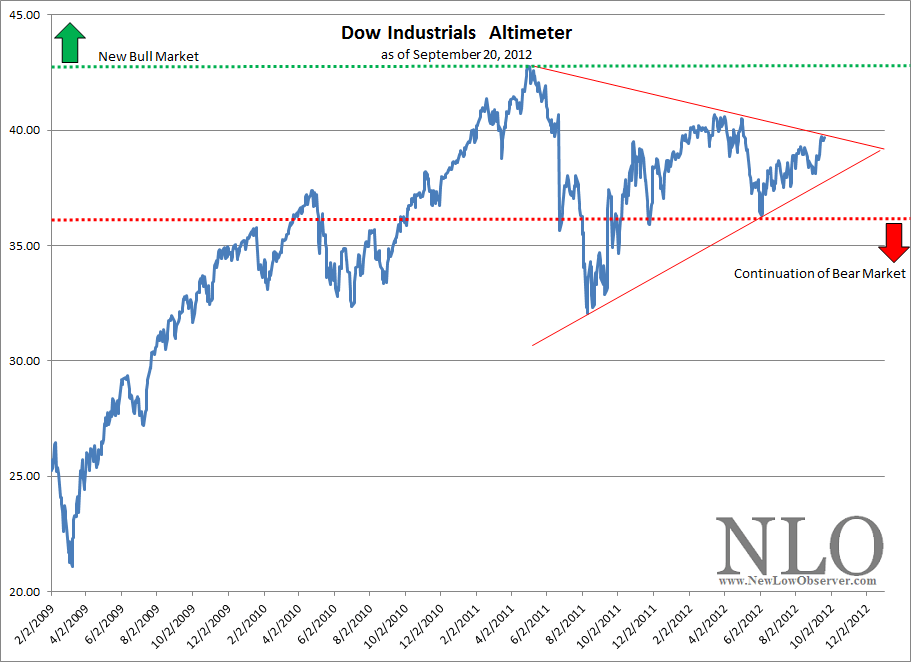
Below is a chart of the Dow Jones Industrial Average Altimeter.  Our best interpretation of the current altimeter pattern is that the Dow Industrials need to exceed the previous high set in April of 2011 in order for us to feel that a new bull market has emerged.

image

As we’ve described before, the Altimeter reflects the relative value of a stock or index compared to the dividend that is paid.  Those interested in knowing what the dividend for the Dow Industrials is can find that information in Barron’s Market Laboratory section under Indexes’ P/Es & Yields (found here).

Surprisingly, the formation of the Dow Industrials Altimeter is exactly the same formation as the Value Line Geometric Index, as seen in the chart below:

image

In a previous article (found here), we talked about how the Value Line Geometric Index (VLIC) is an equal weighted index that reflects how all stocks are doing since the bull market began in the first quarter of 2009.  The fact that the Value Line Geometric Index has not achieve a new high suggests that there is limited participation by all stocks in the market. Therefore, confidence in new highs by large cap stocks, as reflected in the Dow Industrials and S&P 500, should not be trusted.

We believe that there is limited upside potential based on the Dow Theory non-confirmation (article found here) and the broader market as reflected in the VLIC Index.

Gold Stock Investors: To Beat Inflation Look to Food Processors, Producers and Distributors

We’ve long maintained the view that in order for long-term investors to beat inflation, the conventional wisdom of investing in gold and silver stocks is not the most advantageous way to benefit from what almost everyone believes is coming as a consequence of QE4ever.  While we favor the physical metals (especially silver) and their paper derivatives like (GLD) and (SLV), we’ve also claimed that a specific strategy is needed in order to get the most mileage out of gold and silver stock investing.  However, in order to really beat inflation, forget gold and silver stocks and instead consider companies involved in food processing, producing and distribution industries.

Before we can tackle our food processors, producers and distributors, we need to examine the well documented wealth destruction that has occurred in the gold stock sector in the last year despite the relatively slight decline in the price of gold. Below is a table reflecting the percentage range that many gold and silver stocks have experienced between their one year high and low.

Symbol Name 1-yr % range
NG NovaGold Resources Inc. -69.33%
MUX McEwen Mining Inc. -68.23%
SSRI Silver Standard Resources Inc. -57.35%
PAAS Pan American Silver Corp. -56.19%
KGC Kinross Gold Corporation -55.98%
BAA Banro Corporation -53.55%
AUQ AuRico Gold Inc. -53.13%
AEM Agnico-Eagle Mines Ltd. -51.78%
HMY Harmony Gold Mining Co. Ltd. -44.81%
ABX Barrick Gold Corporation -41.79%
GG Goldcorp Inc. -41.74%
NEM Newmont Mining Corp. -40.69%
AU AngloGold Ashanti Ltd. -37.81%
GFI Gold Fields Ltd. -36.32%
BVN Compania de Minas Buenaventura SA -34.03%
SLV iShares Silver Trust -30.46%
GLD SPDR Gold Shares -15.50%

In all instances, those who had invested in these stocks did not expect that they’d face the prospect of –30% declines in value before they’d realize a gain. In fact, many of these stocks are not at a break-even point if purchased a year ago. Naturally, this should lead inflationistas and gold bugs to feeling a high level of frustration with the belief that gold stocks are a true inflation hedge.

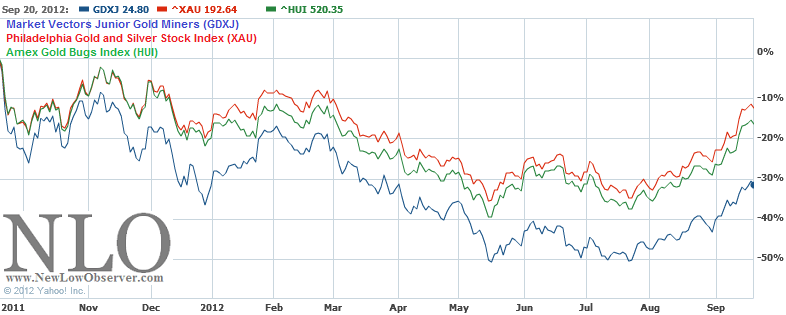
Some perpetual gold bull analysts/marketers argue that gold junior and exploration companies provide better investment opportunities as compared to the many large cap gold stocks like Barrick Gold (ABX), Agnico-Eagle (AEM), and Newmont Mining (NEM). However, the last year has been unforgiving to the larger junior and exploration companies as represented by the Market Vectors Junior Gold Miners (GDXJ) in the chart below:

image

As early as 2008, in an article titled “Why Gold Will Decline More than the Markets,” we’ve cautioned gold stock investors to be prepared for gold stocks to decline by a greater percentage whenever the general stock market, as represented by the Dow Jones Industrial Average (DIA) or S&P 500 Index (SPY), declines -10% or more.

Within the last year, the closest the Dow Industrials and S&P 500 came to a -10% decline was from April 2nd to June 1st when the indexes fell –8.63% and –9.93%, respectively.  Unfortunately, the Philadelphia Gold and Silver Stock Index (XAU) was already in a declining trend after having lost -22.85% from the April 8, 2011 high until April 2, 2012.  Despite this fact, the XAU Index managed to lose an additional –20.87% from April 2, 2012 to the May 15, 2012 low.

As an alternative to the “mines” of precious metal stock investing, we’ve recommended investing in food processors, producers and distributors that have a history prudent of dividend increasing policies to take advantage of the expectations of high inflation down the road.  Among the many companies that we’re currently following closely  in this sector are Hershey (HSY), ConAgra (CAG), and Sysco Foods (SYY).

With all the unexplained pain in the precious metal sector in the last year, companies like ConAgra (CAG), Hershey (HSY) and Sysco Foods (SYY) have continued to increase shareholder value, dividend payments and see steady gains in their stock price.  Although the last two years hasn’t been as favorable for Sysco Foods, HSY and CAG have managed to keep pace with the overall market.

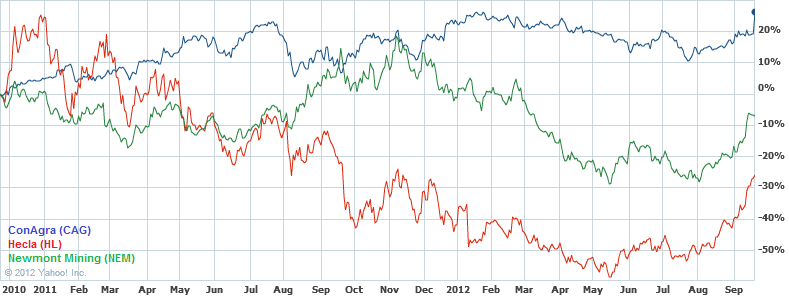
Our belief in the processors, producers and distributors is rooted in the performance of these stocks during the last precious metal bull market from 1970 to 1980 and beyond. In a piece titled “ConAgra: A History of Beating Precious Metals During a Commodity Bull Market,” we compared the performance of ConAgra to Newmont Mining (NEM) and Hecla Mining (HL) at the peak in the market in 1972, before the –42% decline in the Dow Industrials, and the subsequent peak in the commodity bull market in 1980.

What we found was that CAG matched the performance of NEM and HL by the end of the gold bull market in 1980 and went on to out-distance both stocks after the commodity bull market ended, by nearly seven time in 1983.  As a follow-up to our initial ConAgra observation in November 21, 2010, we can see the performance of the same three stock in the chart below:

image

The performance of ConAgra over the last 2 years has been exceptional in comparison to Newmont Mining and Hecla Mining. Today, ConAgra reported that first quarter net doubled and raised their full year expected earnings. CAG’s stock was up +6.20% on the news.  The news out of ConAgra suggests that processors, producers and distributors have much to gain from the coming inflation.

Precious metal enthusiasts will likely argue that the less than redeeming attributes of the companies selected (Newmont Mining and Hecla Mining) such as bad management, unprofitable properties, etc. contributed to the poor performance.  Another common refrain is, “look how my gold stocks have done in the last 3 or 4 months.” We believe such arguments are the equivalent of whistling past the graveyard.

Consider the following data points, since June 30, 1972 CAG, HL and NEM have generated the following returns, according to Morningstar.com:

  • CAG: +9,021.62%
  • HL:  -42.76%
  • NEM: +392.29%

When viewed from the perspective of trying to beat inflation, during the only proven gold bull market in recent history, gold and silver stocks don’t have the durability to truly beat inflation. For those that are ardent long-term value investors, you don’t really need to wade into the dark pools of precious metal stock investing where a mine can flood, a strike will break out, management can be slightly off with their estimates or the cost of production increases causing a stock to collapse in the middle of widely recognized gold bull market.  Instead, focus your research and due diligence in the food processors, producers and distributors that are trading near their respective new lows. You will be rewarded far beyond the high inflation period to come.

Sell Abbott Laboratories (ABT) at the Market

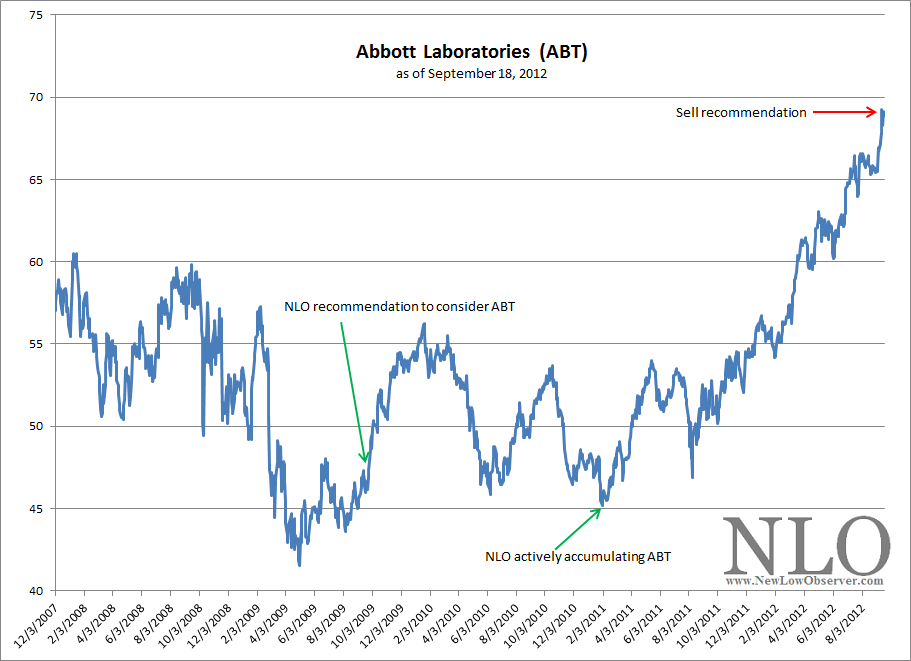
There comes a time when great companies reach a sell range.  In our view, Abbott Laboratories (ABT) just approached that mark for us.

After highlighting the fundamental and technical aspects of Abbott back at $47 on September 24, 2009, (article here) and actively accumulating the stock near the January 31, 2011 low (article here), the stock has risen 47% since 2009 and 53% since 2011 (excluding dividends). The annualized return is equivalent to +13.89% since 2009 and +28% since 2011. The stock outpaced the S&P 500 by roughly 13% from our 2009 review and by 37% since our early 2011 article.

image

Let’s revisit our original assessment of Abbott in 2009. The stock was trading at 14x earnings, 10x cash flow, and sporting a 3.4% dividend yield. Today, Abbott is currently trading at 22x earnings, 12x cash flow, and 3.0% dividend yield. The table below shows the relative change that has occurred since 2009.

2009 2012 % Chg
P/E 14 22 57%
P/CF 10 12.4 24%
Yield 3.4% 3.0% -12%
Price $47.00 $68.90 47%

While our valuation model shows that Abbott is undervalued at a 3% dividend yield, 13x earnings, and 10x cash flow, we’d rather recommend selling the stock only if purchased near the $45-$47 price range as indicated in our prior articles.

Those not interested in following through with our sell recommendation can feel comfortable knowing that ABT is a great long-term holding with a minimum 40% downside cushion since our 2009 posting.  It’s no doubt that income investors can hold shares of Abbott knowing that dividend will be safe and will continue to grow.  Anyone who bought Abbott at $47 would be sitting on yield on cost of 4.3%. Not too bad when 10 Year T-Bill is close to zero.

In any event, we believe it may be a good time to off load shares of Abbott by either selling the entire position or selling the principle while letting the profit runs.

QE3: A Blunt Object with Dull Impact

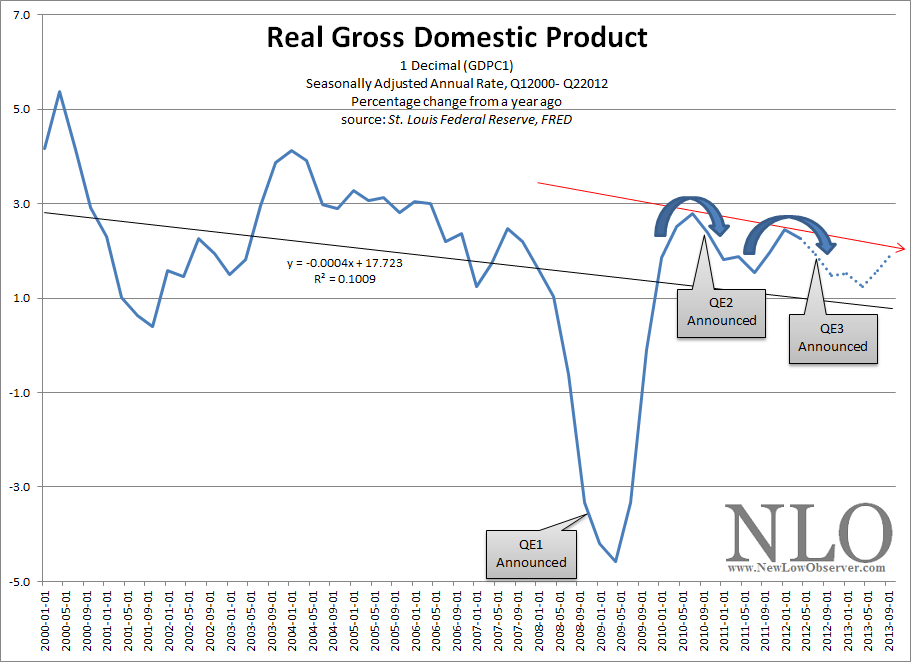
On September 13, 2012, the Federal Reserve issued a statement (found here) that an additional round of quantitative easing (QE3) was going to be the preferred method for monetary policy going forward.  The  QE3  would be in the form of $40 billion of monthly purchases of agency backed mortgage securities.  The rationale for this policy implementation was explained to be put in place to ensure maximum employment and price stability.  We wonder whether a natural state of maximum employment has already been achieved.  After all,  isn’t it always at the maximum level?

It is necessary to put the implementation of QE3 into perspective.  The first official pronouncement of QE took place on November 24, 2008.  At that time, the stock market, as reflected by the Dow Jones Industrial Average, had already declined –37.66% from the October 2007 high.  The deployment of QE1 at the time resulted in a temporary bounce and then the stock market proceeded to complete the decline to the March 2009 low, an additional decline of –26%. A -26% decline as if there was no effort on the part of the Federal Reserve to stabilize the situation, speaks volumes of the relative ineffectiveness of such a policy.

The second iteration of QE took place in early November 2010.  At the time, the Dow Jones Industrial Average was already in an established rising trend (+75% above the March 2009 low) and tacked on an additional +11.94%, to the April 2011 peak.  After the April 2011 peak, the Dow Jones Industrial Average declined –15.91%.  The implementation of QE2 in 2010 was nearly 5% above the October 3, 2011 low.  Does billions of dollars of money thrown at the economy suggest that it was worth the stagnant or mild gains in the economy?

As we’ve said in our January 2011 article titled “Federal Reserve Isn’t to Blame for the Current Market Run,” and as demonstrated by the relatively mild gains and/or declining returns as represented by the Dow Jones Industrial Average, whenever monetary policy has been put in place, quantitative easing has little impact on the expected outcome for where the stock market and economy will go.  Additionally, we've shown how in periods when the Federal Reserve didn't exist (1864-1913), the stock market would routinely rebound 50% to 100% of prior losses.

Why do we make comparisons between the stock market and Federal Reserve policy when actions taken by the Fed are intended to affect economic activity and not the stock market?  The answer lies in a 2004 paper, co-authored by Ben Bernanke before he became Fed chairman, titled “Monetary Policy Alternatives at the Zero Bound: An Empirical Assessment” which is THE basis for quantitative easing in the United States.  On page 8 of the 113 page document, step one for effective QE (out of three) is stated as follows:

“..using communications policies to shape public expectations about the future course of interest rates…[1]”

This is significant because the stock market is the court of public opinion on all matters relating to current and future economic expectations.  Dow Theory, a 110-year old approach to interpreting the stock market, has the following to say on this matter:

“The Averages Discount Everything — The fluctuations of the daily closing prices of the Dow-Jones rail and industrial averages afford a composite of all the hopes, disappointments, and knowledge of everyone who knows anything of financial matters, and for that reason the effects of coming events (excluding acts of God) are always properly anticipated in their movements.[2]”

All initial communications by the Federal Reserve are meant to sway the public and is voted on by the stock market either rising or falling in acceptance or rejection of the Federal Reserve’s communiqué. The book by Benjamin Graham titled Security Analysis highlights the point that the market is an arena where votes are cast in the following quote:

“The stock market is a voting machine…[3]”

We believe that the Federal Reserve decides exactly how much they have to follow through with their “communication policies” based on the magnitude of the reaction from the financial markets.

For us to believe that quantitative easing is an effective tool in the court of public opinion and ultimately for the economy, we'd like to see both the Dow Jones Industrial Average and Dow Jones Transportation Average to exceed previous all-time highs on the news.  Unfortunately, the latest announcement has not catapulted both indexes to new highs which, according to Dow Theory, puts the latest policy initiative in question.

Although there is little to demonstrate that monetary tools being put in place, like quantitative easing, are actually effective, what we are seeing is an emerging trend in when the Federal Reserve decides to take action.  In the chart below we see that when the percentage change from a year ago of real gross domestic product (GDP) has peaked, the Federal Reserve will attempt to take steps to stop the declining trend of GDP.

image

Keep in mind that since QE2, real GDP growth has still managed to trend lower than the period before, on a percentage basis.  This is not the ideal outcome of massive amounts of “liquidity” being “created.”  As can be seen in the chart above, the overall trend in year-over-year (y-o-y) percentage growth in real GDP has reflected a pronounced declining trend in alignment with the peaks of 2000 and 2004.  However, in the entire history of collected y-o-y percentage growth in real GDP, since 1947, the declining trend has been well established and should not be considered a new phenomena.

The fact that QE2 could not demonstrate y-o-y growth greater than the 2010 peak before QE3 was implemented suggests that the stock market and economy are easily susceptible to a major “shock” in spite of the Federal Reserve’s best efforts.  An additional takeaway from our interpretation is that, unless under “emergency conditions,” the Federal Reserve Bank will implement massive amounts of renewed quantitative easing if real GDP appears to have peaked as was the case shortly before the QE3 announcement on September 13, 2012.

[1] Ben S. Bernanke, Vincent R. Reinhart, and Brian P. Sack. “Monetary Policy Alternatives at the Zero Bound:
An Empirical Assessment.” Federal Reserve Bank, Washington D.C. 2004. PDF found here.

[2] Rhea, Robert. The Dow Theory. 1932. Barron’s Publishing, page 19.

[3] Graham, Benjamin. Security Analysis. 1934. page 452. found here.

U.S. Dividend Watch List: September 14, 2012

Below are the 11 companies on our U.S. Dividend Watch List that are within 11% of their respective 52-week lows. Stocks that appear on our watch lists are not recommendations to buy. Instead, they are the starting point for doing your research and determining the best company to buy. Ideally, a stock that is purchased from this list is done after a considerable decline in the price and rigorous due diligence.

Symbol Name Price % Yr Low P/E EPS (ttm) Dividend Yield Payout Ratio
CAH Cardinal Health, Inc.  38.23 2.47% 12.25 3.12 0.95 2.48% 30%
ERIE Erie Indemnity Company  64.05 4.87% 22.47 2.85 2.21 3.45% 78%
ABM ABM Industries, Inc. 18.84 7.77% 19.42 0.97 0.58 3.08% 60%
WGL WGL Holdings, Inc. 39.96 8.50% 20.28 1.97 1.60 4.00% 81%
PPL PP&L Corporation 29.06 8.96% 9.88 2.94 1.44 4.96% 49%
ED Consolidated Edison, Inc.  59.76 9.14% 16.51 3.62 2.42 4.05% 67%
MCD McDonald's Corp.  91.62 9.47% 17.22 5.32 2.80 3.06% 53%
WEYS Weyco Group, Inc.  22.82 9.61% 15.63 1.46 0.68 2.98% 47%
CWT California Water Service 18.44 9.82% 20.95 0.88 0.63 3.42% 72%
ANAT American National Insurance 72.40 10.07% 10.71 6.76 3.08 4.25% 46%
MCY Mercury General Corp. 39.77 10.52% 15.18 2.62 2.44 6.14% 93%
11 Companies

Watch List Review

Cardinal Health (CAH) has retained the top spot for several weeks now.  Despite that, the stock is holding well above the $37 support level.  Fundamentally, our model indicates that Cardinal Health has a downside risk of $33-34 if the market declines and an upside fair value of $57.  The 2.5% yield could provide a good cushion if you are willing to take on such an attractive risk/reward, given the flat yield curve.  In addition, we find the  payout ratio at 30% very compelling.  As Charles Dow said in his January 28, 1902 writing, “Nothing strengthens a stock more than margin of safety in dividend earnings, and nothing weakens a stock more than doubt in regard to stability in of dividends.

We continue to go back to a classic blue-chip name of McDonald’s (MCD).  Fundamentally, the company would be undervalue around a dividend yield of 3.6%.  Given the low interest rate environment we’re in, 3% yield with 50% payout ratio appears to be sound.  Although the global weakness may have taken the stock down, the technical level shows very promising signs.  The stock made a low in June 2012 at $85 then rallied to $92 in mid July 2012.  MCD then retested the low in August at $86.  A break above the $92 would be a very bullish signal for any technical trader.

Yield seekers may turn their attention to Mercury (MCY) and American National (ANAT) with dividend yields of 6% and 4.25%, respectively.  These two insurance companies are trading at a deep discount to their historical book value.  American National trades at half of its tangible book while Mercury trades just slightly (10%) above its book value.  The concern may be from the heavy exposure in the bond or fixed income market.  We believe that has already been baked into the price and we should see the price stablize at their current level, however, one can never be too sure so we suggest 2-3 stage purchases into these insurance companies.

Top Five Performance Review

In our ongoing review of the NLO Dividend Watch List, we have taken the top five stocks on our list from September 16,  2011 and have check their performance one year later. The top five companies on that list can be seen in the table below.

Symbol Name 2011 Price 2012 Price % change
ANAT American National Insurance 70.88 72.3276 2.04%
TMP Tompkins Financial Corp. 36.51 40.42 10.71%
HGIC Harleysville Group Inc.  26.76 59.9 123.84%
SYY Sysco Corp. 27.40 30.34 10.73%
BRO Brown & Brown, Inc. 19.01 26.71 40.50%
Average 37.57%

Real Estate: A Sustainable Rise

The cover story for the September 10th weekly magazine Barron’s is on the recent surge in real estate and how the rise in property prices is no fluke.  In the article by Jonathan R. Laing titled “Happy at Last,” readers are given a cautiously optimistic assessment of what has already been a well established trend in the real estate market.  A distinction in this article is the confidence with which many professionals believe that the current rise in real estate is sustainable for the foreseeable future. 

We agree that real estate will have a sustainable trajectory upward as we outlined in our December 10, 2010 article titled “Real Estate: The Verdict is In” (found here).  We believe that the clear reversal of the indicators that we discussed at the end of 2010 has proven that the real estate market has bottomed.  The following is a review of the indicators that we track that have definitively shown that the direction is up.

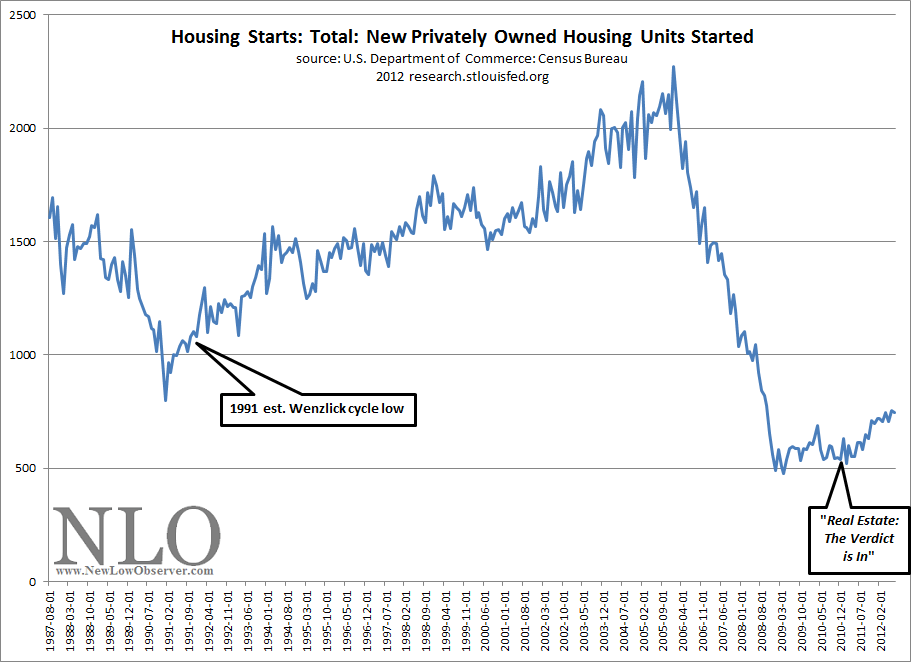
As can be seen in the chart below, U.S. housing starts bottomed in January 2009 and started to base over the next 2 years.  Two months after our December 2010 article, housing starts began to increase at a healthy pace.

image

The broad basing pattern in U.S. housing starts and the relatively mild increase, as compared to the 1991 bottom, seems to indicate a more realistic view on expectations for real estate going forward.

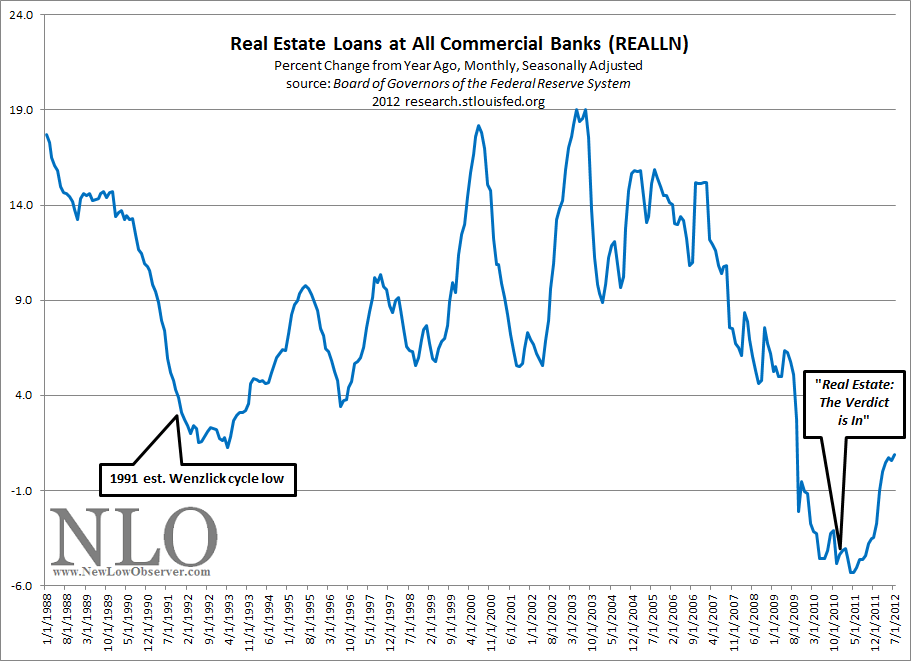
The next chart that we find useful for determining the direction of the real estate market is the real estate loans at all commercial banks.  When we published our December 2010 article, we said that the bottom had occurred in April 2010.  In fact, the actual bottom took place in April 2011 as shown below.

image

The real estate market cannot thrive in an environment where lenders are unwilling to lend.  Tracking the real estate loans by banks is instructive as to what the direction in might be.  Our assessment of this indication suggested that on a relative basis, the declining trend was at, or near, an end.  The dramatic increase in lending since early 2011 has helped push select real estate markets higher.

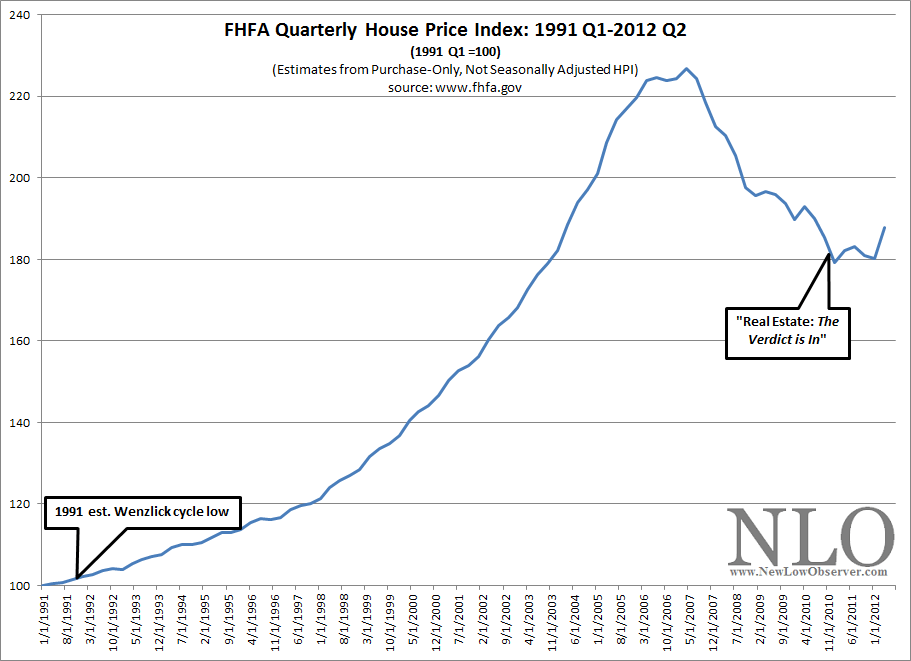
Much of the research analysis that we do on the topic of real estate is based on the work of Roy Wenzlick.  If there ever was a scientifically accurate approach to analyzing the real estate market, Roy Wenzlick perfected it.  Anyone who read his newsletter, The Real Estate Analyst (published from 1932-1974), would have thought that Wenzlick was strictly a statistician.  However, while Wenzlick was a compiler of significant amounts of data on real estate, he also believed that the market for properties ran on a clearly defined cycle.  On each chart above, we have indicated Wenzlick’s last estimated low for real estate based on that cycle.

The chart below illustrates the importance of considering Wenzlick’s estimate of the real estate cycle because it isn’t the rise that we’re interested in as much as when the next decline begins and when the bottom might occur.

image

The real estate cycle that Roy Wenzlick adheres to pointed to a low in 1991 and a low in late 2009.  In the Federal Housing Finance Agency’s House Price Index (HPI) for the nation, we can seen that 2009 was not quite the end of the decline for real estate.  Knowing that all cycle analysis is a rough estimate, at best, we hedged our view to include the possibility that the bottom would occur as late as the end of 2010.

While the outlook for real estate prices appear to be up for an extended period of time, the stock price of homebuilders like Beazer Homes (BZH), Hovnanian Enterprises (HOV), Toll Brothers (TOL), DR Horton (DHI), Pulte Group (PHI) and Lennar Corp. (LEN) are expected to rise and fall in anticipation of cyclical (short-term) trends.  We continue to recommend considering any of these companies, including homebuilder ETFs like S&P Homebuilders (XHB), when they are within 10% of their respective 52-week lows.  We believe that a revisit of the June 2012 lows will be the prices to watch for as the next buying opportunity for these stocks.

Barron’s is on the right track in terms of where the real estate market has been. However, the fact that Barron’s is favorably highlighting this trend indicates that there may be a short-term reversal in many of the widely followed indicators in the industry.  This suggests that there are immediate long-term opportunities for homebuyers while real values in homebuilder stocks will arrive six to twelve months from now.

A Deteriorating Situation at Warner Chilcott (WCRX)

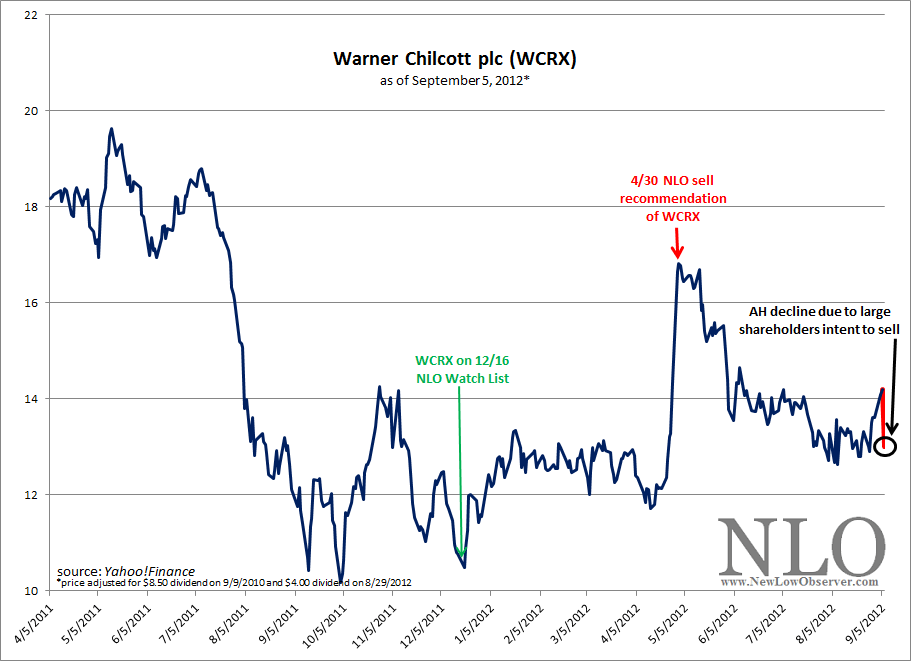
After our sell recommendation of Warner Chilcott (WCRX) on April 30, 2012 (found here), the stock price had been on a 3-month slide.  The stock had declined by $4.02, or -24%, by the first week of August.  

However, on August 8th, after the announcement that the company was no longer for sale, WCRX found some traction and started to move higher and rose from $12.63 to as high as $14.09, nearly +12% in a single month.

image

After the close of trading on September 5, 2012, seemingly out of nowhere, it was announced that the “main” shareholders and company management were going to sell nearly half of their holdings, or nearly 42.9 million shares, in the company (found here) and (found here).  Among the management that is selling shares is CFO Paul Herendeen who will be letting go of 30.9% of the 1 million shares that he owns.

The “main” shareholders, Bain Capital Partners, JPMorgan Partners, and Thomas H. Lee Partners, took Warner Chilcott “…private in 2005 for about 1.6 billion pounds ($2.1 billion)…” (Bloomberg source).  After waiting only a year, the “main” shareholders took WCRX public (raising  $1 billion) as the stock sold below the offering price of $15 (September 21, 2006 IPO data).

According to Value Line Investment Survey dated July 13, 2012, Warner Chilcott has a fair value of $25.76. However, although gyrating wildly, the total debt has increased from 86% in 2006 to 95% in 2012 and a book value that has declined nearly -83% since going public.

News of insider selling and the failure to sell off the company couldn’t have come at a less opportune time.  We believe that there is more downside left with WCRX and reiterate our sell recommendation of April 30, 2012.

Dow Theory: Downside Prospects

We have indicated in our August 2, 2011 posting (found here) the fact that we are now in a bear market.  According to Dow Theory, the primary trend remains in place until the opposite indication has been signaled.  This is best described by Richard Russell in the following remark:

…the Dow Theorist has learned that the last trend should be considered to remain in effect until the contrary has been proved”[1].

We believe that there has not been a reversal of this bear market indication as outlined in our August 7, 2012 Dow Theory analysis (found here).

Despite getting a bear market signal only days earlier, on August 9, 2011 we indicated that a bear market rally (found here) was likely to take place.  Our work on the topic of Dow Theory at that time indicated that there was upside potential to go as far as the prior highs (12,807.51).  From the August 9th low, the Dow Industrials rose as high as 13,338.70, or +23.38%.

From our experience on the topic, bear markets usually connote declines of -30% or more.  However, the bear market that we’ve experienced so far can be characterized from a slight dip to a nice market run to the upside.  While the Dow Jones Industrial Average and the Dow Jones Transportation Average have diverged overall, there has been nothing that we’ve seen since August 2, 2011 to make a person feel like any confidence in the indication.  After all, it has been over a year since the signal and no real fireworks.  Was it really worth reducing market exposure for a non-event?

Since this bull market move began on March 9, 2009, there have been sizable declines of -14% or more in 2010 and 2011 before the stock market continued higher.  The best we can do at this point is assume that 2012 is due for a correction in line with the two previous years and see what the downside prospects might be.

period of decline Dow Industrials % change
April 26, 2010-July 2, 2010 -14.60%
May 2, 2011-October 3, 2011 -19.19%
May 1, 2012-???? -2.09%
   
   
period of decline Dow Transports % change
May 3, 2010-July 6, 2010 -18.72%
July 7, 2011-October 3, 2011 -28.11%
March 15, 2012-???? -6.39%

Because a bear market decline of -30% or more has not taken place, the best we can do is assume that a similar decline to 2010 and 2011 is the most likely outcome…for now.  The previous declines, within the context of a bull market, have averaged –16.90% for the Dow Industrials and –23.42% for the Dow Transports. 

If the Industrials were to decline from the current level by –16.90% it would fall to 11,035.12.  If the Transports were to decline from the current level by –23.42% it would fall to 4,096.84.

As described in our Dow Theory analysis from August 7, 2012 (found here), there are two overhanging non-confirmations of a bull market.  This means that the overall trend of the Industrials and Transports should eventually be down.  In our negative bias against an new bull market, particular emphasis is weighted against the Transportation Index which has been falling while the Industrial Index has been rising.

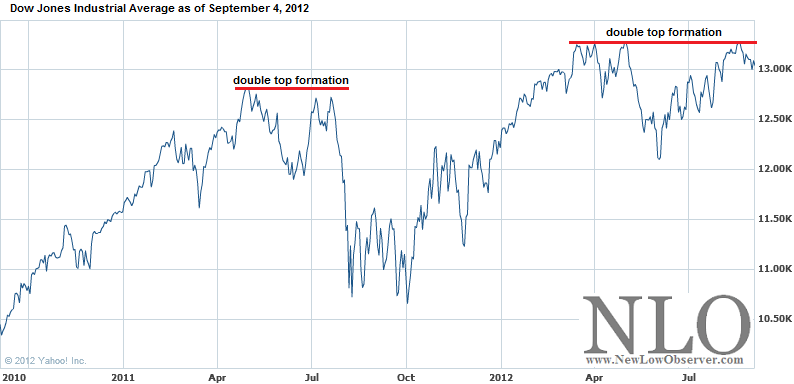
However, the last week of August has provide the Dow Industrial Average with what we consider a double-top.  Although not the most classic double top, it is still a double top. 

image

Double tops and double bottoms were indicated to be very important formations according to Charles H. Dow.  Alternatively, William Peter Hamilton and Robert Rhea arrived at the conclusion that such formations bear little importance when considering the price movement of the indexes.

From our own work on the topic of double tops and double bottoms, we have found that Dow was right about the importance of such a price characteristics and have been able to prove, with significant evidence throughout the history of the Dow indexes, that double tops and double bottoms are critical indicators for determining market direction when applying Dow Theory. 

In this case, a double tops mean that the direction for the stock market is down.  Since the bear market signal, based on Dow Theory, hasn’t resulted in a decline of over -30% for either the Transports or Industrials, were proposing that at the very minimum a decline of 13%–15% should be expected.

[1] Russell, Richard. Richard Russell’s Dow Theory Letters. Issue 166. December 27, 1961. page 1.

U.S. Dividend Watch List: August 31, 2012

Below are the 22 companies on our U.S. Dividend Watch List that are within 11% of their respective 52-week lows. Stocks that appear on our watch lists are not recommendations to buy. Instead, they are the starting point for doing your research and determining the best company to buy. Ideally, a stock that is purchased from this list is done after a considerable decline in the price and rigorous due diligence.

Symbol Name Price % Yr Low P/E EPS (ttm) Dividend Yield Payout Ratio
CAH Cardinal Health, Inc.  39.55 2.57% 12.92 3.06 0.95 2.40% 31%
ERIE Erie Indemnity Company  63.77 4.32% 22.38 2.85 2.21 3.47% 78%
EXPD Expeditors International 36.61 5.11% 21.79 1.68 0.56 1.53% 33%
WGL WGL Holdings, Inc. 39.04 5.97% 19.82 1.97 1.60 4.10% 81%
MCY Mercury General Corp. 38.29 6.33% 14.61 2.62 2.44 6.37% 93%
UNM Unum Group 19.51 6.73% 26.36 0.74 0.52 2.67% 70%
MCD McDonald's Corp.  89.49 6.98% 16.82 5.32 2.80 3.13% 53%
RLI RLI Corp. 63.36 7.15% 12.33 5.14 1.28 2.02% 25%
MATW Matthews International Corp.  29.93 7.35% 13.48 2.22 0.36 1.20% 16%
ANAT American National Insurance 70.69 7.58% 10.46 6.76 3.08 4.36% 46%
OMI Owens & Minor, Inc. 27.99 8.19% 15.21 1.84 0.88 3.14% 48%
CWT California Water Service 18.29 8.80% 20.78 0.88 0.63 3.44% 72%
SJI South Jersey Industries, Inc. 50.62 8.81% 15.92 3.18 1.61 3.18% 51%
BDX Becton, Dickinson and Co. 75.98 9.18% 13.76 5.52 1.80 2.37% 33%
LM Legg Mason, Inc.  24.58 9.93% 22.76 1.08 0.44 1.79% 41%
PPL PP&L Corporation 29.33 9.93% 9.98 2.94 1.44 4.91% 49%
WEYS Weyco Group, Inc.  22.94 10.18% 15.71 1.46 0.68 2.96% 47%
HRL Hormel Foods Corp. 28.72 10.33% 15.96 1.8 0.60 2.09% 33%
IBKC IBERIABANK Corp.  46.91 10.35% 21.13 2.22 1.36 2.90% 61%
VVC Vectren Corp. 28.21 10.67% 14.54 1.94 1.40 4.96% 72%
JNJ Johnson & Johnson  67.43 10.85% 21.41 3.15 2.44 3.62% 77%
ED Consolidated Edison, Inc.  60.62 10.96% 16.75 3.62 2.42 3.99% 67%
22 Companies

Watch List Review

Cardinal Health (CAH) remained at the top spot again this week.  With the 13-F filing released, we found that Loews Corp. doubled its holding of the stock from 50k shares to 100k shares.  In addition to that, the board approved a $750m share repurchase.

Technically speaking, CAH has been trading between a $39 and $43 range for a year.  Any break above the $43 level would be a bullish sign and a break below $39 would mark a bearish signal.  Any trader would take positions now with a stop slightly below $39.  However, we feel that a long-term investor could buy the shares knowing the stock has traded in-line or as expected.  Our model indicates that shares of CAH should be bought anywhere below $40 and would be a bargain around $26.

Erie Indemnity (ERIE) is an insurance broker and is a new addition to our list.  One of the biggest things we noticed is the amount of cash the company has on its books.  ERIE holds $2.76B in cash and the market cap is $3.39B.  That cash holding contributes to 81% of the company value.  Although we don’t know for sure the implication of that, we believe it may be because of the cash reserve they are required to hold.  But when we compared ERIE's cash reserve's to their competitors, it is much higher than most.  Value Line Investment Survey indicates that ERIE is considered at fair value at 15x earnings, thus 22x trailing 12-month earnings and 19x forward earnings doesn’t scream out buy just yet.

McDonald (MCD) is trading just 7% above its 52-week low.  Weakness in Asia and Europe continue to hold the stock back.  The cost of commodities may also contribute to the margin squeeze.  At $87/share, MCD is approaching our ‘buy’ price according to our model.  If the bear market takes its toll, our model indicates that we could possibly see the stock trade at $50/share.  IQTrends (www.iqtrends.com) indicates that this name is approaching its undervalued range at 3.6% dividend yield.