Monthly Archives: July 2010

August Ex-Dividend Dates for Watch List Companies

Below are the approximate ex-dividend dates for August for companies that appeared on our Dividend Achiever Watch List from this week. If you happen to be researching these companies for potential investment, it would be advisable to consider the ex-dividend date prior to possible purchases. Owning the shares of the company that you're interested in before the ex-dividend date entitles you to the upcoming dividend payment. Owning the shares on or after the ex-dividend date means that you would have to wait at least three months before receipt of the next dividend payment.
Symbol Name Ex-Div Date
FII Federated Investors, Inc. 8/3/2010
PFE Pfizer, Inc. 8/3/2010
CWT California Water Service Group 8/4/2010
XOM Exxon Mobil 8/9/2010
WMT Wal-Mart Stores, Inc. 8/10/2010
WAG Walgreen Company 8/16/2010
DNB Dun & Bradstreet 8/24/2010
GS Goldman Sachs 8/25/2010
JNJ Johnson & Johnson 8/25/2010
SVU SuperValu Inc. 8/25/2010
CTWS Connecticut Water Service, Inc. 8/25/2010
UFPI Universal Forest Products, Inc. 8/25/2010
AROW Arrow Financial 8/30/2010

Please verify the ex-dividend date and payout ratio before committing funds to these stocks. Additionally, do not base your next long or short-term purchase on the dividend payment or yield. Instead, get as much research in as you possibly can before the ex-dividend date "just in case" you're actually interested in buying the stock.
Email our team here.

Dow Theory and Richard Russell

In attempting to understand Dow Theory it is necessary to follow the best and the brightest on this topic. Over the last 52 years, the brightest person on Dow Theory has been Richard Russell. No single person has been more outspoken on their views on the market using Dow Theory, uninterrupted since 1958, than Richard Russell. So when Richard Russell does an about face on his interpretation of Dow Theory it is worth our time to examine the reasons.
First, it is necessary to provide context around the ideas on Russell’s most recent market call.
  • From November 12, 2007 to January 2, 2009, Russell indicated that we were in a bear market. The Dow went from 12,987.55 to 9,034.69, a decline of -30.44%.
  • From January 5, 2009 to January 12, 2009, Russell indicated that we were in a bull market. The Dow went from 8,952.89 to 6,926.49, a decline of –22.63%.
  • From March 11, 2009 to July 22, 2009, Russell indicated that we were in a bear market. The Dow went from 6,930.40 to 8,881.26, a gain of +28.15%.
  • From July 23, 2009 to May 19, 2010, Russell indicated that we were in a bull market. The Dow went from 9,069.29 to 10,444.37, a gain of +15.16%.
  • From May 20, 2010 to July 8, 2010, Russell indicated that we were in a bear market. The Dow went from 10,068.01 to 10,138.99, a slight gain was registered for the period (<1%).
On July 9, 2010, Richard Russell said:


“When the facts change, I change. To do otherwise would be idiotic. Something occurred yesterday that made me sit up and take notice. We had the non-confirmation by the D-J Transportation Average, a situation that I discussed on the July 5 site.”
“Following the Transport non-confirmation, yesterday the market surged higher, Dow up 274 and Transports up 152. But that's not all. What I noticed was that yesterday was a 90% up day [up volume versus down volume] -- the formula for a bottom.”
According to Russell, the Transports non-confirmation along with a 90% up volume/down volume ratio is what led to the conclusion that the market was indicating that a bottom was in. Russell goes on to recommend buying various ETFs with stop losses. Several problems arise when market action is viewed from Russell’s perspective.
First, Russell has ignored the fact that a trend is in place until a counter trend is signaled. So far, we haven’t had a bear market indication since the March 9, 2009 low. If the Transports were to confirm the Industrials by falling below the February 5, 2010 low, then we’d have our first bear market signal.
Second, when thinking in terms of Dow Theory, market participants have three variables to consider the Dow Jones Transportation index, Dow Jones Industrials and NYSE volume. Volume attributes are considered over a period of time. Single day action on volume should not be the determining factor for considering a bull or bear market. If this is the case, then most market signals could be very misleading. In my observations, market volume has increasingly become an addendum to Dow Theory.
Third, Russell has often disregarded the pure Dow Theory indications that have come along the way since the March 2009 low. It seems that Russell’s understanding of macro issues and his personal experience in the markets has led to his decision to err on the side of caution. However, Russell’s cautious streak has usurped the value of Dow Theory to act as a “…composite index of all the hopes, disappointments, and knowledge of everyone who knows anything of financial matters, and for that reason the effects of coming events (excluding acts of God) are always properly discounted in their movement. The averages quickly appraise such calamities as fires and earthquakes.” (Rhea, Robert, The Dow Theory, page 19).
Next, Russell has set himself up for the need to change his analysis by not thinking through Dow Theory to its conclusion. By calling a bottom at this juncture, Russell has left out the all-important confirmation that is required by the Industrials and Transports. 10,450.64 and 4,467.25 are the new levels that the Industrials and Transports need to surpass before any buying policy should be considered. In addition, after surpassing the referenced upside confirmation points, the next level of resistance is 8% away for both indexes. This means that we could go to the old high and then quickly reverse to the downside if a bull market confirmation isn’t signaled. However, given the most recent market action, our focus should be on the confirmation of the reversal pattern first, then the possible bull market indication.
Another matter of concern is that Richard Russell makes recommendations that don’t address the issue of investing in values. Values are a core tenet of Dow Theory. In fact, when you read Dow Theory Unplugged or Charles H. Dow: Economist, you will find that values, not technicals, are espoused. Russell points his readers to speculative opportunities instead of undervalued stocks which can be held for “the long term” if the bullish assessment happens to be incorrect. Our list of Dividend Achiever stocks at or near a new low addresses the prospect that if we’re wrong there is some recourse. In this case, you get the ability to compound your investment over time with the prospect of capital appreciation.
Finally, our stance on stop loss orders is widely known as indicated in the article “Automatic Orders Don’t Provide Protection” as well as our disclaimer at the end of each sell recommendation. Russell's recommendation of buying ETFs is reckless at best especially in light of the May 6, 2010 “flash crash.” Adding fuel to the flames is the article titled “ETF ‘Circuit Breakers’ Needed to Stop Flash Crashes: Pros.” Our stance on ETFs is well founded and preceded any discussion of the true risks associated with them on May 6th (“ETF: Mediocrity With No Pretense of Value” and “ETF: Indiscriminant Risk”).
It is likely that perma-bulls will seize on the Russell commentary of July 9th as the heralding of a new-new era in investing. On the other hand, “contrarian investors” will suggest that when Richard Russell, perma-bear that he is, has entered the bull ring then the bull run is definitely over. It is our contention that while Richard Russell might be right about a reversal pattern being in place he is not using Dow Theory.
Our latest views on Dow Theory can be found at the following link (NLO on Dow Theory). Keep in mind that all trends are considered to remain in place until otherwise indicated. So far we are still in a cyclical bull market within a secular bear market.

Dividend Achiever Watch List

At the end of the week, our watch list contracted to 38 companies. Here is the watch list which ranks current and former Dividend Achievers that are within 10% of the 52-week low for July 9, 2010. Stocks that appear on our watch lists are not recommendations to buy.  Instead, they are the starting point for doing your research and determining the best company to buy.  Ideally, a stock that is purchased from this list is done after a considerable decline in the price and extensive due diligence.

Symbol Name Price % Yr Low P/E EPS (ttm) Div/Shr Yield Payout Ratio
FRS Frisch's Restaurants, Inc 19.95 2.26% 10.08 1.98 0.52 2.61% 26%
DNB Dun & Bradstreet Corp. 67.46 2.99% 13.52 4.99 1.40 2.08% 28%
WMT Wal-Mart Stores, Inc. 49.43 4.39% 12.97 3.81 1.21 2.45% 32%
FII Federated Investors Inc 21.24 4.84% 10.84 1.96 0.96 4.52% 49%
XOM Exxon Mobil Corp.   58.78 5.08% 13.39 4.39 1.76 2.99% 40%
PFE Pfizer Inc 14.77 5.50% 13.68 1.08 0.72 4.87% 67%
AROW Arrow Financial Corp.  24.14 5.60% 12.91 1.87 1.00 4.14% 53%
UMBF UMB Financial Corp.  36.62 5.93% 15.92 2.30 0.74 2.02% 32%
MATW Matthews International Corp.  29.69 6.04% 14.34 2.07 0.28 0.94% 14%
FFIN First Financial Bankshares, Inc.  49.32 6.04% 19.12 2.58 1.36 2.76% 53%
GS Goldman Sachs Group, Inc.   138.06 6.61% 5.75 24.01 1.40 1.01% 6%
THFF First Financial Corp. Indiana  26.82 6.77% 14.74 1.82 0.92 3.43% 51%
NTRS Northern Trust Corp.  48.53 6.78% 15.26 3.18 1.12 2.31% 35%
TR Tootsie Roll Industries Inc  24.15 6.86% 25.69 0.94 0.32 1.33% 34%
T AT&T Inc 24.83 7.07% 12.35 2.01 1.68 6.77% 84%
CWT California Water Service Group 36.35 7.51% 18.83 1.93 1.19 3.27% 62%
JNJ Johnson & Johnson   60.54 7.63% 12.72 4.76 2.16 3.57% 45%
SVU SUPERVALU INC 11.21 7.79% 6.06 1.85 0.35 3.12% 19%
WAG Walgreen Co. 28.40 8.15% 13.65 2.08 0.55 1.94% 26%
HSC Harsco Corp. 24.90 8.54% 18.58 1.34 0.82 3.29% 61%
HRB H&R Block, Inc. 14.60 8.63% 10.21 1.43 0.60 4.11% 42%
XRAY DENTSPLY International Inc.  30.22 8.74% 16.51 1.83 0.20 0.66% 11%
HCC HCC Insurance Holdings, Inc. 25.59 8.89% 8.53 3.00 0.54 2.11% 18%
STR Questar Corp. 16.22 9.15% 6.01 2.70 0.52 3.21% 19%
CTWS Connecticut Water Service, Inc.  21.88 9.40% 18.54 1.18 0.91 4.16% 77%
NJR New Jersey Resources Corp. 36.65 9.44% 16.58 2.21 1.36 3.71% 62%
BDX Becton, Dickinson and Co. 69.46 9.54% 13.33 5.21 1.48 2.13% 28%
UFPI Universal Forest Products, Inc.  32.04 9.54% 23.73 1.35 0.40 1.25% 30%
STFC State Auto Financial Corp.  16.24 9.58% 17.46 0.93 0.60 3.69% 65%
LOW Lowe's Companies Inc 20.43 9.72% 16.75 1.22 0.44 2.15% 36%
LLY Eli Lilly & Co. 35.17 9.84% 9.06 3.88 1.96 5.57% 51%
PAYX Paychex, Inc.  26.28 10.23% 19.91 1.32 1.24 4.72% 94%
ADM Archer Daniels Midland Co. 26.72 10.32% 11.00 2.43 0.60 2.25% 25%
BRC Brady Corp. 26.18 10.42% 17.34 1.51 0.70 2.67% 46%
KO Coca-Cola Co 52.40 10.50% 17.24 3.04 1.76 3.36% 58%
ABT Abbott Laboratories 48.03 10.54% 14.09 3.41 1.76 3.66% 52%
NWN Northwest Natural Gas Co. 45.25 10.83% 16.82 2.69 1.66 3.67% 62%
VIVO Meridian Bioscience Inc.  17.77 10.85% 22.49 0.79 0.76 4.28% 96%
38 Companies


*Goldman Sachs isn't a former or current dividend achiever but we feel that it is worth watching because it's a proxy of our financial system.

Watch List Summary

The best performing stock from the previous list was Monsanto (MON) which rose 6.1%.  The worst performing stock was SuperValu (SVU) which fell 6.6%.  Overall, the Dividend Achiever watch list gained 0.8% versus the Dow which was up 0.5%. Because our list has more than a handful of great companies, I urged investors to filter for companies with less than 50% payout ratio. This should minimized the risk of dividend reduction if earnings are to fall by half. If you understand the companies' history and their ability to pay the dividend, payout ratios in excess of 50% may be considered.
Investor flocked to safety as Aaa bond yield fell to 4.88% in June.  This is the lowest yield since February of 1966 (4.78%).  Yield at the December 2008 low, the peak of credit crunch, was at 5.05%.  This allow corporations, those with good balance sheets, to refinance or issue more debts at lower rate.
There are many great names on this list. One in particular is Becton Dickinson (BDX) which last traded at $69.46.  The reason why we like this name is because Warren Buffett added the name in late 2009. We highlighted the company in our watch list in 8/14/09 when BDX was trading at $66.39. After Buffett took position, shares rose to $80 and now have retraced back.  For those who missed the opportunity then have the opportunity now. As an added bonus, BDX is currently paying $0.37 of dividend quarterly compared to $0.33 in 2009. This is 12% above the previous payout. So while stock price have flat line, fundamental improved. While the stock price looks higher at $69, it is cheaper now at $69 because of the dividend yield (2.13% vs 2.00%).
Once again, I suggest readers to use the March 2009 low (or companies' most distressed time) as downside projection for investing.  Our conservative view is to embrace the worse case scenario prior to investing.  March 2009 low fits that description.  Although we use the one year (52 weeks) time frame, the past year was nothing but a major bull run and anyone who bought at or near the low could, and should, be taking profits.  It is important to place these companies in your own watch list so that when opportunity arises, you can purchase them with a greater margin of safety.

Email our team here.

Canadian Dividend Achievers

This list of Canadian Dividend Achievers, published by Mergent's, includes current and former Canadian Dividend Achievers and then ranking the companies based on those closest to the 52-week low. We've updated the stock symbol to connect to the Financial Post, one of Canada's top business publications. You'll find the most complete fundamental information on these companies at the FP website.  However, Yahoo!Finance probably has the better long-term charts and historical dividend data.  Enjoy.
Yahoo! Finanical Post Name Trade % from Low
RBA.TO RBA Ritchie Bros Auctioneers $19.62 2.88%
IMO.TO IMO Imperial Oil $38.86 2.94%
ESI.TO ESI Ensign Energy Services $12.61 3.62%
IGM.TO IGM IGM Financial $38.66 5.31%
CCO.TO CCO Cameco $23.59 9.01%
CTC-A.TO CTC.A Canadian Tire $54.27 9.64%
SU.TO SU Suncor Energy $32.88 9.93%
POW.TO POW Power Corp $26.35 11.04%
SNC.TO SNC SNC-Lavalin $44.00 11.36%
TLM.TO TLM Talisman Energy $16.58 12.03%
TIH.TO TIH Toromont $23.50 12.93%
PWF.TO PWF Power Financial $28.06 14.48%
TRI.TO TRI Thomson Reuters $38.54 18.66%
Email our team here.

Richard Russell Review: Letter 742

Dow Theory Letters issue 742 was published on November 1, 1978. At the time, the Dow Jones Industrial Average indicated was at the 806.05 level. In this issue, Richard Russell discusses several topics that are very important to every Dow Theorist.
First, Russell states that:
…history shows that when bull (or bear) markets really begin, Dow Theory signals are generally greeted with derision, skepticism, and scorn-rather than wholesale agreement!” page 1
This comment is in response to the Dow Theory bull market signal that was given on August 2, 1978. In this case, Russell felt there wasn’t enough skepticism by market participants to warrant a need to trust the signal. I’m guessing that after 12 years of a secular bear market any good news about the market would appeal to the glass half-full crowd.
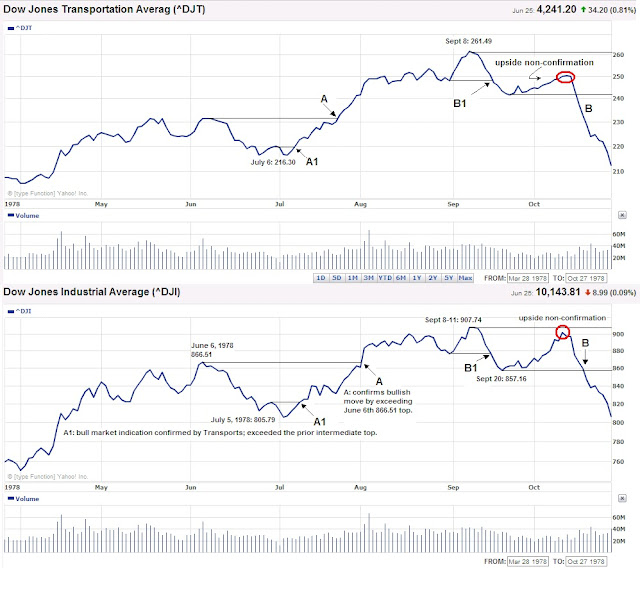
Letter 742 also has a chart (located here) of the Dow Jones Industrials, Transports, Utility Averages and NYSE volume. Upon closer inspection of the chart below, ranging from March 28, 1978 to October 27, 1978, you can find two confirmations of a bull market and one confirmed bear market indication as part of Dow Theory.

According to Russell, point A (August 2nd), on the Dow Industrials, was a false secondary peak or bull market indication. However, it should be noted that when the Industrials went above the June 29th peak of 821.64 (point A1) on July 21st it was a clear indication that the index was going to retest the previous high at point A.

After the bull market move upward a bear market indication was given when the Industrials and Transports fell below point B1 that corresponded to the August 31st low of 876.82 and 248.78 respectively. A bull market non-confirmation was indicated (red circles) in the fact that neither index could exceed the high of September 8, 1978.
Let’s do the math for a moment, point A1 gave a buy signal plus point A’s confirmation of the buy signal equaled a 9.62% rise by the time the market gave the bull market non-confirmation at Dow Industrials 900. The same timing applied to the Dow Transports would have equaled a gain of 13.64%. To my mind, this was in line with our view that any return close to 10% in less than a year is an acceptable amount to trigger a sell of any stock.
Russell also repeats a common attribute that he seeks in the market before considering going “all in.” Russell says:

I noted that every bull market in history had started from an over-sold base, but that this market had not seen a over-sold condition since late-1976.” Page 1.

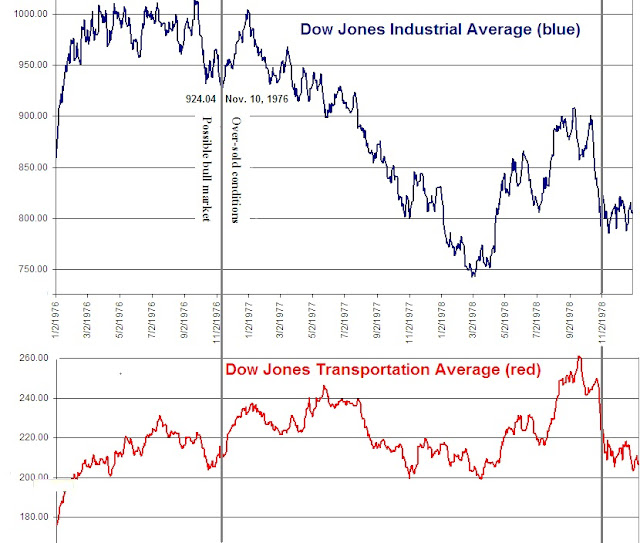
In this remark, I have two thoughts that immediately come to mind which is reflected in the chart below. The first is that even after the 1974 bottom there was another time (1976) that was “most ideal” to buy stocks at over-sold levels, according to Russell. However, even though late-1976 was experiencing oversold conditions, it certainly didn’t mean that further declines were out of the question. After the ’76 bottom, the Dow Industrials had a short rally and then fell as low as 742.12, a decline of 19.69% from the 1976 lows, by February 28, 1978. Finally, the view that an over-sold base is a condition necessary for a bull market may not be accurate.

On page 2 Russell said:

Right now, I want all my subscribers to stay out as per my instructions in Letter after Letter.”

This suggests that after the January 1975 buy signal given by Russell, it was very difficult to keep a long-term position even though it was the absolute best time to “buy and hold” stocks.

The violence and rapidity of this smash has few precedents in stock market history.” Page 2.

When calculated to the November 14, 1978 low, the decline from September 8, 1978 equaled a drop of 13.5%. To me this doesn’t seem like all the much of a decline.

Somewhere in the period ahead, we are going to see the real ‘third phase bear market action’ in the Dow and most other stocks. True, during 1973-1974 the majority of stocks were pulverized in a slide that was comparable to 1929-32 in many ways. But the Dow lost less than 50% of its value at that time. My guess is that before the third or final phase of this bear market is over, we are going to see the Dow at drastic new lows, we’re going to see dividends cut across the board, we’re going to see very high interest rates, and we’re going to see something that this generation has never seen before-wholesale liquidation of debt in all sections of the economy, private, corporate and perhaps even government.” Page 2

“Each time it looks as if the ‘plug is going to be pulled,’ the bear market (with the help of huge infusions of monetary inflation from the Fed) pulls itself out of the hole.” Page 2

Russell was waiting for the third phase of the bear market. According to Russell, the Fed was holding the market up with the trade-off being higher inflation. My thinking is that a crash didn’t occur simply because the Fed was willing to accept higher inflation as a substitute for a crash. In addition, if the markets were to get a crash and record inflation at the same time it would be exceptional situation. The third phase decline that Russell expected never seemed to materialize on the scale of 1973-74 or greater.
Other Notes in Letter 742:
  • E. George Schaefer’s investment performance from 1949 to 1966.
  • James Dines book the “Invisible Crash
  • MC Horsey’s chart of an inflation adjusted Dow since 1960
  • Benjamin and Herbert Stein’s book “On the Brink” with reference to, of all things, the Chinese cornering the gold market
More:

Richard Russell Review: Letter 745

Dow Theory Letters Issue 745 was written on December 6, 1978.  At the time, the Dow Jones Industrial Average was indicated to be at the 811.42 level.  What stood out the most to me was the fact that Richard Russell made very clear commentary on the price of gold and the direction of stocks.  Russell made the following commentary:

"It [gold/stock ratio] is telling us that for the foreseeable future (until the next signal), if we do anything we should do it in stocks." page 3.

Anyone familiar with the stock market in 1978 would know that if you had bought a handful of stocks and didn't sell them until 10 years later you would have had a compounded annual growth rate of 8.73% (this takes into consideration the crash of 1987).  Russell's comments on being in stocks would have seemed to be very much on target.  However, it is his aversion to gold at this time that seems to contradict his earlier comments on gold.
In Letter 742 dated November 1, 1978, Richard Russell said the following about gold:
"Slowly, very slowly, it's dawning on the world that we're witnessing one hell of a bull market-in gold. I've been writing pages and pages about gold in each Letter, trying to get new subscribers in the metal (or the coins), trying to get older subscribers to STAY in gold.  Happily, a large percentage of my subscribers are now sitting with large gold positions.  And the paper profits (in terms of dollars) are mounting." page 5.

This commentary seems odd because in Letter 745, Russell goes on to say:

"At any rate, it is a bearish omen when the [gold] open interest stays high in the face of a persistent decline, and that is what has occurred." page 6

Russell called himself to task by asking the following question:

"Question: Russell, you were so hot on gold a few months ago.  Gold was 'real money,' you said.  Gold 'would save the system,' you said.  How can you just "turn off" on gold?
"Answer: I haven't turned off on gold, I've turned off on gold at this time.  The market isn't like your wife or your daughter who you love through thick and thin.  We're dealing here with correct procedure and purchasing power.  The fact that I advocate gold-backed currency has nothing to do with the fact that I think gold is in a bear trend over the coming months.  In this business, you had better learn that the trend makes you the money, not the item.  I'd rather buy Cesspools, Inc. if that stock was going up than IBM if IBM is heading down." Page 7
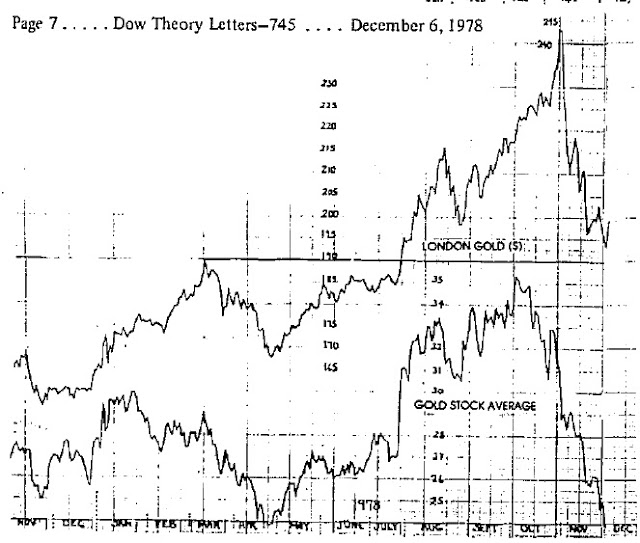
In retrospect, we know that gold went as high as $850 an ounce in January 1980.  However, it is interesting to me that Russell said that a bear trend was approaching "...over the coming months."  In Letter 745, Russell included a chart that compared the London Gold to the Gold Stock Average.


Russell's favorable comments of gold on November 1, 1978 were well off of the highs from the prior month.  However, since Russell was a practioner of Dow Theory and was using the London price of gold along with the equivalent of the XAU gold index to act as a confirming mechanism for the future price of gold, it should have been considered that because the London price didn't fall to the corresponding low set in April of 1978 that there must have been a non-confirmation of the downside trend.  Instead, Russell said the following:
"The GSA [Gold Stock Average] has collapsed, and is now down to its previous low for the year recorded last April.  Bullion has obviously held up better than the gold shares, but so far the downside non-confirmations by bullion have failed to halt the decline.  This kind of action is always indicative of a weak market, and it just seems that there are still too many optimistic gold-holders around." Page 6.
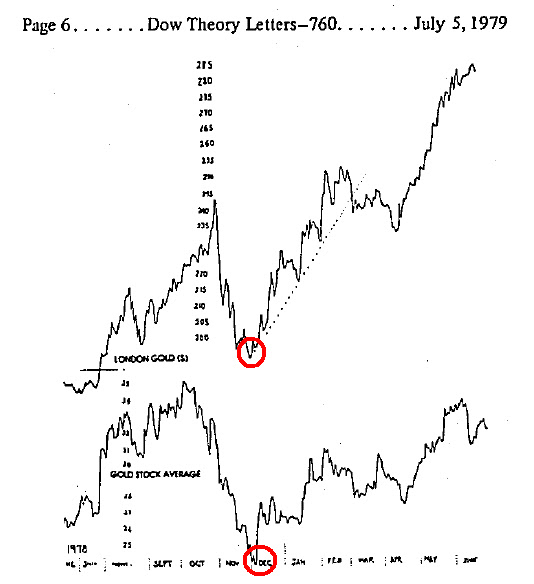
Is it possible that the gold shares are held by the public and speculators (weak hands) and the bullion is held by investors and "institutions" (strong hands)?    Somehow I think this relationship has some value.  I'm just not sure if Russell called this intermediate move correctly.  So I decided to search for an updated version of the London Gold and GSA comparison.  Below is what I found in the July 5, 1979 issue:


It should be noted that the exact bottom in the price of gold and gold stocks (red circles) coincided with the publishing of the December 6, 1978 Letter 745.
Also Worth Mentioning:
  • Russell said that "Greed and options don't mix."  My impression on this remark is that I always thought that the purpose of options is to get exaggerated gains with the trade-off being no equity.  Seems to me that greed and options go hand in hand.
  • Dow Theory Letters are available at http://www.dowtheoryletters.com/
More:

Nasdaq 100 Watch List

Below are the top 20 Nasdaq 100 companies that are within 7% of the 52-week low. This list is strictly for the purpose of researching whether or not the companies have viable business models. These companies are deemed highly speculative unless otherwise noted.

Symbol Name Trade P/E EPS Yield P/B % from Low
APOL Apollo Group, Inc. 41.86 10.47 4 0.00% 4.9 0.99%
RIMM Research In Motion Limited 48.14 N/A 0 0.00% N/A 1.35%
DELL Dell Inc. 12.03 15.95 0.75 0.00% 4 1.60%
YHOO Yahoo! Inc. 14.07 25.26 0.56 0.00% 1.53 2.33%
QCOM QUALCOMM Incorporated 32.37 17.26 1.88 2.20% 2.53 2.34%
SPLS Staples, Inc. 19.19 17.75 1.08 1.80% 2.07 2.51%
AMGN Amgen Inc. 51.7 10.97 4.71 0.00% 2.25 2.74%
ADBE Adobe Systems Incorporated 26.73 37.54 0.71 0.00% 2.71 2.77%
SYMC Symantec Corporation 13.98 16.03 0.87 0.00% 2.43 2.95%
VRTX Vertex Pharmaceuticals 32.22 0 -3.5 0.00% 6.59 3.10%
ERTS Electronic Arts Inc. 14.6 0 -2.08 0.00% 1.73 3.84%
STLD Steel Dynamics, Inc. 13.03 18.97 0.69 2.20% 1.39 4.83%
FISV Fiserv, Inc. 45.47 14.25 3.19 0.00% 2.24 5.40%
NVDA NVIDIA Corporation 10.25 21.27 0.48 0.00% 2.08 5.56%
XRAY DENTSPLY Intl 29.39 16.07 1.83 0.60% 2.38 5.76%
MSFT Microsoft Corporation 23.27 12.06 1.93 2.10% 4.44 5.77%
GILD Gilead Sciences, Inc. 34.87 11.18 3.12 0.00% 4.19 6.18%
LOGI Logitech Intl 13.91 38.43 0.36 0.00% 2.34 6.26%
CEPH Cephalon, Inc. 55.95 11.16 5.01 0.00% 1.76 6.47%
PAYX Paychex, Inc. 25.47 19.31 1.32 4.70% 6.7 6.84%

Email our team here.