Monthly Archives: May 2010

International Dividend Achievers

Below are the top ten current and former International Dividend Achievers (ranked by dividend yield) that trade as ADRs on the New York Stock Exchange.  I had to choose the top ten because there are over 40 international Dividend Achievers that are within 20% of the low.  This list is based on Mergent's designation of companies that have had a history of dividend increases over "several" years in a row. 
Please be sure to calculate the payout ratios before buying these stocks  Payout ratios above 70% are cutting it close if you're not prepared for the potential risk.  The stock symbols next to the company names take you directly to the history of dividend payments.  As always, only buy these stocks if you're willing to accept losing 50%, otherwise, the risk may outweigh the reward.  Thanks again to the author of The Stock Market Advantage for the suggestion on including international stocks.
Symbol Name Price % from Low Yield
STD Banco Santander $10.15 10.69% 9.20%
NGG National Grid $40.54 3.10% 8.80%
AZN AstraZeneca $42.25 5.47% 8.10%
BP British Petroleum $42.95 5.76% 7.80%
BTI British American Tobacco $58.55 9.77% 7.40%
TEF Telefonica $57.37 5.36% 6.90%
TOT Total S.A. $46.63 8.27% 6.60%
RUK Reed Elsevier $27.99 5.74% 6.10%
TMX Telefonos de Mexico $14.07 8.23% 5.60%
GSK GlaxoSmithKline $33.46 4.07% 5.50%
Email our team here.

Canadian Dividend Achievers

This list of Canadian Dividend Achievers is published by Mergent's includes current and former Canadian Dividend Achievers and then ranking the companies based on those closest to the 52-week low. Do your homework on these companies and, whenever possible, please report back to us with your findings along with source citations.
Symbol Name Trade Pct from Yr Low
CLC-UN.TO CML HEALTHCARE INCOME FUND $10.22 0.20%
IMO.TO IMPERIAL OIL $39.95 5.83%
IGM.TO IGM FINANCIAL INC. $39.74 6.57%
RBA.TO RITCHIE BROS AUCTIONEERS INC. $21.52 6.64%
CCJ.TO CAMECO CORP $25.68 6.87%
SU.TO SUNCOR ENERGY INC. $32.08 7.29%
ESI.TO ENSIGN ENERGY SERVICES INC. $13.24 8.61%
ALA-UN.TO ALTAGAS INCOME TRUST $16.99 9.26%
ARF-UN.TO ARMTEC INFRA. FUND $18.90 13.86%
TRI.TO THOMSON REUTERS CORPORATION $37.24 15.98%
TRP.TO TRANSCANADA CORP. $34.91 16.33%
POW.TO POWER CORP CDA $27.47 16.35%
CTC-A.TO CANADIAN TIRE CORP LTD CL A NV $57.44 19.22%
SNC.TO SNC-LAVALIN SV $46.32 19.54%
PWF.TO POWER FINANCIAL CORP. $29.33 19.71%

Email our team here.

Nasdaq 100 Watch List

Below are the Nasdaq 100 companies that are within 20% of the 52-week low. This list is strictly for the purpose of researching whether or not the companies have viable business models or are about to go out of business. These companies are deemed highly speculative unless otherwise noted.

Symbol Name Price P/E EPS Yield P/B % from Low
SYMC Symantec Corporation $14.17 16.25 $0.87 0.00% 2.58 1.00%
APOL Apollo Group, Inc. $53.16 13.3 $4.00 0.00% 6.02 1.84%
QCOM QUALCOMM Incorporated $35.56 18.97 $1.88 2.10% 2.81 3.01%
GILD Gilead Sciences, Inc. $35.92 11.52 $3.12 0.00% 4.45 3.28%
ERTS Electronic Arts Inc. $16.51 0 -$2.08 0.00% 2 5.16%
AMGN Amgen Inc. $51.78 10.99 $4.71 0.00% 2.22 5.46%
GENZ Genzyme Corporation $48.65 118.1 $0.41 0.00% 1.78 7.18%
ATVI Activision Blizzard, Inc $10.75 45.74 $0.24 1.40% 1.23 8.26%
RYAAY Ryanair Holdings plc $23.54 0 $0.00 0.00% 0 9.23%
YHOO Yahoo! Inc. $15.34 27.54 $0.56 0.00% 1.71 9.81%
LOGI Logitech International S.A. $14.19 39.2 $0.36 0.00% 2.53 10.60%
RIMM Research In Motion Limited $60.69 0 $0.00 0.00% 0 11.77%
CEPH Cephalon, Inc. $58.86 11.74 $5.01 0.00% 1.86 12.01%
BIIB Biogen Idec Inc $47.43 14.36 $3.30 0.00% 2.18 13.60%
FSLR First Solar, Inc. $112.36 14.9 $7.54 0.00% 3.47 13.83%
SPLS Staples, Inc. $21.52 19.91 $1.08 1.70% 2.35 14.96%
FISV Fiserv, Inc. $47.55 14.9 $3.19 0.00% 2.35 15.67%
SIAL Sigma-Aldrich Corporation $53.32 18.19 $2.93 1.20% 3.84 16.42%
XRAY DENTSPLY International $32.43 17.73 $1.83 0.60% 2.64 16.70%
DELL Dell Inc. $13.33 16.56 $0.81 0.00% 4.4 17.65%
ORCL Oracle Corporation $22.57 20.17 $1.12 0.90% 3.98 17.80%
STLD Steel Dynamics, Inc. $14.67 21.35 $0.69 2.00% 1.58 18.02%
MXIM Maxim Integrated Products $17.76 73.09 $0.24 4.50% 2.26 18.72%
CHRW C.H. Robinson Worldwide $58.11 27.18 $2.14 1.70% 9.17 19.22%
TEVA Teva Pharmaceutical $54.82 21.77 $2.52 1.20% 2.53 19.41%
PAYX Paychex, Inc. $28.54 21.7 $1.32 4.30% 7.45 19.71%
Email our team here.

Dividend Achiever Watch List

At the end of the week, our watch list contracted to 66 companies. Here is the watch list which ranks current and former Dividend Achievers that are within 20% of the 52-week low for May 28, 2010. Stocks that appear on our watch lists are not recommendations to buy.  Instead, they are the starting point for doing your research and determining the best company to buy.  Ideally, a stock that is purchased from this list is done after a considerable decline in the price and extensive due diligence.
Symbol Name Price % Yr Low P/E EPS (ttm) Div/Shr Yield Payout Ratio
VIVO Meridian Bioscience Inc.  17.48 1.10% 22.13 0.79 0.76 4.35% 96%
FII Federated Investors Inc 22.21 1.88% 11.33 1.96 0.96 4.32% 49%
LLY Eli Lilly & Co. 32.79 2.40% 8.45 3.88 1.96 5.98% 51%
XOM Exxon Mobil Corp.   60.46 3.42% 13.77 4.39 1.76 2.91% 40%
ADM Archer Daniels Midland Co. 25.27 4.34% 10.40 2.43 0.60 2.37% 25%
T AT&T Inc 24.30 4.79% 12.09 2.01 1.68 6.91% 84%
CTWS Connecticut Water Service, Inc.  20.80 5.00% 17.63 1.18 0.91 4.38% 77%
SHEN Shenandoah Telecom 16.93 5.16% 15.39 1.10 0.32 1.89% 29%
FRS Frisch's Restaurants, Inc 20.95 5.22% 10.58 1.98 0.52 2.48% 26%
DNB Dun & Bradstreet Corp. 72.99 5.63% 14.63 4.99 1.40 1.92% 28%
MON Monsanto Co. 50.87 5.63% 21.20 2.40 1.06 2.08% 44%
AVP Avon Products, Inc. 26.49 5.96% 20.86 1.27 0.88 3.32% 69%
CWT California Water Service Group 35.83 6.04% 18.56 1.93 1.19 3.32% 62%
VVC Vectren Corp. 23.05 6.42% 15.16 1.52 1.36 5.90% 89%
WMT Wal-Mart Stores, Inc. 50.56 6.78% 13.27 3.81 1.21 2.39% 32%
UMBF UMB Financial Corp.  38.95 7.18% 16.93 2.30 0.74 1.90% 32%
GS* Goldman Sachs Group, Inc.   144.26 7.50% 6.01 24.01 1.40 0.97% 6%
NWN Northwest Natural Gas Co. 43.97 7.69% 16.35 2.69 1.66 3.78% 62%
AROW Arrow Financial Corp.  25.48 7.78% 13.63 1.87 1.00 3.92% 53%
HCC HCC Insurance Holdings, Inc. 25.07 7.97% 8.36 3.00 0.54 2.15% 18%
FFIN First Financial Bankshares, Inc.  50.24 8.00% 19.47 2.58 1.36 2.71% 53%
JNJ Johnson & Johnson   58.30 8.24% 12.25 4.76 2.16 3.70% 45%
NJR New Jersey Resources Corp. 35.45 8.31% 16.04 2.21 1.36 3.84% 62%
BEC Beckman Coulter, Inc. 57.44 8.32% 24.03 2.39 0.72 1.25% 30%
NTRS Northern Trust Corp.  50.81 8.75% 15.98 3.18 1.12 2.20% 35%
PFE Pfizer Inc 15.23 9.25% 14.10 1.08 0.72 4.73% 67%
MDU MDU Resources Group Inc. 18.70 9.29% 13.36 1.40 0.63 3.37% 45%
ABT Abbott Laboratories 47.56 9.46% 13.95 3.41 1.76 3.70% 52%
FPL FPL Group, Inc. 49.93 10.25% 11.30 4.42 2.00 4.01% 45%
SFNC Simmons First National Corp.  26.36 10.29% 16.07 1.64 0.76 2.88% 46%
HSC Harsco Corp. 27.21 10.34% 20.31 1.34 0.82 3.01% 61%
WEYS Weyco Group, Inc.  22.99 10.42% 18.69 1.23 0.64 2.78% 52%
KO Coca-Cola Co 51.40 10.87% 16.91 3.04 1.76 3.42% 58%
SVU SUPERVALU INC 13.47 11.05% 7.28 1.85 0.35 2.60% 19%
PGN Progress Energy, Inc. 38.59 11.08% 14.19 2.72 2.48 6.43% 91%
PBI Pitney Bowes Inc   22.64 11.09% 11.79 1.92 1.46 6.45% 76%
AWR American States Water Co. 34.37 11.52% 19.20 1.79 1.04 3.03% 58%
THFF First Financial Corp. Indiana  28.35 11.92% 15.58 1.82 0.92 3.25% 51%
BDX Becton, Dickinson and Co. 71.30 12.44% 13.69 5.21 1.48 2.08% 28%
UGI UGI Corp. 26.14 12.77% 11.94 2.19 1.00 3.83% 46%
WTR Aqua America Inc 17.45 13.39% 22.09 0.79 0.58 3.32% 73%
APD Air Products & Chemicals, Inc. 69.06 14.11% 17.31 3.99 1.96 2.84% 49%
PNY Piedmont Natural Gas Co., Inc. 25.41 14.61% 11.99 2.12 1.12 4.41% 53%
TR Tootsie Roll Industries Inc  25.04 14.70% 26.64 0.94 0.32 1.28% 34%
HRB H&R Block, Inc. 16.08 14.86% 10.94 1.47 0.60 3.73% 41%
WAG Walgreen Co. 32.04 14.88% 15.04 2.13 0.55 1.72% 26%
TMP Tompkins Financial Corp. 39.82 14.94% 13.19 3.02 1.36 3.42% 45%
PX Praxair, Inc. 77.60 15.49% 18.97 4.09 1.80 2.32% 44%
BCR CR Bard, Inc. 80.97 15.51% 17.12 4.73 0.68 0.84% 14%
MATW Matthews International Corp.  32.38 15.64% 15.64 2.07 0.28 0.86% 14%
ATO Atmos Energy Corp. 27.12 15.70% 13.04 2.08 1.34 4.94% 64%
MGEE MGE Energy Inc.  35.32 16.34% 16.20 2.18 1.47 4.16% 67%
SIAL Sigma-Aldrich Corp.  53.32 16.42% 18.20 2.93 0.64 1.20% 22%
SBSI Southside Bancshares, Inc.  20.25 16.44% 7.61 2.66 0.68 3.36% 26%
XRAY DENTSPLY International Inc.  32.43 16.70% 17.72 1.83 0.20 0.62% 11%
RNST Renasant Corp.  14.38 17.39% 18.92 0.76 0.68 4.73% 89%
WGL WGL Holdings, Inc. 33.85 17.49% 14.59 2.32 1.51 4.46% 65%
MHP McGraw-Hill Cos., Inc. 27.80 18.05% 11.35 2.45 0.94 3.38% 38%
HRL Hormel Foods Corp. 39.80 18.31% 14.58 2.73 0.84 2.11% 31%
SYBT S.Y. BanCorp., Inc.  23.44 18.38% 19.37 1.21 0.68 2.90% 56%
DBD Diebold, Inc. 28.98 18.87% 40.25 0.72 1.08 3.73% 150%
CHRW C.H. Robinson Worldwide, Inc.  58.11 19.22% 27.15 2.14 1.00 1.72% 47%
STFC State Auto Financial Corp.  18.08 19.66% 19.44 0.93 0.60 3.32% 65%
PAYX Paychex, Inc.  28.54 19.71% 21.62 1.32 1.24 4.34% 94%
BRO Brown & Brown, Inc. 19.60 20.10% 18.67 1.05 0.31 1.58% 30%
KMB Kimberly-Clark Corp. 60.70 20.39% 13.61 4.46 2.64 4.35% 59%
66 Companies


*Goldman Sachs isn't a former or current dividend achiever but I feel that it is worth watching because it could be the proxy of our financial system.

Watch List Summary

The best performing stock from last week's list was Harsco (HSC) which rose 4.9%.  The worst performing stock was Monsanto (MON) which fell 7.4% after the company guided down their earning outlook and free-cash flow. Looks like Barron's article on 5/17/10 was a little early (although the firm did reduced their price target from $90 to $65). Strange stuff if you ask me. Although there was plenty of volatility in the market, last week watch list and the Dow ended the week virtually flat.

Readers should use the March 2009 low (or companies' most distress time) as a base case for investing.  Our conservative view is to embrace the worse case scenario prior to investing.  March 2009 low fits that description.  Although we use the one year (52 weeks) time frame, the past year was nothing but major bull run and anyone who bought at or near the low can be taking profit.  It's important to place these companies in your own watch list so that when opportunities arise, you can purchase them with greater margin of safety. 
Email our team here.

Canadian Dividend Achievers

A reader asks, "Have you ever considered adding foreign companies to this watch list? Some of them have very enticing dividends?"  
Our Answer: In general, we have considered foreign companies and have come to the conclusion that we don't have much of an interest in them.  Our view is that investors should invest in the companies that they have the best access to quality information.  Another bias that we have about foreign investing is that most American companies derive a large portion of their earnings overseas thereby nullifying the need to invest abroad.  Finally, as an American investor, if you can't find quality companies to invest in then maybe sending your money far afield isn't going to resolve the dilemma. 

With that said, we're introducing the Canadian Dividend Achievers, as defined by Mergent's, to our site.  Getting a copy of Mergent's Dividend Achievers is highly recommended since it has more details on all the companies in question. We'll publish this list weekly as we do with the Nasdaq 100 and the (American) Dividend Achievers using the same criteria. 

Symbol Name Price % from Yr Low
SU.TO SUNCOR ENERGY INC. 30.66 2.54%
IMO.TO IMPERIAL OIL 39.2 3.84%
CLC-UN.TO CML HEALTHCARE INCOME FUND 10.75 3.97%
ESI.TO ENSIGN ENERGY SERVICES INC. 12.75 4.59%
IGM.TO IGM FINANCIAL INC. 39.19 5.92%
RBA.TO RITCHIE BROS AUCTIONEERS INC. 21.65 7.28%
ALA-UN.TO ALTAGAS INCOME TRUST 16.69 7.33%
CCO.TO CAMECO CORP 25.8 7.37%
POW.TO POWER CORP CDA 26.44 11.99%
ARF-UN.TO ARMTEC INFRASTRUCTURE INCOME FU 18.75 12.95%
TRP.TO TRANSCANADA CORP. 34.5 14.96%
PWF.TO POWER FINANCIAL CORP. 28.21 15.14%
TRI.TO THOMSON REUTERS CORPORATION 37.09 15.51%
CTC-A.TO CANADIAN TIRE CORP LTD CL A NV 56.15 18.21%
NWF-UN.TO NORTH WEST UN 17.9 20.30%
FTT.TO FINNING INTL 17.47 20.48%

It is our goal to include the International Dividend Achievers (current and former Dividend Achievers) that trade on the U.S. exchanges. Much thanks to Stocksystm for his wonderful site The Stock Market Advantage and for getting us off our duffs and moving this site to a new level higher. We know that this isn't exactly what you wanted (i.e. high yielding international stocks) however, we hope our tracking of Dividend Achievers from Canada and hopefully non-North American Dividend Achievers will satiate your appetite for the time being. We're still aiming for "quality" and "consistency" whenever possible.
Disclaimer: If it seemed that we know little or nothing about the (American) Dividend Achievers then that goes double for the Canadian Dividend Achievers.  We're only using those companies that are designated by Mergent's as current and/or former Canadian Dividend Achievers and then ranking the companies based on those closest to the 52-week low. Do your homework on these companies and, whenever possible, please report back to us with your findings along with source citations.  We really want to know more about our neighbors to the north.
Email our team here.

Correction to Graham Rule

I'd like to make a correction to my earlier mistake on calculating one of the Graham Rule. On May 14th watch list, I said that "I ran a new filter through this list using Graham rule of earning yield being higher than twice the long-term rate which I use 10 years T-bill."  This isn't the case.

The correct method as posted on an article "Benjamin Graham's Stock Selection Criteria" is for an earning yield at least twice the AAA yield (which can be found under market data on our side bar).

Based on that one criteria, the following five companies (from May 14th) past the test.

Symbol Name Earning Yield
LLY Eli Lilly & Co. 11%
GS Goldman Sachs Group 17%
HCC HCC Insurance Holdings 12%
SVU SUPERVALU INC 14%
MRK Merck & Co., Inc 14%

The AAA yield at the end of April 2010 is 5.29%. Any company with earning yield exceeding 10.58% would qualify under this rule.

This is just one of many rules Graham set. Many other look at the balance sheet for companies' viability if worse case hit. I'll be doing a study on the Dow 30 to see how well the Blue Chip fit into this model. - Art

Email our team here.

Benjamin Graham’s Stock Selection Criteria

A reader asked, "On Friday May 21, 2010 post, you mentioned 10 criteria that Ben Graham used for investing. How do I find them?"  You can find Graham's criteria from a research paper titled "A Test of Ben Graham's Stock Selection Criteria".

Here are the 10 criteria:

  1. An earnings-to-price yield at least twice the AAA bond yield.
  2. A price-earnings ratio less than 40 percent of the highest price-earnings ratio the stock had over the past five years.
  3. A dividend yield of at least two-thirds the AAA bond yield.
  4. Stock price below two-thirds of tangible book value per share.
  5. Stock price two-thirds “net current asset value.”
  6. Total debt less than book value.
  7. Current ratio greater than two.
  8. Total debt less than twice “net current asset value.”
  9. Earnings growth of prior ten years at least 7 percent on an annual basis.
  10. Stability of growth of earnings in that no more than two declines of 5 percent or more in the prior 10 years.
How well do these criterion work? I have yet to test this method myself, so I can only reference them to someone who has. This article highlight some of the findings. We urge anyone who is not familiar with the Ben Graham approach to value investing to pick up these two books, The Intelligent Investor and Security Analysis.  We will attempt to use some of these criteria and apply them to our watch list. - Art
Sources:
  • Klerck WG and Maritz AC, 1997, "A test of Graham's stock selection criteria on industrial shares traded on the JSE," Investment Analysts Journal, 45:25-33.
  • Graham M and Uliana E, 2001, "Evidence of a Value-Growth Phenomenon on the Johannesburg Stock Exchange," Investment Analysts Journal, 53:7-18.
Email our team here.

Nasdaq 100 Watch List

Although we track companies that are near their 52-week lows, the true benchmark for all stocks is the lowest point reached from the period of 2006 to the present.  This means that in order to determine if the company of interest is of "value," you must contrast the current data with the lowest quarterly/annual  earnings, P/E, P/B, P/S, share price during the last 3 to 4 years. 

Do not accept the fact that these companies are undervalued unless compared to the worst period after the financial crisis began.  If, as an investor, you cannot accept the potential of the stock of interest falling to, or below, the November 2008 or March 2009 lows, then your money should not be in the stock in question.  This concept is emphasized in the quote by Charles H. Dow in our posting titled "A Comprehensive View On Valuing Earnings."  

Below are the Nasdaq 100 companies that are within 21% of their respective 52-week low. Stocks that appear on our watch lists are not recommendations to buy. Instead, they are the starting point for doing your research and determining the best company to buy. Ideally, a stock that is purchased from this list is done after a considerable decline in the price and thorough due diligence.   

Symbol Name Price P/E EPS Yield P/B % from Low
GILD Gilead Sciences, Inc. 36.57 11.73 3.12 0.00% 4.54 1.33%
RYAAY Ryanair Holdings plc 23.14 0 0 0.00% 0 2.39%
QCOM QUALCOMM 35.89 19.14 1.88 2.10% 2.82 3.04%
ATVI Activision 10.24 43.59 0.24 1.40% 1.19 3.15%
GENZ Genzyme 49.41 119.93 0.41 0.00% 1.75 4.93%
SYMC Symantec 14.71 16.87 0.87 0.00% 2.6 5.30%
APOL Apollo Group, Inc. 55.5 13.88 4 0.00% 6.29 6.32%
ERTS Electronic Arts Inc. 16.7 0 -2.08 0.00% 1.96 6.37%
AMGN Amgen Inc. 52.44 11.13 4.71 0.00% 2.29 8.80%
CEPH Cephalon, Inc. 57.79 11.52 5.01 0.00% 1.87 9.97%
YHOO Yahoo! Inc. 15.48 27.78 0.56 0.00% 1.64 10.77%
LOGI Logitech 14.22 39.28 0.36 0.00% 2.41 10.83%
STLD Steel Dynamics, Inc. 14.01 20.39 0.69 2.20% 1.44 12.71%
RIMM RIMM 61.61 0 0 0.00% 0 13.46%
SPLS Staples, Inc. 21.52 21.04 1.02 1.70% 2.3 14.96%
FSLR First Solar, Inc. 113.95 15.11 7.54 0.00% 3.28 15.44%
SIAL Sigma-Aldrich 52.87 18.03 2.93 1.20% 3.68 16.89%
BIIB Biogen Idec Inc 48.98 14.83 3.3 0.00% 2.23 17.32%
FISV Fiserv, Inc. 47.43 14.86 3.19 0.00% 2.29 18.58%
XRAY DENTSPLY 33.06 18.08 1.83 0.60% 2.65 18.96%
MXIM Maxim Integrated 17.69 72.8 0.24 4.50% 2.21 20.67%

Watch List Summary

The stock that fell the most from last week's watch list was Symantec (SYMC) which lost -8.75%.  The stock that gained the most was Apollo Group (APOL) at 5.15%.  In all, the Nasdaq 100 Watch List of last week lost -3.21% as compared to the Nasdaq 100 index which lost -4.42%. 
One of my favorite stocks, Dentsply Intl (XRAY), is appearing on our list for the first time in very long time.  According to Yahoo! Finance, "DENTSPLY International Inc. designs, develops, manufactures, and markets dental consumable products, dental laboratory products, and dental specialty products worldwide."  As a Dividend Achiever and a member of the Nasdaq 100, XRAY had a 15-year history of consecutive dividend increases until March 2010.  The compounded annual growth rate (CAGR) of the dividend is in the low twenties.  The lack of an increase in the last quarter is "acceptable" and probably prudent considering the state of our economy going forward.  XRAY is definitely a company to research and accumulate as the price gets closer to the March 2009 low.
Email our team here.

Dividend Achiever Watch List

At the end of the week, our watch list contracted to 59 companies. Here is the watch list which ranks current and former Dividend Achievers that are within 20% of the 52-week low for May 21, 2010. Stocks that appear on our watch lists are not recommendations to buy.  Instead, they are the starting point for doing your research and determining the best company to buy.  Ideally, a stock that is purchased from this list is done after a considerable decline in the price and extensive due diligence.

Symbol Name Price % Yr Low P/E EPS Div/Shr Yield Payout Ratio
MON Monsanto Co. 54.95 2.10% 22.90 2.40 1.06 1.93% 44%
HSC Harsco Corp. 25.94 2.45% 19.36 1.34 0.82 3.16% 61%
ADM Archer Daniels Midland Co. 25.41 2.58% 10.46 2.43 0.60 2.36% 25%
LLY Lilly (Eli) & Co. 33.12 2.89% 8.54 3.88 1.96 5.92% 51%
VIVO Meridian Bioscience Inc.  17.99 3.93% 22.77 0.79 0.76 4.22% 96%
XOM Exxon Mobil Corp.   60.88 4.14% 13.87 4.39 1.76 2.89% 40%
FII Federated Investors Inc 22.65 4.86% 11.56 1.96 0.96 4.24% 49%
GS Goldman Sachs Group, Inc.   140.62 5.00% 5.86 24.01 1.40 1.00% 6%
MDU MDU Resources Group Inc. 17.98 5.27% 12.84 1.40 0.63 3.50% 45%
FRS Frisch's Restaurants, Inc 21.00 5.47% 10.61 1.98 0.52 2.48% 26%
DNB Dun & Bradstreet Corp. 73.33 6.12% 14.70 4.99 1.40 1.91% 28%
VVC Vectren Corp. 22.71 6.17% 14.94 1.52 1.36 5.99% 89%
T AT&T Inc 24.85 7.16% 12.36 2.01 1.68 6.76% 84%
HCC HCC Insurance Holdings, Inc. 24.74 7.19% 8.25 3.00 0.54 2.18% 18%
CWT California Water Service Group 36.10 7.79% 18.70 1.93 1.19 3.30% 62%
UMBF UMB Financial Corp.  39.33 8.23% 17.10 2.30 0.74 1.88% 32%
WMT Wal-Mart Stores, Inc. 51.37 8.49% 13.88 3.70 1.21 2.36% 33%
BEC Beckman Coulter, Inc. 56.54 8.84% 23.66 2.39 0.72 1.27% 30%
SVU SUPERVALU INC 13.23 9.07% 7.15 1.85 0.35 2.65% 19%
SHEN Shenandoah Telecom 17.57 9.13% 15.97 1.10 0.32 1.82% 29%
UGI UGI Corp. 25.39 9.53% 11.59 2.19 1.00 3.94% 46%
CTWS Connecticut Water Service, Inc.  21.43 9.67% 18.16 1.18 0.91 4.25% 77%
ABT Abbott Laboratories 46.94 9.67% 13.77 3.41 1.76 3.75% 52%
WTR Aqua America Inc 16.91 9.88% 21.41 0.79 0.58 3.43% 73%
AWR American States Water Co. 33.87 9.90% 18.92 1.79 1.04 3.07% 58%
AVP Avon Products, Inc. 26.66 9.94% 20.99 1.27 0.88 3.30% 69%
NWN Northwest Natural Gas Co. 43.69 10.24% 16.24 2.69 1.66 3.80% 62%
FFIN First Financial Bankshares, Inc.  51.34 10.36% 19.90 2.58 1.36 2.65% 53%
PBI Pitney Bowes Inc   22.51 10.45% 11.72 1.92 1.46 6.49% 76%
PFE Pfizer Inc 15.40 10.47% 14.26 1.08 0.72 4.68% 67%
NJR New Jersey Resources Corp. 35.36 10.50% 16.00 2.21 1.36 3.85% 62%
APD Air Products & Chemicals, Inc. 66.94 10.61% 16.78 3.99 1.96 2.93% 49%
WEYS Weyco Group, Inc.  23.10 10.95% 18.78 1.23 0.64 2.77% 52%
NTRS Northern Trust Corp.  51.88 11.04% 16.31 3.18 1.12 2.16% 35%
KO Coca-Cola Co 51.59 11.28% 16.97 3.04 1.76 3.41% 58%
FPL FPL Group, Inc. 50.59 11.70% 11.45 4.42 2.00 3.95% 45%
AROW Arrow Financial Corp.  25.66 11.71% 13.72 1.87 1.00 3.90% 53%
THFF First Financial Corp. Indiana  28.43 12.24% 16.43 1.73 0.90 3.17% 52%
BDX Becton, Dickinson and Co. 71.49 12.74% 13.72 5.21 1.48 2.07% 28%
SFNC Simmons First National Corp.  27.01 13.01% 16.47 1.64 0.76 2.81% 46%
JNJ Johnson & Johnson   60.88 13.03% 12.79 4.76 2.16 3.55% 45%
BCR CR Bard, Inc. 79.57 13.70% 16.82 4.73 0.68 0.85% 14%
PGN Progress Energy, Inc. 38.46 13.96% 14.14 2.72 2.48 6.45% 91%
ATO Atmos Energy Corp. 26.80 14.33% 12.88 2.08 1.34 5.00% 64%
PX Praxair, Inc. 77.10 14.75% 18.85 4.09 1.80 2.33% 44%
TMP Tompkins Financial Corp. 40.22 16.09% 13.32 3.02 1.36 3.38% 45%
SBSI Southside Bancshares, Inc.  20.27 16.56% 7.62 2.66 0.68 3.35% 26%
BRO Brown & Brown, Inc. 19.10 17.00% 18.19 1.05 0.31 1.62% 30%
PNY Piedmont Natural Gas Co., Inc. 25.35 17.09% 11.96 2.12 1.12 4.42% 53%
SYBT S.Y. BanCorp., Inc.  23.28 17.58% 19.24 1.21 0.68 2.92% 56%
SIAL Sigma-Aldrich Corp.  52.87 17.83% 18.04 2.93 0.64 1.21% 22%
HRB H&R Block, Inc. 16.37 18.28% 11.14 1.47 0.60 3.67% 41%
WAG Walgreen Co. 33.10 18.68% 15.54 2.13 0.55 1.66% 26%
XRAY DENTSPLY International Inc.  33.06 18.96% 18.07 1.83 0.20 0.60% 11%
WGL WGL Holdings, Inc. 34.02 18.99% 14.66 2.32 1.51 4.44% 65%
MATW Matthews International Corp.  32.78 19.11% 15.84 2.07 0.28 0.85% 14%
BMI Badger Meter, Inc. 38.94 19.52% 17.94 2.17 0.48 1.23% 22%
HGIC Harleysville Group Inc.  31.37 20.24% 11.41 2.75 1.30 4.14% 47%
RNST Renasant Corp.  14.74 20.33% 19.39 0.76 0.68 4.61% 89%
59 Companies


Watch List Summary
The best performing stock from last week's list was Monsanto (MON) which rose 0.6% after a positive note from Barron's on 5/17/10.  The worst performing stock was Shenandoah Telecommunication (SHEN) which fell 9%. Overall, the Dividend Achiever watch list lost 3.8% versus the Dow which lost 4%.
Again, I ran a new filter through this list using Graham rule of earning yield being higher than twice the AAA bond yield (5.29%). The result is that 5 companies passed the test. That's 8% of the companies on the list. Let me remind you that this is only one criteria out of ten. I'll do an analysis on this issue for the up-coming article.
Readers should use the March 2009 low (or companies' most distress time) as a base case for investing.  Our conservative view is to embrace the worse case scenario prior to investing.  March 2009 low fits that description.  Although we use the one year (52 weeks) time frame, the past year was nothing but major bull run and anyone who bought at or near the low can be taking profit.  It's important to place these companies in your own watch list so that when opportunities arise, you can purchase them with greater margin of safety.

Email our team here.

How to Use the Jobs Indicator to Buy Apple Stock

There is a little known way that you can use the Jobs Indicator to determine the very best time to buy Apple (AAPL) stock.  Whenever Steve Jobs decides to sell a large portion of his stock, that is the ideal time to buy Apple (AAPL) stock. 
In the first chart, we can seen that Steve Jobs decides to sell a large portion of his stock 7 years after the peak in the price and 79.6% from the 1991 top.  Apparently, Microsoft (MSFT) seemed to think that AAPL was cheap at twice the price that Jobs sold out.  I don't know the exact reason Jobs sold at the bottom in 1997. However, you have to admit that as an indicator, Jobs selling the stock at the time was the greatest indication of when to buy Apple stock.  I wonder if Microsoft still has that $150 million investment in AAPL.  If MSFT still holds that position, the value of the Apple investment is now worth $5.7 billion.
In the charts below, you will see the other time that Jobs "sold" out of Apple (AAPL) stock.  This is a more controversial case of selling, surrendering or voluntarily giving up his options since it was later found that "...Jobs was granted 7.5 million stock options in 2001 without approval from the board of directors and documentation was falsified to indicate a full board meeting had taken place as required, according to a report."
Jobs was later cleared of possible criminal charges related to actually falsifying documents.  Instead, two of his most loyal staffers were thrown under the bus.  The reason for the ill-timed transaction in 2003 might not be reflective of Steve Jobs' "judgment."  However, whenever Jobs gives up a large portion of his holdings in Apple (AAPL), there seems to have been great opportunities to pick up shares in the stock on the cheap.
Email our team here.

Nasdaq 100 Watch List

Below are the Nasdaq 100 companies that are within 21% of their respective 52-week low. Stocks that appear on our watch lists are not recommendations to buy. Instead, they are the starting point for doing your research and determining the best company to buy. Ideally, a stock that is purchased from this list is done after a considerable decline in the price and considerable due diligence.

Name (SYMBOL) Price P/E EPS Yield P/B Pct from Yr Low
Activision Blizzard, Inc (ATVI) $10.69 45.49 0.24 1.40% 1.25 7.65%
Amgen Inc. (AMGN) $54.69 11.61 4.71 0.00% 2.42 15.14%
Apollo Group, Inc. (APOL) $52.78 13.2 4 0.00% 6.18 1.11%
Biogen Idec Inc (BIIB) $50.13 15.18 3.3 0.00% 2.32 20.07%
Cephalon, Inc. (CEPH) $60.69 12.1 5.01 0.00% 1.98 15.49%
Electronic Arts Inc. (ERTS) $17.42 0 -2.31 0.00% 2.28 10.96%
Genzyme Corporation (GENZ) $50.43 122.4 0.41 0.00% 1.83 7.09%
Gilead Sciences, Inc. (GILD) $37.78 12.12 3.12 0.00% 4.74 0.61%
Logitech (LOGI) $14.74 40.72 0.36 0.00% 2.69 14.89%
QUALCOMM (QCOM) $37.30 19.89 1.88 2.00% 3 5.88%
Ryanair Holdings plc (RYAAY) $24.72 0 0 0.00% 0 4.39%
Sigma-Aldrich (SIAL) $54.23 18.5 2.93 1.20% 4.01 21.00%
Staples, Inc. (SPLS) $22.12 21.62 1.02 1.60% 2.39 18.16%
Stericycle, Inc. (SRCL) $56.70 26.83 2.11 0.00% 5.49 21.00%
Symantec Corporation (SYMC) $16.12 18.49 0.87 0.00% 2.89 15.39%
Yahoo! Inc. (YHOO) $16.39 29.37 0.56 0.00% 1.84 17.32%

Watch List Summary

The stock that fell the most from last week's watch list was Apollo Group (APOL) which fell -3% for the week. Yahoo! (YHOO) gained the most for the week with 7.19%.

In all, the Nasdaq 100 Watch List of last week gained 1.15% as compared to the Nasdaq 100 index which gained 3.12%.  As quickly as Cintas (CTAS) got on the Watch List is as quickly as it came off the watch list.  Although CTAS is not on the watch list, I would still continue to follow the company for additional analysis and possible purchase at the right price. 
Email our team here.

Dividend Achiever Watch List

At the end of the week, our watch list contracted to 42 companies. Here is the watch list which ranks current and former Dividend Achievers that are within 20% of the 52-week low for May 14, 2010. Stocks that appear on our watch lists are not recommendations to buy.  Instead, they are the starting point for doing your research and determining the best company to buy.  Ideally, a stock that is purchased from this list is done after a considerable decline in the price and extensive due diligence.

Symbol Name Price % Yr Low P/E EPS Dividend Yield Payout Ratio
MON Monsanto Co. 54.61 0.98% 22.75 2.40 1.06 1.94% 44%
LLY Eli Lilly & Co. 33.92 5.37% 8.74 3.88 1.96 5.78% 51%
FRS Frisch's Restaurants, Inc 21.01 5.52% 10.61 1.98 0.52 2.48% 26%
FII Federated Investors Inc 23.16 7.22% 11.82 1.96 0.96 4.15% 49%
HSC Harsco Corp. 27.56 7.99% 20.57 1.34 0.82 2.98% 61%
VIVO Meridian Bioscience Inc.  18.73 8.20% 23.71 0.79 0.76 4.06% 96%
DNB Dun & Bradstreet Corp. 74.98 8.51% 15.06 4.98 1.40 1.87% 28%
XOM Exxon Mobil Corp.   63.60 8.79% 14.49 4.39 1.76 2.77% 40%
ADM Archer Daniels Midland Co. 26.77 9.31% 11.02 2.43 0.60 2.24% 25%
T AT&T Inc 25.40 9.53% 12.64 2.01 1.68 6.61% 84%
WMT Wal-Mart Stores, Inc. 52.12 10.07% 14.09 3.70 1.21 2.32% 33%
GS Goldman Sachs Group, Inc.   143.23 11.08% 5.97 24.01 1.40 0.98% 6%
HCC HCC Insurance Holdings, Inc. 25.74 11.53% 8.58 3.00 0.54 2.10% 18%
VVC Vectren Corp. 23.95 11.97% 14.60 1.64 1.36 5.68% 83%
SVU SUPERVALU Inc. 13.64 12.45% 7.37 1.85 0.35 2.57% 19%
ABT Abbott Laboratories 48.50 13.45% 14.22 3.41 1.76 3.63% 52%
BEC Beckman Coulter, Inc. 58.85 13.54% 24.62 2.39 0.72 1.22% 30%
NTRS Northern Trust Corp.  53.18 13.83% 16.72 3.18 1.12 2.11% 35%
PBI Pitney Bowes Inc   23.34 14.52% 12.16 1.92 1.46 6.26% 76%
UMBF UMB Financial Corp.  41.66 14.64% 18.03 2.31 0.74 1.78% 32%
FFIN First Financial Bankshares, Inc.  53.69 15.44% 20.81 2.58 1.36 2.53% 53%
BDX Becton, Dickinson and Co. 73.26 15.53% 14.06 5.21 1.48 2.02% 28%
APD Air Products & Chemicals, Inc. 69.57 15.85% 17.44 3.99 1.96 2.82% 49%
PX Praxair, Inc. 77.90 15.94% 19.05 4.09 1.80 2.31% 44%
PFE Pfizer Inc 16.20 16.21% 15.00 1.08 0.72 4.44% 67%
CTWS Connecticut Water Service, Inc.  22.64 16.34% 19.03 1.19 0.91 4.02% 76%
FPL FPL Group, Inc. 52.71 16.38% 11.93 4.42 2.00 3.79% 45%
CWT California Water Service 39.06 16.63% 20.24 1.93 1.19 3.05% 62%
MDU MDU Resources Group Inc. 19.44 16.76% 13.89 1.40 0.63 3.24% 45%
WTR Aqua America Inc 17.97 16.76% 22.75 0.79 0.58 3.23% 73%
NWN Northwest Natural Gas Co. 46.76 17.99% 17.38 2.69 1.66 3.55% 62%
PGN Progress Energy, Inc. 40.00 18.52% 14.71 2.72 2.48 6.20% 91%
JNJ Johnson & Johnson   63.97 18.77% 13.44 4.76 2.16 3.38% 45%
BCR CR Bard, Inc. 82.70 19.44% 17.48 4.73 0.68 0.82% 14%
WEYS Weyco Group, Inc.  24.92 19.69% 20.26 1.23 0.64 2.57% 52%
BRO Brown & Brown, Inc. 19.52 19.73% 18.59 1.05 0.31 1.59% 30%
AROW Arrow Financial Corp.  27.51 19.76% 14.71 1.87 1.00 3.64% 53%
ATO Atmos Energy Corp. 28.11 19.92% 13.51 2.08 1.34 4.77% 64%
SHEN Shenandoah Telecom 19.32 20.00% 30.19 0.64 0.32 1.66% 50%
SFNC Simmons First National Corp.  28.69 20.04% 17.49 1.64 0.76 2.65% 46%
THFF First Financial Corp. Indiana  30.49 20.37% 17.62 1.73 0.90 2.95% 52%
MRK Merck & Co., Inc 32.88 34.92% 7.10 4.63 1.52 4.62% 33%
42 Companies


Watch List Summary

The best performing stock from last week's list was Shenandoah Telecommunication (SHEN) which rose 14%. The worst performing stock was Monsanto (MON) which fell 7.6%. Overall, the Dividend Achiever watch list gained 2.6% versus the Dow which was up 2.25%.

I ran a new filter through this list using Graham rule of earning yield being higher than twice the long-term rate which I use 10 years T-bill. The result is that 19 companies passed the test. That's 40% of the companies on the list!

Again, I reiterate readers to use this list to your advantage. There are (and will be) great companies paying nice dividends with low payout ratios. Place these companies in your own watch list so that when opportunities arise, you can purchase them with greater margin of safety.
Email our team here.

Dow Theory

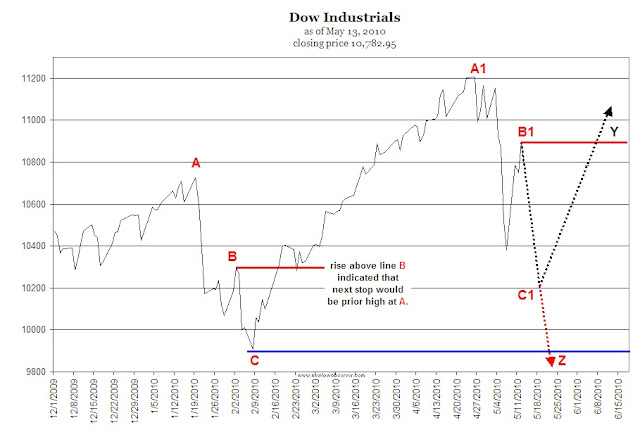
The decline from the intermediate high on May 12, 2010 is now putting in place the prospects for another classic secondary reaction of the Dow Industrials. According to Dow Theory, secondary reactions can range from 33% to 66% of the move upward from the previous low in the last secondary reaction.

In the chart below, you can see that the last secondary low took place at point C on February 5, 2010.

Depending on the point you choose (using the closing price or the intraday low), the Dow reached a low at 9822.83 on February 5th. From the low, the peak in the Dow occurred on April 26th at the intraday high of 11,308.95. Based on the difference of the low and the high, the next potential downside targets are as follows:
  • 10,565.89
  • 10,318.21
  • 9822.83
According to Charles H. Dow, analysis of market action needs to take in any periods that have similar characteristics. In this case, I believe that the Dow is tracing out exactly the same pattern as had happened from January 19th to February 5th. In the points A1, B1, and C1 we can see the pattern that might materialize according to Dow’s theory.
So far, we have already traced out the pattern from A1 to B1. The turn at B1 has laid the groundwork for what we can expect might happen next. The prospect is that we fall below 10,375 and possibly turn upward somewhere around 10,200. However, because of the extreme decline that occurred on May 6th, the Dow could fall as low as point C and still reverse back to the point B1.
If the Dow falls below the blue line at point C, then we can label the market trend as bearish. In addition, all of the moves in the Dow Industrials must be confirmed by the Transportation index. The ideal scenario is that the index goes back to B1 at the very least. However, with all the recent turmoil in the markets, I would not be surprised if we got a bear market signal below point Z.
It should be noted that although I have only discussed a bunch of lines going up and down, the ideas behind the concepts are rooted in fundamentals. The very same fundamentals that formed the basis for investors like Graham, Dodd and Buffett.

The Cloud of ETFs Looms Large

The mystery of the reason why ETFs were such a large proportion of the stock market free-fall on Thursday May 6, 2010 should come as no surprise to readers of this site. In 2009, we published a series of articles on ETF investments that didn’t paint a favorable picture.

The first article, titled “ETF: Mediocrity with No Pretense of Value,” referenced a very important section of the Federal Register which described the way in which ETFs are supposed to work. We offered up our own explanation of how we interpreted the description of the Federal Register text. Our closing remark to that article was the following:
“The blowback from something like this is on par with the unwinding of a derivative contract gone bad.”
The next article that we followed up with was titled “ETF: Indiscriminant Risk.” Our closing comment in that article was:
“As I hinted at before, ETFs pose a tremendous risk to the stock market and the portfolios of the respective ETF will be remembered for the fact that due to a liquidity drain all the stocks held will collapse regardless of value. With little cash on hand and an "automated" form of management there will be a crash on the most liquid stocks because the relatively illiquid stocks won't be able register a bid.”
In a SeekingAlpha.com article titled “U.S. Natural Gas Fund: The Beginning of the ETF Unwinding?”, we asked, “Are we on the cusp of seeing this situation with EFTs unravel?” In the same article we said, with considerable forethought:
“In their zeal to create hedging and leveraging opportunities to the retail investors, leveraged ETF distributors didn't emphasis enough the fact that the risk of loss was far beyond known market risk. Unfortunately, like the FIRREA rule change we could see painful unintended consequences.”
It is our assertion that all of the matters that we’ve raised are salient issues that need to be addressed. It is our view that instruments like ETFs should be left to the professionals exclusively or unwound altogether. The continued belief that retail investors need to invest in an ETF fund that issues “creation units” as described in the Federal Register is a definite recipe for disaster, if not now then at some point down the road.
The source citations from our “ETF: Mediocrity with No Pretense of Value” article and SeekingAlpha’s “U.S. Natural Gas Fund: The Beginning of the ETF Unwinding?” are well worth reviewing. Only after  reviewing all the sources mentioned will it be possible to come to the conclusions that we have regarding ETFs.
Investment Notes:

Email our team here.

Automatic Orders Don’t Provide Protection

The New Low Observer team is quite skeptical when it comes to strategies that are supposed to "protect" the investor from risk of loss. Such strategies as the use of stop orders, limit orders, and the many variations on the theme are supposed to protect an investor if their long-term holding of a stock suddenly declines to a level which would either generate a loss or significantly reduce a profit. Unfortunately, none of these "tools" will save a small investor when the market or an individual stock is under significant strain.
 
On Thursday May 6, 2010, we were given a prime example of why we are against using "protection" strategies offered by your broker to mitigate losses. The kind of collapse and recovery that was seen on May 6th occurs more frequently than most people think. While I admit that few stocks go from $40 to a penny (...or $0.0001 as one of my stock alerts from my broker told me) and then back to $40 in one day like Accenture (ACN) did. Many stocks drop 15% to 20% in a single day based on a larger than expected loss or missing their earnings target by a penny (that infamous penny again). Depending on the quality of the stock, in most cases, the price recovers the losses quite quickly in a matter of weeks or months. Since most people claim to be long term investors, automated orders force small investors out of a stock at unreasonable prices.
 
Some investors have explained that it is foolish not to use a stop loss order because they protect from losing "too" much. After all, wouldn't an investor want to get out of Proctor & Gamble (PG) (no pun intended) if it was bought at $60 then climbs to $62 and then falls all the way down to $55 during market hours? Under normal market conditions I would completely agree, however...it is safest to assume that there are never "normal" market conditions. On May 6th, Proctor and Gamble (PG) essentially recovered all of the losses except the 3% that was on par with the market indexes at the close for the day. If you had a trailing stop loss at $60 then more than likely you would have gotten out of (PG) at or near the lowest price if you held 1000 shares or less.
 
As any regular reader of our site knows, when we issue sell recommendations, we are specific in indicating that stop orders etc... are not to be utilized when selling a stock. Our boiler plate language for every sell recommendation is as follows:
 

"it is always recommended that when selling a stock, one should not place stop orders, limit orders or orders after hours. This leaves the seller in the position of being vulnerable to the whims of the market makers. Instead, place your sell orders only as a market order during market hours. Some would complain that a market order during market hours might leave some profits on the table. However, we would rather leave some money on the table rather than have it taken away from us by the trades that are placed by institutions and market makers."

Most uninformed or new market participants would like to blame computers trading for the rapid sell-off in stocks. However, stock market history suggests that market imbalances are as old as the day is long (this explains why "money" dominates the exchanges of goods and services instead of barter). There is ample evidence from all previous market panics in history to point out who gets the short end of the stick under "fast" market conditions. The use of protection strategies like stop loss orders, etc... usually doesn't work for small investors when it is needed the most.
 
The explanation of the reason why protection strategies don't work is simple and I'll do my best to articulate the concept. When an automatic order is triggered, the sale or purchase of a stock is triggered. However, if you are a small investor, your order to sell 100 shares does not get priority over the single order to sell 1 million shares. If you're a market maker, you're going to be forced to create a market for the million shares even though there are enough small trades equal to 1 million shares to match. However, it is less work and more efficient to match up the large orders first and then worry about the small orders later. It's like having $8 in cash to pay for your items at the grocery store. Five dollars are in ones and the rest is in pennies. Does the clerk start counting the pennies first or the dollar bills?
 
Naturally the million shares and others like them get priority to be cleared from the stock exchange thereby getting preferential pricing instantaneously. Sitting on the sidelines are the small trades that need to be matched up. However, if your 100 share automatic sell order has to wait for multiple million share orders to clear first, then by the time your order is ready to be placed the price of the stock would have fallen well below your original limit price. In some instances, I've seen where the smaller trades are executed 40% below the original trigger. The opposite is true of automatic orders to purchase stocks resulting in the all-too-familiar decline in the stock price immediately after the small investor buys.
 
We don't know how long it will take for small investors to realize the risk of automatic orders. Our position on this matter remains clear, automatic orders are fraught with problems with little in the way of recourse for an unlevel playing field.
 
Investment Notes: