Category Archives: SRL

LinkedIn Corp. Downside Targets

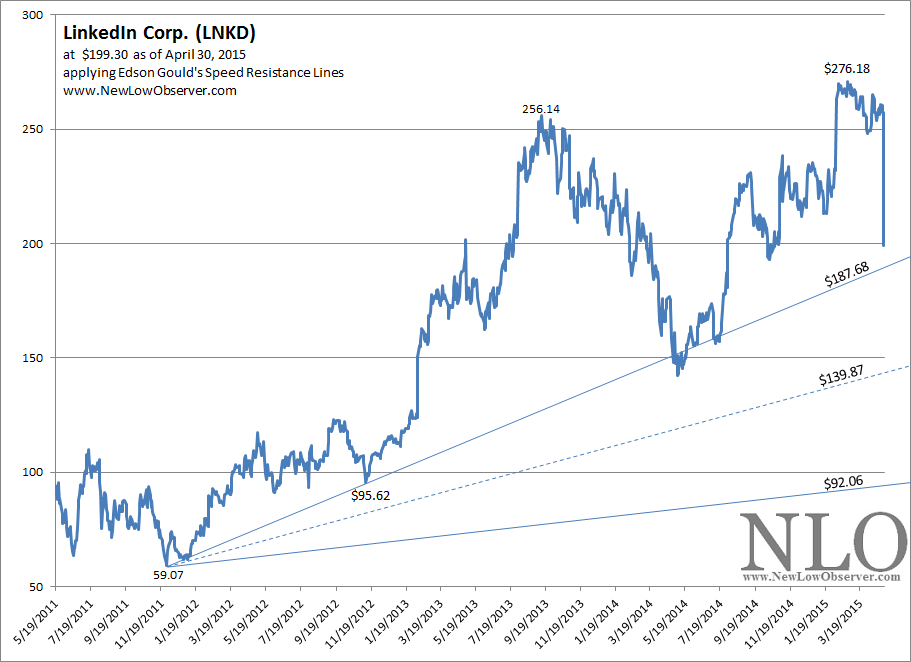
On April 30, 2015, in after-hours trading, LinkedIn (LNKD) declined –20.95% from the closing price of $252.13 to $199.30.  with such a decline, it is worth considering what the downside risk would be according to Edson Gould’s Speed Resistance Lines (SRL).
image

The above chart shows the current SRL downside targets based on the peak price of $276.16:

  • $187.68 (conservative target)
  • $139.87 (midpoint target)
  • $92.06 (extreme target)

What is most relevant in this SRL is the downside targets from the previous peak at $256.14.  At that time, LNKD had the following downside targets:

  • $181.00 (conservative target)
  • $133.19 (midpoint target)
  • $85.38 (extreme target)

In the prior decline, LNKD fell to slightly below the midpoint target at $133.19.  This suggests that the current slump should go below the conservative downside target of $187.68.  Going below the $187.68 level should get the stock price to the ascending midpoint target of $139.87.  Those interested in LNKD should consider the stock in stages at or below the ascending $139 level with an acceptance of a decline to the ascending $92.06 level.

Worth noting is that anyone who had a standing stop loss order with their broker, say below $250 or $240, will be forced out of their position once the stock market opens on May 1, 2015 at whatever the opening price is as long as it is below either of the sample levels.  At $199, investors with stop loss orders will take a severe beating even though they may not have been involved in the after hour activity.
A Different Perspective on Lumber Liquidator

On February 25, 2015, when Lumber Liquidator was trading at $57.23, we said the following:

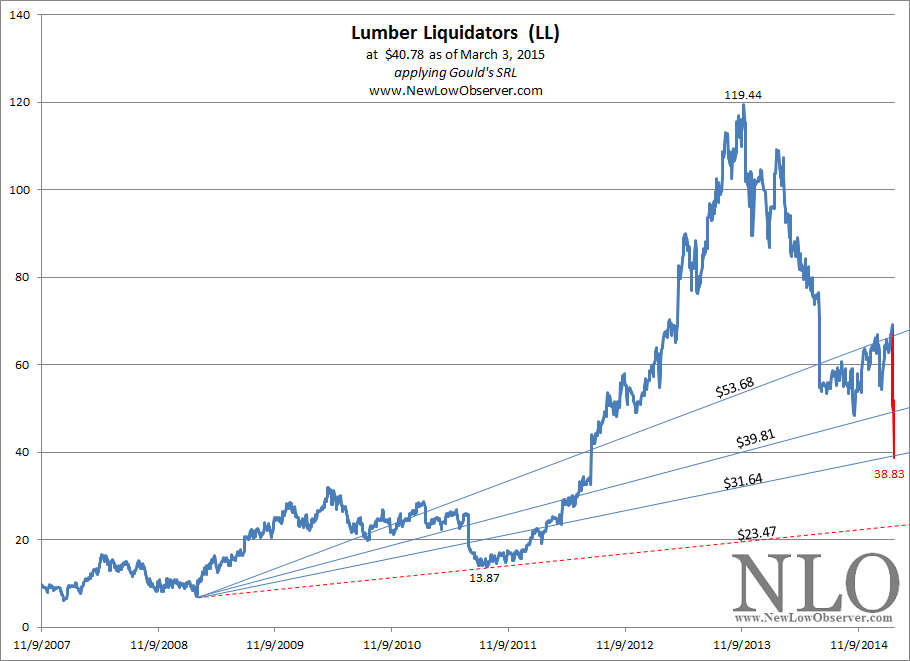
“Those interested in LL and willing to perform appropriate due diligence could engage in a three phase purchase plan beginning below $39.81, $31.64 and $23.47.  Investors, as opposed to speculators, should be willing to accept that there is no compensation for the wait when holding LL and that the decline to the ascending $23.47 level is a real risk.”

In fact, Lumber Liquidator blasted below the $39.81 support level and has rested at the $31.64 support level and started to move higher as seen in the chart below.

image

We’ve intentionally left out the move up from $38.83 to highlight the extent of the decline and the high level of coincidence with the supports levels that we had outlined in the previous month.  All that remains is the decline to the $23.47 level.

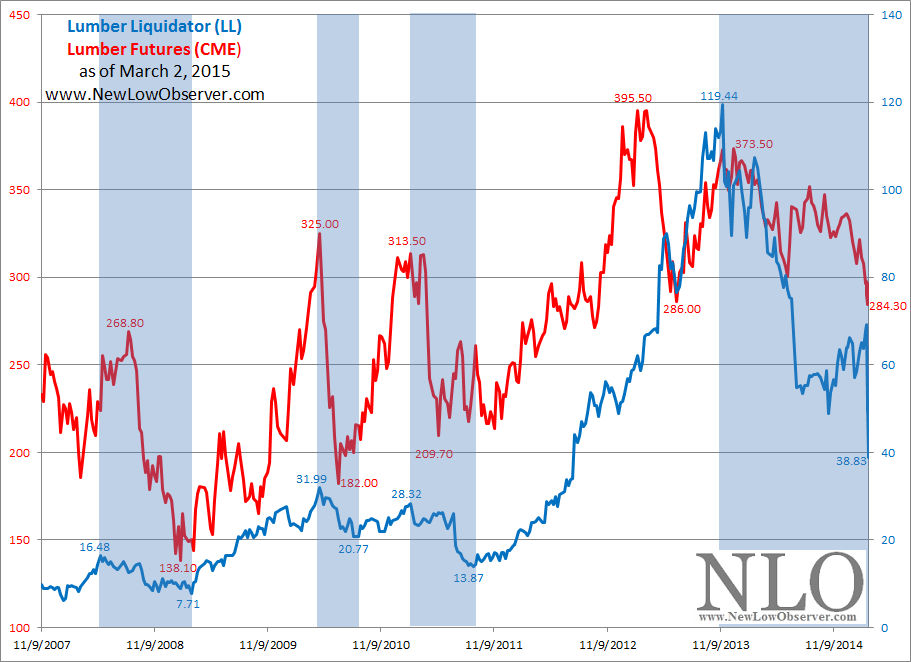
While famous short-sellers have the ear of influential media to talk their book and ensure their profits, we only have price action to work from.  For this reason, it is well worth noting another coincidence that relates to Lumber Liquidator and futures price on lumber as seen in the chart below.

image

The coincidence of Lumber Liquidator (LL) declining significantly at the same time as the futures price of lumber (as traded on the Chicago Mercantile Exchange) seems difficult to ignore.  Investors should take note of the fact that in three prior periods indicated in blue, LL has lost a minimum of –35% and as much as –53% when the price of lumber declined –33% or more. 

So far, from December 2013 to March 2015, the price of lumber has declined –23% while LL has declined as much as –67.49%.  Much of the decline in LL has been exacerbated by concerns related to quality and sourcing of the flooring.  However,  the current decline is only slightly out of alignment from what has happened in the past. 

We say slightly because we’re excluding the peak in lumber at 395.50 when LL was trading at $62.19.  While lumber was trading lower and not to exceed the $395.50 (considered a bear market), LL gained another +92.05%.  If Lumber Liquidator’s decline was measured from the February 15, 2013 peak in lumber at $395.50, the decline in the stock price would equal –37.56%.

Assuming we aren’t on the cusp a new bear market, the decline in LL has been overdone and an individual willing to accept the downside risk to $23.47 should consider implementing a three phase purchase plan.  An investor must keep in mind that the conservative upside target is $80.53 which is the new “limit” for the stock instead of the previous $119.44.  In addition, the downside targets now act as upside resistance level as was the case when LL could not sustain the $53.68 level prior to the recent collapse.

Technical Take: LL & SAM

Below are the downside targets using Speed Resistance Lines [SRL] for Lumber Liquidator Holdings (LL) and Boston Beer Company (SAM) based on the work of Edson Gould.

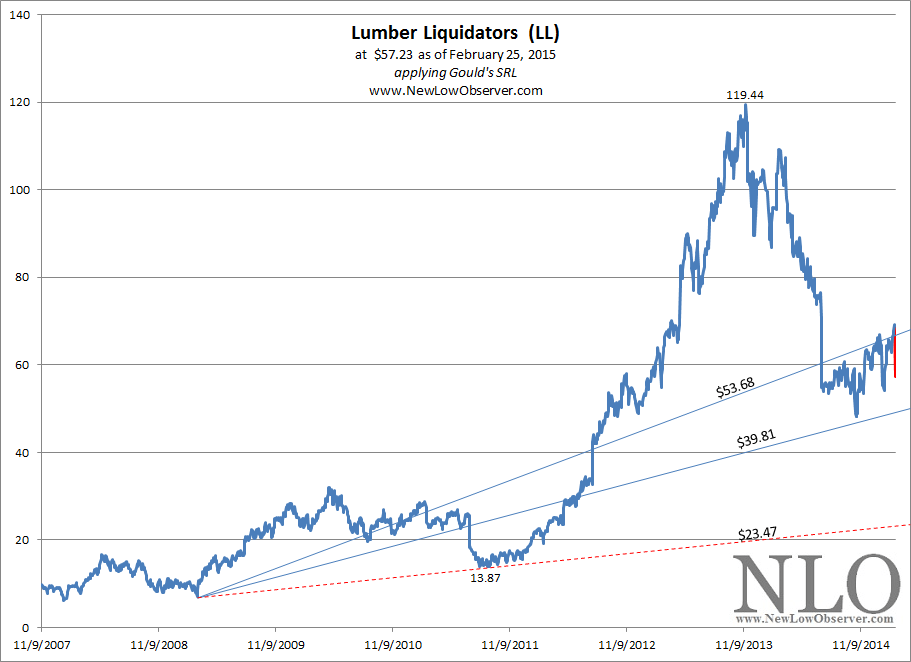
Lumber Liquidator (LL) has declined from the peak of $119.44.  Gould’s SRLs suggest that from the peak price, LL has a conservative downside target of $53.68 and an extreme downside target of $39.81.

image

On February 25, 2015, LL was unable to sustain a price above the ascending $53.68 level with a decline of over –17%.  Our best guess is that LL will decline to the ascending $39.81 level, which currently approximates $49.50 price.  Those interested in LL and willing to perform appropriate due diligence could engage in a three phase purchase plan beginning below $39.81, $31.64 and $23.47.  Investors, as opposed to speculators, should be willing to accept that there is no compensation for the wait when holding LL and that the decline to the ascending $23.47 level is a real risk.

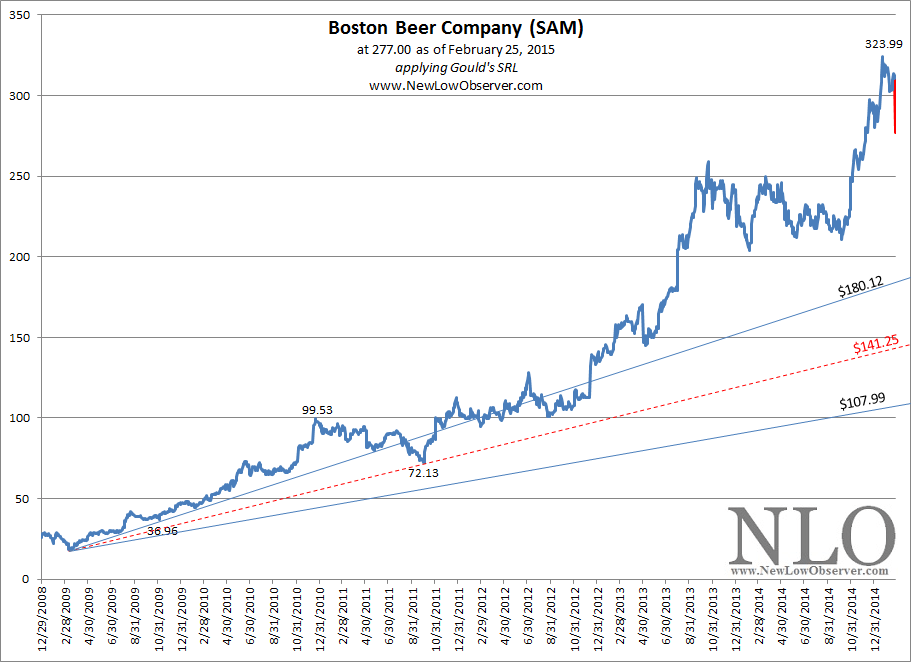
Boston Beer Company (SAM) is the brewer of Samuel Adams beer and a multitude of other “craft” beers.  Today SAM declined –10% on an earnings miss.  Below is the SRL for SAM.

image

Our expectations for SAM are not very high as the last time that the stock was able to achieve the conservative downside target of $70.13 was in 2011.  Since that time, SAM has faltered but not fallen.  In spite of this fact, we’ve outlined the conservative downside target of $180.12 and the extreme downside target of $107.99.  Investors should note that a decline to the ascending $180.12 level is an ideal buying target with a follow-up purchase below $141.25.  As with Lumber Liquidators, SAM is bet on growth in the stock price and not much else. 

The relative strength of each company (long-term viability) is what makes these stocks compelling and worth considering at the appropriate predetermined price.

TripAdvisor Running Away From Buyers

On February 12, 2015, news of Expedia (EXPE) buying Orbitz (OWW) combined with the earnings release by TripAdvisor (TRIP) has resulted in OWW increasing +21.83% while TRIP has increased by +23.76%.  This cannot be good news for Priceline (PCLN) shareholders as the likelihood of the company overpaying for TRIP grows.

Our February 6, 2015 Nasdaq 100 Watch List had the following review of TripAdvisor and Priceline:

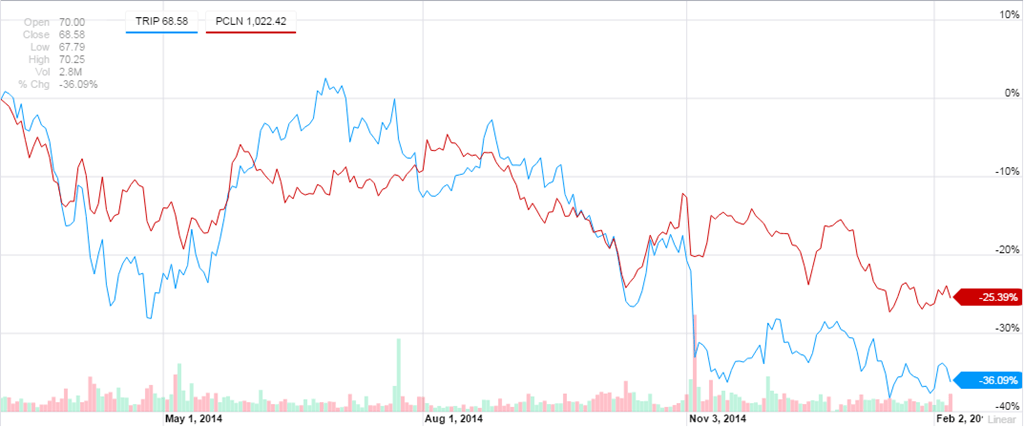
A couple of stocks that have caught our eye are Priceline (PCLN) and TripAdvisor (TRIP).  Both stocks are low in price relative to their March 2014 peaks. 

image

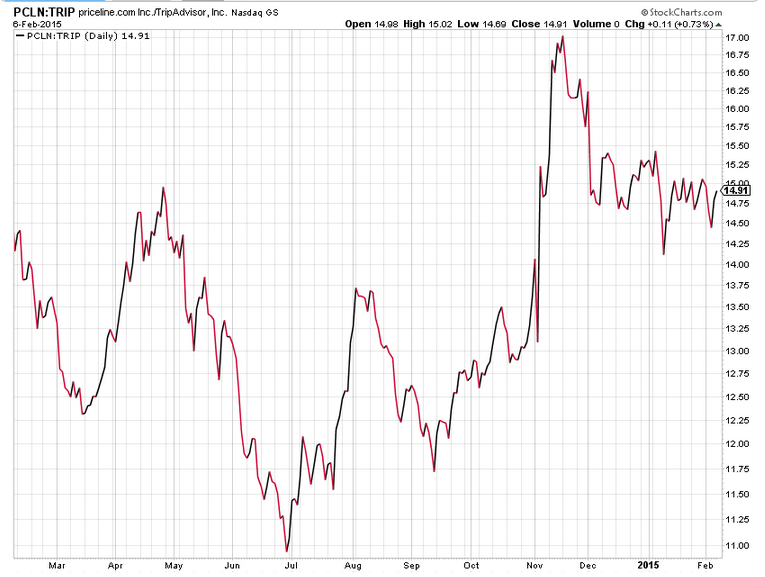
There has been some recent talk about PCLN absorbing TRIP in a buyout.  Below is the relative price difference between PCLN and TRIP.  In the last year, mid-November 2014 was the best time for PCLN to leverage the stock price to buy TRIP while July 2014 was the worst time to use stock to buy TRIP.

image

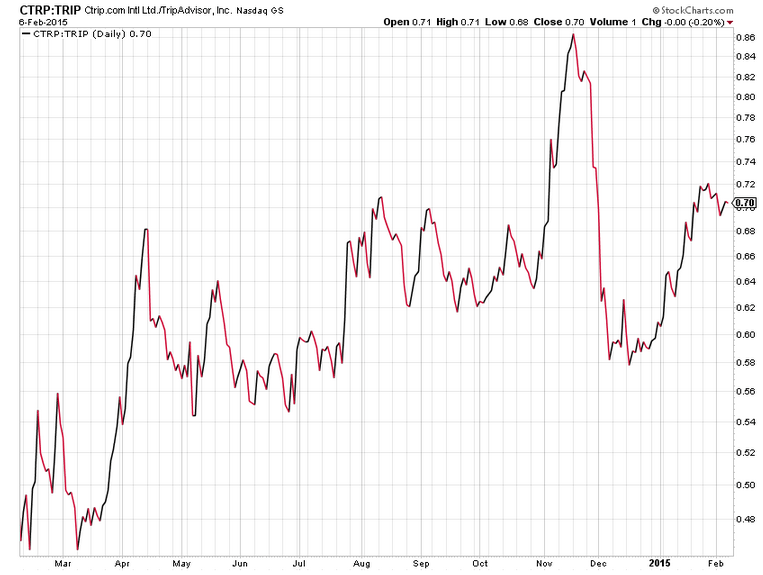
While PCLN has changed on a relatively small basis over the last year, Ctrip.com (a company that we correctly analyzed on December 2011) has had a tremendous amount of relative price change over TRIP in the last year.

image

While TripAdvisor (TRIP) may not be the best investment over Priceline (PCLN) on a fundamental basis, the potential for a buyout of TRIP may make good investment sense due to the need to eliminate a competitor or to take advantage of existing clients, assets or infrastructure.  Things could get worse for the market overall, pushing all of the stocks in the sector down. Barring a general market correction, investors probably have until the middle of December 2015 for a deal to be hammered out if the stock price doesn’t recover from the current levels.

We remain confident that TripAdvisor is the best relative value in the competition elimination game for the sector.  In reality, Ctrip.com acquiring TRIP is very unlikely.  However, we believe that with the recent jump in the price of TRIP, Priceline will feel the burn and get into a rampant bidding war for TRIP.  This could result in TRIP being acquired for well above the most recent 52-week high of $110. 

Below are the downside targets along with the conservative/extreme upside targets for TRIP based on Gould’s Speed Resistance Lines.  Non-members of our site wishing to view the upside/downside targets can send an email to nlo@newlowobserver.com.

Qualcomm Chokes and Other Thoughts

On January 29, 2015, Qualcomm (QCOM) announced that a “…key customer passed on new chip…”  On the news, QCOM stock fell as much as –12%.

Royal Gold: SRL Update

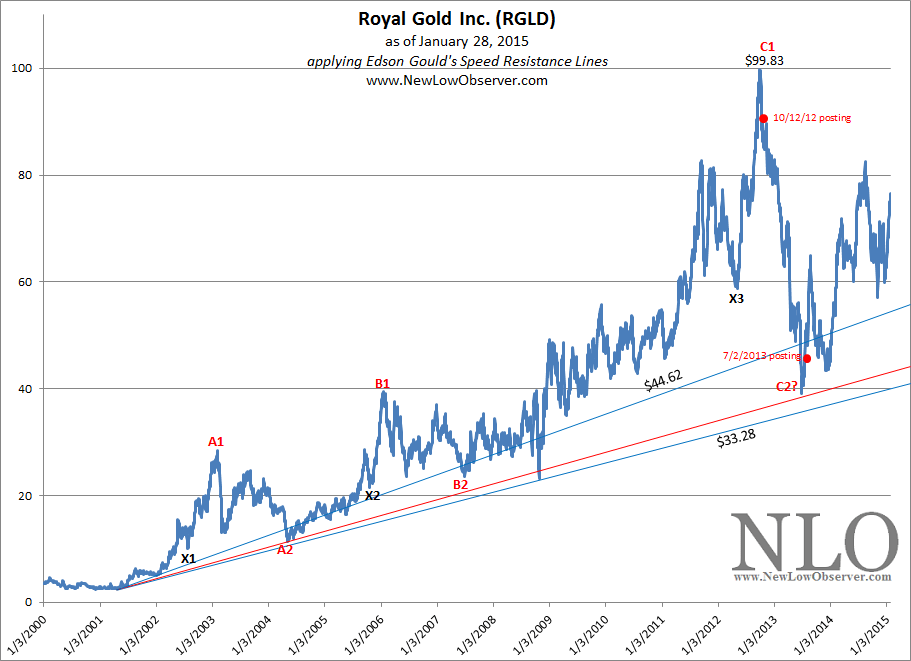
On October 12, 2012, we posted the following SRL for Royal Gold:

image

We said the following of the above chart:

“The SRL for Royal Gold at $44.62 doesn’t seem outlandish given what has already occurred in the previous declines from prior peaks.  The X marks the first decline after a “minor” parabolic move that was later exceeded on a larger scale to point A1, B1 and C1.  Additionally, the  X reflects the minimum retracement from the top and has provided consistent support for the price for RGLD.

“We’d consider buying RGLD if it declines to either of the support levels of X3 or C2.  The movement of RGLD has been consistent with the price of gold (GLD) which is in stark contrast with gold stocks as represented by the Philadelphia Gold and Silver Stock Index (^XAU)....”

On July 12, 2013, we said the following of RGLD:

“RGLD has fulfilled almost all of our expectations for downside risk since October 2012.  Although we’d much rather see this stock reach the extreme downside target of $33.28, we feel that purchases at the current level and below would be consistent with asset accumulation and wealth building, in contrast to those who were considering the stock at or near the October 2012 levels.”

So far, Royal Gold has adhered to the SRL outlined on October 12, 2012 and July 12, 2013 as displayed in the chart below.

image

Royal Gold has a mid-range upside target of $100.39 and an extreme upside target of $133.85 based on Gould’s Speed Resistance Line.  However, the upside targets are somewhat immaterial when considered from the context of buying based on values.

Oil and Gas Stock Index Downside Targets

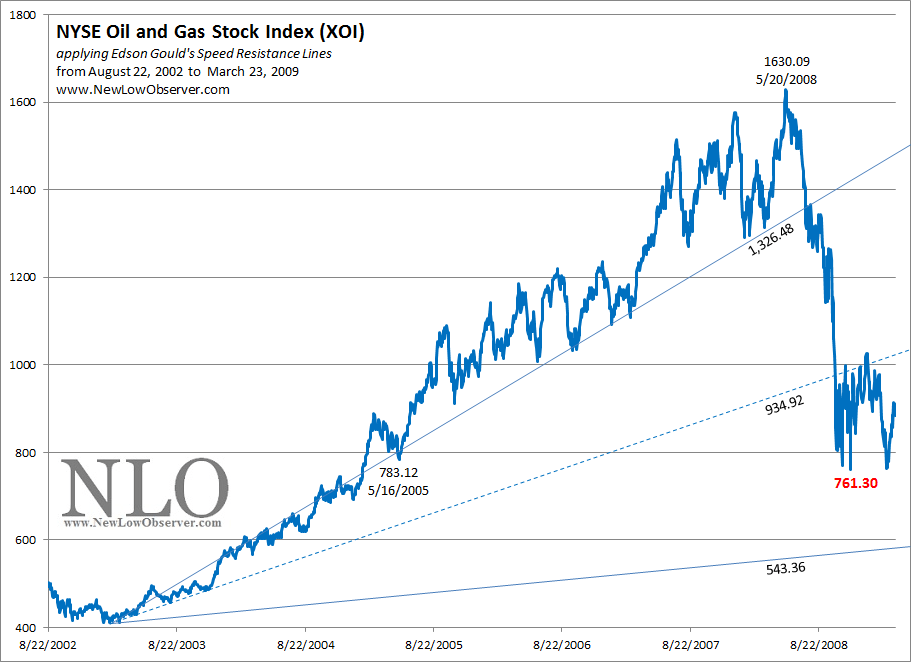
In the period from 2002 to 2009, the NYSE Oil and Gas Stock Index (XOI) presents us with a possible template for what to expect in the current decline in the same index.  Below is Gould’s Speed Resistance Lines (SRL) for 2002 to 2009 of the XOI Index.

image

The above chart shows the conservative downside target of 1,326.48 and the extreme downside target of 543.36.  The mid-point of the downside targets is 934.92.  In the case of the XOI index, it managed to achieved the conservative and mid range for the index.  However, the extreme downside target was not achieved.  The full extent of the decline is indicated in red at the 761.30 level.

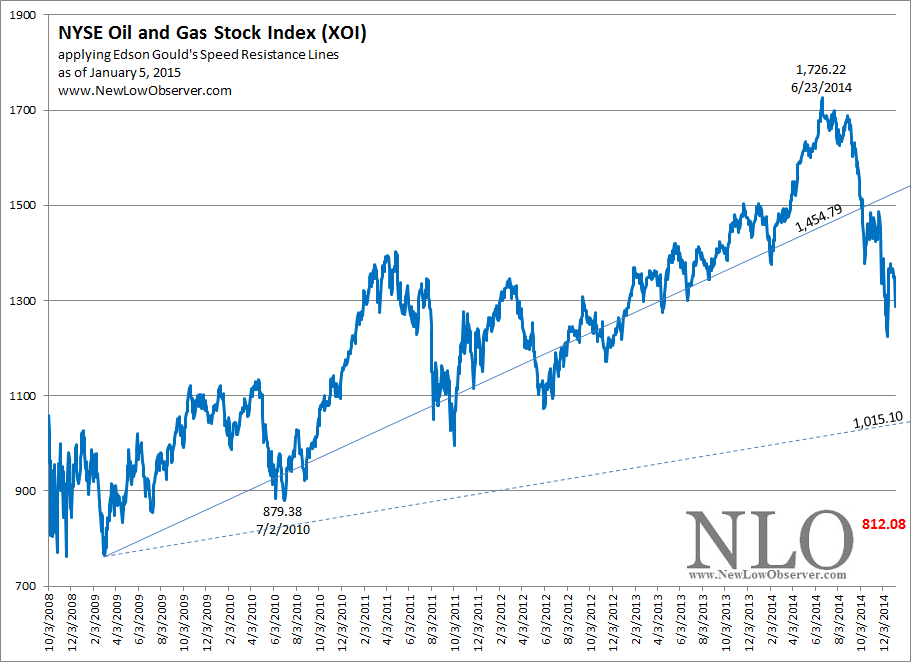
Our guess is that the XOI index will accomplish a similar pattern of “performance” on the downside in the current run as was the case in the 2002 to 2009 period.  We’ve charted the progress of the XOI Index in the period from 2008 to the present with Gould’s SRL.

image

The conservative downside target of 1,454.79 has been constructed while the mid-point of 1,015.10 is also indicated.  However, we did not include the extreme downside target of 575.41.  We did indicate in red the 812.08 level which was the extent of the decline in the period from the 2008 high to the 2009 low. 

Suffice to say that we expect the XOI index could easily fall to 1,015.10 and subsequently to the 812.08.  Those interested in the oil sector should start initiating positions at or below the ascending 1,015.10 level.  Two funds that trade in line with the XOI index are PowerShares DB Oil ETF (DBO) and Direxion Daily Energy Bull 3x (ERX).  One ETF that trades the opposite of the XOI index is the Direxion Daily Energy Bear 3x (ERY).

Best Buy’s New Normal

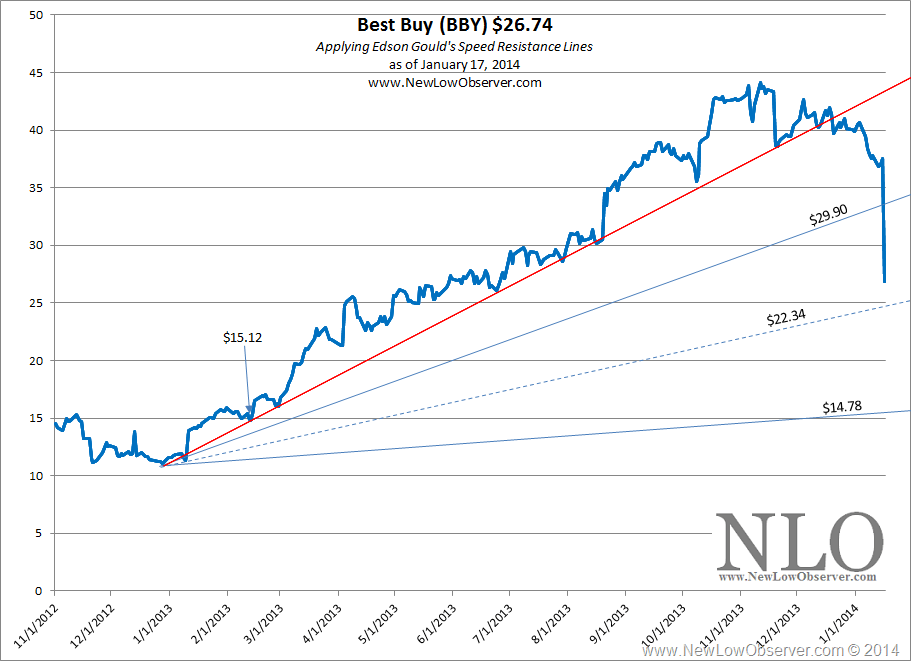
On January 17, 2014, we posted Edson Gould’s Speed Resistance Lines for Best Buy (BBY) in an attempt to determine what the extent of the decline might be.  From that posting we said the following:

“Best Buy has had a history of resting [at] the extreme downside target, currently at $14.78.  However, we have split the difference and placed an intermediate downside support level of $22.34.  Again, this is not a recommendation to buy or sell Best Buy, instead, it is an attempt to observe how closely the stock will adhere to the SRLs indicated in the chart.”

image 

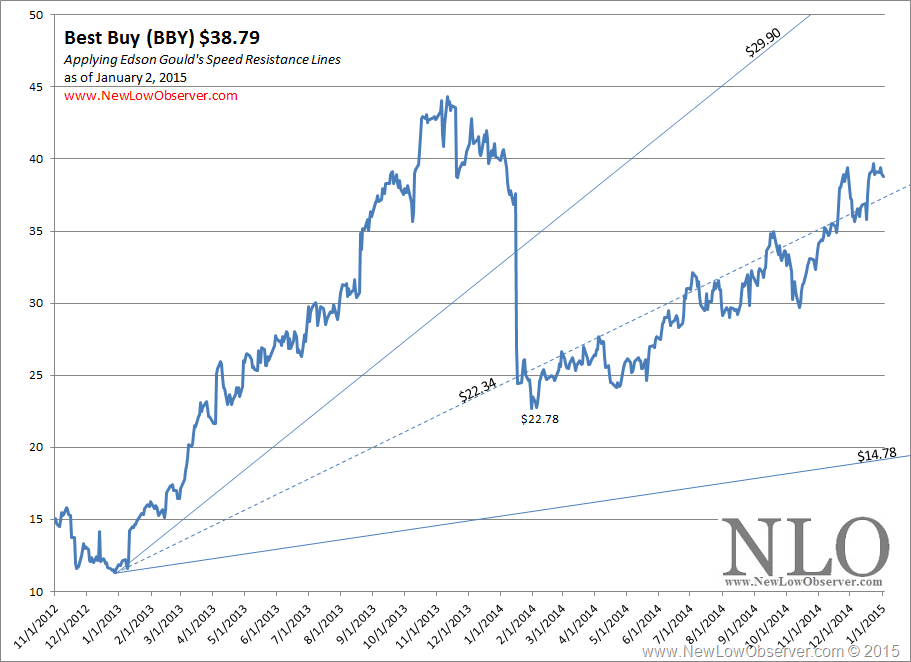
Nearly one year later, we can see that although the historical trend had been for BBY to decline to the extreme downside target ( at $14.78), the estimate of $22.34 was a fair assessment of downside risk as the stock has managed to vacillate at or above the ascending $22.34 level seen below.

image

The quality of Gould’s SRL has been fairly consistent and reasonably accurate.  We look forward to introducing additional SRLs of stocks that have established a declining trend to determine downside targets.  The conservative upside target for BBY is $44.85.

Quick Take: Carbo Ceramics

Review

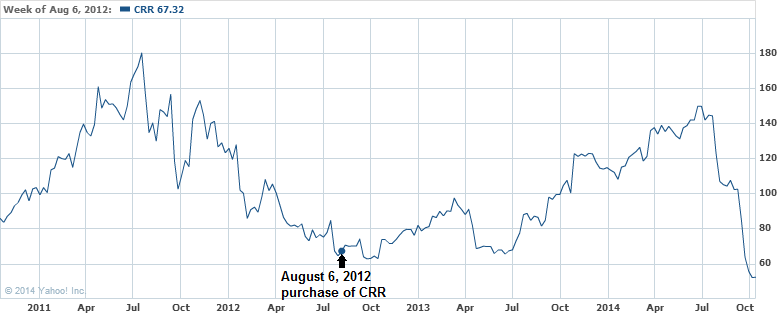
On August 6, 2012, we purchased Carbo Ceramics with the following rationale:

“Carbo Ceramics (CRR) has been mentioned by us on several occasions.  CRR first appeared on our February 10, 2012 U.S. Dividend Watch List (found here) and was trading at $85.94.  An Altimeter was run on CRR which indicated that the stock would be undervalued at $62.40 (found here).  However, as CRR has experienced a dividend increase of 12.5% since our May 28, 2012 Altimeter, the stock is now considered undervalued at $70.  While we do expect approximately 20% downside risk from the current price, we are comfortable with adding to our position when such a decline takes place.”

As it appeared that Carbo was undervalued between $62.40 and $70, we used 5% of our portfolio to purchase the stock. After August 6, 2012, Carbo Ceramics fell as low as $63.03 and increased as much as $156.

image

Update

Below are the updated numbers for Carbo Ceramics after the decline from the most recent peak of $156.  We will cover both aspects of CRR based on Gould’s Altimeter and Speed Resistance Lines.  First, the qualitative review based on the Altimeter.

Netflix: Downside Targets

Review

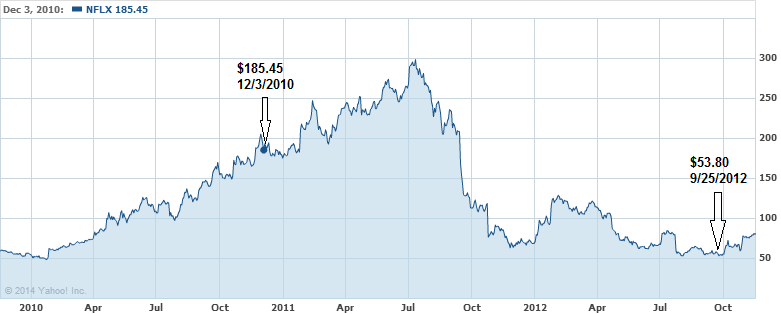
On December 3, 2010, we ran the numbers for Netflix,based on the work of Edson Gould’s Speed Resistance Lines, to determine what the downside risk might be for the stock.  The projected downside targets are illustrated below:

Not long afterwards, Netflix stock price soared from $185.45 to $300.  However, the goal of our site is to determine downside risk and the rise in the stock price of was of little interest.  Our view is that if we missed an investment opportunity then we will consider investing only if the stock declines to any of the anticipated downside targets.

image 

Naturally, there was considerable opportunity that we missed on the way from $185 to $300.  However, our rule is to seek values and from our experience all quality companies become undervalued at some point. Finally and for numerous reasons, Netflix declined from the peak of $300 to as low as $53.80.  Naturally, we were able to pick up shares of Netflix at $62, a price we felt was reasonable at the time.  Our critical review of the downside targets allows us to accept our purchases for the long-term in case we happen to be wrong about the short-term upside prospects.

October 15, 2014: Netflix Downside Targets

Quick Take: GoPro Downside Targets

We’re fascinated with the news surrounding GoPro (GPRO).  The stock went public on June 26, 2014 at $24 per share and has since increase in price to $89.93 as of October 8, 2014.  As public offerings go, the rise in price is considered a success.  As recently as October 7, 2014, Barclays raised their price target for GPRO from $45 to $60, in spite of the fact that the stock is already trading well above the new target price.  It seems that Barclays doesn’t want to appear over anxious to recommend the stock even though they are not confirming their expectation for the stock to decline.

Continue reading

Apple meets NLO Upside Target

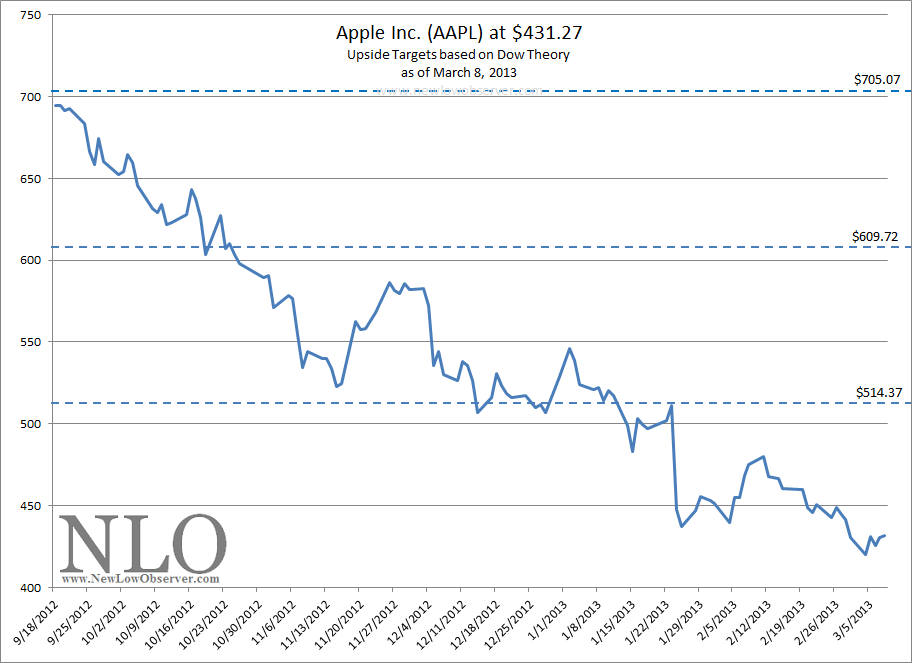
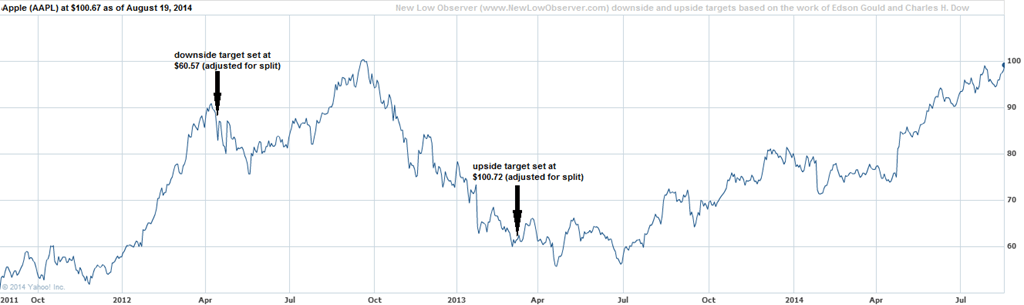
On August 19, 2014, Apple (AAPL) stock price rose as high as $100.66.  When Apple was trading at $61.61 on March 9, 2013, we said the following with the accompanying chart:

“Apple Inc. (AAPL) is at the top of our watch list as it is within 5% of the one year low.  In our April 14, 2012 test of the quality of Edson Gould’s Speed Resistance lines, Apple fell from $636 [adjusted price of $90.85] to our projected level of $424.15 [adjusted price of $60.59] (found here).  Now that the stock has achieved our downside target, we expected that a reaction to the upside is likely.”

image

On July 17, 2013, when Apple was trading at $61.47, we re-affirmed our view of the upside potential for Apple with the following commentary:

“Currently, Apple is demonstrating a basing pattern that if successful, could result in a breakout to the upside.  At the current levels, we wouldn’t be opposed to buying some shares of Apple with the expectation that the stock could decline an additional –25% to –35%.”

The work of Edson Gould has proven to be astounding when considered in its context.  On April 14, 2012, we posted an article titled “Considering the Downside Prospects for Apple”.  At that time, we were revising the previous estimates of downside risk done on February 5, 2012 (third party source available here).

What was mentioned on February 5, 2012 is critical to understanding how Edson Gould’s downside projections work.  At the time, we said:

“The very first thing that we look for, to determine speed resistance lines, is the most recent peak in the price. Because AAPL is continually making new highs, we only need to use the latest price of $455.68 [post split price of $65.09] as our starting point….As the price of Apple increases, so too does the SRL lines based on the work of Edson Gould.”

This means that as long as the price of the stock increases to a new high the speed resistance lines are expected to increase as well.  Only when the stock starts on a declining trend can we expect that the stock price might go to the conservative and extreme downside targets.

image

On April 14, 2012, when Apple was trading at $90.89 (pre-split price of $636.23), we said the following:

“…we believe that, based on the current speed resistance lines, no one would expect Apple to decline to our conservative downside target of $424 (post split price of $60.57)...”

The strength of Gould’s downside risk estimates is that we didn’t even have the peak price of $100.71 set on September 18, 2012 but we were still able to see the conservative downside target of $60.57 achieved.  Had we used the peak price, we would have achieved the $67.14 conservative downside target much earlier than the $60.57 level.

Nu Skin Meets Our Downside Target

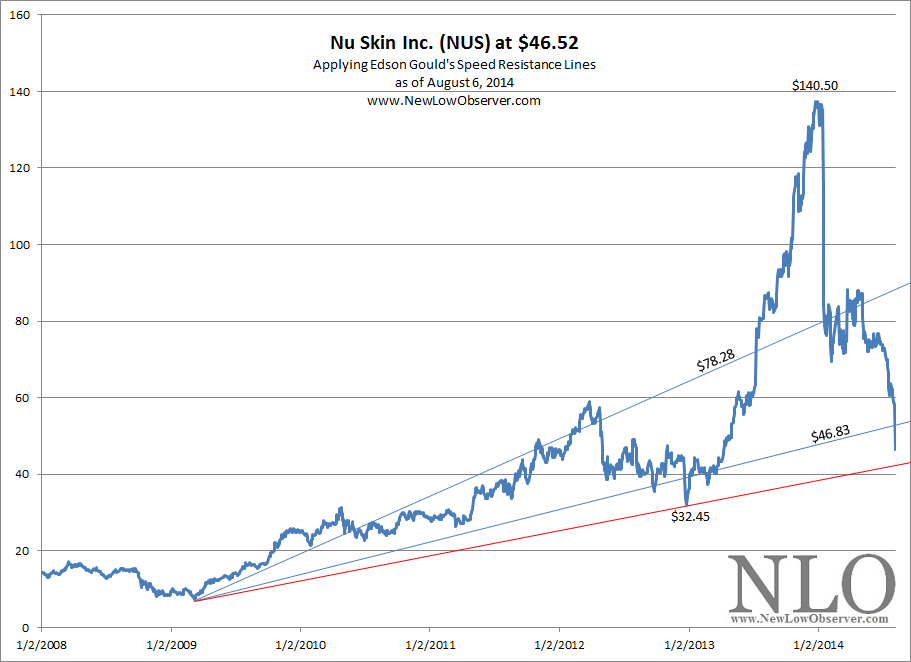
On January 16, 2014 at 8:40am EST, we said the following of Nu Skin Enterprises (NUS):

“If the stock closes below $79.28 then the price should vacillate at or below the rising conservative SRL in the medium-term.  If the stock manages to close above the $79.28 level then the upside target is $118.92.  Additionally, the extreme downside target of $46.83 is just on the horizon.  In theory, this stock should achieve the extreme downside level before hardened speculators will jump in.”

On August 6, 2014, NUS declined as low as $43.50 and closed at $46.52.  An updated Speed Resistance Line is included below:

image

NUS has met our January 2014 call for the extreme downside target of $46.83.  It is at this point that NUS becomes interesting to hardened speculators.  Based on Gould’s SRL, NUS has an upside targets of $82.73 and $118.92. 

Gold: Reassessing the Risks

On March 3, 2013, we said the following about the downside prospects for gold (article and chart found here):

“The prevailing controversy, among gold bugs, is whether or not gold stocks have bottomed.  As our Gold Stock Indicator has indicated, so far, gold stocks have a long way to go before reaching lows similar to what occurred in 2008, on a relative basis.  This debate about gold stocks only arise out of the fact that they have fallen so much while the price of gold has been ‘stable.’

“However, when the price of gold is viewed from the perspective of Edson Gould’s Speed Resistance Lines (SRL), we see that there is a lot room for gold to move to the downside.

“We can’t be certain that the price of gold has any further to fall. However, our experience with the work of Edson Gould cannot be ignored.  We’ll have to assume that if gold breaks below $1,531 then it would be wise to build $1,179.25 into our expectations.”

The above commentary was based on the March 1, 2013 price of gold.  Since that time, gold has declined from  $1,582.25 to slightly above Edson Gould’s ascending conservative downside target at $1,195.25 on December 20, 2013.  This was within 1.35% of the estimated target.  Additionally, gold stocks as represented by the XAU Index declined –37.72%.  Below is our updated review on the price of gold.

Continue reading

iShares Biotechnology Downside Targets

“…provided the secondary reaction can be assumed to have run its normal course, which should be somewhere between 33 per cent and 66 per cent of the total primary advance attained since the last preceding important secondary reaction.”

Rhea, Robert. The Dow Theory. Barron’s. 1932. page 58.