Price Momentum Indicators for the indicated metals. Continue reading
- Japan
- Market Indicator
- Price Momentum Indicators
- Richard Russell
- Silver
- Speed Resistance Lines
- U.S. Dividend Watch List

Below is a chart of Platinum from 1916 to 2021, applying the Velocity Indicator using monthly data.
Posted in palladium, Platinum, Velocity Indicator
On January 24, 2020, we said the following of Palladium:
“Because of the precedent set in the period from 1996 to 2001, we expect that the conservative downside target of $1,627.93 will be achieved.”
Below is the charting of our assessment and the subsequent price action.

Not only did palladium decline below the target of $1,627.93, the price of palladium fell to $1,370 on an intraday basis on March 19, 2020, almost exactly half the distance between the conservative and mid-range targets.
Posted in palladium
Below are the upside and downside targets for Palladium based on the February 27, 2020 peak. Continue reading
In reviewing the price history of Palladium and in light of the most recent parabolic increase, we have outlined the current increase in the price and compare it to the 1996-2003 rise and decline.
1996-2003
In the period from 1996 to 2004, the price of Palladium increased +837% and subsequently declined from the peak by -86.05%.
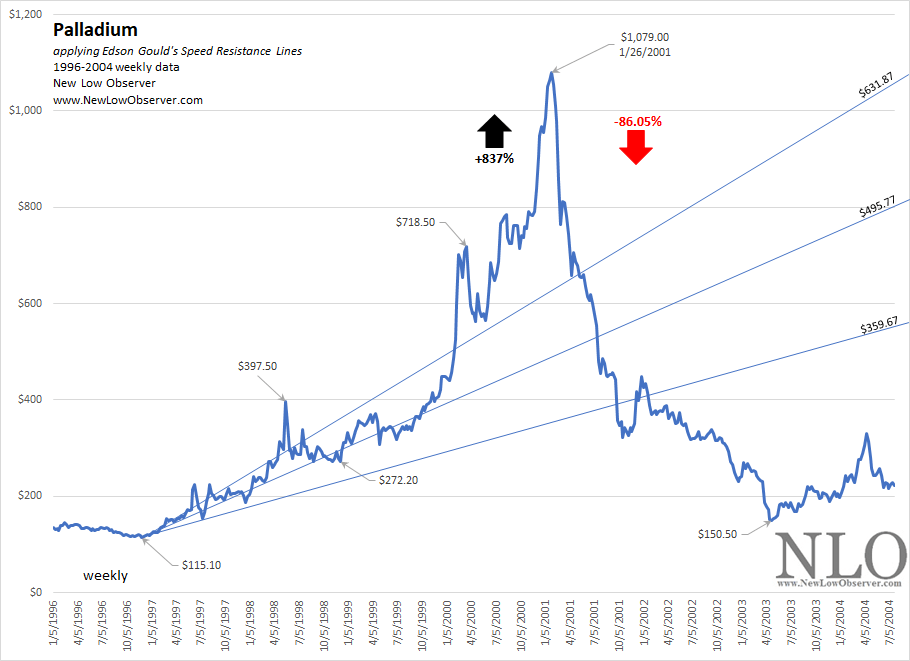
The chart above includes the Speed Resistance Lines (SRL) based on the work of Edson Gould. In this specific instance, the price of Palladium declined through all of the downside targets. In addition, the continued until it reached a low of approximately $150.50 or -58% below the $359.67 Speed Resistance Line.
In the following review of the most recent increase in Palladium, we’ll compare the 2016-2020 run-up to the increase from 1996 to 2001 to identify the signs of what might come in the price going forward.
Then v. Now
Technically Speaking
When looking at the price of Palladium in both periods, we have identified the most important points contributing to our analysis.
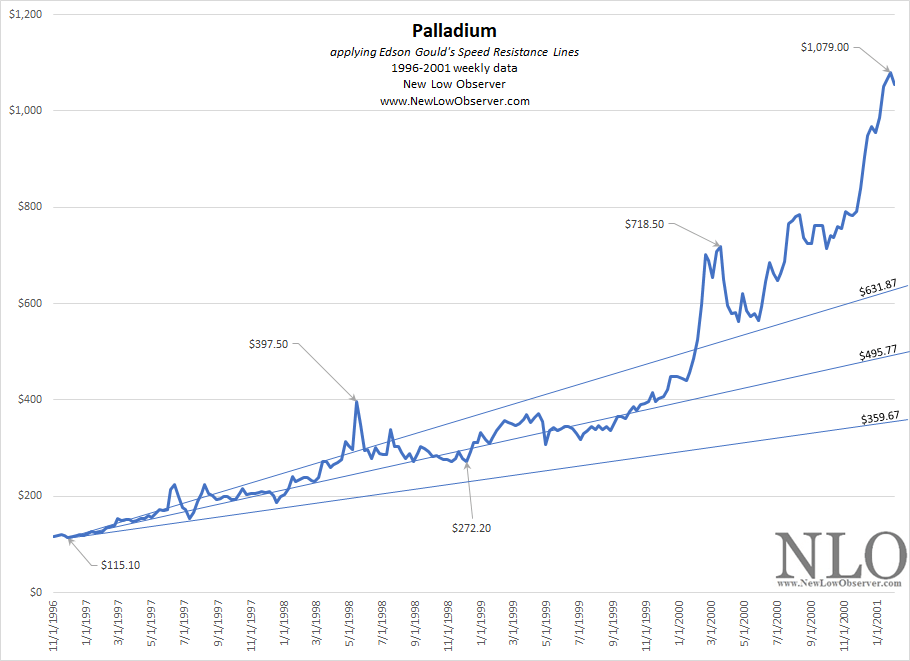
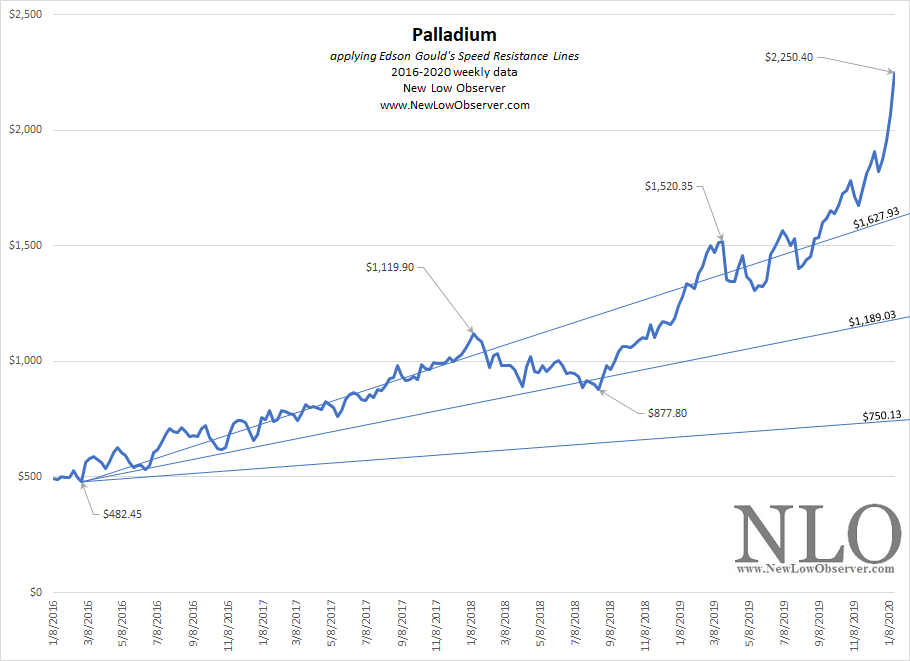
The start to our review is the first intermediate peak after the low. In the case of the 1996-2004 period, that first peak was at $397.50. For the period of 2016-2020, that peak was $1,119.90. The subsequent lows that followed, $272.20 and $877.80, helped to establish the downside targets.
Worth noting is the decline from the initial peaks to slightly below the mid-range downside targets before a continuation of the rising trend to the second intermediate peaks at $718.50 and $1,520.35, respectively. In both cases, the decline from the second intermediate peaks are situated around the conservative downside targets at $631.87 and $1,627.93.
In both cases, the parabolic move ensues after the second intermediate peak, which is a considerable distance from the level of the conservative downside target.
Conclusion
Because of the precedent set in the period from 1996 to 2001, we expect that the conservative downside target of $1,627.93 will be achieved.
We could consider it luck if the price of Palladium were to decline to the mid-range level of $1,189.03 or the extreme target of $750.13. However, if the period from 1996 to 2003 is truly a precedent setting period then it would not be surprising to see Palladium decline to $750.13 as a normal reaction to the parabolic increase.
Posted in downside, Edson Gould, palladium, parabolic, Speed Resistance Lines
The price of palladium has increased significantly since 2016.

Naturally, parabolic peaks mean that the price is nearing a top. The downside prospects are the only clear consideration at this point in time. Below are the downside targets for the Aberdeen Standard Physical Palladium Shares ETF (PALL) that we have generated based on the most recent peak. Continue reading
Posted in Edson Gould, palladium, parabolic, Speed Resistance Lines