Since our last posting, Gold (GLD) and gold stocks (XAU Index) continue to trade in a range as seen below.
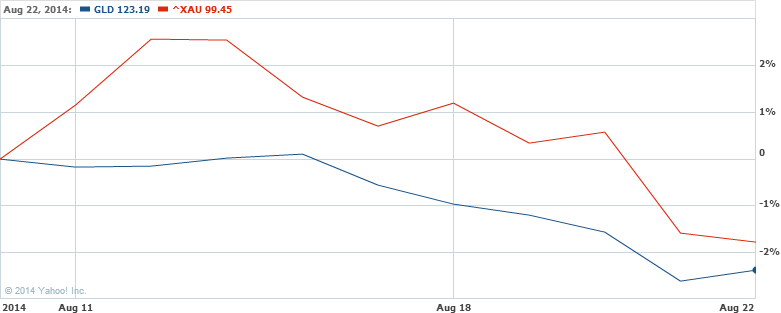

Since our last posting, Gold (GLD) and gold stocks (XAU Index) continue to trade in a range as seen below.
Gold and precious metal stocks continue their long road to nowhere with a minor increase of +1.32% in the SPDR Gold Share (GLD) during the last week.
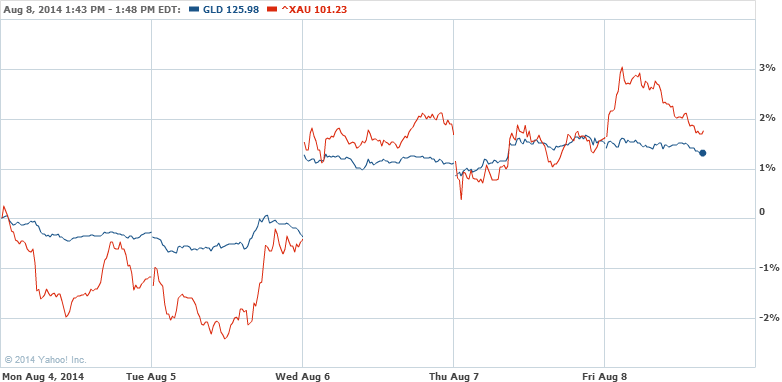
Gold and gold stock continue to remain range-bound as indicated in the chart below.
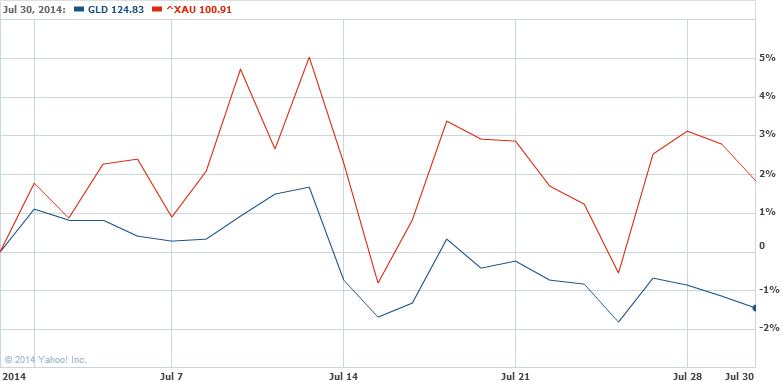
Our Gold Stock Indicator appears to be registering an unprecedented pattern that has not occurred since the inception of the XAU Index.
Gold and gold stocks had a lot of movement this past week but little to show for it.
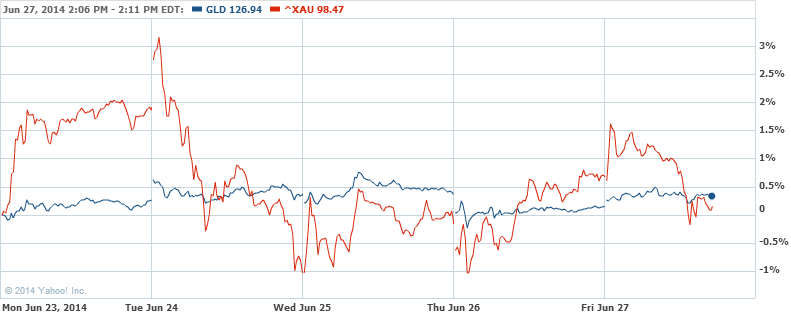
Gold and gold stock continued to climb higher in the last week. The gold ETF (GLD) rose +2.90% in the last five days while the gold stock index (XAU) rose +6%.

The Gold Stock Indicator for the same period shows the critical levels that need to be exceeded on the upside.
Posted in Barron's Gold Mining Index, gold, gold bugs, Gold Stock Indicator, XAU
Tagged members
A big week for gold and gold stocks.
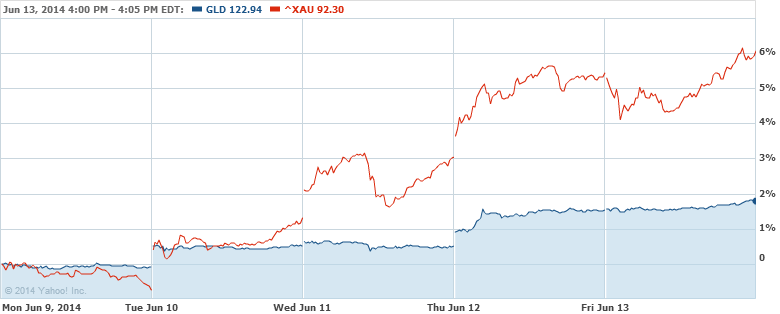
The gold ETF, under the symbol GLD, increased +1.79% while the Philadelphia Gold and Silver Stock Index increased +6%. As a measure of the extreme in performance of gold stocks, Allied Nevada Gold (ANV) increased +22.41% in the last five days. However, the real test of the current market in gold and gold stocks is revealed in the Gold Stock Indicator below.
Gold Stock Indicator Review
On June 7, 2013 (found here), we said the following of gold and gold stocks:
“…the pattern has typically been that when the stock market swoons, so does gold stocks and to a greater degree. If the Dow Jones Industrial Average cannot maintain the current level gold stocks will decline massively.”
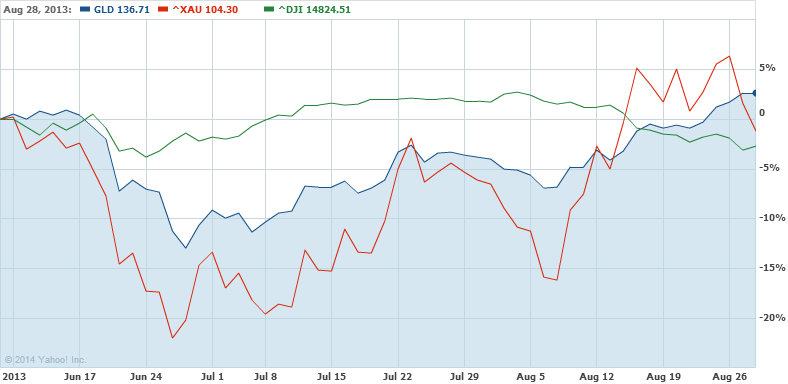
For a brief moment, from June 7, 2013 to June 24, 2013, the Dow Jones Industrial Average declined approximately –3.5%. In the same period of time, the price of gold declined –13% while the XAU gold stock index declined –22%.
On the whole, precious metals investors need to etch the following comments from Charles H. Dow into their mind:
“For the past 25 years the commodity market and the stock market have moved almost exactly together. The index number representing many commodities rose from 88 in 1878 to 120 in 1881. It dropped back to 90 in 1885, rose to 95 in 1891, dropped back to 73 in 1896, and recovered to 90 in 1900. Furthermore, index numbers kept in Europe and applied to quite different commodities had almost exactly the same movement in the same time. It is not necessary to say to anyone familiar with the course of the stock market that this has been exactly the course of stocks in the same period ( source: Dow, Charles. Review and Outlook. Wall Street Journal.February 21, 1901.)”
When Charles Dow speaks of commodities, gold and silver should be included in the category. Accepting this reasoning will provide precious metal investors with the necessary risk planning thought process, hopefully before investing in the sector. Even if the decline in the Dow Industrials does not lead to the decline in gold stocks in every instance, it is better to be prepared for an outcome that occurs a majority of the time.
At the time, our Gold Stock Indicator had the following trend:

Our GSI was at the “stage 3 buy” level and it looked like the upside resistance was to the “stage 2 buy” level. However, we did hold out the possibility that the “stage 4 buy” signal was still on the horizon. The “stage 4 buy” level was indicated on June 26, 2013 in our posting titled “Gold Stock Indicator: Now Is the Time” (found here).
Gold Stock Indicator: June 6, 2014
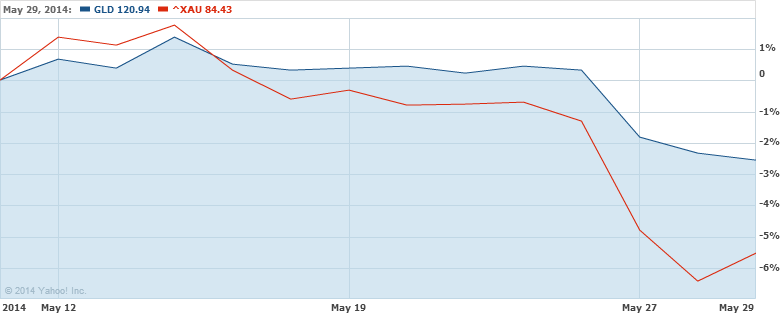
Since May 9, 2014, the gold ETF SPDR Gold Shares has declined –2.55% while the Philadelphia Gold and Silver Stock Index has declined –5.54%.
Below is the charting of the Gold Stock Indicator (GSI) since March 2012.
This week there was a lot of downside action for the price of gold and gold stocks as represented in the chart below.
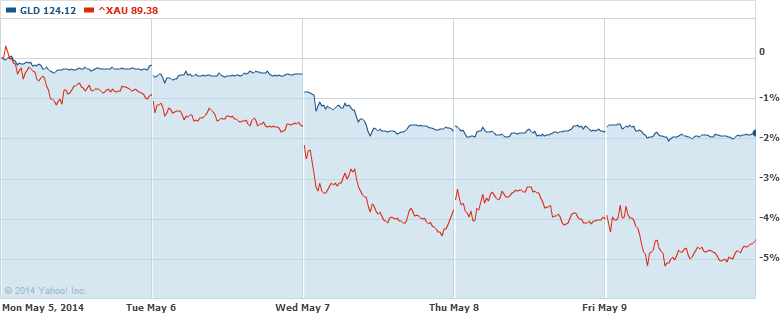
The gold ETF declined –1.86% while gold stocks fell –4.51%. The good news is that gold and gold stocks have traded in a range for the last year. The bad news is that gold and gold stocks cannot seem to break above the previous peaks in that same one year range.
Another trendless week for the price of gold and gold stocks.
Below is the updated XAU Gold Stock Indicator (GSI):
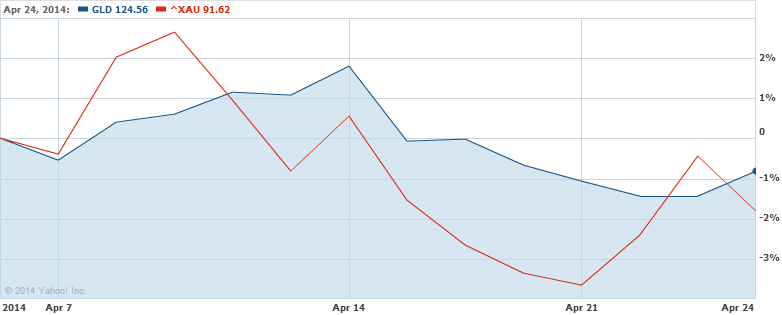
Since April 4, 2014, the price of gold has continued to vacillate in a range of +/- 1%. Likewise, gold stocks have traded in a range of +/- 3%.
Below is the updated XAU Gold Stock Indicator:
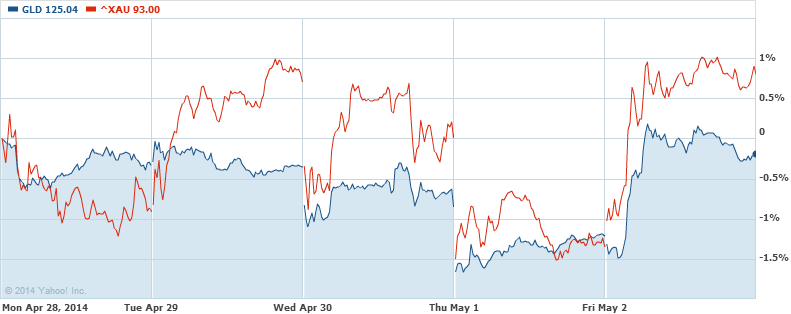
Gold and gold stock continue to trade in a narrow range. This past week, gold increased just over +1% while gold stocks gained +0.82%.
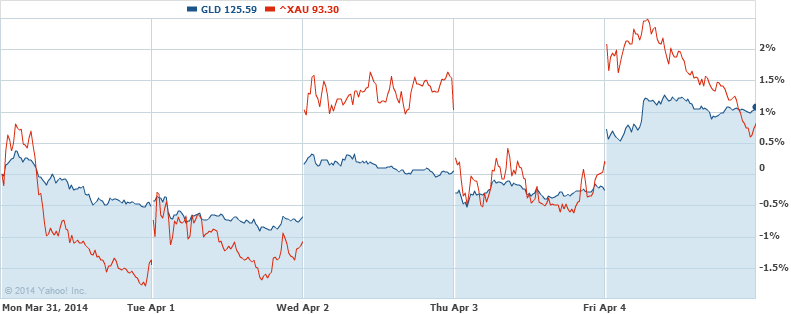
This is the second week in a row of declining gold and gold stocks. The past week saw gold decline –1.86% while gold stocks fell –4.11%.
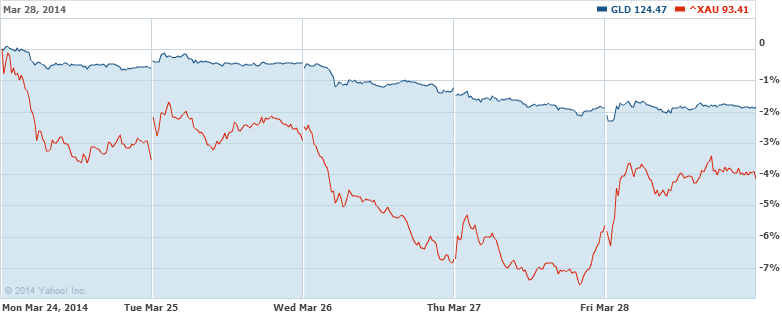
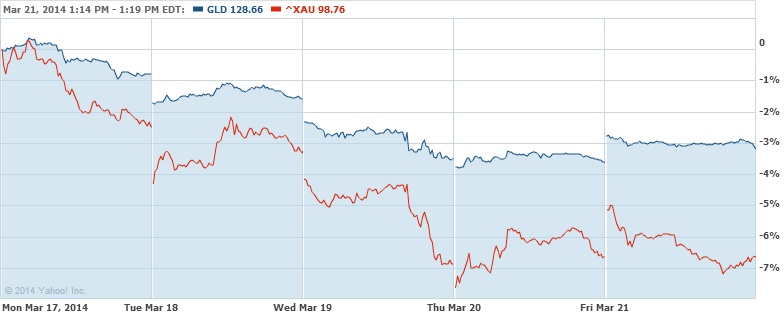
The gold and gold stock market appears to be deflating to more “respectable” levels. Gold as represented by the ETF GLD declined –3.20% while the Philadelphia Gold and Silver Stock Index (XAU) declined –6.65%.
The expected decline has finally arrived. Hopefully, the Gold Stock indicator can declined all the way to the June 2013 low. At which point there should be additional accumulation of gold stocks. Gold stocks are already at what we consider to be significant values compared to the historical “norm” and relative to the general equity market. Any additional declines to prior lows is welcomed.
A reader asks:
“(Barrick Gold Corp) ABX has seen considerable gains since the time of your last two purchases. Have you considered taking profits at this time?”
Our response: