Category Archives: Dogs of the TSX

Canadian Watch List: November 2018

TSX 60 Performance Review

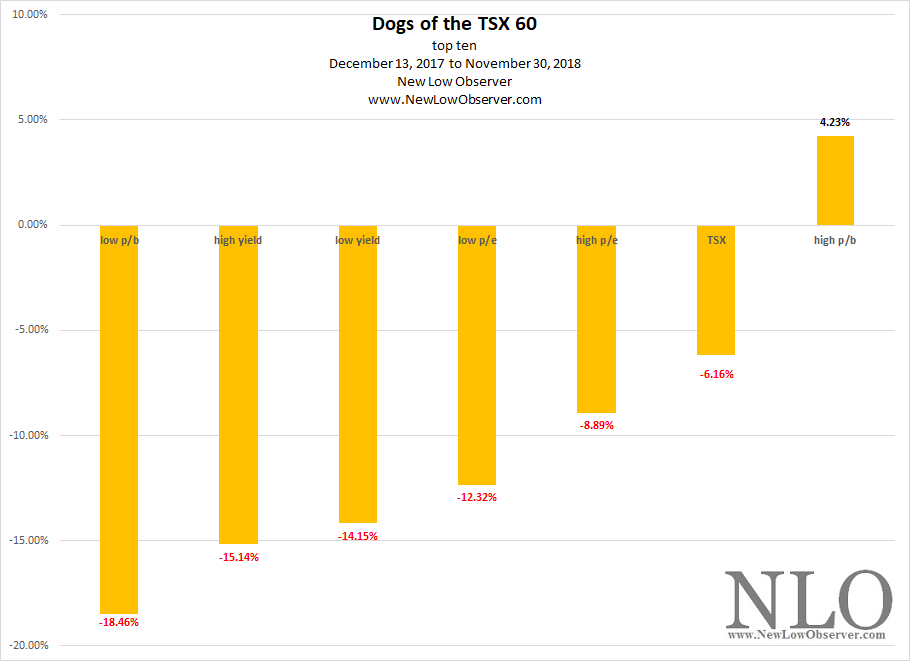
Below is the performance review of the Dogs of the TSX 60 stocks since December 13, 2017:
image

The entire list of stocks in each category has done an about face in terms of performance.  In our previous posting on September 23, 2018, the Toronto Stock Exchange (TSX) was the best performing category.  However, since September 2018, the “high p/b” category has ended up in the plus column while the TSX is now in the negative.

Another curious change is that the “high yield” group is exceeding the “low p/b” and “low p/e” categories but is still unable to exceed the performance of the “low yield” set of stock, as has been the case throughout the year since our December 13, 2017 list was created.

Below is a list of the various stocks within each category and their respective performance since December 13, 2017.

low p/e 12/13/2017 11/30/2108 % chg high p/e 12/13/2017 11/30/2018 % chg
ABX.TO $17.91 $17.03 -4.91% K.TO $5.11 $3.66 -28.38%
POW.TO $32.24 $26.41 -18.08% WPM.TO $27.31 $20.83 -23.73%
ARX.TO $14.77 $9.19 -37.78% DOL.TO $52.75 $34.66 -34.29%
BNS.TO $82.85 $72.22 -12.83% AEM.TO $54.34 $46.11 -15.15%
SLF.TO $52.32 $48.74 -6.84% FNV.TO $98.10 $90.74 -7.50%
CVE.TO $11.92 $9.62 -19.30% QSR.TO $79.31 $77.74 -1.98%
CM.TO $120.19 $110.68 -7.91% AGU.TO merged merged 0.00%
BMO.TO $100.88 $98.43 -2.43% POT.TO merged merged 0.00%
TECK-B.TO $30.68 $26.88 -12.39% BAM-A.TO $56.59 $58.07 2.62%
HSE.TO $16.04 $15.93 -0.69% CSU.TO $780.92 $933.65 19.56%
avg. -12.32% avg. -8.89%
low p/b 12/13/2017 11/30/2108 % chg high p/b 12/13/2017 11/30/2018 % chg
ELD.TO $1.61 $0.75 -53.42% BCE.TO $62.82 $57.09 -9.12%
G.TO $15.66 $12.37 -21.01% FNV.TO $98.10 $90.91 -7.33%
POW.TO $32.24 $26.41 -18.08% SAP.TO $44.83 $40.48 -9.70%
CPG.TO $8.80 $3.86 -56.14% GIL.TO $41.25 $43.73 6.01%
CCO.TO $13.40 $15.86 18.36% QSR.TO $79.31 $77.84 -1.85%
YRI.TO $3.28 $2.81 -14.33% ATD-B.TO $66.90 $69.47 3.84%
CVE.TO $11.92 $11.92 0.00% RCI-B.TO $65.16 $70.72 8.53%
FM.TO $16.55 $12.10 -26.89% CNR.TO $103.45 $114.42 10.60%
TECK-B.TO $30.68 $26.88 -12.39% CP.TO $230.75 $280.96 21.76%
HSE.TO $16.04 $15.93 -0.69% CSU.TO $780.92 $933.65 19.56%
avg. -18.46% avg. 4.23%
low yield 12/13/2017 11/30/2108 % chg high yield 12/13/2017 11/30/2018 % chg
ABX.TO $17.91 $17.03 -4.91% BCE.TO $62.82 $57.09 -9.12%
DOL.TO $52.75 $34.66 -34.29% IPL.TO $27.67 $21.28 -23.09%
G.TO $15.66 $12.35 -21.14% EMA.TO $47.89 $44.53 -7.02%
YRI.TO $3.28 $2.81 -14.33% TRP.TO $62.87 $54.00 -14.11%
ATD-B.TO $66.90 $69.47 3.84% POW.TO $32.24 $26.41 -18.08%
L.TO $68.37 $60.95 -10.85% ENB.TO $49.58 $43.36 -12.55%
FM.TO $16.55 $12.10 -26.89% CPG.TO $8.80 $3.86 -56.14%
TECK-B.TO $30.68 $26.88 -12.39% PPL.TO $45.00 $44.52 -1.07%
ECA.TO $15.11 $9.05 -40.11% T.TO $48.69 $47.57 -2.30%
CSU.TO $780.92 $933.65 19.56% CM.TO $120.19 $110.68 -7.91%
avg. -14.15% avg. -15.14%

Below is the November 2018 Watch List and the 10-Year Targets for Power Corporation of Canada. Continue reading
Dogs of the TSX 60

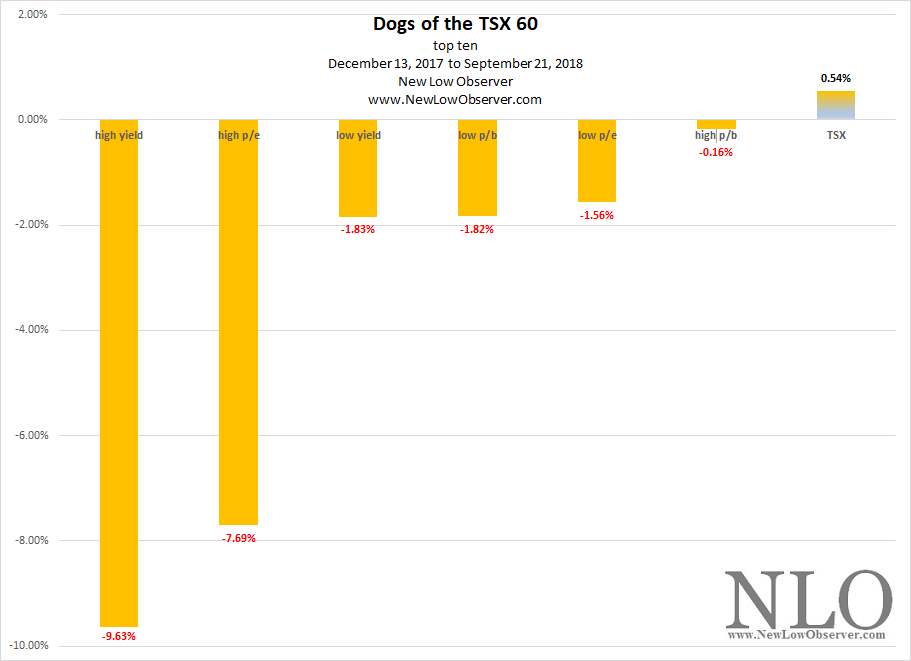
The Dogs of the Toronto Stock Exchange 60 largest market cap stocks is continuing the pattern that we observed with the the highest yielding stocks severely underperforming all other categories.

image

Below is a list of the various stocks within each category and their respective performance since December 13, 2017. Continue reading

Dogs of the TSX 60: March 2018

This is a performance update to the posting done on December 13, 2017 titled “Dogs of the TSX 60” assuming the stocks listed were bought on December 29, 2017.  That post also included the top three stocks for the respective categories on December 29, 2017 in the comment section.

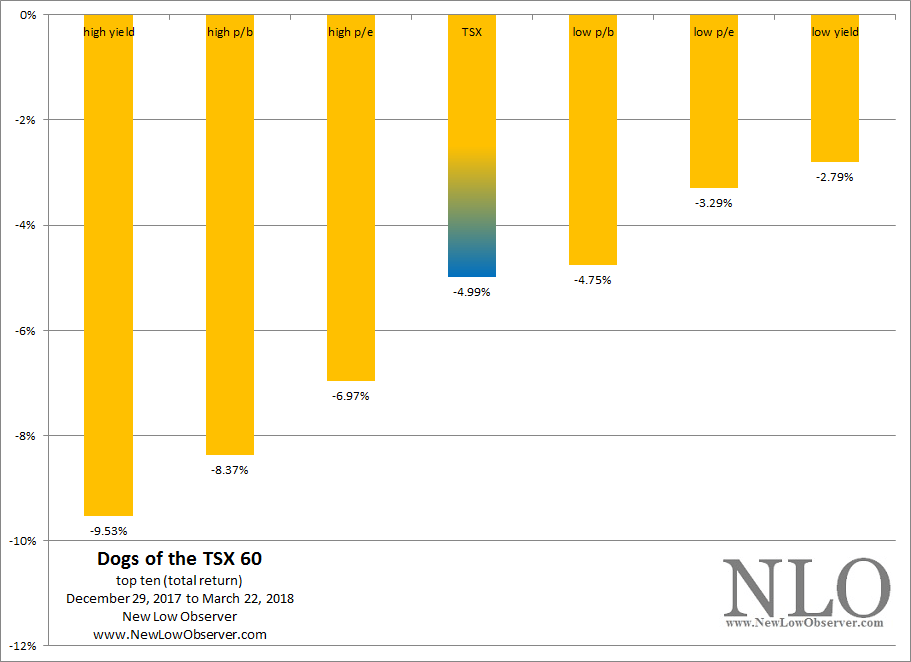
The first performance review is based on the top ten stocks in the respective categories and compared to the Toronto Stock Exchange.

image

This shows that in spite of the popularity of the concept, “selecting the ten highest yielding stocks and holding for a year…,” the performance of the dogs (highest yielding) has been subpar since December 29, 2017.  The categories that have beat the TSX are low price-to-book, low price-to-earnings, and low dividend yield.  This has been consistent since we started running these numbers.  As we said in our review of the July 7, 2016 Canadian Business article titled “Blue chips at a bargain? Meet the 10 ‘Dogs of the TSX’” :

“Note that all of the low categories performed better while all the high categories performed the worst.  This has been borne out in the few Canadian Dividend Watch List performance reviews that we’ve done so far.”

In our February 2018 Canadian Dividend Watch List we said the following:

“If the goal is the beat the performance of the Toronto Stock Exchange then we believe that the consideration of the ‘low yield’ category might be worth considering.”

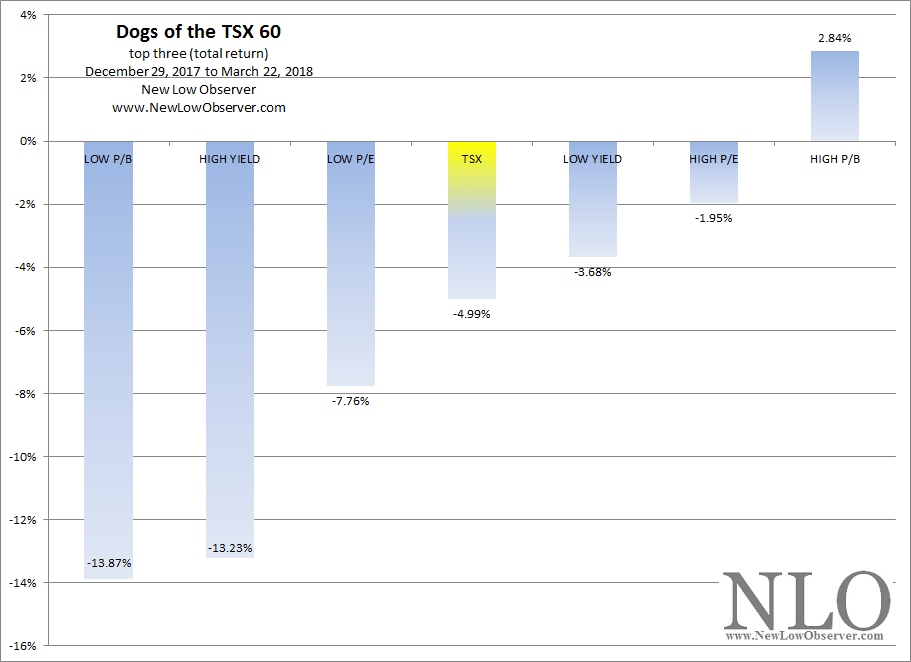
When we look at the top three Canadian Dogs of the TSX 60 from December 29, 2017 to March 22, 2018 (on a total return basis), we find the following performance.

image


Low yield managed to beat the TSX, however, both of the other “low” categories underperformed the TSX.  High p/e and high p/b out-performed the TSX.  However, as we mentioned in the February 2018 posting, we’d opt for the low yield stocks to out-perform the TSX over the remaining year. Again, high yield (dogs of the TSX 60) managed to linger as the worst performing on a consistent basis.

Dogs of the TSX 60

Below is our outline of the stocks that are part of the Toronto Stock Exchange TSX 60 and the rudimentary strategy of selecting the stocks based on the Dogs of the Dow investment approach.

2017 Dogs of TSX

Performance Review

Earlier this year, we did a “2016 Dogs of the TSX” where we outlined the stocks that conformed to the “Dogs of the Dow” strategy based on stocks from the Toronto Stock Exchange.  The Canadian stocks that we reviewed generated the following returns:

  • Category 1: +51.59%
  • Category 2: +12.52%
  • Category 3: +9.71%
  • TSX: +18.51%

This was was a smack down of epic proportions. Category 1 outdistanced all other groups by more than double, this includes the Toronto Stock Exchange gain of +18.51%.  Discerning investors should note the overall fundamental attributes of each category as there are some surprising elements to each.  As an example, Category 1 had the following value attributes at the time:

  • average p/e: 62x
  • average earnings: $0.02
  • average p/b: 0.75
  • average payout ratio: 398%

All is well in a rising market, however, we’ll continue to review the three categories to confirm that returns are consistent regardless of the market conditions.  This means that the TSE Index needs to be in a declining trend for us to confirm the value to the categories that we’ve created.

2017 Dogs of the TSX

Continue reading

2016 Dogs of the TSX

In our most recent article on “Dogs of the Dow: A Look Back at 2015 & Forward to 2016”, we highlighted the stocks that are part of the Dow Jones Industrial Average that “…an investor annually select[s] for investment the ten Dow Jones Industrial Average stocks whose dividend is the highest fraction of their price [dividend yield] (wikipedia).”

Within the context of this concept, picking the ten highest yielding stocks of the Dow Jones Industrial Average, there is an important qualitative element that is implied by using the Dow.  Michael O’Higgins, author of the 1991 book Beating the Dow which outlined the idea later called “Dogs of the Dow”, said the following of the blue chip index:

“As the most popular indicator of market activity, the Dow is itself an influential barometer of the market and economic conditions. Individually, the 30 stocks that make up the Dow industrials are among the most widely held, widely analyzed, and widely publicized in the world. They are also among the biggest and the strongest. Combined, the 30 Dow components have assets of around 2.5 trillion dollars, nearly five million employees, and sales that exceed the gross national product of every country in the world except China, Germany, India, Japan and the United States.

“These prime companies may gain, lose, spin off, acquire, merge, rename themselves, reorganize, even drop out of the Dow, but they are an integral and vital part of our economic system, and in one form or another they are here to stay.

“The Dow companies and their products and services are household names to most people.”

The very fact that the companies from the Dow Industrials is limited to only 30 widely followed companies is what makes the concept “work”.  This strategy for investing gets extremely thin on performance when applied to the S&P 500 or any other “broad” index.  Part of the reason for this is the fact that some companies that are part of the S&P 500 Index aren’t at a “blue chip” status, yet.  Therefore, the whole point of using the Dow Jones Industrial Average is to isolate the best companies to invest in regardless of the market conditions.  Concerns regarding diversification are addressed here.

Understanding the above commentary about why the Dow Industrials are used, we are now going to apply the same concept to three different categories of stocks within the Toronto Stock Exchange Composite Index.

Continue reading