Members
-
Topics
Archives
-
-
Recent Posts
-
-
-
Investor Education
Market Return After Exceptional Years
Dollar Cost Averaging Tool
Dow Theory: The Formation of a Line
Dividend Capture Strategy Analysis
Golden Cross – How Golden Is It?
Debunked – Death Cross
Work Smart, Not Hard
Charles H. Dow, Father of Value Investing
It's All About the Dividends
Dow Theory: Buying in Scales
How to Avoid Losses
When Dividends are Canceled
Cyclical and Secular Markets
Inflation Proof Myth
What is Fair Value?
Issues with P-E Ratios
Beware of Gold Dividends
Gold Standard Myth
Lagging Gold Stocks?
No Sophisticated Investors
Dollar down, Gold up?
Problems with Market Share
Aim for Annualized Returns
Anatomy of Bear Market Trade
Don’t Use Stop Orders
How to Value Earnings
Low Yields, Big Gains
Set Limits, Gain More
Ex-Dividend Dates -
-
Historical Data
1290-1950: Price Index
1670-2012: Inflation Rate
1790-1947: Wholesale Price Cycle
1795-1973: Real Estate Cycle
1800-1965: U.S. Yields
1834-1928: U.S. Stock Index
1835-2019: Booms and Busts
1846-1895: Gold/Silver Value
1853-2019: Recession/Depression Index
1860-1907: Most Active Stock Average
1870-2033: Real Estate Cycles
1871-2020: Market Dividend Yield
1875-1940: St. Louis Rents
1876-1934: Credit-New Dwellings
1896-1925: Inflation-Stocks
1897-2019: Sentiment Index
1900-1903: Dow Theory
1900-1923: Cigars and Cigarettes
1900-2019: Silver/Dow Ratio
1901-2019: YoY DJIA
1903-1907: Dow Theory
1906-1932: Barron's Averages
1907-1910: Dow Theory
1910-1913: Dow Theory
1910-1936: U.S. Real Estate
1910-2016: Union Pacific Corp.
1914-2012: Fed/GDP Ratio
1919-1934: Barron's Industrial Production
1920-1940: Homestake Mining
1921-1939: US Realty
1922-1930: Discount Rate
1924-2001: Gold/Silver Stocks
1927-1937: Borden Co.
1927-1937: National Dairy Products
1927-1937: Union Carbide
1928-1943: Discount Rate
1929-1937: Monsanto Co.
1937-1969: Intelligent Investor
1939-1965: Utility Stocks v. Interest Rates
1941-1967: Texas Pacific Land
1947-1970: Inventory-Sales Ratio
1948-2019: Profits v. DJIA
1949-1970: Dow 600? SRL
1958-1976: Gold Expert
1963-1977: Farmland Values
1971-2018: Nasdaq v. Gold
1971-1974: REIT Crash
1972-1979: REIT Index Crash
1986-2018: Hang Seng Index Cycles
1986-2019: Crude Oil Cycles
1999-2017: Cell Phone Market Share
2008: Transaction History
2010-2021: Bitcoin Cycles -
Interesting Read
Inside a Moneymaking Machine Like No Other
The Fuzzy, Insane Math That's Creating So Many Billion-Dollar Tech Companies
Berkshire Hathaway Shareholder Letters
Forex Investors May Face $1 Billion Loss as Trade Site Vanishes
Why the oil price is falling
How a $600 Million Hedge Fund Disappeared
Hedge Fund Manager Who Remembers 1998 Rout Says Prepare for Pain
Swiss National Bank Starts Negative
Tice: Crash is Coming...Although
More on Edson Gould (PDF)
Schiller's CAPE ratio is wrong
Double-Digit Inflation in the 1970s (PDF)
401k Crisis
Quick Link Archive
Category Archives: Gold Stock Indicator
Gold Stock Indicator: February 2021
Below is a chart of the Gold Stock Indicator as of February 12, 2021: Continue reading
Gold Stock Indicator: October 2018
On April 14, 2011, in our very first attempt at understanding Edson Gould’s Speed Resistance Lines, when the Philadelphia Gold and Silver Stock Index (XAU) was within 6 trading days of the top, we said the following:
“Based on the most recent high of 228.95 the downside target for the XAU index is 76.32. We recommend that whenever the XAU index falls at or below the speed resistance line drawn on the chart, between now and just before 2028, as part of the secular rising trend in interest rates/inflation, we would expect that the stocks in the index are underpriced. Confirmation of fair values should be determined for possible speculative positions at these times.”
The chart below reflects the April 14, 2011 level and the projected downside target and is contrasted with the actual low attained, so far.
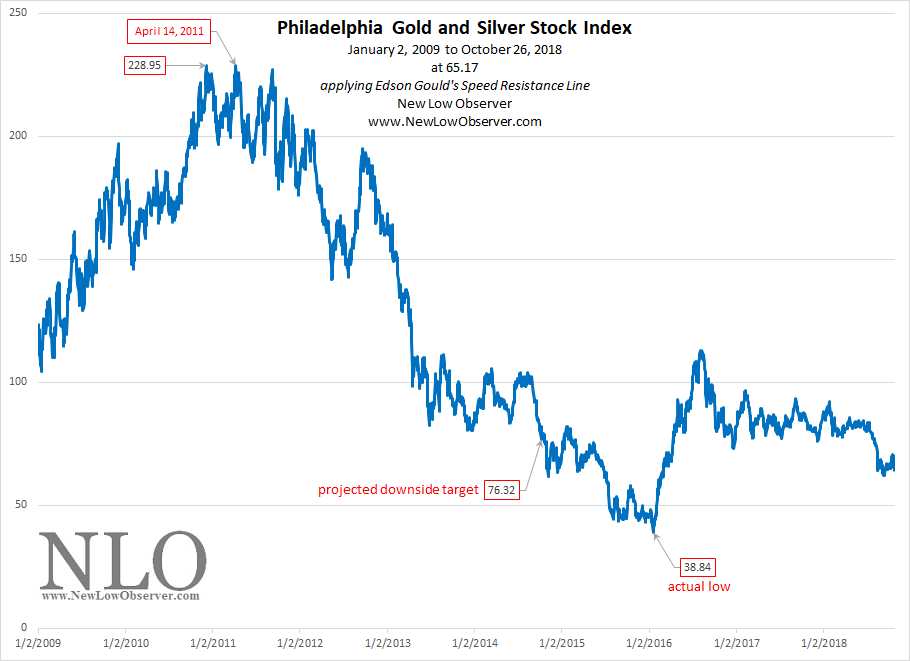
The most obvious failure is the fact that the XAU Index declined to 38.84 instead of the 76.32 level, by early 2016. Additionally, we did not arrive at a timeframe that was useful to traders or investors in gold and silver stocks.
Below, we’re going to use the same methodology of projecting price targets for both the price of gold and the XAU Index. However, in this review, we’ll be focused on what the upside targets are from the current levels.
Let it be known that the downside target for gold is $1,049.40 and for the XAU Index is 38.84, until proven otherwise. We believe a reasonable market participant should be willing to accept that both levels will retest the prior low before moving higher. Continue reading
Gold Stocks: Hedge Free
We have been quoted here on many occasions saying that when the general equity market takes a dive of –10% or more, so too does gold stocks by a greater margin. Our point, gold stocks are not a hedge from general market drops.
In our September 24, 2014 article titled “Gold Stocks: Risks and Remedies” we highlighted the numerous instances from 1939 to 2011 of when the Dow declined by more than -10% and showed how either the Barron’s Gold Mining Index or the Philadelphia Gold & Silver Stock Index declined by a greater percentage.
In the recent decline of the DJIA from January 26, 2018 to February 8, 2018, the index declined –10.36%. So how much did the Philadelphia Gold & Silver Stock Index (XAU) decline? The XAU declined –11.57%.
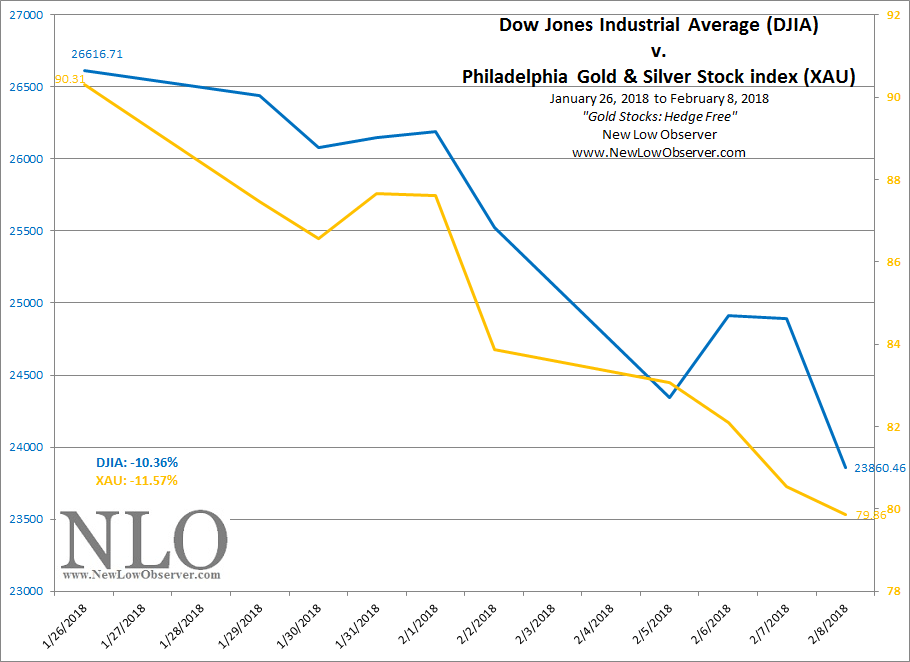
In the chart above, we have excluded the decline of –14.75% from January 24, 2018 to February 9, 2018 in the XAU index. Add this to the growing list of instances of when the DJIA declines more than –10% and gold stocks also decline by a greater percentage.
Posted in DJIA, gold, gold bugs, Gold Stock Indicator, XAU
Gold Stock Indicator: January 2018
On September 17, 2017, we said the following:
“We’re still in the diabolical no-man’s land where, according to Dow Theory, the previous trend (bear market) is in place until proven otherwise.”
The price of gold continues to confound even the most bullish gold analyst. However, as we can see below, it is make-or-break time for the precious metal.
Gold Stock Indicator: December 2017
Below is the updated Gold Stock Indicator as of December 28, 2017:
Gold Stock Indicator: October 2017
Below is the updated Gold Stock Indicator as of October 31, 2017:
Gold Stock Indicator: August 2017
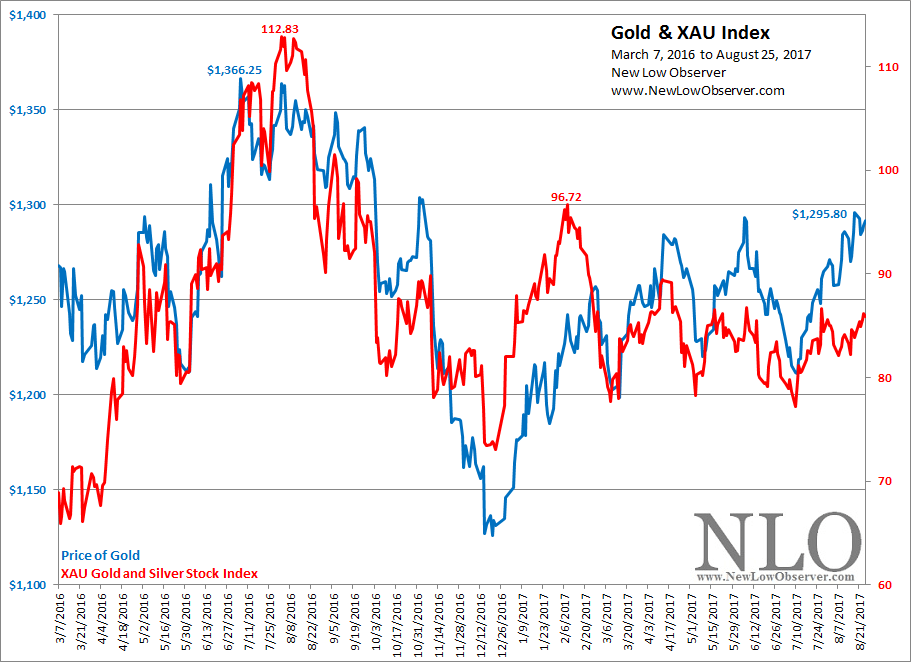
Gold and gold stocks are really dragging it out. There may be a recovery on the horizon but you wouldn’t know it from the lackluster performance in the face of Bitcoin going parabolic and daily geopolitical machinations.
Gold Stock Indicator: May 2017
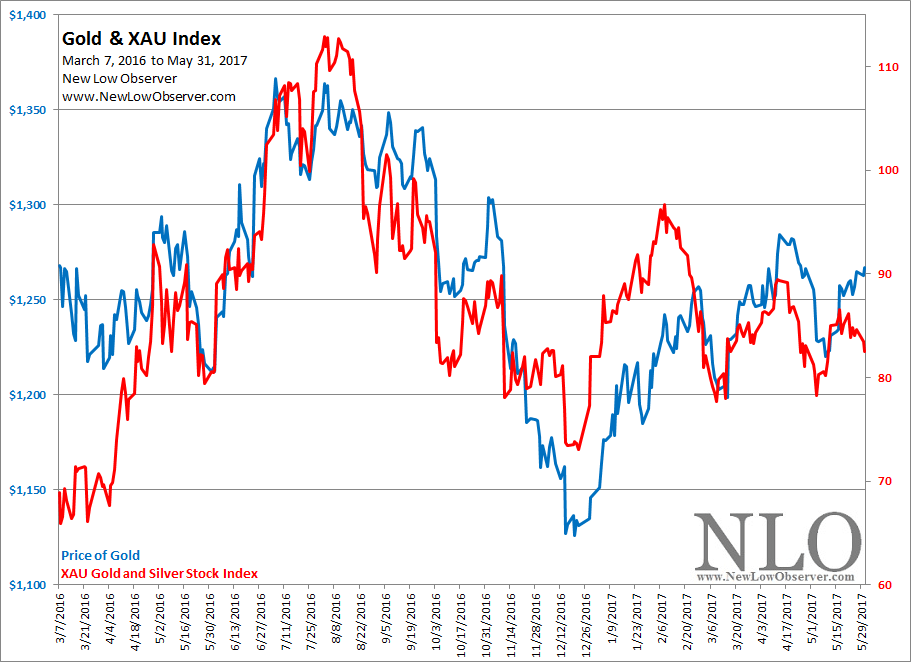
Gold and gold stocks have been treading water since January 2017. While a trading range has been established, there are ominous signs on the horizon.
Are There “Values” in Gold Stocks?
Looking at any analysis of gold stocks, you would think that fundamentals matter. The companies have quarterly reports that reflect operating expenses, pre-tax profits, estimates reserves, sometimes earnings and in rare instances dividends.
However, when it comes to gold stocks, the only thing that matters is the direction in the price of gold. If you believe you know the direction of gold then, by default, you know the direction that gold stocks are headed. All semblance of fundamental analysis is ultimately not relevant to the price of a gold stock, in spite of proven & probable reserves, acquisitions, share buybacks, AISC or claims by the CEO that things are looking up (they rarely, if ever, say the opposite).
Take a look at a comparison between gold and the price of Barrick Gold Corp. (ABX) in the period from October 2003 to April 2017.
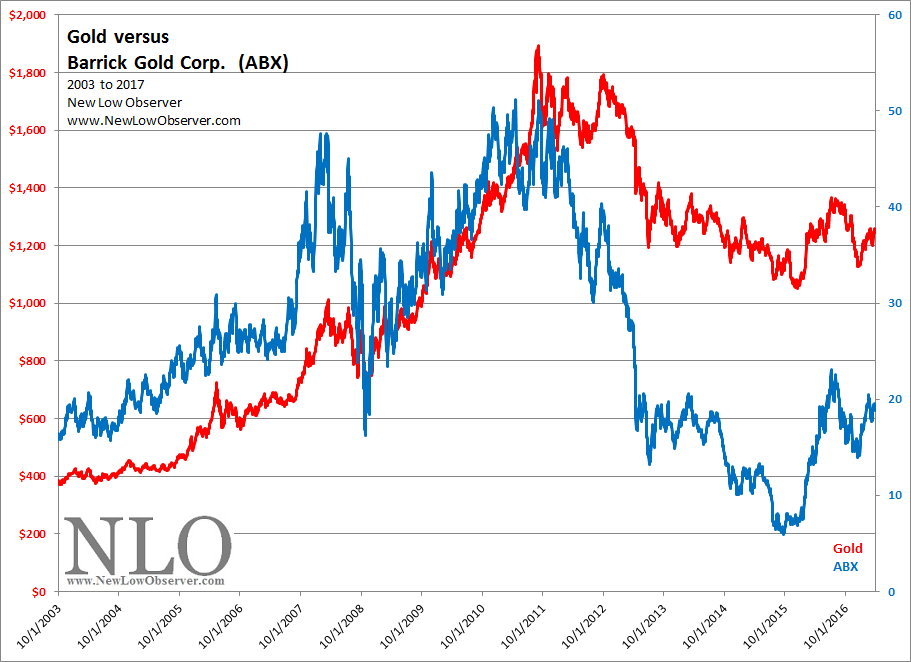
The only distinction to be made between the price of the stock and the price of gold is the magnitude of the direction up or down. If fundamental investing mattered, then at some point there should be some level of divergence in the general direction of gold and gold stocks. This would allow savvy investors to seize on the mispricing of a stock and ride the wave up or down.
For the sake of comparison, look at the difference between corn and Archer Daniels Midland (ADM) over the same period as the ABX and gold review.

In the case of ADM, we can see the areas (blue boxes) where there are distinct divergences between the price of the stock and the price of corn. These are key areas where fundamental values, and basic economics, demonstrate key levels of under/overvaluation. Of course, ADM is not simply a pure play on corn as they’re involved in other agricultural products. However, knowing the industry, pricing, competition and other attributes of the business could give you a distinct advantage as a buyer and seller of ADM stock. This is not the case for gold stocks.
Lest we be called out for being selective in choosing a period that was only in a rising trend, we have included the period from 1983 to 2001 and compared the Philadelphia Gold and Silver Stock Index (XAU) to the price of gold, a time when gold was in a declining trend. In this more expansive period of time, there was only one point in time, January 1986 to July 1986, when there was a material divergence between the price of gold and gold stocks.

It is precisely when there is a material divergence between gold and gold stocks that a fundamental review will reveal the true “value” and therefore warrant contrarian investments (short/long) in the gold stock complex. If a period of divergence isn’t as readily identifiable, as in the ADM example, then you know that what should be examined isn’t the stock but the underlying commodity.
Ultimately, when a well known stock analyst ( or unknown) applies fundamental analysis to a gold stock, you know that you are reading material that is of little or no value in relation to reality.
Posted in Fundamentals, gold, Gold Stock Indicator, junk
Gold SRL
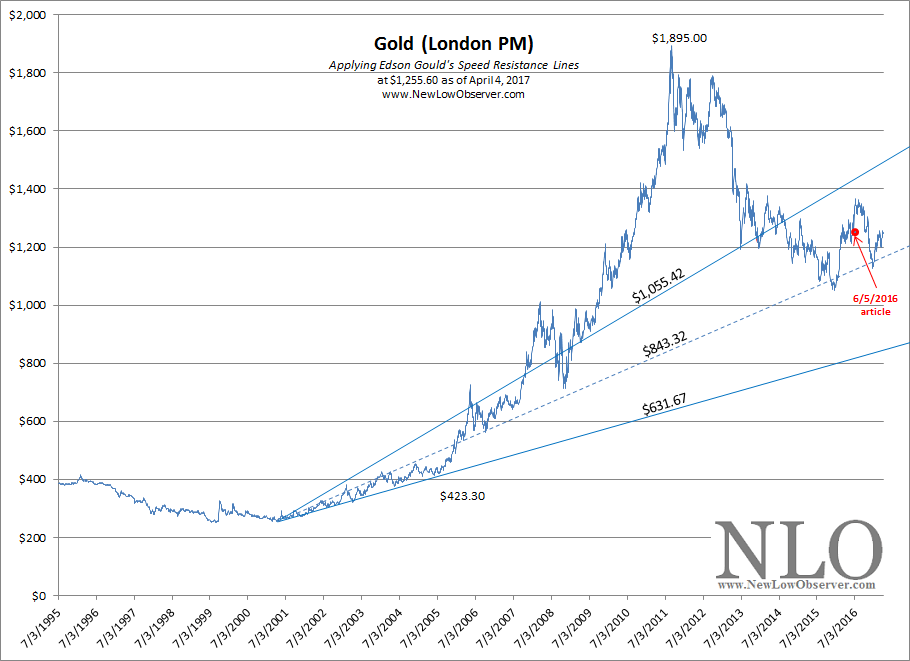
On June 5, 2016, we said the following of gold:
“Upside resistance is at the ascending $1,055.42 level. the current downside move looks to retest the previous move to the ascending $843.32 level.”
Breaking this down, we note where gold was at on June 5, 2016 on the accompanying chart. At the time, gold had come off of a +17% spike in price from the December 17, 2015 low. A run up to the ascending $1,055.42 level would have brought gold as high as $1,400. The best that gold could do on the upside was $1,366.25 before falling back down to the ascending $843.32 level.
Where to Now?
Gold Stock Indicator: March 2017
Performance Review
In the March 2016 posting on the Gold Stock Indicator (GSI), we said the following:
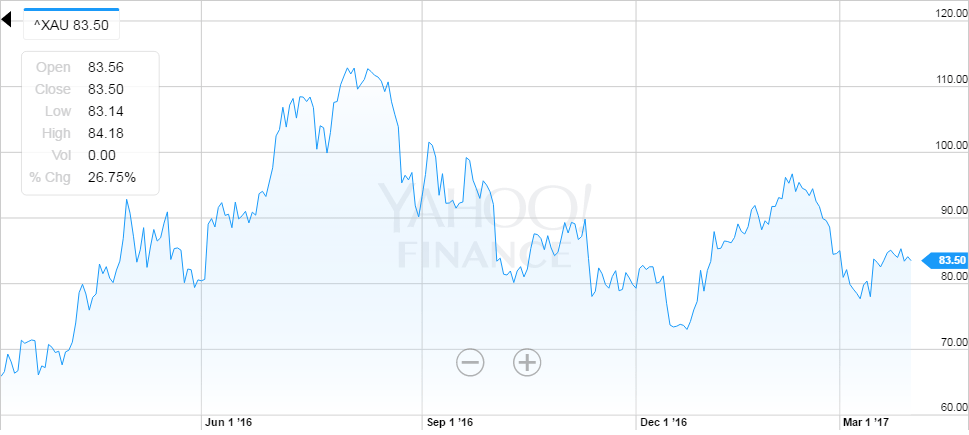
“As long as gold can stay above $1,184.25 and the XAU Index can stay above 57.96, the chances are that a new bull market in gold is in force. Naturally, a decline below the most recent 1-year lows would erase any notion of a bull market in gold. In spite of a decline below 38.84, the XAU Index is at the most extreme in terms of value. With the assumption that the future will see an oversupply of commodities (a further collapse in prices), investors and speculators who are not averse to a high risk portion of their portfolio should consider investment in gold stocks. First time investors in this sector should start with a position in Market Vectors Gold Miners ETF (GDX), and then wait.”
Since that early March 2016 posting, the price of gold stocks (as represented by the XAU Gold and Silver Stock Index) have increased as much as +78.16% while settling at the current level of +26%.
Meanwhile, the Market Vectors Gold Miners ETF (GDX) has ranged as high as +61% while falling as low as –2.21% and currently sits at a gain of +16% since our March 2016 posting.
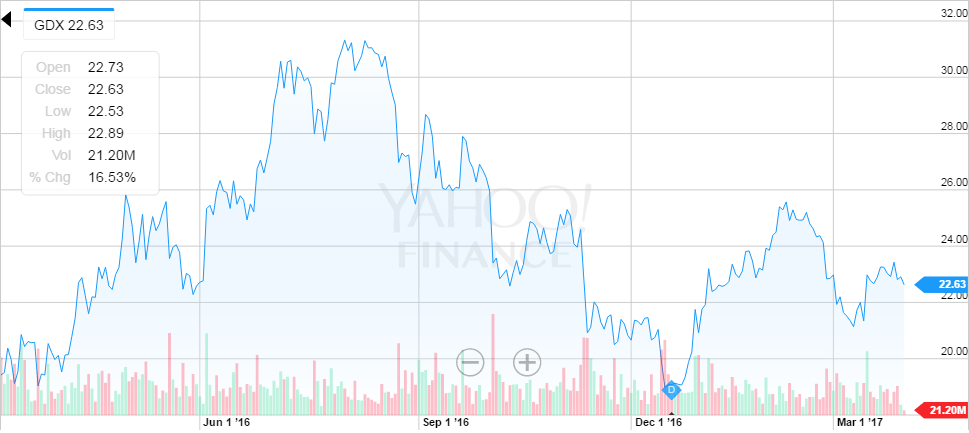
One year later and the tale of the market for gold and gold stocks is told in the chart below.
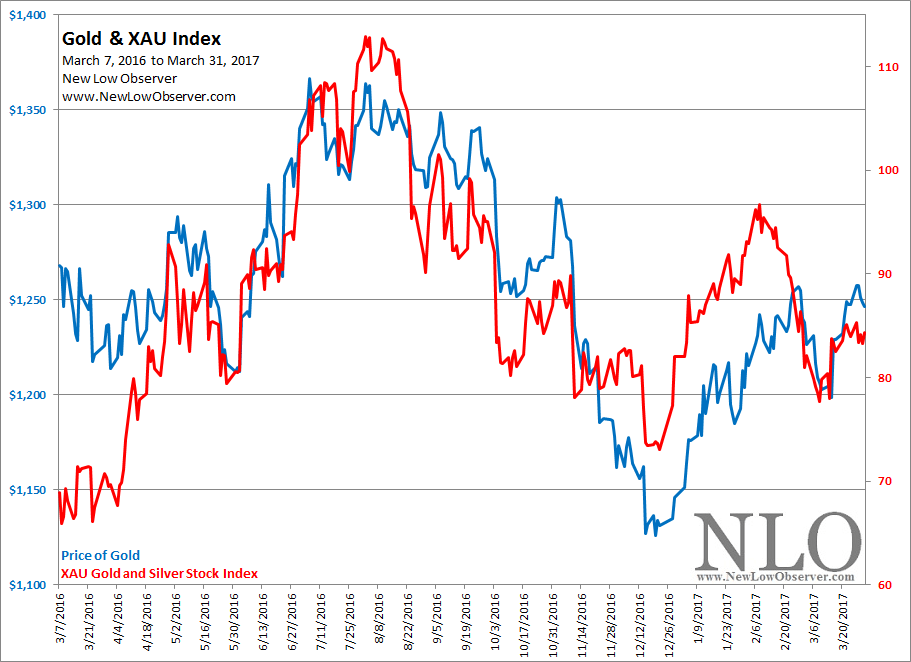
We see that there has been a lot of volatility in the last year but little in the way of change for the price of gold while gold stocks have made some marginal gains. This is where analysis and interpretation are key.
Gold Stock Indicator: February 2017
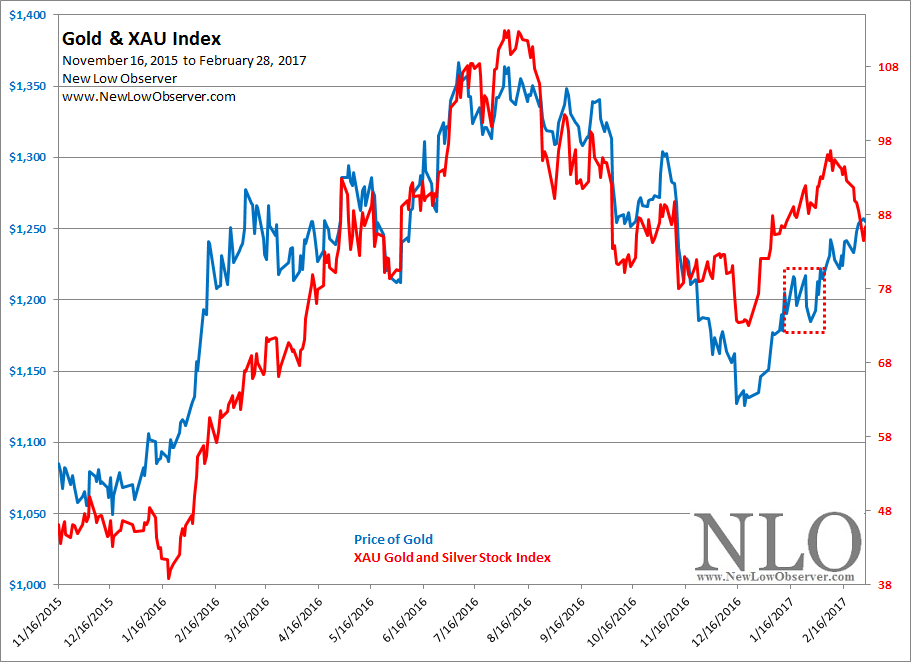
Since our January 2017 posting on gold and precious metals stocks, the price of gold has increased +3.48% while at the same time precious stocks have declined –5.87%. There are some contradictions in the movement of each indicator which we will interpret below.
Gold Stock Indicator: January 2017
Since our last posting on gold and gold stocks (as represented by the Philadelphia Gold and Silver Stock Index [XAU]), the change in price has been +3.28% and +10.64%, respectively.
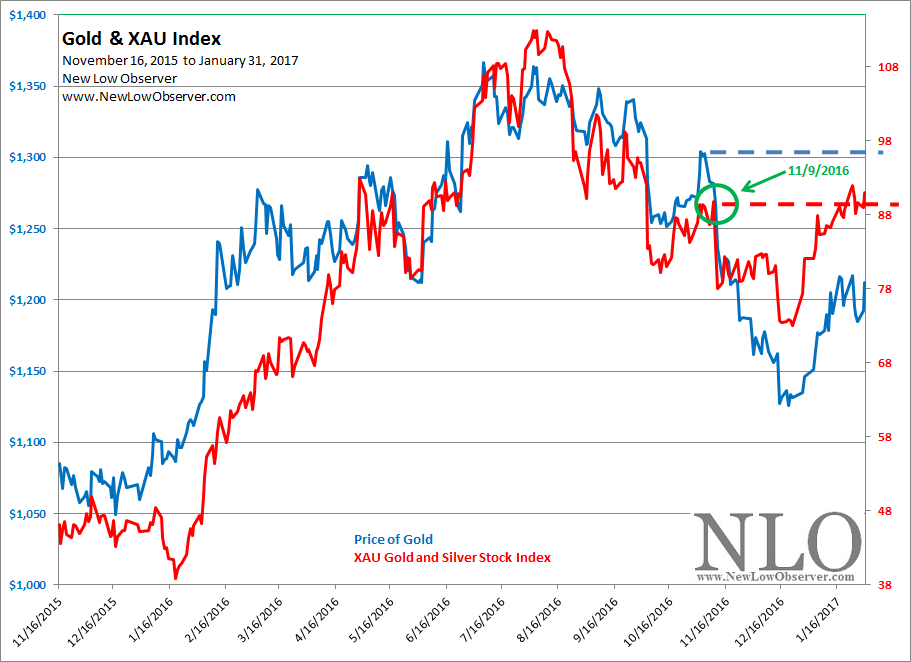
As of the most recent reading, gold stocks are saying something that has yet to be confirmed by the price of gold. With the price of the XAU increasing above 89.83 level set on November 9, 2016, gold stocks are saying that the trend should be higher. Unfortunately, the price of gold needs to confirm the direction as well. As we know, the price of gold typically lags gold and silver stock but in this case the lag is somewhat large.
Gold Stock Indicator: December 2016
After our assessment on gold and gold stocks in October 2016, the price of both have declined but to varying degrees. Gold declined by –7.82% while gold stocks, as represented by the Philadelphia Gold and Silver Stock Index (XAU), fell by –2.91%.