Monthly Archives: May 2012

Carbo Ceramics Altimeter

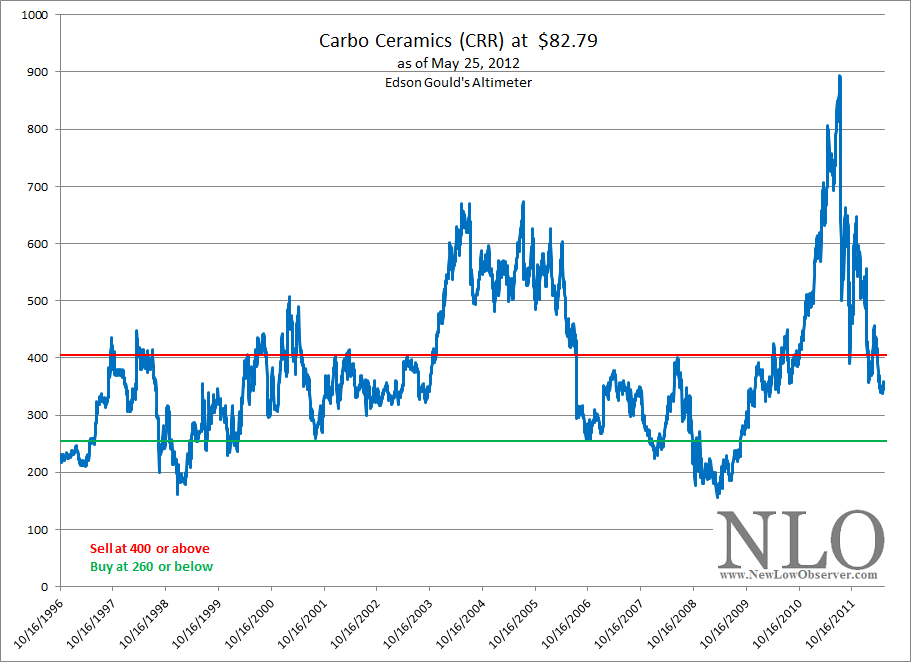
Below is the Altimeter for Carbo Ceramics (CRR) which is ranked number 7 on our May 25, 2012 U.S. Dividend Watch List (found here).  Using Edson Gould’s Altimeter, we have arrived at the conclusion that Carbo Ceramics (CRR) should be bought (green line) any time the Altimeter declines to 260 and below and should be sold (red line) whenever the Altimeter rises to 400 and above.
image

Below is a table which outlines the actual price and date when Carbo Ceramics’ Altimeter rises or falls to the indicated levels.

Date Altimeter level stock price buy/sell % change
6/13/1997 257.40 12.87 buy 59%
10/2/1997 410.80 20.54 sell -41%
8/27/1998 239.00 11.95 buy 67%
4/24/2000 399.60 19.98 sell -22%
8/20/2001 258.33 15.50 buy 56%
1/3/2002 403.00 24.20 sell 27%
10/3/2006 256.16 30.74 buy 82%
6/23/2008 401.50 56.21 sell -21%
10/6/2008 258.35 43.92 buy 65%
4/15/2010 403.55 72.64 sell ????????
???????? 260.00 62.40 buy  

Based on the current dividend for Carbo Ceramics, we have anticipated that the stock price will decline to $62.40 before the next buy indication is triggered.  However, as we’ll describe below, there are some careful considerations of what you give up when deciding to buy Carbo Ceramics based on Edson Gould’s Altimeter.

First, it is important to note that in all except one instance, January 3, 2002, Carbo Ceramics had reasonable gains when a buy indication was triggered and avoided losses when the sell indication was triggered.

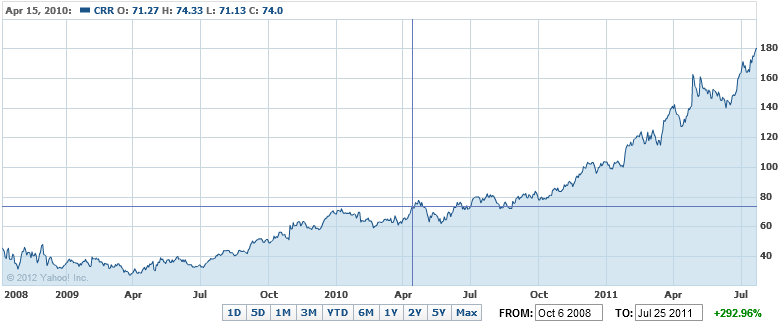
As an example, if you bought in October 6, 2008 and sold on April 15, 2010 (at crosshair below), you only gained 65% and you would have missed the additional 143% rise in the stock’s price, as seen in the following chart:
image

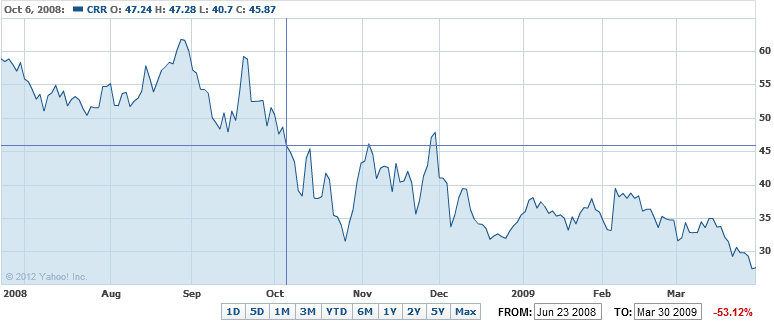
Likewise, the June 23, 2008 sell signal at $56.21 didn’t account for the –53% decline that occurred afterwards.  Instead,  Carbo Ceramics declined -21% from the $56.21 level by the time the next buy signal was indicated on October 6, 2008 (at crosshairs below).
image

So what does all this mean, “buy at the 160 level” and “sell at the 400 level” in the Altimeter?  For the New Low Team, it means that if we can gain an average of +60% in 1-1/2 years with each buy and sell cycle then we will do quite well if we can avoid all of the huge losses, at the expense of missing the huge gains.

Who is Edson Gould?

“Edson Gould spent over 60 years working in and studying financial markets. Gould studied the arts at Princeton, engineering at Lehigh (from where he graduated in 1922), and finance at New York University. In 1922, after working for a short time at Western Electric, he joined Moody’s Investor Service as an analyst and later was editor of Moody’s Stock Survey, Bond Survey, and Advisory Reports. In 1948, he began at Arthur Wiesenberger & Company, where he developed and edited the well-known Wiesenberger Investment Report and became a senior partner. He also was Research Director at E. B. Smith (which later became Smith Barney), and worked for Nuveen.”

(source: Market Technicians Association. Gould, Edson Beers, Knowledge Base. Accessed April 26, 2012. link MTA reference.)

“Market technician Edson Gould always laughed at the idea of having a significant influence on the stock market, but his predictions were the most precise around. He pinpointed major bull markets and prophesied bottom-out markets as if he had his own peephole into the future. But in place of a crystal ball and wacky off-the-cuff schemes, his were smart, intensely researched and time-tested theories that made him a legend in the investment community.”

(source: Fisher, Kenneth L.. 100 Minds That Made the Market. Business Classics, Woodside, CA. 1993. page 320.)

Transaction Review on NUGT, A Simple Lesson Learned

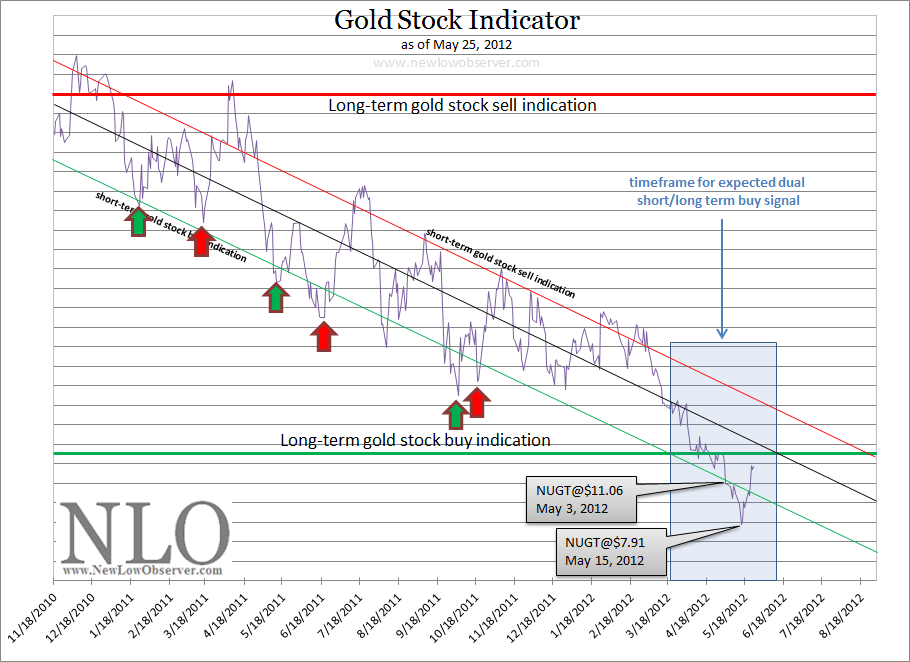
This posting is in response to a great question posted by Sandesh.  On May 25th, Sandesh asked, “Any update on NUGT now that it is recovered?”  The chart below should say it all:

image

Our May 3rd transaction alert (found here) informed readers that we had taken a position in NUGT based on our Gold Stock Indicator falling below both the short and long term buy indications.  In our initial transaction alert, we set the parameters when we would buy more and/or sell our position.  Then, on May 6th, we revised and expanded the parameters to buy and sell (found here), based on our confidence of the indicator and the investment product.

Our revised parameters said the following:

  1. 50% of the amount we wish to invest now (done)
  2. 50% of the amount we wish to invest after a decline of -20%
  3. we’re exiting the transaction after a total loss of -40% or greater
  4. we’re exiting the transaction when the next short-term signal buy DUST is indicated.

We entered NUGT at $11.13.  If we followed our rules, as laid out in our revised parameters, we would have bought more NUGT at $8.96 and sold out of the transaction if the ETF fells as low as $6.65.  Our average gain would have been +13%.  Had we remained in the position without buying additional amounts then we’d have a gain of +3.14%.

We believe that we have learned the lessons from our speculative forays with NUGT.  The first lesson is, “stick to the plan.”  We expect to implement the same parameters in our next transaction for both NUGT or DUST. 

Note: Thanks go to Sandesh for initiating our response.

Our Current Gold Stock Indicator Analysis:

In the chart below, you will notice that in all instances of an initial “short-term buy indication” [green arrow] (except August 8, 2011),  the Gold Stock Indicator was followed by a second opportunity to buy [red arrow] NUGT, sometimes at lower levels.

image

It is important to note that our assessment of a second opportunity to buy NUGT only occurs when the indicator does not immediately go to the short-term gold stock sell indication.  We believe that, due to our Dow Theory indication that the bear market rally has ended (found here), we are on the cusp of a major stock market decline. 

As we’ve stated many times in the past, gold and gold stocks generally cannot move higher in the face of a declining stock market.  Therefore, we believe that gold and gold stocks are enjoying a temporary advance and will ultimately succumb to the forces of general decline in stock market.  Therefore, we’re willing to accept the lesson of our latest NUGT transaction for either the second signal to buy NUGT or the next signal to buy DUST.

Note: In the chart above, we first calculated the expected downside target back in our Feb. 7, 2012 posting (found here).  We’re surprise that, at least for now, that our assessment was correct.  We’re hopeful that our analysis of a “double bottom” is correct as well.

U.S. Dividend Watch List: May 25, 2012

Below are 26 companies on our U.S. Dividend Watch List that are within 11% of their respective 52-week lows. Stocks that appear on our watch lists are not recommendations to buy. Instead, they are the starting point for doing your research and determining the best company to buy. Ideally, a stock that is purchased from this list is done after a considerable decline in the price and rigorous due diligence.

Symbol Name Price % Yr Low P/E EPS (ttm) Dividend Yield Payout Ratio
CHRW C.H. Robinson 59.69 1.63% 22.27 2.68 1.32 2.21% 49%
UNM Unum Group 20.13 2.08% 26.49 0.76 0.42 2.09% 55%
BMO Bank of Montreal 52.99 2.24% 9.41 5.63 2.85 5.38% 51%
NFG National Fuel Gas 43.37 2.65% 17.07 2.54 1.42 3.27% 56%
COP ConocoPhillips 52.11 2.86% 5.69 9.16 2.64 5.07% 29%
TDS TDS 19.89 2.90% 10.41 1.91 0.49 2.46% 26%
CRR Carbo Ceramics 82.79 3.18% 14.71 5.63 0.96 1.16% 17%
WAG Walgreen Co. 31.36 3.36% 10.70 2.93 0.90 2.87% 31%
EXPD Expeditors Int'l 38.47 3.47% 22.24 1.73 0.56 1.46% 32%
TR Tootsie Roll Industries 22.51 4.07% 30.01 0.75 0.32 1.42% 43%
ANAT American Nat'l Insurance 68.95 4.93% 9.70 7.11 3.08 4.47% 43%
MATW Matthews Int'l 30.08 5.29% 12.59 2.39 0.36 1.20% 15%
CWT California Water Service 17.61 5.77% 20.48 0.86 0.63 3.58% 73%
JNJ Johnson & Johnson  62.51 5.81% 17.13 3.65 2.44 3.90% 67%
BDX Becton, Dickinson 74.42 6.94% 13.56 5.49 1.80 2.42% 33%
JW-A John Wiley & Sons 45.01 7.45% 14.29 3.15 0.80 1.78% 25%
NJR New Jersey Resources 42.58 7.53% 14.24 2.99 1.52 3.57% 51%
OMI Owens & Minor, Inc. 27.93 7.96% 15.35 1.82 0.88 3.15% 48%
PG Procter & Gamble Co.  62.49 8.56% 19.17 3.26 2.25 3.60% 69%
AMAT Applied Materials Inc. 10.541 8.66% 10.44 1.01 0.36 3.42% 36%
UTX United Technologies 73.02 9.20% 15.37 4.75 1.92 2.63% 40%
THFF First Financial Corp. 28.61 9.83% 10.52 2.72 0.94 3.29% 35%
PPL PP&L Corporation 27.52 10.08% 9.72 2.83 1.44 5.23% 51%
MSEX Middlesex Water  18.21 10.30% 23.05 0.79 0.74 4.06% 94%
WEYS Weyco Group, Inc.  22.97 10.33% 16.18 1.42 0.68 2.96% 48%
CLX Clorox Co. 69.59 10.36% 17.27 4.03 2.56 3.68% 64%
26 Companies

Watch List Summary

CH Robinson (CHRW) tops our list this week. But we caution against this name as well as the sector because of the Dow Theory trend (indicated here). We briefly stated our case for the Transportation Index in our May 18 Nasdaq Watch List.

ConocoPhillips (COP) rose 4% over the week after the split off their chemical division.  We’d expect the dividend to be relatively safe but we questioned the growth potential of the exploration and production business.  As the resource pool shrinks (oil), more pressure will be placed on the company to build up its reserves.  Morningstar.com placed a fair value at $58 which is 11% above its current price.  More on ConocoPhillips and Phillips 66 in this article.

Carbo Ceramics (CRR) remain under pressure. Its earning estimate for 2012 has been revised downward by Valueline.  They are now expect to earn $6.10 per share versus previously estimated of $7.55.  Fair value however is estimated to be at 20x cash flow per share (CF).  Valueline estimate 2012 Price/Cash Flow to come in around $7.70 which places the fair value at $154.  The Morningstar.com figures show that Carbo Ceramics is currently trading at 17x CF which is about a 10% discount to fair value.

Canadian & American investors should be made aware of Bank of Montreal (BMO), currently #3 on our list, which is featured in the latest edition of Bloomberg Markets article titled "World's Strongest Banks", which says following the say:

"Bank of Montreal (BMO), Canada’s fourth-largest lender, also ramped up its presence in the U.S. by buying Marshall & Ilsley Corp., a Milwaukee-based bank, last year for $4.19 billion. Prior to that, its main U.S. asset had been the small Chicago-based Harris Bank franchise it bought in 1984."

Bank of Montreal's acquisition of Marshall & Ilsley (MI) is significant because MI had a 36-year history of dividend increases before being taken over.  This suggest that BMO has aquired a significant asset at a severely undervalued price.  Even before the financial crisis, we never had much interest in a banking stock.  However, high quality banks like Bank of Hawaii (BOH) and Bank of Montreal (BMO) must be considered at the right price.  Our transaction alerts will tip you off to when we begin our campaign of buying BMO.

Top Five Performance Review

In our ongoing review of the NLO Dividend Watch List, we have taken the top five stocks on our list from May 27, 2011 and have check their performance one year later. The top five companies on that list can be seen in the table below.

Symbol Name 2011 Price 2012 Price % change
HTLF Heartland Financial USA, Inc.  14.09 19.13 35.77%
TGT Target Corp. 49.37 57.62 16.71%
CHFC Chemical Financial Corp.  19.29 20.89 8.29%
ANAT American National Insurance 76.74 68.95 -10.15%
WABC Westamerica BanCorp.  49.87 45.32 -9.12%
Average 8.30%
DJI Dow Jones Industrial 12,441.58 12,454.83 0.11%
SPX S&P 500 1,331.10 1,317.82 -1.00%

NLO_Div_2011.5.27

We highlighted Heartland Financial (HTLF), Target (TGT), and American National Insurance (ANAT).  Our strong conviction in American National didn’t pan out as we expected and the stock fell -10%.  Including the dividend of 4%, the net loss for American National Insurance would be -6%.  Heartland Financial was trading at a 7% discount to its book value but traded up to 1.1x book value.  Target never traded up to 1% yield mark that we anticipated.  However, the gain of +16.7% was greatly appreciated. Ironically, Pershing Square's exit from Target marked the bottom of the stock's price.

Three out of the five companies, Heartland Financial, Target, and Chemical Finance, achieved our goal of +10% within one year.

In the News: May 27, 2012

Why Intel Deserves Another Look at Barron’s

GMCR Director Steps Down; Company Shrinks Board at Barron’s

NetApp Off 13%: FBN Ups to Buy on Cash, Takeout Value at Barron’s

Buybacks Pressuring Investment-Grade Companies at Barron’s

Southwest’s International Adventure Wins Fans at Barron’s

Harry’s Dented ETF To Shut Down at Barron’s

Germany to the Euro: Drop Dead at The Atlantic

'What if Facebook Debuted at $15 and Popped to $35? Nobody Would Complain' at The Atlantic

The Best Way to Tell If People Are Smack-Talking Your Company on Twitter at The Atlantic

The Right Way to Debate Someone on the Internet at The Atlantic

Smack! The BRICs Hit a Wall of Their Own Making at The Atlantic

Why the Internet Makes It Impossible to Stop Giant Wall Street Losses at The Atlantic

Does It Matter Where You Go to College? At The Atlantic

How the Professor Who Fooled Wikipedia Got Caught by Reddit at The Atlantic

The Wacky World of Prices: Rental Cars, Hollywood, and HBO at The Atlantic

Timeshare Prices Plummet to $1 at SmartMoney

Skepticism grows around Medco/Express Scripts deal at Reuters

Without its PBM Partner, Walgreen is a Sell: Citi at Barron’s

JP Morgan to Settle Overdrafting Case at Barron’s

What a Quarter for GMCR! Can it be Repeated? at Barron’s

Facebook gets an “A” in Financial Reporting at Grumpy Old Accountants

Pimco: Foreclosure Deal Cheap for Banks at Bloomberg

I Didn't Tell Facebook I'm Engaged, So Why Is It Asking About My Fiancé? at The Atlantic

IRS to Mom and Pop: Drop Dead at The Atlantic

Why Professional Licenses Are a Barrier to Growth at The Atlantic

Authors of Kindle Singles Are Raking in Tens of Thousands of Dollars at The Atlantic

The 400% Man at Smart Money

The Financial Consequences of Too Many Men at University of Minnesota


Canadian Dividend Watch List: May 25, 2012

This is a list of Canadian dividend stocks that currently, or in the past, had a history of consecutive dividend increases. For those wishing to find the most complete fundamental information on these companies, we recommend visiting one of Canada’s leading financial websites, the Financial Post (found here). However, Yahoo!Finance probably has the better long-term charts and historical dividend data.

Symbol Name Price P/E EPS Price/Book % Chg Low Go to FP
AGF-B.TO AGF Management Limited $11.65 8.97 1.13 0.95 0.95%
SJR-B.TO Shaw Communications, Inc. $19.52 18.86 1.44 2.59 2.90%
IGM.TO IGM Financial Inc. $40.10 12.17 3.45 2.35 3.59%
IAG.TO Indu'l Alliance Insur. and Finan'l Services $25.83 8.58 1.13 0.97 4.36%
TCL-A.TO Transcontinental Inc. $9.76 6.9 0.23 0.67 4.50%
EMP-A.TO Empire Co. Ltd. $56.00 10.24 4.39 1.15 6.54%
BNS.TO The Bank Of Nova Scotia $50.95 11.19 4.74 2.02 7.17%
CCA.TO Cogeco Cable Inc. $45.88 - 0.24 1.95 8.00%
PWF.TO Power Financial Corporation $25.66 11.53 2.53 1.57 8.64%
HCG.TO Home Capital Group Inc. $43.03 7.63 5.74 1.8 8.83%
CWB.TO Canadian Western Bank $26.18 12.64 2.16 1.81 9.08%

Watch List Summary

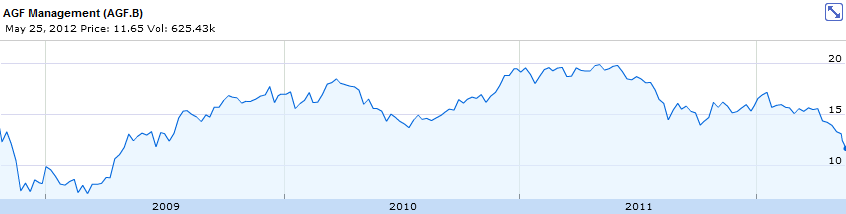
AGF Management (AGF.B): (According to the Financial Post, “AGF Management Limited is a wealth management corporation whose principal subsidiaries provide mutual fund management and distribution, trust products and services, investment advisory services and third-party fund administration services for clients.”

AGF is skating on thin ice with a dividend payout ratio of 94%.  This means that if the company were to experience any decline in earnings (likely) then there is the prospect of the company cutting the dividend.  Currently, AGF has a dividend yield of 9.30% which suggests that a dividend cut isn’t too far away if things don’t improve soon.

Currently, $11.13 is the point that will either make or break the stock price. If AGF.B cannot stay above $11.13 then there is a good chance that the stock will revisit the prior low of $6.46, a decline of –42%.  According to Dow Theory, AGF has the following downside targets:

  • $11.13
  • $9.58
  • $8.03
  • $6.46

image

Industrial Alliance Insurance and Financial Services (IAG.TO):  According to Yahoo!Finance, IAG.TO is “a life and health insurance company, [which] engages in the provision of various insurance products, savings and retirement plans, and other financial products and services in the United States and Canada.”

IAG.TO has a dividend yield of 3.80% and a payout ratio of 89%.  Again, with such a narrow margin of safety, in terms of the dividend payout ratio, investors should not be surprised if a dividend cut were to take place.   According to Dow Theory, IAG.TO has the following downside targets:

  • $32.55
  • $23.20
  • $13.85

With IAG.TO trading at $25.83, the $23.20 price is a critical support level for the stock.  This stock would be considered for purchase by us when, and if, it reaches the $18.50 level.  According to Dow Theory, IAG.TO has a fair value of $27.87.

Watch List Performance Review

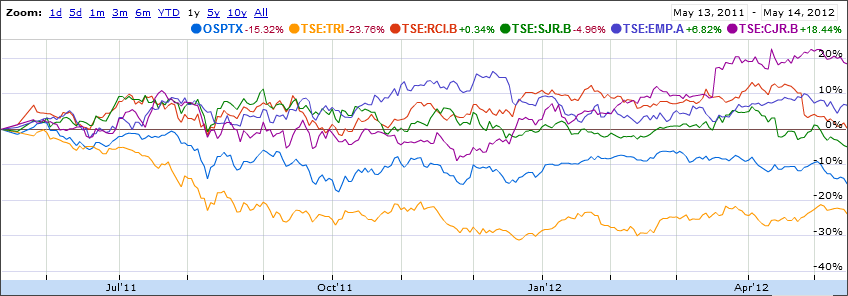
In our ongoing review of the NLO Canadian Dividend Watch List, we have taken the top five stocks from our May 13, 2011 list (found here) and have checked their performance, approximately one year later, as compared to the S&P/TSX Composite index. The top five companies from that list can be seen in the table below.

Symbol
Name 2011 2012 % change
TRI Thomson Reuters 37.78 28.51 -24.54%
RCI.B Rogers Comm. 35.82 35.5 -0.89%
SJR.B Shaw Comm. 20 19.11 -4.45%
EMP.A Empire Co. Ltd. 54.45 57.83 6.21%
CJR.B Corus Ent. Inc. 20.44 23.64 15.66%
      Average: -1.60%
         
S&P/TSX Toronto Stock Exchange     -15.32%

image

While our watch list was in the negative at the end of the year, it did well compared to the Toronto Stock Exchange over the same period.  In fact, 4 of the five stocks on our list were able to achieve our goal of gains of +10% in less than 6 months.

NetApp: Dow Theory Gets It Right

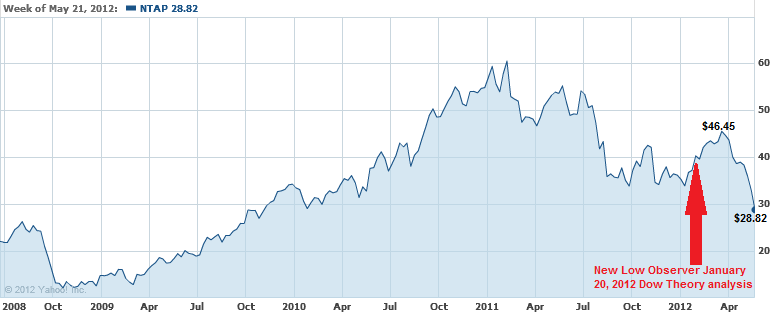
On May 24, 2012, NetApp (NTAP) was hammered down –12.29% after it was announced that the company forecasted lower earnings.  The decline of NetApp comes as no surprise to us as we ran our analysis of the company in our January 20, 2012 Nasdaq 100 Watch List (found here).  In our Dow Theory analysis of NTAP, we said the following:

“According to Dow Theory, the current downside targets are $28.02, $22.52 and $17.02. Based on the current price of $36.85, NTAP could fall by 53% in the worst case scenario. According to Dow Theory, NTAP has upside targets of $44.52, $50.02 and $55.52.

The Punchline: After a 39% decline in price, NetApp (NTAP) is a prime candidate for a two transaction purchase. The first purchase should take place starting at $30. The second purchase should take place around $23.47. Based on the market capitalization, NTAP may actually be a buyout candidate.”

Dow Theory set accurate parameters for the upside and downside targets.  After our January 20, 2012 posting, NTAP rose as high as $46.45 and has retrenched as low as the current closing price of $28.82.  Although we said that NTAP is a buy at prices below $30, as indicated above, our macro view on the markets are negative at the present time as found in our May 19, 2012 (found here) Dow Theory analysis.

image

It appears that NTAP will easily achieve the Dow Theory downside target of $22.52 and may achieve a rebound at the $20 level.  However, because Dow Theory suggests that the overall market will decline further, we believe that the first purchase of NTAP could reasonably take place at $22.52 or below, instead of $30 or below.

We will reassess NTAP in terms of the general market when, and if, the price declines to the $22.52 price.

Nasdaq 100 Watch List: May 18, 2012

Below are the Nasdaq 100 companies that are within 10% of their respective 52-week lows. Stocks that appear on our watch lists are not recommendations to buy. Instead, they are the starting point for doing your research and determining the best company to buy. Ideally, a stock that is purchased from this list is done after a considerable decline in the price and rigorous due diligence.

Symbol Name Price P/E EPS Yield Price/Book % from Low
FSLR First Solar, Inc. 13.66 - -7.01 0 0.4 0.08%
GMCR Green Mountain Coffee 24.05 11.56 2.08 0 1.74 0.17%
CHRW CH Robinson Worldwide 58.88 21.96 2.68 2.2 7.78 0.26%
EXPD Expeditors Int'l of Washington 37.32 21.57 1.73 1.5 3.8 0.38%
SYMC Symantec Corporation 14.74 9.39 1.57 0 2.12 0.41%
CTRP Ctrip.com International Ltd. 18.91 18.01 1.05 0 2.59 0.53%
SNDK SanDisk Corp. 31.52 8.81 3.58 0 1.12 0.59%
WYNN Wynn Resorts Ltd. 101.94 21.62 4.72 2 46.03 0.91%
RIMM Research In Motion Limited 10.99 4.95 2.22 0 0.58 0.92%
INFY Infosys Ltd. 42.87 14.29 3 1.3 3.69 0.97%
NTAP NetApp, Inc. 33.06 22.01 1.5 0 3.07 0.98%
FOSL Fossil, Inc. 70.28 14.99 4.69 0 3.9 1.02%
EA Electronic Arts Inc. 14.1 61.3 0.23 0 1.91 1.95%
APOL Apollo Group Inc. 32.02 6.97 4.6 0 3.54 3.52%
ORCL Oracle Corporation 25.61 13.42 1.91 0.9 3.05 3.60%
MCHP Microchip Technology Inc. 30.49 18.48 1.65 4.5 3 4.06%
VMED Virgin Media, Inc. 21.48 53.17 0.4 0.7 7.83 4.68%
GOLD Randgold Resources Limited 76.45 16.63 4.6 0.5 3.06 4.86%
NVDA NVIDIA Corporation 12.08 14.75 0.82 0 1.82 5.32%
AMAT Applied Materials Inc. 10.36 10.23 1.01 3.5 1.55 6.80%
VOD Vodafone Group plc 26.1 12.08 2.16 3.6 1.01 7.36%
LRCX Lam Research Corporation 37.57 16.62 2.26 0 1.73 7.93%
ALTR Altera Corp. 33.23 16.45 2.02 1 3.46 9.35%
SPLS Staples, Inc. 13.07 9.39 1.39 3.3 1.29 9.46%

Watch List Summary

We’d like to address the first four companies on our list with a rating of AVOID or SELL for the following reasons:

  • First Solar (FSLR):  We never believed in the attributes of the solar industry despite all the claimed benefits to the environment.  If a detailed examination of the solar industry was done for the period of 1970 to 1980, you would find that the reasons for the lack of success then is re-emerging today.  FSLR might be a great speculation, however, anyone wishing to buy the stock should be willing to accept 100% loss or avoid the stock altogether.  As was the case in the 1970’s, the “top tier” solar companies will probably get acquired by the major oil companies.  However, the timing of such an acquisition is too difficult for us to predict.  Therefore, the safest postures is to assume more downside risk with little sustainable upside opportunity.
  • Green Mountain Coffee Roasters (GMCR):  We’ve had a history of calculating the downside risk associated with GMCR.  On October 25, 2011 (found here), we published Edson Gould’s Speed Resistance Lines [SRL] which indicated that the downside risk for the stock was between $59.93 and $37.21 (at the time GMCR was trading at $64.75).  In that same posting we said that if GMCR were to fall below $37.21, then the next downside target is the absurdly low level of $3.  Even if $3 is never achieved, falling from the current price of $24.05 to $12.02 is too much pain to accept.
  • C.H. Robinson (CHRW) and Expeditors International of Washington (EXPD): Our recent Dow Theory (found here) indication pointing to an end to the bear market rally with the joint decline of the Dow Jones Industrial Average and Dow Jones Transportation Average means that large declines may lie ahead.  Since the Transportation Index has led the way up, it stand to reason, and experience, that the index will lead the way down.  We believe that CHRW and EXPD are in for more pain and faster than most other stocks because they are in the business of freight forwarding and logistics.

Companies that we’re excited to see on our watch list are as follows:

  • Microchip Technology (MCHP):  Microchip Technology first appeared on our watch list on March 20, 2010 (found here) at the price of $28.25.  Afterwards, MCHP rose as high as $41 by May 10, 2011.  On July 15, 2011, after the stock declined nearly -22% from the high, we suggested that MCHP would be too hard to ignore at such a high dividend yield. This recommendation was within 9% of the current 1-year low.  We will become serial acquirers of MCHP as the stock price declines further.
  • Applied Materials (AMAT), NVIDIA (NVDA), Altera (ALTR):   These chip stocks are runners-up in the chip stock sweepstakes.  We feels that accumulating of chip stocks with high ROA, ROE, profit margins, operating margins and low debt will prove highly profitable in both the intermediate and long term.

Watch List Performance Review

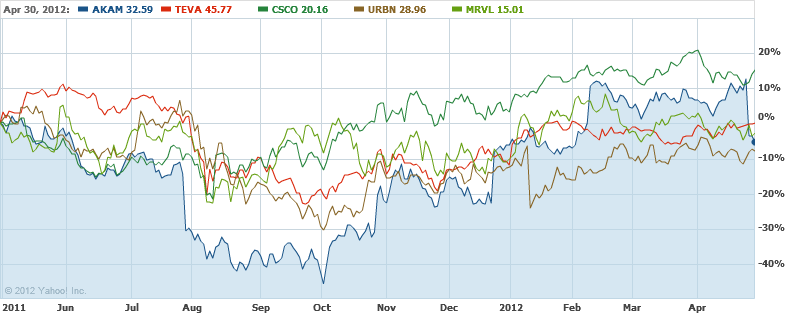
In our ongoing review of the NLO Nasdaq 100 Watch List, we have taken the top five stocks on our list from April 29, 2011 and have check their performance one year later. The top five companies on that list can be seen in the table below.

Symbol Apr-11 Apr-12 change
AKAM 34.43 32.59 -5.34%
TEVA 45.73 45.77 0.09%
CSCO 17.52 20.16 15.07%
URBN 31.47 28.96 -7.98%
MRVL 15.43 15.01 -2.72%
    Average -0.18%
       
Nasdaq 100     15.31%

image

No two ways about it, the stocks on our watch list got hammered big time.  The Nasdaq 100 index gained 15.31% while our top five stocks went nowhere.  However, three of the five stocks our goal of at least 10% within a year.  TEVA gained 10% in the first month before declining –20%.  CSCO gained +10% in six months while AKAM gained +10% in 9 months.

U.S. Dividend Watch List: May 18, 2012

Watch List Summary

The stock market seems to be in a full bear mode now that the Dow and the Transport have breached its recent low. Despite better than expected housing starts and industrial production, the market fell for a 3rd week. The biggest internet IPO, Facebook (FB), couldn’t spur more buying on Friday. As such, our watch list expanded to include 35 companies that are within 11% of the low.

With current market re-entering bear mode, there is still investment values to be had. We keep going back to Walgreen (WAG) for the same reasons, its risk/reward profile is at historic low levels. The stock is trading just 3.2% above the low and $3o appears to be a good support level. The dividend payout ratio of 31% provides margin of safety of 69% against a decline in earnings. Our most conservative analysis puts fair value at the  $29.90.

A company that we haven’t seen in a while is Air Product & Chemicals (APD). We recommended the stock on September 29, 2008 (found here) after the stock sustained a decline of -42% from the 2008 high.  The specialty chemical company is estimated to be undervalue at 3.30%. We are willing to say that APD is undervalue at the current yield of 3.29%.  The payout ratio of 46% and estimated growth rate of 14% give us a hint that APD could be a great buy when the market makes a turn.

United Technologies (UTX) fell 16% since mid March. The stock has a strong support at $68 level but this cyclical name may have more downside to go if we at the beginning of the bear market. Based on IQ Trend, the current yield of 2.65% suggest that the company is undervalue.

Fore more detail on companies such as ConocoPhillips (COP), Carbo Ceramics (CRR), and Johnson & Johnson (JNJ), please refer to our May 4 post.

Below are the 35 companies that meet our criteria and are within 11% of the 52-week low:

Symbol Name Price % Yr Low P/E EPS (ttm) Dividend Yield Payout Ratio
COP ConocoPhillips 50.82 0.32% 5.55 9.16 2.64 5.19% 29%
EXPD Expeditors International 37.32 0.38% 21.57 1.73 0.56 1.50% 32%
NFG National Fuel Gas Co. 42.79 0.15% 16.85 2.54 1.42 3.32% 56%
CHRW C.H. Robinson Worldwide  58.88 0.26% 21.97 2.68 1.32 2.24% 49%
UNM Unum Group 19.9 0.91% 26.18 0.76 0.42 2.11% 55%
CRR Carbo Ceramics, Inc. 81.05 1.01% 14.40 5.63 0.96 1.18% 17%
ANAT American National Insurance 67.63 2.92% 9.51 7.11 3.08 4.55% 43%
WAG Walgreen Co. 31.31 3.20% 10.69 2.93 0.90 2.87% 31%
TR Tootsie Roll Inc.  22.39 3.51% 29.85 0.75 0.32 1.43% 43%
TDS TDS 20.05 3.72% 10.50 1.91 0.49 2.44% 26%
BMO Bank of Montreal 53.96 4.11% 9.85 5.48 2.85 5.28% 52%
JW-A John Wiley & Sons Inc. 43.75 4.44% 13.89 3.15 0.80 1.83% 25%
MATW Matthews Int'l Corp. 29.85 4.48% 12.49 2.39 0.36 1.21% 15%
CWT California Water Service 17.47 4.92% 20.31 0.86 0.63 3.61% 73%
BDX Becton, Dickinson 74.19 6.61% 13.51 5.49 1.80 2.43% 33%
OMI Owens & Minor, Inc. 27.64 6.84% 15.19 1.82 0.88 3.18% 48%
JNJ Johnson & Johnson  63.35 7.23% 17.36 3.65 2.44 3.85% 67%
CLX Clorox Co. 67.64 7.26% 16.78 4.03 2.56 3.78% 64%
APD Air Products & Chemicals 77.81 7.68% 13.99 5.56 2.56 3.29% 46%
LM Legg Mason, Inc.  24.11 7.83% 15.66 1.54 0.44 1.82% 29%
UTX United Technologies Corp. 72.38 8.24% 15.24 4.75 1.92 2.65% 40%
NJR New Jersey Resources 42.9 8.33% 14.35 2.99 1.52 3.54% 51%
THFF First Financial Corp. 28.27 8.52% 10.39 2.72 0.94 3.33% 35%
SYY Sysco Corp. 27.26 8.65% 13.98 1.95 1.08 3.96% 55%
PPL PP&L Corporation 27.19 8.76% 9.61 2.83 1.44 5.30% 51%
TMP Tompkins Financial Corp. 36.36 8.96% 11.73 3.1 1.44 3.96% 46%
MSEX Middlesex Water Co.  18 9.02% 22.78 0.79 0.74 4.11% 94%
CAH Cardinal Health, Inc.  40.96 9.14% 13.88 2.95 0.95 2.32% 32%
AROW Arrow Financial Corp.  23.54 9.49% 12.59 1.87 1.00 4.25% 53%
WGL WGL Holdings, Inc. 38.15 9.91% 20.29 1.88 1.60 4.19% 85%
BMS Bemis Co Inc 29.91 9.92% 17.80 1.68 1.00 3.34% 60%
UNS UniSource Energy Corp. 36.24 9.95% 13.94 2.6 1.72 4.75% 66%
PG Procter & Gamble Co.  63.52 10.35% 19.48 3.26 2.25 3.54% 69%
WEYS Weyco Group, Inc.  22.98 10.37% 16.18 1.42 0.68 2.96% 48%
SJI South Jersey Industries 47.34 10.48% 15.52 3.05 1.61 3.40% 53%
35 Companies

Top Five Performance Review

In our ongoing review of the NLO Dividend Watch List, we have taken the top five stocks on our list from May 18, 2011 (not published) and have check their performance one year later. The top five companies on that list can be seen in the table below.

Symbol Name 2011 Price 2012 Price % change
HHS Harte-Hanks, Inc. 8.44 8.57 1.54%
SJW SJW Corp. 22.17 23.30 5.10%
WEYS Weyco Group, Inc.  22.75 22.98 1.01%
TGT Target Corp. 49.69 55.46 11.61%
WABC Westamerica BanCorp.  49.82 44.22 -11.24%
Average 1.60%
DJI Dow Jones Industrial 12,512.04 12,369.38 -1.14%
SPX S&P 500 1,333.27 1,295.22 -2.85%

Our top five outperformed the market by 4.45%. While the Westamerica (WABC) loss was offset by the gains of Target (TGT), SJW Corp. gains of 5.1% propelled the top five to be above par. Noteworthy seventh spot was Harleyville (HGIC) which nearly double after it was taken over.

Our target of +10% gains was achieved by 4 of the 5 stocks at the top of last year's list.  Weyco and SJW Corp. gained +10% in two months.  Target gained +10% in 5 months while Hart-Hanke gained +10% in 7 months.

Dow Theory

Our posting from May 12, 2012 should have said it all, we said the following:

“We believe that the break below 12,715 on the Industrials and 5,047 on the Transports would lead to a more bearish move for the market, at least for the intermediate term.”

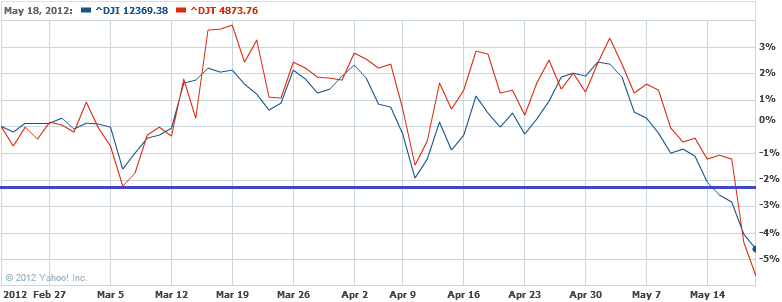
On May 14, 2012, the Dow Jones Industrial Index fell to the closing low of 12,695.35. This was below the 12,715 level that we believed was a critical support level for the Industrial Index.

On May 17, 2012, the Dow Jones Transportation Index fell to the closing low of 4,938.18.  On May 18, 2012, the Transports fell to the closing low of 4,873.76.  This was significant in that it was below both the 5,047 level and below the 200-day moving average.

image

As of Friday May 18, 2012, the bear market rally, which began on August 9, 2011 (found here), is over. Now it is a simple matter of how much of a decline that we have in store.  The following are the downside targets for the Dow Jones Industrial Average (% decline based on 5/18/2012 close):

  • 11,728.46 at –5.18%
  • 11,192.80 at –9.51%
  • 10,362.26 at –16.23%

We will reassess the downside moves when and if the above targets are met.

Transaction Alert

We were wrong about our speculation in NUGT.  Therefore, we plan to sell NUGT if it declines to $8.79.

We bought NUGT based on the dual (short and long-term) indication from our Gold Stock Indicator as indicated in our April 4, 2012 article (found here).

Our preference for using Direxion Gold Miners Bull (NUGT) and Direxion Gold Miners Bear (DUST) ETFs are not for the risk averse.  DUST and NUGT are speculative vehicles and not investments meant to be held on a long-term basis.

Dow Theory Update

The S&P 500 fell -1% for the week on fears of another European zone collapse. Topping it off, JP Morgan (JPM) announced a $2 billion trading loss for the quarter which took the markets by surprise. One may wonder where the market will head in the coming weeks. Going back to our post on March 15 on Dow Theory, we suggested caution should be the operative word. Since then, the S&P500 had declined -3%.

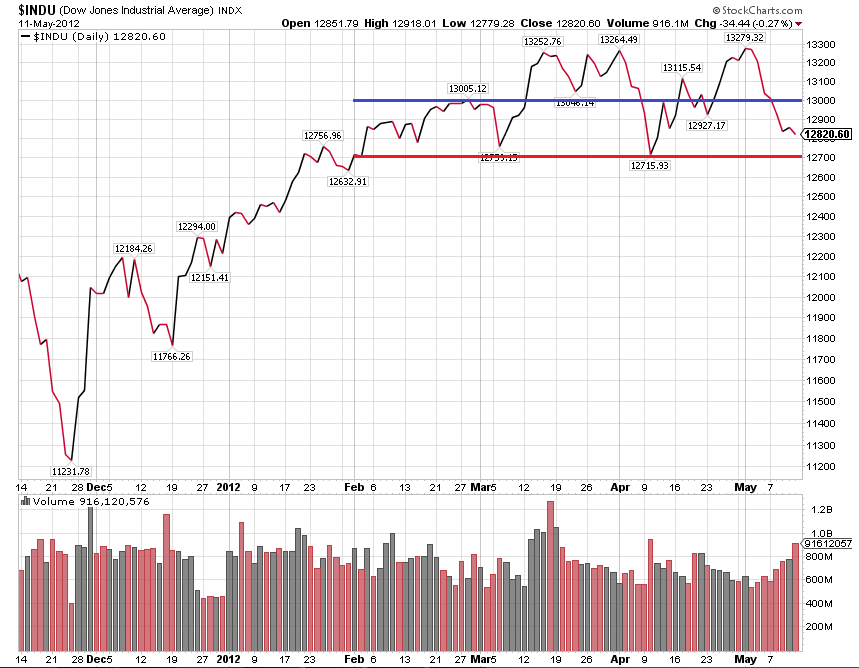
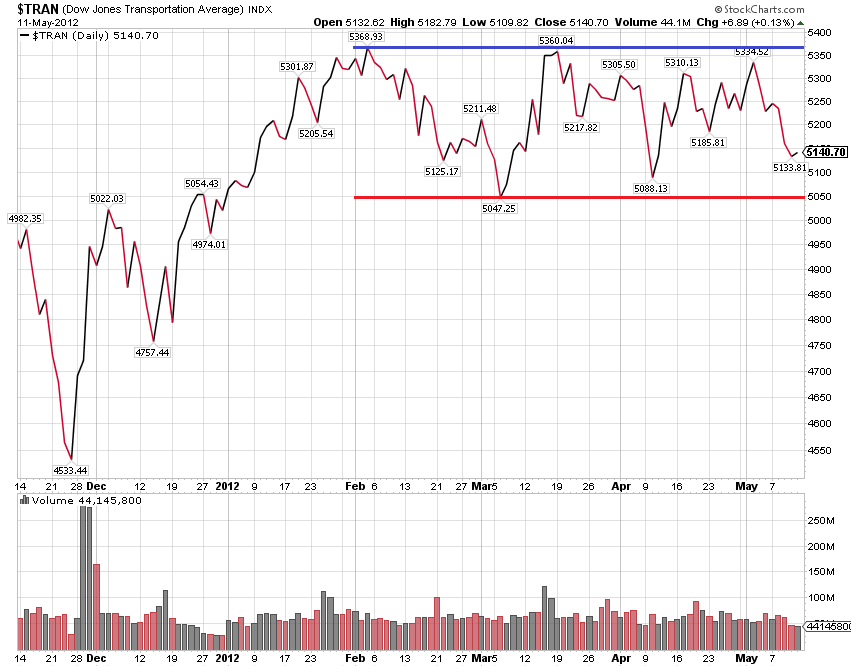
When the Dow Jones Industrial Average broke above the 13,000 level in March, the Dow Jones Transportation Average failed to exceed its February high of 5,368. Divergence between the Industrials and Tranports is continued cause for concern. The transports appear to be trading in a line formation. Similarly, the Industrials have traded in a narrow range between 13,300 and 12,700.

We believe that the break below 12,715 on the Industrials and 5,047 on the Transports (red lines in the chart below) would lead to a more bearish move for the market, at least for the intermediate term.  All of this is within the context of the bear market rally as indicated in our August 9, 2011 article (found here).

INDU

TRAN

Transaction Alert: Bought MKL at the Market

Today we've added to our core portfolio holding of insurance companies with the purchase of Markel (MKL).

We have no plans to sell the stock and would add to our current holdings if the stock declines -20% or more.  An article on the stock will follow in the next couple of weeks.

Update on NUGT

On May 3, 2012 we posted a Transaction Alert indicating that we bought NUGT.

Although the transaction is currently at a breakeven level, we are revising our personal criteria for when to buy more and when to "consider" selling.  Our new criteria is as follows and is acceptable to only those who can accept 100% loss of capital invested:

We’re doing the transaction in two stages:

  1. 50% of the amount we wish to invest now (done)
  2. 50% of the amount we wish to invest after a decline of -20%
  3. we’re exiting the transaction after a total loss of -40% or greater
  4. we’re exiting the transaction when the next short-term signal buy DUST is indicated.

Those who have bought NUGT based on our initial purchase should re-read our more conservative entry and exit outline (found here), although the risks of loss are equally as high as our more aggressive strategy indicated above.

We bought NUGT based on the dual (short and long-term) indication from our Gold Stock Indicator as indicated in our April 4, 2012 article (found here).

Our preference for using Direxion Gold Miners Bull (NUGT) and Direxion Gold Miners Bear (DUST) ETFs are not for the risk averse.  DUST and NUGT are speculative vehicles and not investments meant to be held on a long-term basis.

Should Berkshire Hathaway Be Trading at 1995 Prices?

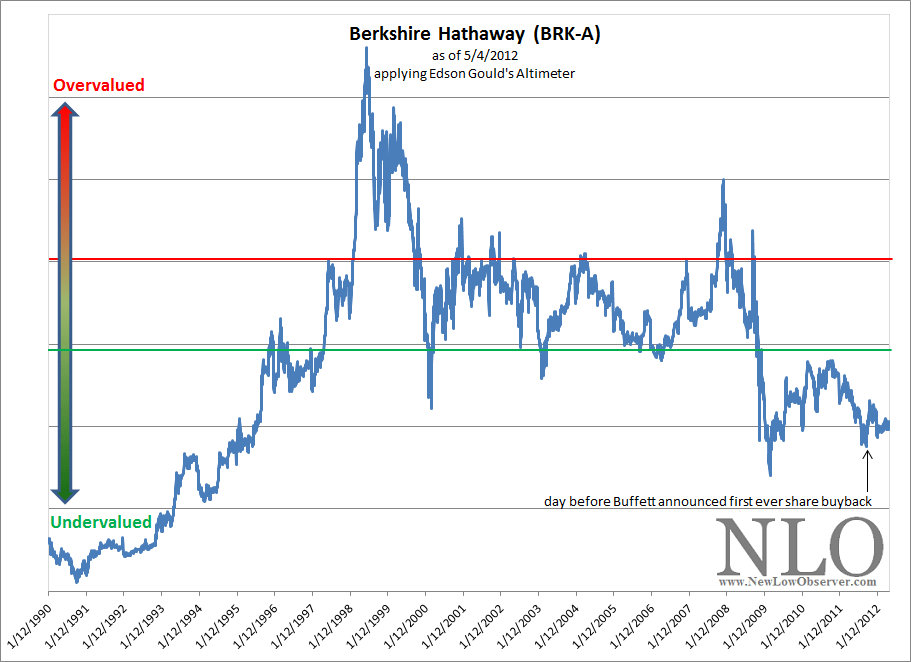
No, this isn’t an article about the prospect of Berkshire Hathaway falling from the current price of $121,950 to $32,100.  Instead, this is what Edson Gould’s Altimeter suggests that Berkshire Hathaway’s (BRK-A) stock price is currently trading at.

Edson Gould’s Altimeter compares the current stock price relative to the dividend that is paid by a company.  As we all know, Berkshire Hathaway does not pay a dividend.  So, how did we arrive at a dividend for Berkshire Hathaway?  We borrowed the dividend policy of Charlie Munger’s Wesco Financial (WSC).  We thought that there would be no better corporate dividend policy to replicate other than that of Warren Buffett’s right hand man.

Exactly what portion of Munger’s dividend policy did we replicate? First, we took WSC’s average dividend payout ratio of 13% from 1999-2010 and applied it to Berkshire Hathaway’s 1977 reported operating earnings of $22.54 per share.  This resulted in a dividend of $2.93.

Next, we compared the compound annual growth rate [CAGR] of the dividend for Wesco Financial which was slightly more than the book value from 1999-2010, at 3.37% and 3.01%, respectively.  Additionally, we took into consideration the fact that by 2010 Wesco Financial had a 38-year history of consecutive dividend increases.  Because Berkshire Hathaway has a 19.8% CAGR of their book value (2011 annual report), we opted to cut that figure in half and assign a dividend growth rate of 9.9%.  Our decision to cut the CAGR of the book value in half was in deference to Buffett’s desire to better deploy the capital in other investment opportunities and the possible diminished impact of the succession team upon Buffett’s “retirement.”

After borrowing the dividend policy from Buffett’s primary business partner and creating a hypothetical dividend and a compounded annual dividend growth rate, assuming regular dividend increases for the last 35 years, we believe that we have constructed a reasonable approximation of an Altimeter which is represented in the chart below.

image

Based on the Altimeter, our best guess is that the period from 1996 to 2008 provided consistent indications of when to add to your positions of Berkshire Hathaway (at or below green line).  The period from 2008 to 2009 provided exceptional opportunities for new investors to buy Berkshire Hathaway as the markets, economy and insurance industry were in crisis mode at the exact same time.

Once the recovery in stocks started it was off to the races for most investors.  Even Berkshire Hathaway was able to participate in the run-up from the 2009 low.  However, on a relative basis, Berkshire’s share price was not increasing  to a level that was reflective of its true value, this is in spite of getting within 10% of the 2007 high in late February 2010.  Based on the Altimeter, Berkshire is currently undervalued by at least 66% and below the 2007 peak by almost 95%.

Those considering the acquisition of Berkshire Hathaway have the following upside targets to consider in the coming 2-3 years, all things being equal:

  • $175,280
  • $197,190
  • $219,100

The following are the possible downside targets:

  • $120,767
  • $105,606

After constructing a fairly conservative dividend policy, the Altimeter clearly outlines the reasons why Warren Buffett would suggest that Berkshire Hathaway will “very aggressively” buy back shares even though the stock is well within striking distance of the all time high.

Who is Edson Gould?

"Edson Gould spent over 60 years working in and studying financial markets. Gould studied the arts at Princeton, engineering at Lehigh (from where he graduated in 1922), and finance at New York University. In 1922, after working for a short time at Western Electric, he joined Moody's Investor Service as an analyst and later was editor of Moody's Stock Survey, Bond Survey, and Advisory Reports. In 1948, he began at Arthur Wiesenberger & Company, where he developed and edited the well-known Wiesenberger Investment Report and became a senior partner. He also was Research Director at E. B. Smith (which later became Smith Barney), and worked for Nuveen."

(source: Market Technicians Association. Gould, Edson Beers, Knowledge Base. Accessed April 26, 2012. link MTA reference.)

"Market technician Edson Gould always laughed at the idea of having a significant influence on the stock market, but his predictions were the most precise around. He pinpointed major bull markets and prophesied bottom-out markets as if he had his own peephole into the future. But in place of a crystal ball and wacky off-the-cuff schemes, his were smart, intensely researched and time-tested theories that made him a legend in the investment community."

(source: Fisher, Kenneth L.. 100 Minds That Made the Market. Business Classics, Woodside, CA. 1993. page 320.)

U.S. Dividend Watch List: May 4, 2012

Watch List Summary

ConocoPhillips (COP) appears on the top of our list but that is because of the split in the stock. While the stock isn’t technically at the low, our observation is that any time a dividend stock splits, it tends to perform well in the subsequent years that follow. We haven’t confirm the dividend payment amount, so the 5% dividend yield would need to be confirmed prior to committing any capital.

Carbo Ceramics (CRR) is appearing on our list again this week. The stock retested its low of $85 and broke that level to settle at a new low of $81.60. The closest breakout was $80 in 2008 so we’re looking for $81.60 to serve as a good support level. The dividend yield of 1.2% isn’t enticing by any means for income investor, but historically speaking, it is closer to its upper band of the dividend yield. The dividend payout ratio of 17% also provides a large margin for safety. With oil prices below $110, we believe it should put some pressure on the stock price. Most drillers will not seek to expand their capital expenditures if oil prices remain at the current level.

Johnson & Johnson (JNJ) made our top ten list this week. There is little need for introduction for this household name which offers a 3.58% dividend yield. Going back to our list from April 8, 2011 you will noticed that JNJ traded at $59.46 and a dividend yield of 3.63% ($2.16/share). In the following month, the company announced a 5% increase in the dividend. This served as a fundamental floor for the stock price. JNJ has risen by about 7% since, excluding dividends. We are confident that JNJ will likely raise their dividend again, creating another “bottom” for the stock price. While the stock may no provide the excitement traders want or "need", value investors can concentrate a large portion of their portfolio in this stock and get a good risk adjusted return when purchased at a reasonable price.

For more information on companies such as Tootsie Roll (TR), C.H. Robinson (CHRW), and Matthews International (MATW) please refer to our watch list from April 6th.

Below are the 20 companies that meet our criteria and are within 11% of the 52-week low:

Symbol Name Price % Yr Low P/E EPS (ttm) Dividend Yield Payout Ratio
COP ConocoPhillips 53.17 0.00% 5.81 9.15 2.64 4.97% 29%
CRR Carbo Ceramics, Inc. 81.6 0.00% 14.49 5.63 0.96 1.18% 17%
CHRW C.H. Robinson Worldwide  60.62 3.22% 22.54 2.69 1.32 2.18% 49%
EXPD Expeditors International 39.5 3.27% 22.07 1.79 0.50 1.27% 28%
TR Tootsie Roll Industries Inc  22.42 3.65% 30.38 0.738 0.32 1.43% 43%
MATW Matthews International 29.79 4.27% 12.16 2.45 0.36 1.21% 15%
FNFG First Niagara Financial  8.58 4.38% 14.54 0.59 0.32 3.73% 54%
LM Legg Mason, Inc.  23.68 4.73% 15.38 1.54 0.32 1.35% 21%
NFG National Fuel Gas Co. 46.77 5.86% 14.99 3.12 1.42 3.04% 46%
CWT California Water Service 17.63 5.89% 19.59 0.9 0.63 3.57% 70%
WEYS Weyco Group, Inc.  22.25 6.89% 15.67 1.42 0.64 2.88% 45%
ANAT American Natl. Insurance 70.25 6.91% 9.39 7.48 3.08 4.38% 41%
CLX Clorox Co. 67.46 6.98% 16.87 4 2.40 3.56% 60%
NJR New Jersey Resources 42.81 8.11% 13.25 3.23 1.52 3.55% 47%
JW-A John Wiley & Sons Inc. 45.31 8.16% 14.38 3.15 0.80 1.77% 25%
AROW Arrow Financial Corp.  23.39 8.79% 12.51 1.87 1.00 4.28% 53%
UNS UniSource Energy Corp. 35.94 9.04% 13.98 2.57 1.72 4.79% 67%
PPL PP&L Corporation 27.35 9.40% 10.13 2.7 1.44 5.27% 53%
JNJ Johnson & Johnson  64.74 9.58% 18.19 3.56 2.28 3.52% 64%
HNZ HJ Heinz Co. 53.31 10.67% 17.77 3 1.92 3.60% 64%
20 Companies

Top Five Performance Review

In our ongoing review of the NLO Dividend Watch List, we have taken the top five stocks on our list from May 6, 2011 and have check their performance one year later. The top five companies on that list can be seen in the table below.

Symbol Name 2011 Price 2012 Price % change
SJW SJW Corp. 22.53 23.31 3.46%
WABC Westamerica BanCorp.  49.6 44.84 -9.60%
CHFC Chemical Financial  19.47 21.75 11.71%
WEYS Weyco Group, Inc.  23.1 22.25 -3.68%
TGT Target Corp. 50.51 55.65 10.18%
Average 2.41%
DJI Dow Jones Industrial 12,723.58 13,038.27 2.47%
SPX S&P 500 1,335.10 1,369.10 2.55%

Our watch list nearly matched the market performance. Once again, our assessment of Westamerica (WABC) didn’t pan out as we expected.  However, the remaining stocks achieved +10% gains within one year of being on our watch list.  SJW and WEYS gained +10% within 2 months while CHFC gained ten percent in seven months.  TGT managed to hit our target in the ninth month after being on our list.

Not making the top five, but among the top seven, was Harleyville (HGIC) which rose +88% after it was taken over. Also, we highlighted Cal-Maine (CALM), an egg producer, which rose +30%. A large part of the rise could be because of the fall in the corn prices which helped expand margins.