Monthly Archives: December 2011

NLO Dividend Watch List: December 23, 2011

The S&P 500 exploded to the upside on Friday bringing the index into positive territory for the year. It has been a slightly different story for the blue chip Dow Jones Industrial Average, which is up 6% for the year.

There may be some bargains to be had in our list of 21 companies that are within 11% of the low.

December 23, 2011

Symbol Name Price % Yr Low P/E EPS (ttm) Dividend Yield Payout Ratio
TR Tootsie Roll Industries Inc  23.74 4.03% 32.97 0.72 0.32 1.35% 44%
BMO Bank of Montreal 54.4 4.96% 10.84 5.02 2.72 5.00% 54%
JW-A John Wiley & Sons Inc 43.99 5.01% 15.44 2.85 0.80 1.82% 28%
BCR CR Bard, Inc. 85.12 5.35% 21.88 3.89 0.76 0.89% 20%
FRS Frisch's Restaurants, Inc 19.5 5.75% 22.16 0.88 0.64 3.28% 73%
WST West Pharmaceutical 37.55 5.77% 20.75 1.81 0.72 1.92% 40%
BDX Becton, Dickinson and Co. 74.44 6.97% 13.25 5.62 1.80 2.42% 32%
EXPD Expeditors Intl.of Washington 41.07 7.37% 22.69 1.81 0.50 1.22% 28%
LM Legg Mason, Inc.  24.45 8.14% 14.91 1.64 0.32 1.31% 20%
AVP Avon Products, Inc. 17.48 8.64% 10.28 1.70 0.92 5.26% 54%
OMI Owens & Minor, Inc. 28.13 8.74% 15.80 1.78 0.80 2.84% 45%
MATW Matthews International Corp.  31.07 8.75% 12.63 2.46 0.36 1.16% 15%
AROW Arrow Financial Corp.  23.44 9.02% 12.67 1.85 1.00 4.27% 54%
CAH Cardinal Health, Inc.   40.96 9.14% 16.00 2.56 0.86 2.10% 34%
SCHW Charles Schwab Corp. 11.54 9.28% 17.22 0.67 0.24 2.08% 36%
T AT&T Inc 29.87 9.82% 15.16 1.97 1.76 5.89% 89%
CLX Clorox Co. 66.59 9.96% 19.19 3.47 2.40 3.60% 69%
BMS Bemis Co Inc 29.94 10.03% 15.05 1.99 0.96 3.21% 48%
CWT California Water Service 18.35 10.21% 18.72 0.98 0.62 3.38% 63%
ANAT American National Insurance 72.75 10.71% 11.30 6.44 3.08 4.23% 48%
UTX United Technologies Corp. 74.18 10.93% 13.92 5.33 1.92 2.59% 36%
21 Companies


Watch List Summary

Tootsie Roll (TR) leads our dividend list by being 4.03% above the one year low.  The chart below shows that in the last 13 years, if TR were bought around the current level, a gain of 20% is achieved in the subsequent 18 months or less.  According to Dow Theory, the minimum retracement of the current price decline from the high is to $26.40 or 11.20% above $23.74.  The downside risk is fairly limited if viewed from the perspective of the 2009 low.  At the current price, TR would need to fall -17.81% in order to accomplish the March 9, 2009 low.  This is an ideal candidate to consider for a stock that has increased its dividend for 47 years in a row, a dividend payout ratio of less than 50% and an additional 3% stock dividend that has been paid since 1966 to go along with the 1.30% cash dividend.
The Punchline: Tootsie Roll (TR) can be purchased at the current level in large quantities relative to other positions in your portfolio.  A second purchase could be done in an equal number of shares if the price declines to the 2009 low.
Bank of Montreal (BMO) has fallen –18.37% from the high      of April 2011.  The one-year low was at $51.83.  According to Dow Theory, BMO has established downside targets, from the high, of $51.06, $35.48 and $19.90.  It is interesting to note that BMO came close to the first downside target and has reversed.  In the short term, we believe that $57.66 is the minimum upside target for the stock based on the established downtrend.  However, if the price of BMO goes below the $51.06 level, we should expect a test of the $35.48 level.
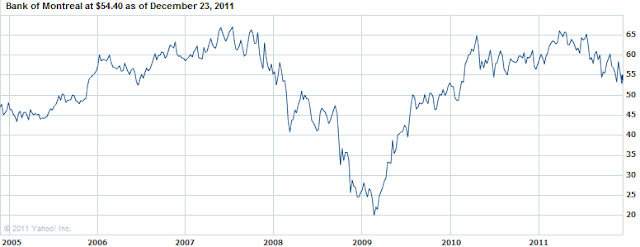
The Punchline:  If BMO is considered for purchase then it should broken into thirds.  Although we favor strong Canadian banks of most U.S. banks, we recommend that any purchase of BMO be small relative to other stock holdings in your portfolio.  No additional purchases should be made of the stock rises after the initial purchase.
John Wiley and Sons (JW-A) is within striking distance of the 52-week low.  According to Dow Theory, based on the low in 2008 to the most recent high, the first downside target is $43.94.  However, with the stock currently at $43.99, there is the possibility that JW-A could fall to the second Dow Theory support level of $34.84.
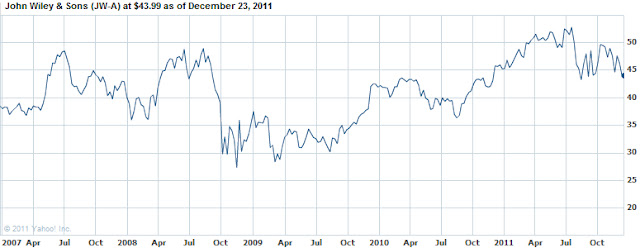
The Punchline: John Wiley is a content provider/aggregator in a world seeking content.  Although the stock might be challenged in the short-term, the longer-term picture may favor JW-A.  However, we’re waiting for clarity on the $43.94 support level.

Sidenote: A company that is on our radar this week is Cardinal Health (CAH). After soaring to a high of $47 this year, the stock retreated as low as $37. The current yield of 2.1% implied that it is 31% undervalued (based on IQTrends [http://www.iqtrends.com/] range of 1.6% yield). This is the first time CAH is on our watch list since our recommendation of the stock in June 2009 (found here). The company spun off the CareFusion (CFN) division since our 2009 recommendation.

Top Five Performance Review

In our ongoing review of the NLO Dividend Watch List, we have taken the top five stocks on our list from December 23, 2010 (not published) and have check their performance one year later. The top five companies on that list can be seen in the table below.
Symbol Name 2010 Price 2011 Price % change
CAG ConAgra Foods, Inc. 22.40 26.6 18.75%
ABT Abbott Laboratories 47.81 56.02 17.17%
SYY Sysco Corp. 29.05 29.43 1.31%
CLX Clorox Co. 63.81 66.59 4.36%
KMB Kimberly-Clark Corp. 63.22 73.73 16.62%


Average 11.64%


DJI Dow Jones Industrial 11,573.49 12,294.00 6.23%
SPX S&P 500 1,256.77 1,265.33 0.68%

Our list from last year did extremely well. The top five beat the Dow by five percentage points, excluding dividends. Four of the top five stocks, except Kimberly Clark (KMB), reached the 10% mark within 6 months.

Disclaimer:

On our current list, we excluded companies that have no earnings. Stocks that appear on our watch lists are not recommendations to buy. Instead, they are the starting point for doing your research and determining the best company to buy. Ideally, a stock that is purchased from this list is done after a considerable decline in the price and extensive due diligence. We suggest that readers use the March 2009 low (or the companies' most distressed level in the last 2 years) as the downside projection for investing. Our view is to embrace the worse case scenario prior to investing. A minimum of 50% decline or the November 2008 to March 2009 low, whichever is lower, would fit that description. It is important to place these companies on your own watch list so that when the opportunity arises, you can purchase them with a greater margin of safety. It is our expectation that, at the most, only 1/3 of the companies that are part of our list will outperform the market over a one-year period.


Please consider donating to the New Low Observer. Thank you.

Dow Theory Applied to Silver?

A reader asks:

“How do you relate Dow Theory to the Silver market?”

Our response:

Charles H. Dow was first an economist, then a commodities expert and finally a stock market analyst. Before Charles H. Dow co-founded the Wall Street Journal, he was better known for writing the “Leadville Letters” for the Providence Journal. The “Leadville Letters” reported on Colorado’s silver mining boom in 1879. After co-founding the Wall Street Journal, the lessons learned in the silver mines ofColorado were found to have application on Wall Street.

Charles Dow was keenly aware of the importance and correlation between commodity prices and stock prices. Many of Dow’s articles in the Wall Street Journal were focused on the movement of commodity prices and all costs of production that went into commodity prices from shipping to the finished product.

As an example, Dow made the following observation:

“For the past 25 years the commodity market and the stock market have moved almost exactly together. The index number representing many commodities rose from 88 in 1878 to 120 in 1881. It dropped back to 90 in 1885, rose to 95 in 1891, dropped back to 73 in 1896, and recovered to 90 in 1900. Furthermore, index numbers kept in Europe and applied to quite different commodities had almost exactly the same movement in the same time. It is not necessary to say to anyone familiar with the course of the stock market that this has been exactly the course of stocks in the same period.”

Much of Dow Theory is based on Dow’s observation of the price action of commodities and then later applied to stock prices. The application of Dow Theory to the price of silver, gold or almost any other commodity is bringing Dow’s work back to its roots. In fact, Dow’s observations in commodities and then later applied to stocks is the basis for much of the modern fundamental and technical analysis that is done today, which includes the quest to determine the “value” of a company and the uses of Fibonacci numbers.

Dow Theory is applicable to all prices that are subject to the whims of market forces. Dow Theory also accounts for manipulation and hoarding. Dow Theory attempts to account for what can reasonably be expected of price action in the not too distant future.

Sources:

  • Dow, Charles. Review and Outlook. Wall Street Journal.February 21, 1901.
  • Bishop, George W. Jr. Who Was the First American Financial Analyst? Financial Analysts Journal, Vol. 20, No. 2 (Mar.-Apr., 1964), p.26-28.
  • Bishop, George W. Jr. New England Journalist: Highlights in the Newspaper Career of Charles H. Dow. The Business History Review.Vol. 34, No. 1 (Spring, 1960) p. 77-93.
  • More on Dow Theory from NLO

Dow Theory: 1907-1910

Bull market indication (A): According to Edwards and Magee, the bull market began on April 24, 1908. The New Low Observer believes that on January 9, 1908 (C), the DJI & DJT confirmed that we're in a bull market by going above the December 6, 1907 intermediate peaks. From the point (C) of the bull signal to the respective market tops, the DJI gained 55% and DJT gained 44%.
Bear market indication (B): Edwards and Magee indicated that on May 3, 1910, the bear market signal was initiated.  However, we believe that on January 12, 1910 (D) the DJI confirmed the  DJT bearish move of falling below the September 9, 1909 low. From the point of the bear signal (D) to the respective market bottoms, the DJI lost -23% and the DJT lost -16%.

iShares Silver Trust (SLV) Update

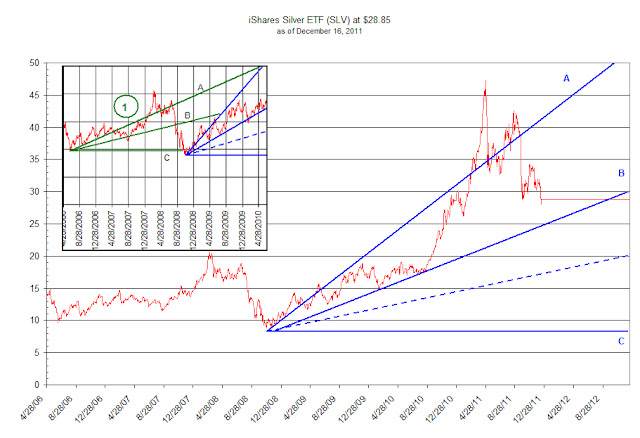
The iShares Silver Trust (SLV) ETF has fallen in line with our assessment from May 5, 2011.  However, it is times like these that we get nervous about our ability to believe that the price action of SLV will continue on a forecast that was presented over six months ago.  Back in May, we said the following:

…we should see SLV tread water for a brief period of time before falling back to the prior low which began with the current run back in November 2008.   Dow Theory suggests that a reasonable buying opportunity would exist at [or] below line B (blue line B).
Currently, the “blue line B” is around $24.31 and rising as time passes.  In our May Dow Theory interpretation of SLV, the price fell right through line B in 2008 without any hesitation.  We’re not so certain that such action will occur this time around.  As long as SLV can hold above the Dow Theory fair value of $28.15, there is a good chance silver will be able to rebound in a meaningful fashion.  However, closing below $28.15 (again) could be a confirmation of the downtrend.    
Many precious metal enthusiasts are arguing that what happened in 2008 was an outlier event for silver and therefore is unlikely to happen this time around.  It is hard to argue against such a view. However, it is difficult to get the period from 1974 to 1976 out our mind (visual here) when gold fell 50% and gold stocks fell 66% in the middle a gold bull market.  
Below is our updated chart of SLV reflecting the most recent price action:
The Punchline: If you like the idea of investing in silver, then a buying opportunity should be at/or below the blue line B ($24.31).  However, don’t go all in, just in case the dashed blue line does materialize at $17.


Nasdaq 100 Watch List: December 16, 2011

Below are the Nasdaq 100 companies that are within 10% of their respective 52-week lows. Stocks that appear on our watch lists are not recommendations to buy. Instead, they are the starting point for doing your research and determining the best company to buy. Ideally, a stock that is purchased from this list is done after a considerable decline in the price and rigorous due diligence.
Symbol
Name Trade P/E EPS Yield P/B % from Low
BMC BMC Software, Inc. 33.17 13.59 2.44 N/A 3.76 0.79%
VMED Virgin Media Inc. 20.95 67.58 0.31 0.70% 5.02 1.01%
CTRP Ctrip.com International, Ltd. 23.1 19.88 1.16 N/A 3.08 1.32%
SYMC Symantec Corporation 15.46 17.59 0.88 N/A 2.49 1.51%
BRCM Broadcom Corporation 28.72 17.29 1.66 1.30% 2.46 2.39%
LRCX Lam Research Corporation 35.92 7.45 4.82 N/A 1.85 2.86%
SRCL Stericycle, Inc. 76.51 30.36 2.52 N/A 5.49 4.74%
WYNN Wynn Resorts, Limited 105.65 24.66 4.28 2.00% 5.04 5.11%
EXPD Expeditors Int'l of Was 40.37 22.3 1.81 1.20% 4.37 5.54%
FSLR First Solar, Inc. 31.91 5.24 6.09 N/A 0.67 6.23%
AMAT Applied Materials, Inc. 10.33 7.12 1.45 3.10% 1.51 6.49%
HSIC Henry Schein, Inc. 62.44 16.39 3.81 N/A 2.23 6.74%
CHRW Robinson Worldwide 66.59 25.91 2.57 2.00% 8.6 6.89%
DTV DIRECTV 42.1 13.12 3.21 N/A N/A 7.62%
GILD Gilead Sciences, Inc. 37.16 10.86 3.42 N/A 4.76 7.87%
CA CA Inc. 20.12 11.81 1.7 1.00% 1.73 8.11%
NTAP NetApp, Inc. 35.71 21.76 1.64 N/A 3.42 8.21%
WCRX Warner Chilcott plc 14.02 36.89 0.38 N/A 88.81 8.68%
AVGO Avago Technologies 28.8 12.87 2.24 1.50% 3.76 9.01%
RIMM Research In Motion 13.44 2.45 5.48 N/A 0.79 9.19%
INFY Infosys Limited 50.37 18.12 2.78 1.10% 4.73 9.22%
MSFT Microsoft Corporation 26 9.45 2.75 3.10% 3.62 9.94%
Watch List Summary
BMC Software (BMC) has not only fallen to a new 52-week low, it has also fallen to a 2-year low.Based on the decline so far, according to Dow Theory, BMC could retrace to the $40 level.Fair value for the stock is at $44.86.The $40 level seems reasonable within the next year for BMC even though it is 20% above the current price.The most obvious downside target for BMC is the October 2008 low of $22.A decline of $22 would equal a loss of 33%.
It should be noted that despite the market turmoil of 2008, BMC did not fall to the 2006 low.Additionally, the long term support line as drawn in the chart for BMC indicates that $22 ultimate price to watch for. If BMC were to replicate the percentage decline from the May 2008 top to the October 2008 low, the stock would decline to a price of $31.11.
The Punchline: Those interested in BMC could split their investments into two transactions.The first purchase could be done between Friday’s closing price and $31.11 and the second if the stock declines to the $22 level. No additional shares should be bought if the price increases.
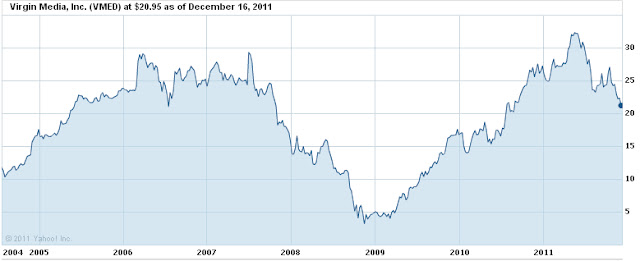
Virgin Media (VMED) has an almost uninterrupted price movement from the low in 2008 to the most recent high of $33.32 in May 2011.According to Dow Theory, VMED broke just below the initial support level of $23.30.The next downside target is the 50% principle level of $18.29.Once breaking below $18.29, VMED could be expected to drop to the $13.28 level.The next upside target for VMED is $25.07 which assumes the best case scenario.
 
However, when contrasting the price movement of VMED to BMC during the decline of 2008, the price of VMED gave up all of the gains from 2004 to 2006 and then some.Those interested in VMED should be willing to accept the stock price to decline to the $13.28 in a worst case situation.
The Punchline:There is significant price support at the $14 level for VMED.This transaction should be broken into thirds with an equal number of shares being bought at each level on the downside.No additional shares should be bought if the price increases.
Ctrip.com International (CTRP) is on a pace to replicate the performance from the high in April 2008 to the low of January 2009 which equaled a loss of 72%. A similar decline in CTRP from the high of $50.57 would bring the price down to $14.16.Suffice to say, the stock “only” needs to decline another $8.94 or 38% from the current price of 23.10.This seems very easy considering the high volatility of Chinese stocks.We believe that unless CTRP is summarily dismissed from the Nasdaq 100 index, there may yet be life in this company.
 
We believe that the Nasdaq 100 committee added CTRP to the index based on the performance of Priceline.com (PCLN).Amazingly, at the current price of $23.10, CTRP sits one penny below the 2nd Dow Theory support level of $23.11.any further deviation below the current price almost ensures that the stock is destined for the $10 range.
The Punchline: Watch and wait for CTRP to establish a solid support level.The nearest upside target is $32.26.


Watch List Performance Review
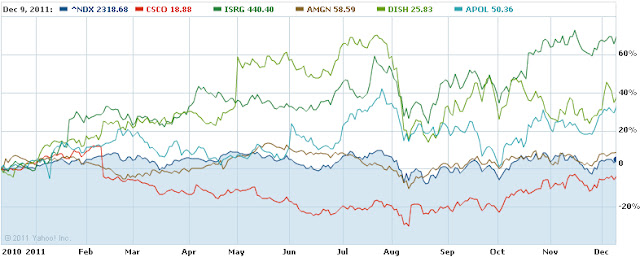
In our ongoing review of the Nasdaq 100 Watch List, we have taken the stocks from our list of December 10, 2010 (found here) and have checked their performance one year later. The companies on that list are provided below with the closing prices from December 10, 2010 to December 9, 2011.
Symbol Name 2010 2011
% change
CSCO Cisco Systems, Inc. 19.70 18.88
-4.16%
ISRG Intuitive Surgical, Inc. 260.07 440.4
69.34%
AMGN Amgen Inc. 53.89 58.59
8.72%
DISH DISH Network Corp 18.80 25.83
37.39%
APOL Apollo Group, Inc. 37.95 50.36
32.70%
Average
28.80%
^NDX Nasdaq 100 Index 2,207.45 2,318.68
5.04%
The performance of the top five stocks from last year was amazing. The average performance was five times better than the Nasdaq 100 index in the same period of time.
Disclaimer:
On our current list, we excluded companies that have no earnings. Stocks that appear on our watch lists are not recommendations to buy. Instead, they are the starting point for doing your research and determining the best company to buy. Ideally, a stock that is purchased from this list is done after a considerable decline in the price and extensive due diligence. We suggest that readers use the March 2009 low (or the companies' most distressed level in the last 2 years) as the downside projection for investing. Our view is to embrace the worse case scenario prior to investing. A minimum of 50% decline or the November 2008 to March 2009 low, whichever is lower, would fit that description. It is important to place these companies on your own watch list so that when the opportunity arises, you can purchase them with a greater margin of safety. It is our expectation that, at the most, only 1/3 of the companies that are part of our list will outperform the market over a one-year period.

Lam Research Buys Novellus: Consolidation in Semis Continues

The Chip sector continued to get smaller and smaller. The most recent news of consolidation came from the largest etch equipment supplier, Lam Research (LRCX), announcing a $3.3 billion buyout of Novellus System (NVLS) in all-stock deal.

Novellus produces deposition machine and Lam Research manufactures etch equipment. The synergy should be good for both companies as well as the industry. Lam Research will have quick access to Intel (INTC) while Novellus will gain ground with NAND flash producers such as Samsung.

We pointed to the fact that the chip sector is one industry to keep an eye on back in early 2010. Since our recommendation, there has been two major acquisitions, Applied Materials (AMAT) bought Varian Semiconductor and Advantest (ATE) bought Verigy. This latest deal may not be the last but we feel that the industry has consolidated enough that a big takeover such as this may not come around any time soon.

Now that the deal is in place, let's take a look at the most recent investment research reports for the assessed fair value (F/V) of Novellus:

Firm Date F/V % Diff
Credit Suisse 6-Dec $42.00 -5%
S&P 10-Dec $41.00 -8%
Valueline 7-Oct $49.40 11%
Morningstar 11-Nov $29.00 -35%
Buyout Value 15-Dec $44.42

Credit Suisse clearly takes the top spot in predicting the fair value of Novellus stock price. This information could be helpful going forward in assessing which data point one should consider.

The following is a recap of the Novellus fundamental figures on the day it was taken over.

P/E - 9.91
F P/E - 12.90
P/Sales - 1.62
P/Book - 2.42

Reference:
Bloomberg: Lam Research to Buy Novellus Systems for $3.3B
EETimes: Lam to buy Novellus in $3.3B, all-stock deal

Please consider donating to the New Low Observer. Thank you.

Nasdaq 100: 2011 Re-Rank Review

On December 9, 2011, the Nasdaq OMX Group announced the names of the companies that would be added and dropped from the Nasdaq 100 Index.  This year there were five companies added and dropped. 
The five companies added in 2011 were:

Fossil, Inc.
Avago Technologies Limited
Nuance Communications, Inc.
Hansen Natural Corporation
Randgold Resources Limited

The five companies dropped in 2011 were:

Illumina, Inc.
Qiagen N.V.
NII Holdings, Inc.
Urban Outfitters, Inc.
FLIR Systems, Inc.

From the following valuation metrics, the companies that are being added to the Nasdaq 100 appear more overvalued than those being dropped.
  • As a group, the stocks being added to the Nasdaq 100 Index have an average price-to-earnings ratio of 60x.  The average price-to-earnings ratio of the stocks being dropped is 21x.
  • The average price-to-book ratio for the companies being added is 5.23x while the price-to-book ratio for the stocks being dropped is 2.40x.
  • On average, the stocks being added are approximately 50% above their 52-week low while the stocks being dropped are only 12% above their 52-week low.
The theory is that the companies being added to the index will significantly improve their earnings enough to justify their high price-to-earnings ratio.  Combined with the expectation of higher earnings is a higher stock price.  However, from our cursory review of the performance of the companies added and then dropped from the Nasdaq 100 Index in 2010, the inclusion into the index hasn’t immediately translated in an increase of the stock price.
In the table below we show the 1-year performance of the seven companies added and dropped from the Nasdaq 100 in 2010.  This performance is based on the announcement of December 13, 2010 until the closing price of December 9, 2011.

Symbol
2010
2011
% change
Akami (added)
50.68
28.11
-44.53%
C-Trip (added)
44.53
23.2
-47.90%
Dollar Tree (added)
55.85
82.55
47.81%
F-5 Networks (added)
139.06
114.74
-17.49%
Micron (added)
8.14
5.89
-27.64%
Netflix (added)
183.8
70.89
-61.43%
Whole Foods (added)
48.63
69.11
42.11%
Average
-15.58%
Cintas (dropped)
27.36
30.43
11.22%
Dish Network (dropped)
16.95
25.83
52.39%
Foster Wheeler (dropped)
33.51
19.36
-42.23%
Hologix (dropped)
17.42
17.2
-1.26%
J.B. Hunt (dropped)
39.49
44.74
13.29%
Logitech (dropped)
19.88
8.36
-57.95%
Patterson Companies (dropped)
29.23
29.34
0.38%
Average
-3.45%
Nasdaq 100
2207.45
2318.68
5.04%
Dow Jones Industrial Average
11428.56
12184.26
6.61%
S&P 500 Index
1240.46
1255.19
1.19%

While not a rousing success for either group, the companies that were added to the Nasdaq 100 Index suffered three times the loss than occurred for the stocks that were dropped from the index.  Of the stocks that were added to the index, the non-tech related companies, Dollar Tree (DLTR) and Whole Foods (WFM), outperformed with gains of 48% and 40%, respectively.  This suggests that the “basics” will outperform in the coming year if the economy continues to experience stagflation.  We believe that the recent re-introduction of Hansen Natural (HANS) will be among the top performing stocks at the time of the next re-ranking of the Nasdaq 100.
On November 18, 2011 (found here), we provided 13 companies that we believed were possible candidates for being removed from the Nasdaq 100 Index.  We were able to identify three of the five companies that were dropped from the index. The characteristic that was most pronounced for the companies being dropped from the Nasdaq 100 Index was a market capitalization of $4 billion or less and 80% less average trading volume.
Because the Nasdaq 100 Index has outperformed most other indexes since inception, it appears that the success of the index has more to do with the companies that are able to remain on the index for a longer period of time rather than those that are added and dropped.
The Punchline:
  • Stocks added to the Nasdaq 100 in 2011 are overvalued
  • Stocks dropped from the Nasdaq 100 in 2011 are undervalued
  • Stocks added in 2010 performed worse than stocks dropped in 2010
  • Of companies added, Hansen Natural (HANS) is expected to perform above average
  • Companies that are added or dropped from the index reduce the performance of the index
  • Out of the 100 companies in the index, we correctly identified 60% of those that were dropped
  • Companies on the Nasdaq 100 for an extended period of time may provide the basis for the index’s exceptional long-term performance

NLO Dividend Watch List: December 9, 2011

The S&P 500 continued its volatile course peaking as high as 1,266 and falling as low as the 1,235 level, a 2% spread. At the end of the week, the S&P 500 rose 0.88%. The blue-chip Dow Jones Industrial Average rose 1.37% for the week showing that investors are moving toward higher quality names.

Our list contains 27 companies that are within 11% of the 52-week low. This is not a recommendation but a good starting point for research.

December 9, 2011

Symbol Name Price % Yr Low P/E EPS Dividend Yield Payout Ratio
AVP Avon Products, Inc. 16.58 3.05% 9.75 1.70 0.92 5.55% 54%
BDX Becton, Dickinson and Co. 72.92 4.79% 12.98 5.62 1.80 2.47% 32%
WST West Pharmaceutical 37.38 5.30% 20.65 1.81 0.72 1.93% 40%
BCR CR Bard, Inc. 85.7 6.06% 22.03 3.89 0.76 0.89% 20%
FNFG First Niagara Financial Group 8.73 6.20% 13.23 0.66 0.64 7.33% 97%
T AT&T Inc 29.03 6.73% 14.74 1.97 1.72 5.92% 87%
TR Tootsie Roll Industries Inc  24.4 6.92% 33.89 0.72 0.32 1.31% 44%
GTY Getty Realty Corp. 13.09 7.12% 9.55 1.37 1.00 7.64% 73%
BMO Bank of Montreal 55.56 7.20% 10.87 5.11 2.82 5.08% 55%
CLX Clorox Co. 65.03 7.38% 18.74 3.47 2.40 3.69% 69%
FRS Frisch's Restaurants, Inc 19.9 7.92% 22.61 0.88 0.64 3.22% 73%
CWT California Water Service 18.05 8.41% 18.42 0.98 0.62 3.43% 63%
AROW Arrow Financial Corp.  23.38 8.74% 12.64 1.85 1.00 4.28% 54%
VNO Vornado Realty Trust 74.43 8.83% 17.85 4.17 2.76 3.71% 66%
BMI Badger Meter, Inc. 29.3 8.88% 18.20 1.61 0.64 2.18% 40%
EXPD Expeditors Intl of Washington 41.73 9.10% 23.06 1.81 0.50 1.20% 28%
BMS Bemis Co Inc 29.71 9.19% 14.93 1.99 0.96 3.23% 48%
SYK Stryker Corp. 47.85 9.42% 15.19 3.15 0.72 1.50% 23%
WFSL Washington Federal, Inc.  13.31 9.55% 13.31 1.00 0.24 1.80% 24%
HCC HCC Insurance Holdings, Inc. 27.04 9.65% 11.17 2.42 0.62 2.29% 26%
ANAT American National Insurance 72.1 9.72% 11.20 6.44 3.08 4.27% 48%
CHRW C.H. Robinson Worldwide  68.44 9.86% 26.63 2.57 1.16 1.69% 45%
MTB M & T Bank Corp. 73.01 9.95% 10.57 6.91 2.80 3.84% 41%
KO Coca-Cola Co 67.57 10.25% 12.42 5.44 1.88 2.78% 35%
JW-A John Wiley & Sons Inc. CL 'A' 46.24 10.38% 15.94 2.90 0.80 1.73% 28%
OMI Owens & Minor, Inc. 28.59 10.51% 16.06 1.78 0.80 2.80% 45%
MSEX Middlesex Water Company  18.31 10.90% 20.81 0.88 0.74 4.04% 84%
27 Companies


Watch List Summary

Avon (AVP) continues to show up on our list. This time around, the stock is 3% above the low. Analysts' consensus expects Avon to grow its earnings by 8%. We expect that figure to come down in the coming weeks as we believe that many analysts are revising their estimate. Still, the earnings yield of 10% and dividend yield of 5.55% are something to consider. The payout ratio of 54% is a good margin of safety. The chart below shows Avon price and P/E going back 10 years. The current valuation is equivalent to the  2009 low. Our estimated fair value for Avon to trade up to is $32.

Avon Products Stock Chart

Next up on our list is Becton Dickinson (BDX). Analysts' consensus calls for Becton to grow earnings by 13% in 2012. The dividend yield of 2.47% is the highest yield in a 10-year period. the conservative payout ratio (32%) and earning yield of 8% makes this a quality stock to consider. IQTrends (http://www.iqtrends.com/) estimates that BDX is undervalued when the stock reaches a 2% yield. Look at the chart below for the 10-year price and dividend yield figures.

Becton Dickinson and Company Stock Chart

Top Five Performance Review

In our ongoing review of the NLO Dividend Watch List, we have taken the top five stocks on our list from December 10, 2010 (not published) and have check their performance one year later. The top five companies on that list can be seen in the table below.

Symbol Name 2010 Price 2011 Price % change
KMB Kimberly-Clark Corp. 61.70 70.14 13.68%
CLX Clorox Co. 62.46 65.03 4.11%
CAG ConAgra Foods, Inc. 22.33 25.7 15.09%
ABT Abbott Laboratories 47.62 54.57 14.59%
CL Colgate-Palmolive Co. 78.21 90.46 15.66%


Average 12.63%


DJI Dow Jones Industrial 11,410.32 12,184.26 6.78%
SPX S&P 500 1,240.40 1,255.19 1.19%

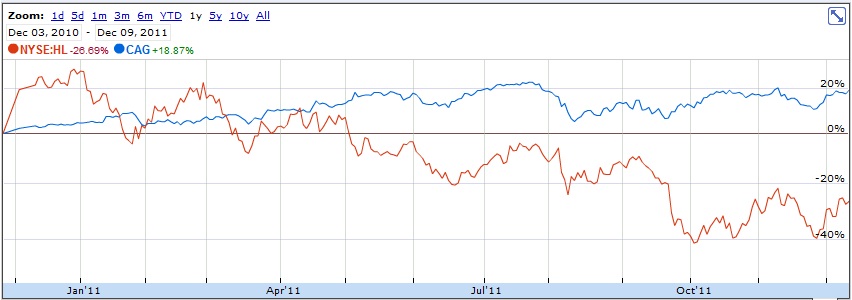
Our top five have beaten both the Dow Jones Industrials by 2x and the S&P 500 by more than 10x! The worst performer was Clorox (CLX) which still managed to beat the S&P 500, excluding dividends. The other four stocks returned more than 10%, excluding dividends. One particular stock we'd like to highlight is ConAgra (CAG). We published an article on December 1, 2010 on SeekingAlpha (read it here) stating our reason to consider ConAgra over Hecla Mining (HL) and yet there were many who opposed our view. One commentor suggested riding the "wave" of Hecla (HL) and yet when you review the performance of the two stocks one year later, you can see that Hecla dropped -27% while ConAgra rose +18%, excluding dividends. Take a look at the chart below for the 1-year performance.

Disclaimer:

On our current list, we excluded companies that have no earnings. Stocks that appear on our watch lists are not recommendations to buy. Instead, they are the starting point for doing your research and determining the best company to buy. Ideally, a stock that is purchased from this list is done after a considerable decline in the price and extensive due diligence. We suggest that readers use the March 2009 low (or the companies' most distressed level in the last 2 years) as the downside projection for investing. Our view is to embrace the worse case scenario prior to investing. A minimum of 50% decline or the November 2008 to March 2009 low, whichever is lower, would fit that description. It is important to place these companies on your own watch list so that when the opportunity arises, you can purchase them with a greater margin of safety. It is our expectation that, at the most, only 1/3 of the companies that are part of our list will outperform the market over a one-year period.

Please consider donating to the New Low Observer. Thank you.
In the News: December 10, 2011

Dow Theory: Bear Market Rally Coming to an End?

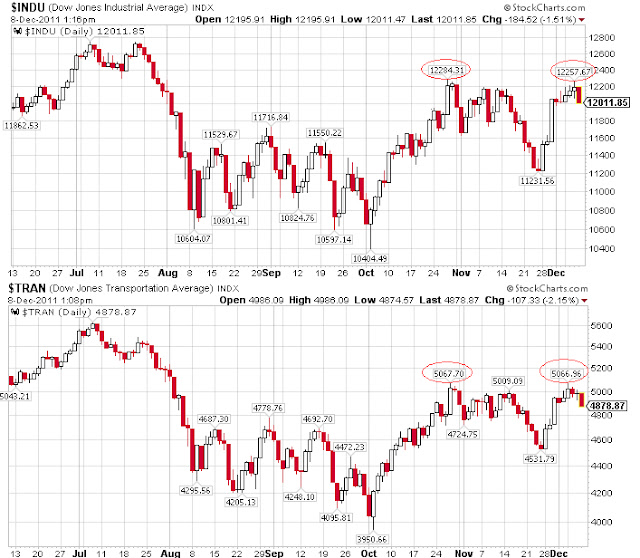
Does the end of the recent upside market action hinge on as little as 27 points? It appears that the inability of both the Dow Jones Industrial Average and Dow Jones Transportation Average to exceed the prior highs set on October 28, 2011 and October 27, 2011 (red circles), respectively, may have marked the end to the bear market rally.
The potential downside targets for both indexes are 1) the November 25th and 2) October 3rd lows, (in that order). Falling below the October low should bring a downside target of 9700 on the Dow Jones Industrial Average.  The upside targets remain in place as indicated in our October 15, 2011 article (found here).

Dow Theory: 1903-1907

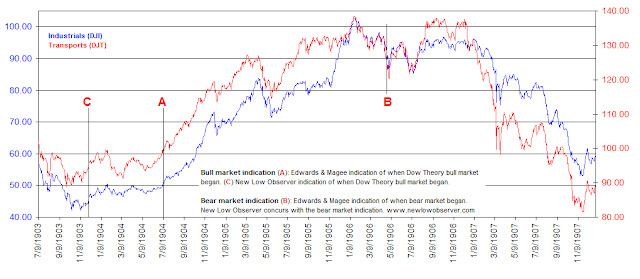
Bull market indication (A):According to Edwards & Magee's book Technical Analysis of Stock Trends, the bull market began at point A. From the point of the bull signal to the respective market tops, the DJI gained 100% and DJT gained 37%. The NLO team believes that at point (C) on 12/4/1903, the DJI confirmed the 11/30/1903 DJT signal that a bull market was in progress by exceeding the late Oct 1903 peaks. From the point of the bull signal to the respective market tops, the DJI gained 126% and DJT gained 47%.
Bear market indication (B): On 4/24/1906 the DJI confirmed the 4/19/1906 DJT bearish move. The signal came when the DJT dropped below the Sept 1905 low and the DJI dropped below the December 1905/March 1906 lows. From the point of the bear signal to the respective market bottoms, the DJI lost -42% and the DJT lost -35%. The NLO team is in agreement with the Edwards and Magee as to when the bear market began.
Please consider donating to the New Low Observer. Thank you.

Dow Theory: 1900-1903

The following is the beginning of a series that examines prior bull and bear market indications according to Dow Theory since 1900.  We will include opinions and insights from the leading Dow Theory proponents and commentators from the respective periods, whenever possible.
Industrials (DJI), Transports (DJT)

Text in chart:

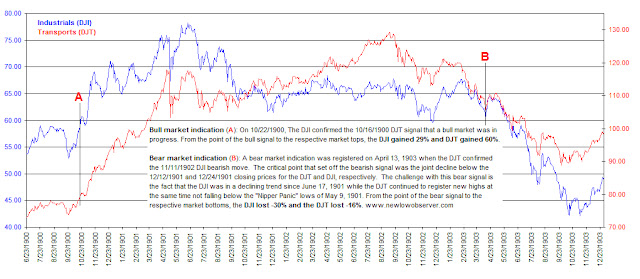
Bull market indication (A): On 10/22/1900, the DJI confirmed the 10/16/1900 DJT signal that a bull market was in progress.  From the point of the bull signal to the respective market tops, the DJI gained 29% and the DJT gained 60%.
Bear market indcation (B): A bear market indication was registered on April 13, 1903 when the DJT confirmed the 11/11/1902 DJI bearish move.  The critical point that set off the bearish signal was the joint delcine below the 12/12/1901 and 12/24/1901 closing prices for the DJT and DJI, respectively.  The challenge with this bear signal is the fact that the DJI was in a declining trend since June 17, 1901 while the DJT continued to register new highs at the same time not falling below the "Nipper Panic" lows of May 9, 1901.  From the point of the bear signal to the respective market bottoms, the DJI lost -30% and the DJT lost -16%.