Monthly Archives: December 2009

Nasdaq 100 Watch List

Below are the Nasdaq 100 companies that are within 20% of the 52-week low. This list is strictly for the purpose of researching whether or not the companies have viable business models or are about to go out of business. These companies are deemed highly speculative unless otherwise noted. -Touc

Symbol Name Trade P/E EPS (ttm) Yield P/B Pct from Yr Low

GENZ

Genzyme

49.01

27.94

1.75

N/A

1.73

4.08%

GILD

Gilead

43.27

16.73

2.59

N/A

7.00

6.52%

APOL

Apollo

60.58

16.15

3.75

N/A

8.18

14.76%

CEPH

Cephalon

62.42

17.25

3.62

N/A

2.19

18.78%

The Language of Wall Street

  • The rich man does not know who is his friend.
  • A man gets no thanks for what he loses that play.
  • They who live in a worry invite death in a hurry.
  • Soft words and hard arguments catch the investor.
  • Put your eggs in one basket and watch the basket.
  • Every time the sheep bleats it loses a mouthful.
  • The rich are meanest when they buy small things.
  • The rich man is apt to be more generous than just.
  • He swears who is accustomed to his own false words.
  • Money easily made, easily goes; easy come, easy go.
  • If you do not hear reason, she will wrap your knuckles.
  • He who prates of his wisdom doth but conceal an ass.
  • Provide for the worst; the best will take care of itself.
  • It is an old maxim that accidents usually help the Bears.
  • Lend money without bond and you but make an enemy.
  • The advice of successful men only is worth application.
  • A man with long hair is generally rash and impetuous.
  • A man must make his opportunity as often as he finds it.
  • Things in motion sooner catch the eye than what not stirs.
  • He who sells what isn’t his, must buy it back or go to prison.
  • Sell and borrow only those stocks which have a wide market.
  • Some had rather guess that much then take pains to learn a little.
  • Men of wit and facts never need be driven to indirect courses.
  • To estimate a man’s wealth, divide the gossip estimates by four.
  • To grasp an opportunity with a firm decision marks an able man.
  • After advancing markets, and prices waiver, lower prices will come.
  • When prices are high, or there is a declining tendency, sell on rallies.
  • Much money made before 20 is apt to be lost in the reign of plenty.
  • He is rich enough to as no debts, and young enough who has health.
  • “Early information” and a big bank account will be the ruin of any man.
  • Moderate riches will carry you; if you have more, you must carry them.
  • The success of a manipulated market depends largely on sustained activity.
  • It is idle to wait for your ship to come in unless you have sent one out.
  • When prices close week without support, a rally would be in order next morning.
  • He who takes no care of little things will not have the care of great ones.
  • When prices are low, or there is an advancing tendency, buy fair concessions.
  • A lordly taste makes a beggar’s purse; a champagne appetite but a purse for beer.

Source: Nelson, Samuel A. The ABC of Stock Speculation. S.A. Nelson. 1902

A View on the "Buy Low, Sell High" Concept

As the old investment adage goes, "buy low and sell high." However, the act of buying low has a few complications which hasn't been easily resolved. One problem is knowing when a stock's price is actually at a low price or not. Most people confuse the absolute level of a stock price with being low. For example, if a stock is selling for $2 then a person might think that this is a great price to acquire the shares. However, if $2 is the new high for the price and one year ago the old low was $0.25 then $2 is actually very high.

One way that the New Low Observer (NLO) has managed to isolate whether a stock is at a low price is by waiting until the stock is within 20% of the new low. This approach isn't a cure for what ails the average investor. However, it does allow average market participants the opportunity to investigate quality companies for potential price increases. The new low of a stock automatically implies that value has been created especially if the company in question can survive as a going concern. This is counter to most information coming out of the Wall Street media machine. Typically, analysts on Wall Street recommend stocks that have risen far above the low before initiating coverage on a stock.

While there are 4336 individual stocks that can be bought on American stock exchanges, NLO has determined that there are basically only 383 companies that warrant your attention. The first group of companies are known as the Dividend Achievers (excel list of companies). These 283 companies are tracked by Mergent's based on their ability to increase their dividends every year for over 10 years in a row as a minimum requirement. It goes without saying that these companies pay some kind of dividend with yields that range from over 5% to less than 1%.

The second major group of companies tracked by NLO are the constituents of the Nasdaq 100. In our earlier forms as Dividend Inc. and Arti Invest, we believed that only Dividend Achievers were worth tracking since the dividend payment was verifiable regardless of "accounting" inconsistencies that are commonly found with "other" companies. The performance of this approach has been well documented and proven quite profitable.

However, the reality of the stock market dictates that we widen our perspective on companies that might afford significant opportunity with reduced risk. We, at NLO, decided that the Nasdaq 100 was the next obvious choice. After all, most mutual funds are bound to invest in these companies regardless of their unwillingness to pay dividend income. Additionally, companies in the Nasdaq 100 have solid reputations with higher prospects for growth over the long term.

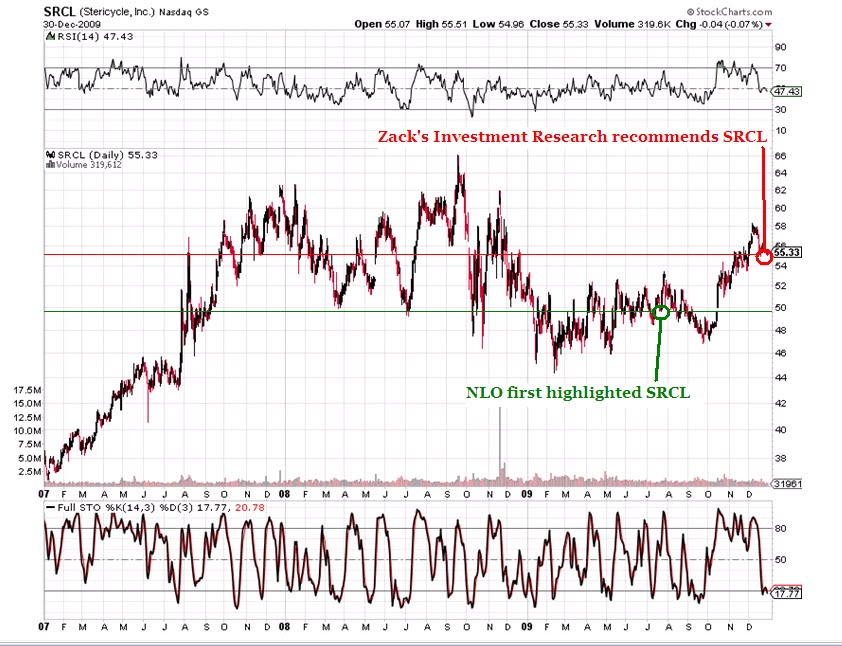
One recent example of the benefit of tracking and research companies posted on NLO, as opposed to those from the Wall Street media machine, is Stericycle (SRCL). SRCL last appeared on our Nasdaq 100 watch list on October 30th. After being on our watchlist since the July 24th initiation of our website, SRCL has managed to climb from the low of $47.76 to the most recent high of $58. This is an increase of 18% from the July low and 21% from the October low and 11.54% from the breakout above our watch list range of being within 20% of the 52-week low.

NLO can be easily contrasted with the recent short-term buy recommendation placed on SRCL by Zack's Investment Research. In a tiny blurb issued today, Zack's Investment Research indicated that SRCL's stock had been in an oversold state based on the stochastics which indicated or implied that the stock was likely to go higher in the near term.

Unfortunately, offering up information about SRCL long after the stock has risen by at least 18% doesn't serve the small investor. After all, isn't the mantra "buy low, sell high?" It is strange to note that no analysts covering SRCL (in the following link) issued a buy recommendation on the stock after February 2004, even though there has been tremendous opportunities to buy in October 2008, February 2009, May 2009 and October 2009.

SRCL is only one of the companies that has been on the NLO Nasdaq 100 Watchlist that performed exceptionally well after getting off the list. Below are other Nasdaq 100 companies and their performance since getting within 20% of the new low:

It should be noted that the above companies are almost the entire list of companies that have appeared on the Nasdaq 100 Watch List. So far, this implies that quality Nasdaq companies could be investigated for speculative opportunities near the new low. Hopefully this approach can provide a reasonable approach to buying low with the prospect of selling higher. Follow along with us as we continue to investigate the speculative opportunities of the Nasdaq 100. -Touc

Nasdaq 100 Watch List

Below are the Nasdaq 100 companies that are within 20% of the 52-week low. This list is strictly for the purpose of researching whether or not the companies have viable business models or are about to go out of business. These companies are deemed highly speculative unless otherwise noted. -Touc

Symbol

Name Trade P/E EPS (ttm) Yield P/B % Yr Low

GENZ

Genzyme Corporation

48.50

27.65

1.75

N/A

1.68

2.99%

GILD

Gilead Sciences, Inc.

43.00

16.63

2.59

N/A

6.87

5.86%

APOL

Apollo Group, Inc.

59.27

15.80

3.75

N/A

7.81

12.28%

CEPH

Cephalon, Inc.

59.88

16.55

3.62

N/A

2.08

13.95%

Dividend Achiever Watch List

At the end of the week, my watch list shrank to 17 companies compared to 20 companies from the previous week. Here are the companies on my watch list as of December 25, 2009.
Symbol Name Price P/E % Yr Low Yield EPS Div/Shr Payout Ratio
SVU SUPERVALU INC 12.90 -0.92 6.35% 2.71% -13.99 0.35 -3%
CWT CALIFORNIA WATER SVC 37.07 18.54 10.69% 3.18% 2.00 1.18 59%
XOM EXXON MOBIL CP 68.66 16.00 10.99% 2.45% 4.29 1.68 39%
BCR BARD C R INC 79.08 15.85 14.71% 0.86% 4.99 0.68 14%
WTR AQUA AMERICA INC 17.69 23.28 14.94% 3.28% 0.76 0.58 76%
UMBF UMB Financial Corporation 38.68 18.42 14.95% 1.91% 2.10 0.74 35%
WEYS Weyco Group, Inc. 23.13 23.13 15.02% 2.59% 1.00 0.60 60%
WMT WAL MART STORES 53.60 15.54 15.89% 2.03% 3.45 1.09 32%
FDO FAMILY DOLLAR STORES 28.02 13.54 16.75% 1.93% 2.07 0.54 26%
THFF First Financial Corporation 30.99 16.93 16.81% 2.90% 1.83 0.90 49%
SRCE 1st Source Corporation 16.25 14.64 17.41% 3.94% 1.11 0.64 58%
UGI U G I CP 25.05 10.61 18.50% 3.19% 2.36 0.80 34%
WGL WGL HOLDINGS INC 34.20 14.31 19.62% 4.30% 2.39 1.47 62%
SYBT S.Y. Bancorp, Inc. 21.89 16.21 19.68% 3.11% 1.35 0.68 50%
AWR AMER ST WATER 35.71 22.04 19.99% 2.91% 1.62 1.04 64%
NTRS Northern Trust Corporation 52.20 13.77 20.50% 2.15% 3.79 1.12 30%
HSY THE HERSHEY COMPANY 36.48 21.33 20.52% 3.26% 1.71 1.19 70%
17 Companies

Merry Christmas!

Sell American National Insurance (ANAT) at the market

It is now time to recommend that American National Insurance (ANAT) be sold at the market. The stock has performed below standard since the research recommendation was issued on April 10, 2008. It is highly recommended that anyone who bought the stock based on my research should re-read the posting. ANAT gave many opportunities to be bought well below the research recommendation price of $105. In fact, ANAT fell to as low as $34 by March 9, 2009. The subsequent rise in the price of 248.28% has been utterly amazing. In the pursuit of "seeking fair profits" the returns that this stock has provided within the last 630 days say that it is necessary to consider alternative opportunities.

Again, ANAT was recommended when it was trading at $105. As of December 21, 2009, ANAT was quoted at $117.51. The total return (including dividends) on ANAT since the recommendation date is 18.27%. On an annualized basis, this equals a total return (including dividends) of 10.59%.

As I have indicated in the purposes and function of this site, the goal is to:

  • maximize the annual yield of each trade.
  • reduce time between buying and selling of each stock.
  • exceed the annual yield of government guaranteed alternatives in each trade.

Research recommendations and investment observations are intended to be a starting point for investigating a quality company at a reasonable price. It is hoped that after doing the background research you can buy the stock at a lower price. Ideally the stock should be held in a tax deferred account and should not consist of less than 20% of your holdings. Personally, I prefer holding only 2-3 stocks at a time.

Sell recommendations are intended to deal with the short term reality of the market. The tracking of the Sell recommendations are the worst case scenario if you happen to have bought a stock at the time the research recommendation was made (please avoid making this mistake.) I aim for mediocrity in my returns, therefore I am happy with 9-12% annual gains. However, since codifying my approach to investing in 2005, I have had annual returns of 20% and above every year since.

It is always recommended that when selling a stock, one should not place stop orders, limit orders or orders after hours. This leaves the seller in the position of being vulnerable to the whims of the market makers. Instead, place your sell orders only as a market order during market hours. Some would complain that a market order during market hours might leave some profits on the table. However, I would rather leave some money on the table rather than have it taken away from me by the trades that are placed by institutions and market makers. -Touc

Sell Northwestern Natural Gas (NWN) at the Market

It is now time to recommend that Northwestern Natural Gas (NWN) be sold at the market. The stock has performed moderately since the research recommendation was issued on October 3, 2009 (. It is highly recommended that anyone who bought the stock based on my research should re-read the posting. Unfortunately, just as it was not possible to buy my AquaAmerica (WTR) recommendation it was the same for my recommendation of NWN, the price only went up from the date recommended.

NWN's stock price has gone nothing but up since the recommendation. However, in the pursuit of "seeking fair profits" the returns that this stock has provided within the last 80 days say that it is necessary to consider alternative opportunities.

NWN was recommended when it was trading at $40.94. As of December 21, 2009, NWN was quoted at $45.25. This equals a return of 10.53%. Selling this stock now generates a return of 2.6x greater than the amount of the dividend yield. Additionally, the 10.53% gain exceeds the return on a 30-year treasury purchased on October 2, 2009 by 2.63x.

Those not interested in following through with my sell recommendation can feel comfortable knowing that NWN is a great long-term holding with a 10.53% cushion since our research recommendation of October 3, 2009.

As I have indicated in the purposes and function of this site, the goal is to:

  • maximize the annual yield of each trade.
  • reduce time between buying and selling of each stock.
  • exceed the annual yield of government guaranteed alternatives in each trade.

Research recommendations and investment observations are intended to be a starting point for investigating a quality company at a reasonable price. It is hoped that after doing the background research you can buy the stock at a lower price. Ideally the stock should be held in a tax deferred account and should not consist of less than 20% of your holdings. Personally, I prefer holding only 2-3 stocks at a time.

Sell recommendations are intended to deal with the short term reality of the market. The tracking of the Sell recommendations are the worst case scenario if you happen to have bought a stock at the time the research recommendation was made (please avoid making this mistake.) I aim for mediocrity in my returns, therefore I am happy with 9-12% annual gains. However, since codifying my approach to investing in 2005, I have had annual returns of 20% and above every year since.

It is always recommended that when selling a stock, one should not place stop orders, limit orders or orders after hours. This leaves the seller in the position of being vulnerable to the whims of the market makers. Instead, place your sell orders only as a market order during market hours. Some would complain that a market order during market hours might leave some profits on the table. However, I would rather leave some money on the table rather than have it taken away from me by the trades that are placed by institutions and market makers. -Touc

Reinstating Glass-Steagall is a Fool’s Errand

In an effort to acquire political capital , Senator John McCain and Senator Maria Cantwell have proposed to reinstate the Glass-Steagall Act which was overturned by the signing of the Graham-Leach-Bliley Act by former President Bill Clinton in 1999. The belief is that, by bringing back the Glass-Steagall Act, all future financial instability will be banished somehow.

It should be remembered that before the passage of the Graham-Leach-Bliley Act, we had the debacle of the Savings and Loan (S&L) crisis. You'd think that with Glass-Steagall on the books, something like the S&L crisis would not have occurred. After all, S&Ls didn't have direct ties to investment banks and brokerage houses. Additionally, S&L regulators knew of the existence of Glass-Steagall. However, Glass-Steagall or not, when a mortgage crisis "happens" the impact on the economy is always devastating. In fact, the off budget costs of the S&L crisis still hasn't been paid for.

Maybe we could say that the S&L crisis occurred because of the accounting change required by FIRREA. Or perhaps the crisis happened because of the lax regulation by the Federal Savings and Loan Insurance Corporation (FSLIC). No matter, the crisis occurred despite all the regulatory agencies and requirements in place to avoid a crisis.

I'd love to use Japan as an example of the impact that a mortgage crisis has on an economy. However, some would argue that the crossholding of shares in banking and brokerage stocks led to a domino effect when the stock market collapsed. Others would argue that the Japanese have an opaque financial system that is run on close ties to the government and that that couldn't possibly happen here in the United States. Wait, that's exactly what happened here in the good ol' USA. Darn!!! That idea is out the window.

For some reason, I distinctly remember that Senator McCain was a "reluctant" participant in what was known as the Keating Five. McCain was the lone Republican Senator among four Democratic senators who acted on behalf of the failed Lincoln Savings and Loan chairman Charles Keating Jr. In his defense, McCain was later cleared of corruption charges but was criticized for using "poor judgment" in his relationship with Keating and Lincoln S&L. Although I'm all for learning from past failures, it seems odd that McCain would be leading the charge to go back to Glass-Steagall given his vote for the law that overturned the 1933 law (later revised in 1934.)

Just so you don't think that I'm Republican bashing, please read my article titled Autopsy of the Glass-Steagall Act. My distrust of politicians cuts right down the middle. After seeing where we've been, let alone where we are, I can't say that I'm impressed with either side of the same coin.

So why is the reinstating of Glass-Steagall such a fool's errand? Well, in order to understand the reasons why, you need to do a cursory review of the history of farming and securitization. Yes, my answer lies in a distinct understanding of how farms and securitization, err, don't really work well together.

You see, financial markets are replete with financial panics in the last quarter of the year (especially October) for a very good reason. In order to commence the fall harvest, farmers need to get the financing necessary to buy the tools to harvest crops and then ship the goods to cities and towns across the nation. Unfortunately, when one farmer needs funding to harvest crops so does a massive number of other farmers. The excessive demand for financing to feed a nation becomes a matter of national security. For this reason, various governments have taken to subsidizing the needs of farmers when banks and financial markets couldn't, can't, or won't. One of the most popular arrangements was known as a farm loan system.

One of the earliest forms of farm loan programs was called Landschaften and was instituted by Frederick II of Prussia after 1750. In this program, the equivalent of corporate farmers banded together by merging their adjacent lands and then issuing a bond using the value of the land as collateral. Interest on the bonds would be paid based on the income generated on the sale of the commodity grown on the land. Financial panics would ensue if, for example, there was an unwilling market for the bonds being sold or if there was too much or too little of a crop being brought to market.

Later iterations of a government sponsored program intended to support farmers was Credit Foncier (English version of website is here). Established in 1852 by Napoleon III, Credit Foncier was specifically chartered to aid the financing of farmers and then needs. Foncier was known as a mortgage bond bank because it securitized the bonds based on the value of the farm land. As an organization that, although not part of the government, had the implicit backing of the government allowed for significant influence. Such influence allowed Credit Foncier to expand well beyond meeting the needs of farmers. After some time, Credit Foncier started to providing a majority of their loans to communes and homeowners in Paris.

In my research of Credit Foncier, I found the following quotes from the New York Times to be quite revealing:

"In 1848, when specie payments were suspended at the Bank of France, one of the pet inflationist projects was such a society as the Credit Foncier, whose obligations to the public should take the form of compulsory paper money."

"But although made a legal tender [money issued by Credit Foncier] in all payments, duties on imports and the public debt not excepted, being inconvertible into specie and issued without regard to quantity, they all become utterly worthless."

“The Credit Foncier of France.” New York Times. June 12, 1876.

In seems interesting to me that Credit Foncier was intended to help inflate the financial system through the guise of helping farmers, but later inflated into oblivion the very "legal tender" that they had control over.

Another type of farm lending institution was known as Credit Agricole. Credit Agricole was unique in that it was advanced money from the government of France to give loans to farmers. When Credit Agricole ran out of the money that was advanced, the government would require the Bank of France to issue new money to Credit Agricole without charging interest on the injection of funds. Credit Agricole would then reprice loans, that had already been issued, with higher interest rates. Inevitiably, the more loans that were made the greater the loss that was incurred. Despite the fact that Credit Agricole was a increasingly money losing operation, when considering the merits of the situation, the New York Times had this to say:

"However, the system of Credit Agricole should be discussed in America, not so much from the standpoint of its defects in France as from the standpoint of the advisability of the American Government furnishing a subsidy to the farmer. In view of the facts, it is realized by those who have studied the subject on the ground in Europe that the advantages to be brought to the American farmer will consist of the ability to get plenty of the greatest possible convenience and at fair and reasonable but not abnormally low rates."

"Some Land Banks". New York Times. October 6, 1912

Credit Agricole, Credit Foncier and the Landschaften system were the early models of financing mechanisms set up to keep farmers well capitalized when the financial markets were not very accommodating. These models would later set the stage for what was thought to be the saving grace for farmers in America.

Farmers and farming has had a hallowed tradition in the U.S. Our government will stop at nothing to help America's farmers. In the past, it was believed that all farmers were necessary and vital to the economy. Currently, corporate farms are showered with funds to "help" them compete with foreign agribusiness. This tends to be at the exclusion of small farms, implying that not all farmers are valued in the same way.

In 1912, legislators began contemplating farm financing systems as a means to smooth out the panics and crashes in financial markets. Among those that were actively considered were the Credit Foncier, Credit Agricole and the Landschaften systems. Each approach had their own merit in the eyes of the legislators, and in fact all approaches would be applied to the American financial system initially for farmers and then later for homeowners.

It is no coincidence that the Federal Reserve Bank came along in 1913. It was built with the stated goal of providing safety and stability in the banking system with the use of monetary policy. Additionally, the Federal Farm Loan System (FFLS) was set up in 1916 to provide loans to the farming industry. Again, I cannot emphasis enough the point that the whole purpose of these institutions were set up to treat the symptom of recurrent panics and crashes associated with farming.

Despite the existence of the Federal Reserve Bank and the Federal Farm Loan system we still had a monumental crash of financial markets from 1929 to 1932. The answer to this reality was the creation of Reconstruction Finance Corporation (RFC) to clean up the foreclosure mess that followed the crash of 1929. With creation of the RFC, banks that should have failed due to imprudent lending practices were given a pass, chief among them were National City Bank also known as Citigoup (C).

Later, as part of the New Deal laws that were passed in 1938 (not so new by then), the Federal National Mortgage Association (Fannie Mae) (FNM) was created based on the Federal Farm Loan System concept which in turn was based on the Credit Foncier, Credit Agricole and Landschaften models. Later iterations of the same flawed farm subsidies applied to homes were Freddie Mac, Ginnie Mae, FHA and a whole host of programs.

The problem with constructing a housing system based on failed farming finance programs is that it never worked without the subsidies. In the case of housing, prices would fall tremendously if it weren't for the fact that interest deductions are given and that Fannie, Freddie (FRE), GNMA, VA, and FHA will buy up or guarantee mortgages so that banks can keep lending. Additionally, first time homebuyer incentives are liberally offered and have always been offered as indicated by the state housing finance agencies website.

Basically, the government schemes that currently exist to incentivize housing, will only ensure that we continue to have financial panics and crashes with variable winners and guaranteed losers. Having Glass-Steagall in place only marginally affects the inevitable outcome. In fact, the fallout from subsidizing the housing market was going to happen anyway. It just happen to coincided with the fact that Glass-Steagall wasn't in place.

Parenthetically, although Glass-Steagall officially died in 1999 when signed into law by Clinton, it was dead on arrival when Swiss Bank announced that was going to buy investment bank Dillion, Reed & Company on May 15, 1997. The Clinton signing the Graham-Leach-Bliley Act was merely a formality as noted in my posting on March 30, 2009. -Touc

Related Articles:

Sources:

  • Conant, Charles A. “Putting the Farmer in Command of Ready Money.” New York Times. September 8, 1912.
  • “The Credit Foncier of England—Another Exposure.” New York Times. August 6, 1868.
  • “The Credit Foncier of France.” New York Times. June 12, 1876.
  • Some Land Banks. New York Times. October 6, 1912.

Nasdaq 100 Watch List

Below are the Nasdaq 100 companies that are within 20% of the 52-week low. This list is strictly for the purpose of researching whether or not the companies have viable business models or are about to go out of business. These companies are deemed highly speculative unless otherwise noted.

Symbol

Name Price P/E EPS Yield P/B

% from Low

GENZ

Genzyme

48.78

27.81

1.75

N/A

1.68

3.59%

GILD

Gilead

42.83

16.56

2.59

N/A

6.90

5.44%

APOL

Apollo Grp

58.40

15.57

3.75

N/A

7.67

10.63%

CEPH

Cephalon

59.04

16.32

3.62

N/A

2.05

12.35%

ERTS

EA

16.72

N/A

-4.06

N/A

2.02

17.42%

ILMN

Illumina

27.88

38.78

0.72

N/A

3.40

19.71%

BIIB

Biogen

50.07

16.76

2.99

N/A

2.18

19.93%

Dividend Achiever Watch List

At the end of the week, my watch list expanded to 20 companies compared to 16 companies from the previous week. Here are the companies on my watch list as of December 18, 2009.

Symbol Name Price P/E % Yr Low Yield EPS Div/Shr Payout Ratio
SVU SUPERVALU INC 12.48 -0.89 2.89% 5.61% -13.99 0.70 -5%
CWT CALIFORNIA WATER SVC 36.66 18.33 9.47% 3.22% 2.00 1.18 59%
XOM EXXON MOBIL CP 68.21 15.89 10.27% 2.46% 4.29 1.68 39%
WTR AQUA AMERICA INC 17.29 22.72 12.35% 3.35% 0.76 0.58 76%
UMBF UMB Financial Corporation 37.94 18.07 12.75% 1.95% 2.10 0.74 35%
BCR BARD C R INC 78.49 15.72 13.85% 0.87% 4.99 0.68 14%
WMT WAL MART STORES 52.85 15.30 14.27% 2.06% 3.45 1.09 32%
SRCE 1st Source Corporation 15.83 14.26 14.38% 4.04% 1.11 0.64 58%
WEYS Weyco Group, Inc. 23.09 23.09 14.82% 2.60% 1.00 0.60 60%
NTRS Northern Trust Corporation 50.07 13.21 15.58% 2.24% 3.79 1.12 30%
UGI U G I CP 24.50 10.36 15.89% 3.27% 2.36 0.80 34%
AWR AMER ST WATER 34.51 21.30 15.96% 3.01% 1.62 1.04 64%
HSY THE HERSHEY COMPANY 35.29 20.63 16.58% 3.37% 1.71 1.19 70%
SYBT S.Y. Bancorp, Inc. 21.55 15.96 17.82% 3.16% 1.35 0.68 50%
WGL WGL HOLDINGS INC 33.70 14.11 17.87% 4.36% 2.39 1.47 62%
NWN NORTHWEST NAT GAS 44.80 15.51 18.80% 3.71% 2.89 1.66 57%
THFF First Financial Corporation 31.52 17.22 18.81% 2.86% 1.83 0.90 49%
FDO FAMILY DOLLAR STORES 28.29 13.65 18.82% 1.91% 2.07 0.54 26%
BRO BROWN & BROWN INC 17.88 15.56 19.60% 1.73% 1.15 0.31 27%
SJW S J W CP 21.93 24.42 20.36% 3.01% 0.90 0.66 73%
20 Companies
New to this list is Family Dollar (FDO) and 1st Source (SRCE).

There are several stocks that are pulling back. Bard CR (BCR) fell 6% today after two downgrades and Wal-Mart (WMT) which has been retracing back to the 50-day moving average line. We'll have to see how these names perform going forward. - Art

Citigroup (C) Continues to Struggle

Below is a second look at an article that I published back in November 2008. This lays bare the extent of the problems faced by Citigroup. I hope anyone interested in Citigroup finds this article helpful. We can only hope that the Citi situation doesn't go the way of CreditAnstalt as described in previous articles. -Touc

The term that is the basis of all discussions in elementary economic modeling, especially when comparing two factors, is ceteris paribus. Ceteris paribus means "with other things the same" and represents the best guess as to what is likely to occur provided all thing remain unchanged. Let us take an overly simplistic view of the situation with Citigroup's government rescue plan and determine the potential outcome ceteris paribus.

According to the Wall Street Journal, in an article by David Enrich, the federal government has agreed to absorb $277 billion of $306 billion of losses that Citigroup has identified as "troubled" assets. Additionally, the Treasury is adding $20 billion on top of the $25 billion recently injected into Citigroup as part of the TARP plan. Remember, the $277 billion is separate from the $700 billion bailout package. Again, this current approach with Citi is counter to the early arguments that there needs to be a comprehensive solution, not an individual approach, to the bailouts after the fall of Fannie, Freddie, Lehman, Merrill and WaMu which spawned the TARP plan to begin with.

Now, let's look at only the off-balance sheet portion of Citigroup. The off-balance sheet portion is called an asset by Citi but isn't included on the books. The off-balance sheet items are valued at $1.23 trillion. I don't know why Citi wouldn't include these items on their balance sheet but if the U.S. government is any indication then the off-balance sheet is probably more like liabilities instead of assets.

If the government is going to front Citi $277 billion (a whopping 40% of the total TARP package for only one company) then that would leave $953 billion remaining on the off-balance sheet portfolio. If we split the $953 billion in half and conservatively assume this portion is "troubled" then we have a figure equal to $476.5 billion. Remember when Merrill Lynch auctioned off $30 billion of CDOs or "troubled" assets back in July 2008? Here's what Bloomberg.com said of that auction on July 29, 2008:

In yesterday's statement, Merrill said it agreed to sell $30.6 billion of collateralized debt obligations -- the mortgage-related bonds that have caused most of the firm's losses -- for $6.7 billion. The buyer is an affiliate of Lone Star Funds, a Dallas-based investment manager.

At the time, Merrill was only able to get $6.7 billion, a loss of 78% or $0.22 cents from every dollar originally invested. Therefore, my assumption of a 50% loss for Citi isn't so far fetched.

Ceteris paribus, this leaves Citi with at least $476.5 billion in losses to write down at some point in the future. This assumes that the economy remains in a slight recession, that earnings are the same, that the dividend for this company has been all but eliminated, that there are no further losses in the housing market. All things being equal, Citi is in for hard times. However, if we take 78% of the entire $953 billion then we get a total loss of $743 billion. A sum exceeding the amount of the entire TARP program even after a $277 billion direct injection to Citi from the government.

Clearly our government under Bush/Obama has severely underestimated the extent of how much damage has been done to our financial system. Along with the lack of knowledge that has been demonstrated, the only policy reaction is to have a blank check approach to dealing with the problem. This is what I meant when I said that chaos will ensue when and if Bank of America falls below $14.00.

Previous articles on Citigroup

Sources:

Stock Checkup: Automatic Data Processing, Inc. (ADP)

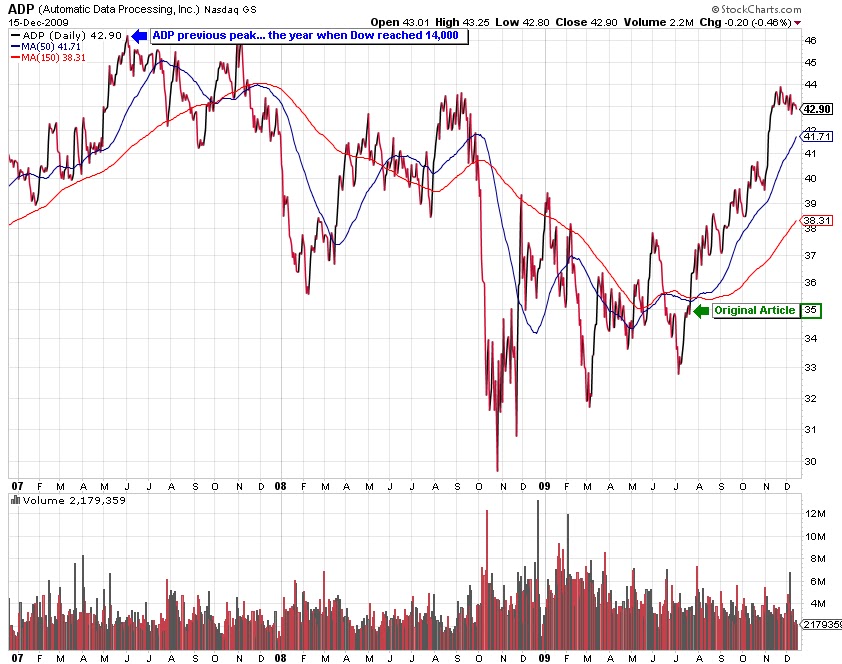
I initiated a write up on Automatic Data Processing (ADP) on July 15th followed with a checkup on the July 30th. My original thesis of ADP was that the stock discounted the unemployment rate. The chart below shows the previous peak in the unemployment in the 1980's. Shortly after, shares of ADP peaked in May 1983. The stock didn't trade higher than the 1983 level until May 1985, two years follow.
As a result, I believe it may be time for investors to begin unloading shares of ADP. At the current price of $41.90, it is trading 34% above the yearly low and 3.6% away from the yearly high. I see this as a 34% downside risk and 3.6% reward profile, which is not much of a compelling argument to buy.
If you were to hold shares of ADP, you'd be sitting on a yield of 3.8% (assuming the original purchase price of $35). Surely that return is much greater than the average CD account and fractionally higher than treasuries. However, your principal has returned a whopping 23% is sold at or near the current price. While the company can and has raised the dividend at a double digit rate (15% CAGR since 1993), I assume that the company may not be able to retain such a pace unless growth return to the employment market.
I'm not suggesting that investor be short sighted and take any gain that comes their way, but I suggest investors to look at the valuation and the technical aspect of the stock. Currently, ADP is trading near its 2007 peak ($46.25). How likely is it that they can better their all-time high? And if they break that level, how much further can it go? See chart below.
As mentioned before, I see ADP as a bargain below $41. At $42.90, it would be wise to take some, if not all, of the profits and search for a better opportunity in the New Low Observer Watch List.

P.S. Exxon (XOM) and SUPERVALU (SVU) are currently dislike by Wall Street for various reasons. They may prove to be a better opportunity. - Art

Sell AquaAmerica (WTR) at the Market

It is now time to recommend that AquaAmerica (WTR) be sold at the market. The stock has performed moderately since the research recommendation was issued on October 31, 2009. It is highly recommended that anyone who bought the stock based on my research should re-read the posting. Unfortunately, it was not possible to buy this stock at any price lower than the recommended date.

WTR's stock price has gone nothing but up since the recommendation. However, in the pursuit of "seeking fair profits" the returns that this stock has provided within the last 46 days say that it is necessary to consider alternative opportunities.

WTR was recommended when it was trading at $15.64. As of December 15, 2009, WTR was quoted at $17.28. This equals a return of 10%. Selling this stock now generates a return of 2x greater than the amount of the dividend yield. Additionally, the 10% gain exceeds the return on a 30-year treasury purchased on October 30, 2009 by 2.35x (if held to maturity.)

Those not interested in following through with my sell recommendation can feel comfortable knowing that WTR is a great long-term holding with a 10% cushion since our research recommendation of October 31, 2009.

As I have indicated in the purposes and function of this site, the goal is to:

  • maximize the annual yield of each trade.
  • reduce time between buying and selling of each stock.
  • exceed the annual yield of government guaranteed alternatives in each trade.

Research recommendations and investment observations are intended to be a starting point for investigating a quality company at a reasonable price. It is hoped that after doing the background research you can buy the stock at a lower price. Ideally the stock should be held in a tax deferred account and should not consist of less than 20% of your holdings. Personally, I prefer holding only 2-3 stocks at a time.

Sell recommendations are intended to deal with the short term reality of the market. The tracking of the Sell recommendations are the worst case scenario if you happen to have bought a stock at the time the research recommendation was made (please avoid making this mistake.) I aim for mediocrity in my returns, therefore I am happy with 9-12% annual gains. However, since codifying my approach to investing in 2005, I have had annual returns of 20% and above every year since.

It is always recommended that when selling a stock, one should not place stop orders, limit orders or orders after hours. This leaves the seller in the position of being vulnerable to the whims of the market makers. Instead, place your sell orders only as a market order during market hours. Some would complain that a market order during market hours might leave some profits on the table. However, I would rather leave some money on the table rather than have it taken away from me by the trades that are placed by institutions and market makers. Touc.

Dow Theory

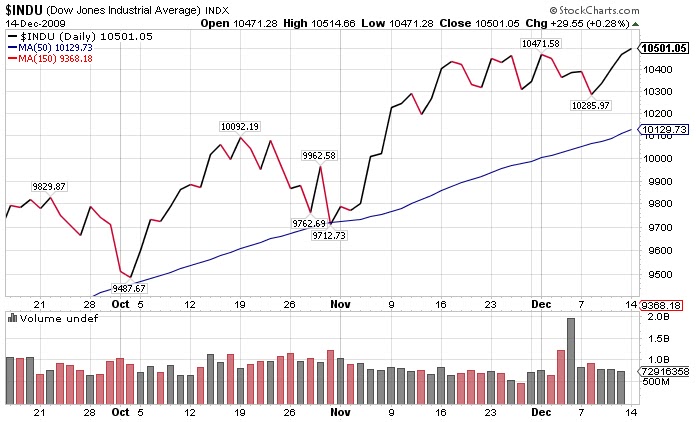
The market continues to move higher. We got a cyclical bull market confirmation within the context of a secular bear market at the close. The Industrials closed at 10,501.05, above the previous high of 10,471.58. The Transports also closed higher at 4,165.11. Art.

Stocks in Focus

Exxon (XOM) announced that it will acquire XTO Energy (XTO) in a $31 billion dollar stock deal. Shares of XOM fell 4.3% today. XOM is trading 12% above the 52 weeks low and 16% below the 52 week high. Such dislocation may provide a good opportunity to buy Exxon.
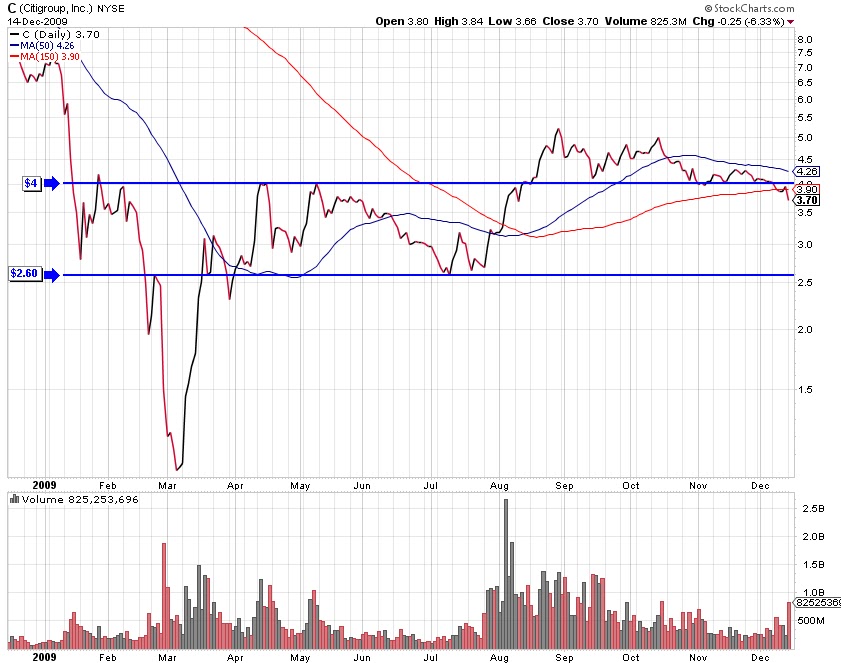
Another name that popped up today was Citigroup (C). After announcing that they will pay back $20 billion of TARP by issuing more shares, the stock fell 6.3% and is now trading below $4. I've written about the technical buy level for Citi and B of A in September. Citigroup may be a good trade if and only if it trades down to $2.60. Please note, this is purely speculation. Art.